Are Bigger Wheels Better for Longboarding? By Riding Style
This post contains affiliate links. As an Amazon Associate, we earn from qualifying purchases.
Bigger wheels are not inherently “better” for longboarding, they are a specific tool for a specific job. A larger wheel diameter provides a higher top speed and rolls over cracks and rough pavement more easily, but it accelerates slower, makes the board taller and heavier, and significantly increases the risk of wheelbite unless your deck has cutouts or you use riser pads. For pure speed and rough terrain, bigger wins. For quick acceleration, low-to-the-ground feel, and sliding, smaller wheels are often the better choice.
That trade-off between speed and acceleration is the whole conversation. It’s not about good versus bad; it’s about matching the wheel to the terrain you ride and the style you practice. The question ‘are bigger wheels better for longboarding’ is central to this.
What follows is a breakdown of the physics, a real-world compatibility checklist, and a look at how wheel size interacts with other specs like hardness and lip shape. By the end, you’ll know exactly where bigger wheels fit, and where they don’t.
Key Takeaways
- Larger wheels (70-85mm) provide higher top speed and smoother roll over cracks and debris, but they accelerate slower and add weight.
- The most common wheel size is 70mm, a balanced midpoint for many riders.
- Wheelbite is the primary risk with bigger wheels; always check deck clearance and consider riser pads or deck cutouts.
- Bigger wheels generally hinder sliding due to increased mass and grip; dedicated slide wheels are often smaller (closer to 70mm).
- Your ideal size depends heavily on your primary riding style: distance/cruising favors larger diameters, while freeride and technical street skating often prefer smaller ones.
The Core Trade-Off: Speed vs. Acceleration
The physics here are straightforward, but the ride feel is everything when considering the are bigger wheels better for longboarding question. A bigger wheel has a larger circumference. With each rotation, it covers more ground than a smaller wheel. This is why, once you’re rolling, larger wheels enable higher final speeds and more stable running, as noted in material science articles from companies like BASF.
The flip side in the are bigger wheels better for longboarding discussion is rotational mass and gearing. That larger, heavier wheel takes more energy to get spinning from a standstill. This is why larger wheels accelerate slower. You’ll feel this on every push start and when pumping for speed on flat ground. A set of 85mm wheels feels planted and fast on a slight decline, but getting them up to speed from a dead stop requires a noticeably stronger push than a set of 65mm wheels.
The part nobody mentions: This acceleration lag isn’t just about muscle. On a route with frequent stops (street crossings, pedestrian traffic), the constant re-acceleration on big wheels can be more fatiguing over a long session than the smoother ride saves you.
This isn’t theoretical. Reddit users comparing wheels often note the practical difference: “I own… 85mm speedvents… 97mm refly wheels… The 97mm… Are more comfortable, but performance is definitely worse.” The comfort comes from rolling over bumps; the performance hit is in agility and acceleration.
So, are bigger wheels faster? Yes, but only after you overcome the initial inertia. For maintaining speed on long, open paths, bigger is better. For stop-and-go urban riding or technical pumping, smaller wheels often feel more responsive.
Wheel Size Compatibility: The Wheelbite Problem
You can’t just slap any size wheel on any board. The limiting factor is wheelbite, when the wheel makes contact with the deck during a turn, causing an abrupt stop that can throw you off. Bigger wheels move the contact point closer to your deck.
Before upgrading, you need a clearance checklist. Ignore it, and you’re buying a problem.
- Check Your Deck’s Cutouts. Many modern cruising and downhill decks have wheel wells or cutouts carved into the board itself. These are designed to provide extra clearance for larger wheels. If your deck has them, you can often go bigger without modification.
- Measure Your Truck Height. Lower-angled or lower-profile trucks bring the deck closer to the wheels. Taller trucks (like 50-degree or specialized “high” bases) create more space.
- The Riser Pad Test. This is the most common fix. A ¼” riser pad is the standard first step for accommodating wheels larger than 65mm on a board without cutouts. Sometimes you’ll need more. The math is simple: if your new wheel is 10mm larger in radius than your old one, you need to raise your deck by at least that amount to maintain the same clearance.
- Test the Lean. Don’t just eyeball it. Tighten your hardware, stand on the board, and lean it over to each side at speed. Listen and look for any contact. Even a slight rub will escalate into a full lock-up when you’re carving hard.
Common mistake: Assuming wheels will fit because they “look okay” when the board is stationary. Weight on the deck compresses the bushings and lowers the board. You must test under load.
This is where a detailed guide to longboard wheels becomes invaluable, as it covers the interplay between deck shape, truck geometry, and wheel size. For big wheels, planning your setup is as important as choosing the wheels themselves. If you’re pushing the limits of size, using riser pads isn’t optional, it’s essential for safety.
How Big Is “Big”? Understanding the Size Ranges
When we talk about wheel sizes, we’re talking about diameter measured in millimeters. The range is broad, and what’s “big” depends on context.
| Wheel Size (Diameter) | Common Use Case | Primary Trade-Off |
|---|---|---|
| 60-69mm | Technical freeride, street skating, park decks. | Lower top speed, less smooth on rough terrain, but fast acceleration and low board height. |
| 70-76mm | The most common range. Cruising, carving, beginner-friendly all-around use. | Balanced performance between speed, comfort, and acceleration. |
| 77-85mm | Long-distance pushing (LDP), cruising over rough pavement, downhill. | Excellent speed retention and crack-rolling, but slower acceleration and increased weight. |
| 86mm+ | Specialized long-distance pumping, rough terrain conquest, e-boards. | Maximum smoothness and roll-over, but significant weight, height, and compatibility challenges. |
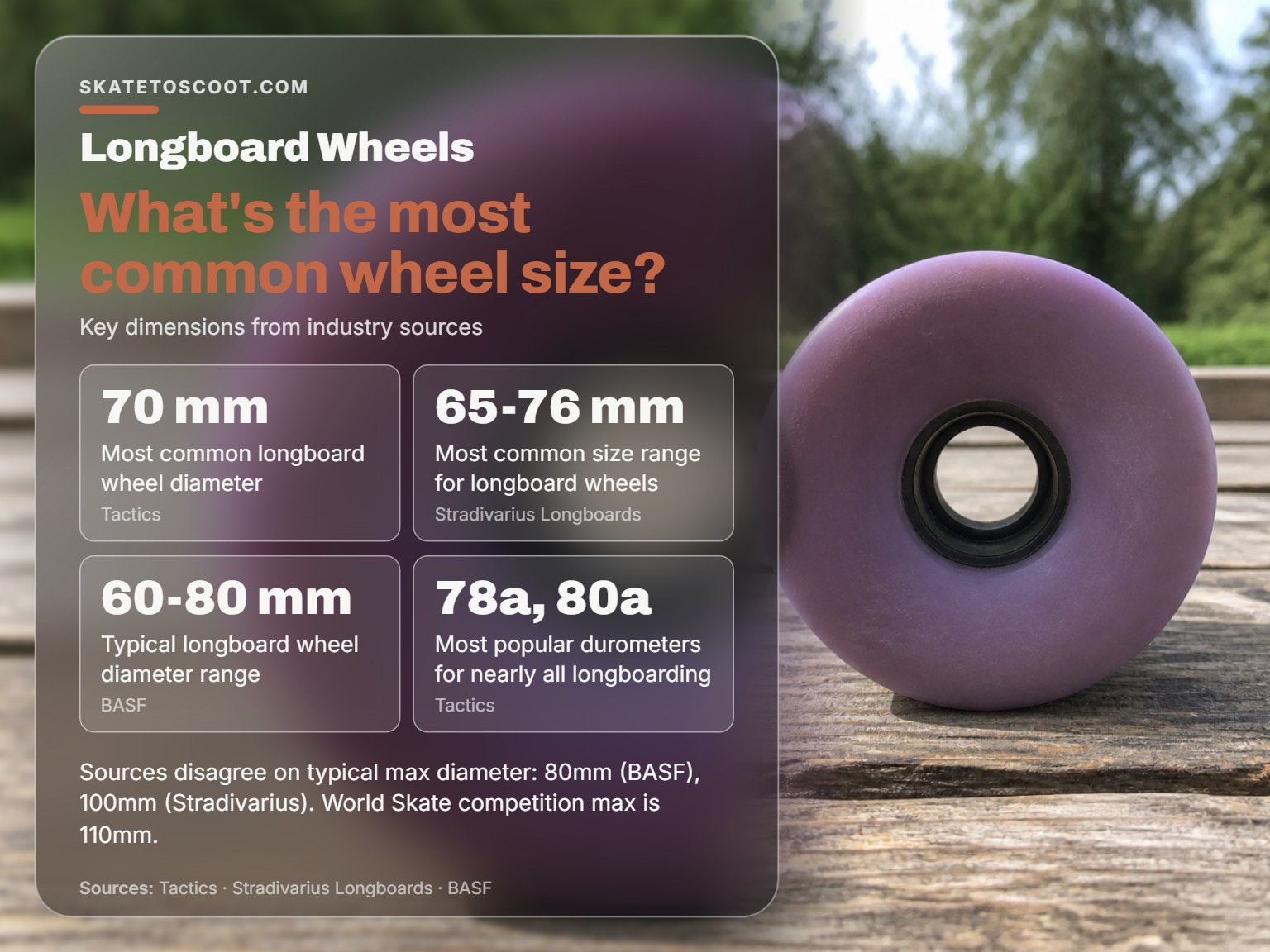
Many consumer guides, like those from Stradivarius Longboards and Tactics, focus on ranges like 65-80mm for good reason, though sources vary on the typical diameter range. It’s where most riders live. 70mm is the most common longboard wheel size, according to retailer Tactics, because it offers a tangible comfort boost over skateboard wheels without the drastic setup changes of true “big” wheels.
The extreme end is governed by organizations like World Skate. Their downhill skateboarding equipment regulations specify a competition maximum of 110mm. That’s a hard ceiling for sanctioned racing, but it’s far beyond what’s practical for everyday riding. Wheels in the 100mm+ range, like the Orangatang Dad Bods, exist for a niche: conquering brutally broken pavement or maximizing roll on perfectly smooth bike paths at the expense of every other performance metric.
TL;DR: For 90% of riders, “bigger” means stepping from 65mm to 70-75mm. Going beyond 85mm is a specialized choice with significant trade-offs.
Wheel Size’s Partners in Crime: Durometer and Contact Patch
Wheel size doesn’t work alone. Its effect is amplified or mitigated by two other specs: durometer (hardness) and contact patch width.
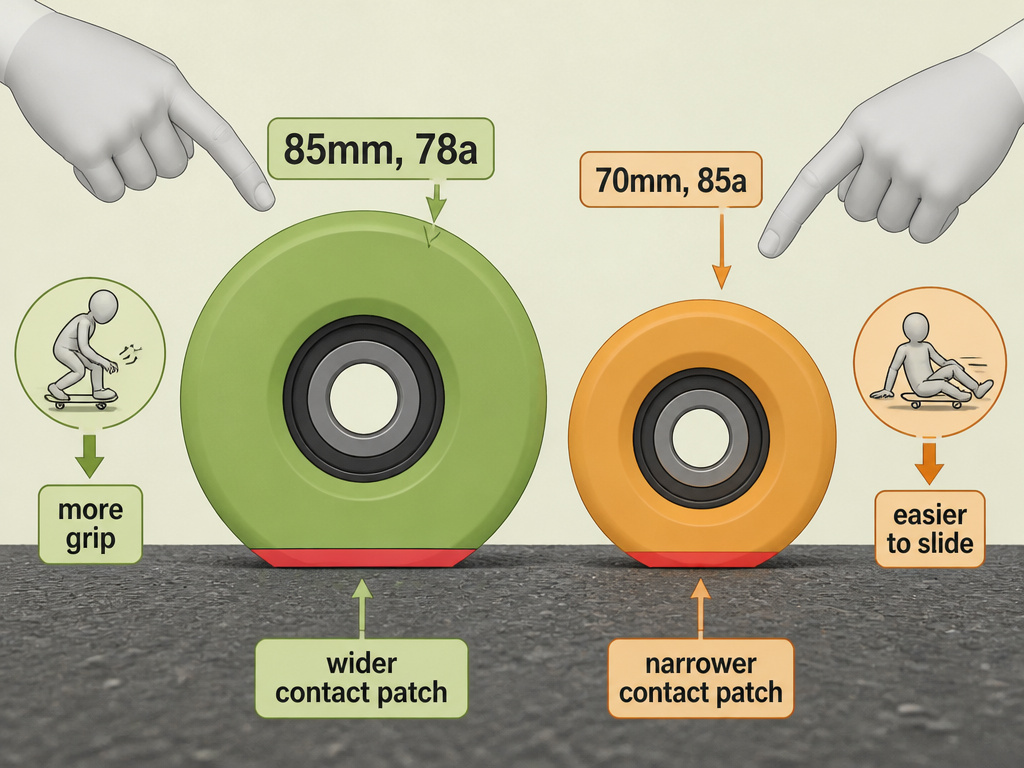
Durometer is measured on the A scale. Softer wheels (lower number, like 78a) grip the road better and absorb vibrations, making rough roads feel smoother. Harder wheels (higher number, like 85a) slide more easily and can roll faster on smooth surfaces. Most longboard wheels have a durometer from 75-88a, with 78a and 80a being the most popular all-around choices.
Here’s the interaction: A big, soft wheel (85mm, 78a) is a rough-road monster, it soaks up bumps and grips tenaciously. That same grip, combined with the wheel’s larger mass, makes it very reluctant to slide. Conversely, a big, hard wheel might roll fast on smooth asphalt but transmit every pebble to your feet. When reading a review of wheels, note how testers describe the urethane formula; two 80a wheels from different brands can slide very differently.
Contact Patch is the width of the urethane that touches the road. A wider patch means more grip and stability, especially in turns, but also more friction, which can slow you down. A narrower patch offers less grip, initiates slides more easily, and generally rolls with less resistance.
Where this goes sideways: Pairing a very large wheel with a very wide contact patch. You get a heavy, grippy unit that’s fantastic for plowing over debris but feels sluggish to accelerate and difficult to break into a slide. For sliding, the advice from manufacturers like BASF is clear: “Anyone wanting to slide perfectly should give preference to narrower wheels.”
This is why the best wheels for rough roads are often a package deal: moderately large diameter (75-85mm) with a softer durometer (77-80a) to absorb impact. The best wheels for cruising follow a similar formula, prioritizing comfort and grip over slide performance.
The Verdict by Riding Style
So, should you go bigger? The answer is locked to what you do on your board.
- Downhill / Speed: Yes, bigger is generally better. You want the highest top speed and stability. Riders often use wheels in the 70-75mm range with a square lip for maximum grip. The World Skate rulebook’s 110mm maximum shows the extreme, but most competitive downhill wheels live in the low 70s.
- Long-Distance Pushing (LDP) / Cruising: Bigger is better. You want to maintain speed with minimal effort and roll over pavement imperfections. Large-diameter wheels are classics for this reason. Comfort and efficiency trump quick acceleration.
- Freeride / Sliding: Smaller is usually better. You want wheels that break traction predictably and don’t carry excessive mass. Smaller-diameter wheels are often used for sliding. While you can slide bigger wheels, it requires more speed and force. As one Reddit user put it: “92mm is pretty big for sliding… Smaller wheels can make it easier to slide.”
- Dancing / Freestyle: Smaller is better. You need a low, stable platform for footwork and tricks. Large wheels raise your center of gravity and add swing weight, making the board feel less nimble.
- Commuting / Urban Carving: It’s a balance. You benefit from larger wheels (70-75mm) rolling over cracks and street debris, but you also need quick acceleration from stops and manageable board height for pushing. This is the sweet spot where the most common wheel sizes live.
Are bigger wheels harder to slide?
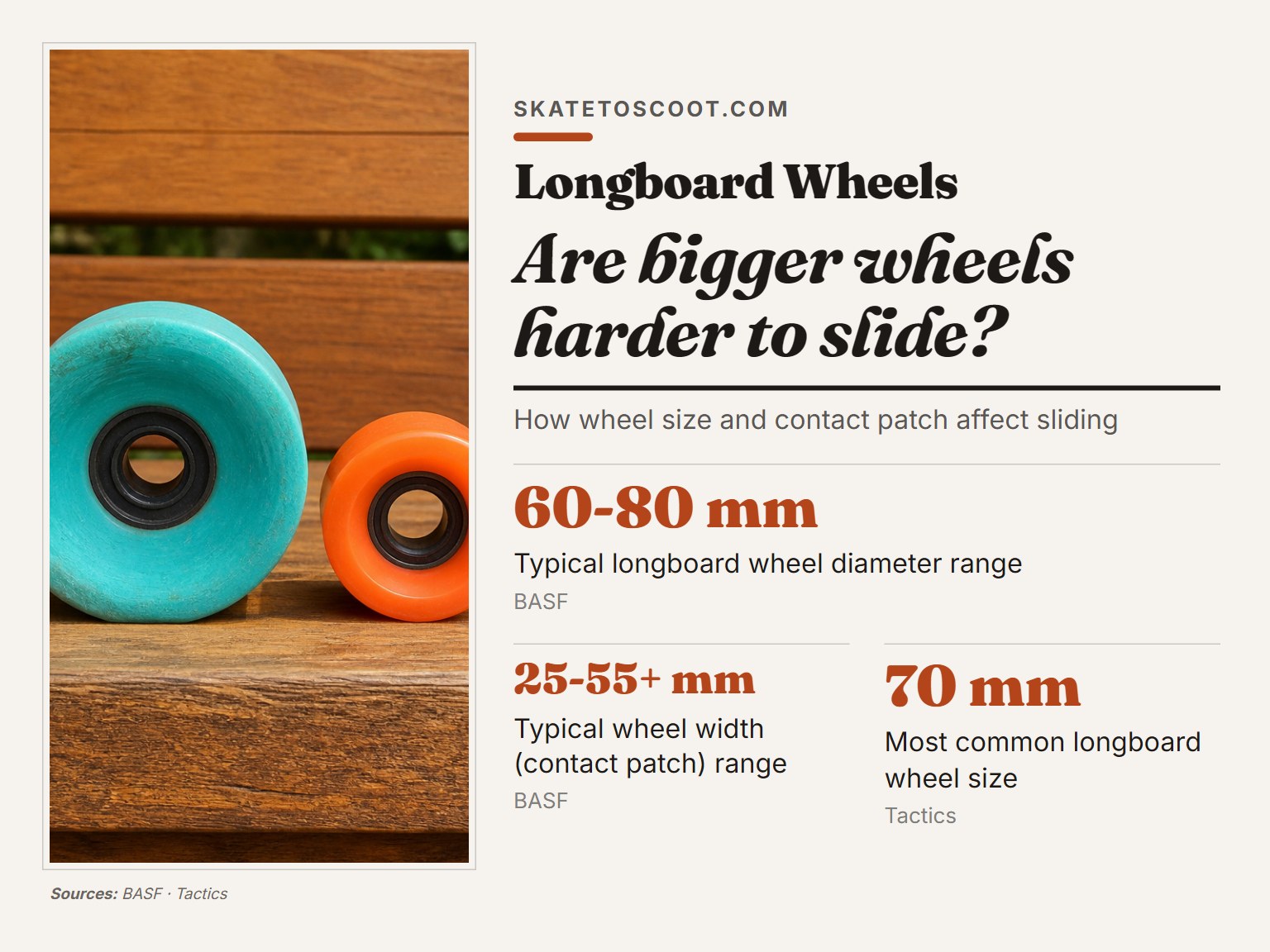
Yes, larger wheels are generally harder to slide. The physics comes down to weight and contact patch. A bigger wheel has more urethane, which means more mass to get rotating and, more critically, more material making contact with the ground. This larger contact patch creates higher friction, making it harder to break traction and initiate a slide. For freeriding and sliding, narrower wheels with a smaller contact patch are recommended because they offer less grip. Wheels designed for sliding often feature a round lip and a sideset core placement, which make it easier to break the wheels loose with less force.
Do bigger wheels make you more stable at speed?
Larger wheels provide significantly more stability at high speeds. Their increased diameter allows them to roll over cracks, pebbles, and rough pavement more smoothly, reducing chatter and vibration. This smoother roll translates directly to a more planted and confident feel. The larger circumference also means each rotation covers more ground, which contributes to a higher top speed and a more consistent, stable roll once you’re moving.
Frequently Asked Questions
What is the best size wheel for a longboard?
There is no single “best” size. For a general-purpose cruiser or first board, 70mm is the safest starting point. It offers a clear comfort and performance improvement over typical skateboard wheels without introducing major compatibility issues. From there, you can size up or down based on your terrain and style.
Is there any advantage to larger wheels?
The two main advantages are higher top speed and better ability to roll over cracks, pebbles, and rough pavement. Larger wheels also maintain speed longer with less pushing effort on flat ground. The advantage is pure performance on smooth or slightly bumpy terrain.
Are 100mm wheels too big for street cruising?
For most people, yes. While 100mm wheels will glide over terrible pavement, they create a very tall, heavy board that is cumbersome to push and carry. Acceleration is slow. They are a specialty tool for conquering specific rough routes, not an all-around improvement. A board with cutouts or a bracket setup is mandatory to avoid wheelbite.
Do bigger wheels wear out slower?
Not necessarily. Wear rate depends more on urethane formula, riding style (sliding vs. Gripping), and road surface than on diameter alone. A larger wheel has more urethane, so it can last longer before needing replacement, but a soft 85mm wheel used for aggressive sliding might wear faster than a hard 70mm wheel used only for cruising.
Before You Go
The question “are bigger wheels better?” is really “are bigger wheels better for what I want to do?” If your priority is a smooth, fast, stable ride over less-than-perfect pavement and you’re willing to deal with slower starts and a higher board, then yes, go bigger. Look at wheels in the 75-85mm range, and pair them with the necessary riser pads or a compatible deck.
If your riding involves quick accelerations, technical slides, or a low platform, the benefits of bigger wheels diminish quickly. Stick to the 65-72mm range, where you’ll find the most versatile and slide-friendly options.
Your first upgrade should be informed. Before you buy, do the clearance check. Know that changing your wheel diameter will change how your board feels on a fundamental level. It’s not just a swap; it’s a recalibration of your entire setup. Start with a moderate step, from 65mm to 70mm, for instance, and feel the difference. That real-world feedback is worth more than any spec sheet.
