Atto Scooter Review: Which Model Fits You?
This post contains affiliate links. As an Amazon Associate, we earn from qualifying purchases.
The ATTO Mobility Scooter is a Class II FDA-cleared, ISO 7176-8:2014-tested folding scooter designed for people with walking difficulties, with models offering speeds up to 10 km/h (6.2 mph), user weight capacities up to 136 kg (300 lbs), and a unique fold-down design that turns it into a rolling suitcase.
That FDA and ISO paperwork isn’t marketing. It’s verification that the scooter meets specific safety and performance standards for a medical mobility device. The practical question, as explored in our Atto scooter review, is whether its real-world portability, battery life, and ride match those lab-tested specs for your specific needs.
What follows: a breakdown of the three models (Classic, Sport, Sport MAX), what the strength tests actually mean, the real weight you’ll lift, travel rules for the battery, and who should look elsewhere.
Key Takeaways
- FDA clearance and ISO 7176-8 certification aren’t optional extras; they are the baseline for a medical mobility device, confirming the ATTO line meets international safety standards for static, impact, and fatigue strength.
- Choose by weight and speed, not just name: The ATTO Sport MAX supports 136 kg (300 lbs) but travels at 6 km/h, while the ATTO Sport handles 120 kg (265 lbs) at 10 km/h, the trade-off is explicit.
- The 66 lb (30 kg) total weight is manageable in two pieces (front ~27 lbs, rear ~38 lbs), but solo users should test-lift a comparable weight before buying, as marketing portability assumes a helper.
- For air travel, use only the standard 249.6 Wh battery; the larger 482.4 Wh XL battery is explicitly “Not Flight Approved” per the manufacturer’s data sheet.
- Long-term storage requires specific steps: Charge to 60%, remove the battery and its fuse, and store at room temperature (~22°C) to preserve the battery for up to six months without maintenance.
What the FDA Clearance and ISO Certification Actually Mean
You see “FDA Cleared” and “ISO Tested” on a lot of medical gear. For the ATTO, these stamps trace to specific, public documents. The original ATTO model received FDA 510(k) clearance (K160909) in 2016 as a Class II medical device under product code INI. The newer ATTO, ATTO Sport, and ATTO Sport MAX models received a separate clearance (K222703) in 2023. This doesn’t mean the FDA tested each scooter. It means the manufacturer demonstrated to the FDA that these models are “substantially equivalent” to already legally marketed devices, a standard regulatory pathway.
The more telling document is the independent ISO 7176-8:2014 test report from SGS. This international standard tests a mobility scooter’s static strength, impact strength, and fatigue strength. For the ATTO and ATTO Sport MAX, the report details the forces key parts can withstand.
A properly conducted ISO 7176-8 test applies measured forces to critical points like armrests and footrests to verify they won’t fail under normal use. For the ATTO, armrests resisted a downward force of 914 Newtons (about 205 lbs of force). For the heavier-duty ATTO Sport MAX, the armrests held 952 N. Footrests on the MAX withstood 1226 N.
These numbers are why certifications matter. They’re not a guarantee against all failure, but they’re a verified, repeatable benchmark that the scooter’s structure has been independently validated. It’s the difference between a brand saying “it’s strong” and a lab report showing exactly how strong under a defined standard.
The ATTO Sport vs. Sport MAX vs. Classic Decision (Which Model Fits You?)
The names are confusing. All three models. ATTO (Classic), ATTO Sport, and ATTO Sport MAX, fold the same way and share core dimensions. Your choice boils down to two specs: top speed and maximum user weight. Getting this wrong means either outgrowing the scooter or paying for speed you can’t legally use.
| Model | Max User Weight | Top Speed | Best For |
|---|---|---|---|
| ATTO (Classic) | 120 kg (265 lbs) | 6.4 km/h (4 mph) | Indoor/outdoor use where higher speed isn’t a priority or isn’t permitted (some municipalities limit scooters to 4 mph). |
| ATTO Sport | 120 kg (265 lbs) | 10 km/h (6.2 mph) | Users who need the faster speed for outdoor errands or longer distances and are under the 265 lb weight limit. |
| ATTO Sport MAX | 136 kg (300 lbs) | 6.0 km/h (per ISO test) | Users who need the higher weight capacity and can accept the slower speed. The trade-off is explicit. |
Here is the thing, the ATTO Sport MAX has a specs disagreement you need to know about. The Movinglife Product Data Sheet lists its speed as 6.4 km/h (4 mph), identical to the Classic. However, the independent ISO 7176-8 test report for the Sport MAX lists its maximum speed as 6.0 km/h. This isn’t an error; it’s a documented discrepancy between sources. You should be aware of both figures.
The weight capacities are strict limits. Exceeding the 120 kg limit on the Classic or Sport, or the 136 kg limit on the MAX, voids warranties and risks structural failure. The ISO static strength tests for the MAX are calibrated for that 136 kg dummy mass.
Portability in Practice: Weight, Folding, and Real-World Lifting
Marketing shows the ATTO folding into a neat trolley. The mechanism works, it goes from a 120 cm long scooter to a 39 cm long bundle. The reality of moving it involves weight distribution. The total assembled weight is 29–30.5 kg (64–66 lbs).
Where this goes sideways: Assuming the 66 lb total is easy for anyone to lift into a car trunk alone. A user review from a caregiver noted it was “a bit heavy for me to lift… Alone,” leading them to always split it.
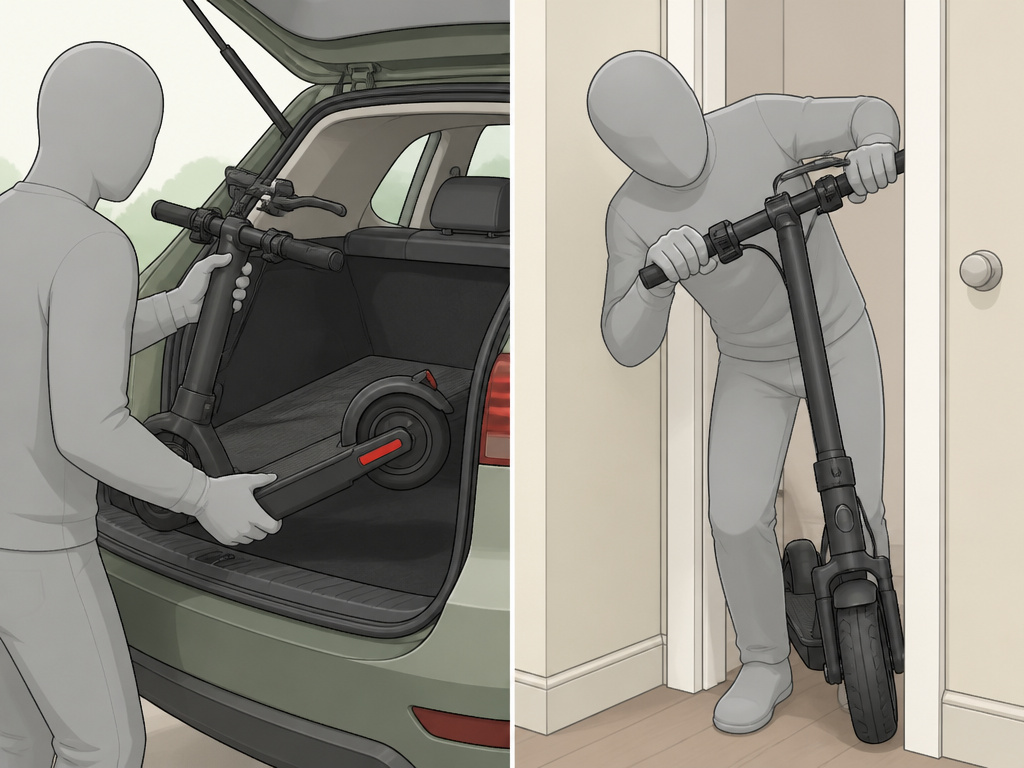
That’s the correct method. The scooter separates into a front section (12–12.5 kg / 26.5–27.5 lbs) and a rear section (17–17.5 kg / 37.5–38.5 lbs). Lifting two 30-40 lb pieces is fundamentally different from heaving a single, awkward 66 lb object. If you’re a solo user, practice lifting a 40 lb bag of dog food or similar into your car’s trunk height. If that’s a struggle, the ATTO’s portability claim hinges on having a helper.
Once folded, the trolley mode is genuinely useful. At 38.9 cm L x 41.9-44.5 cm W x 71-72 cm H (15.3″ x 16.5-17.5″ x 28″), it fits in tight restaurant corners, can be pulled up a few steps, and rolls onto buses or the underground like a suitcase. This is its killer feature for mixed-mode travel.
Battery Life, Charging, and Critical Travel Rules
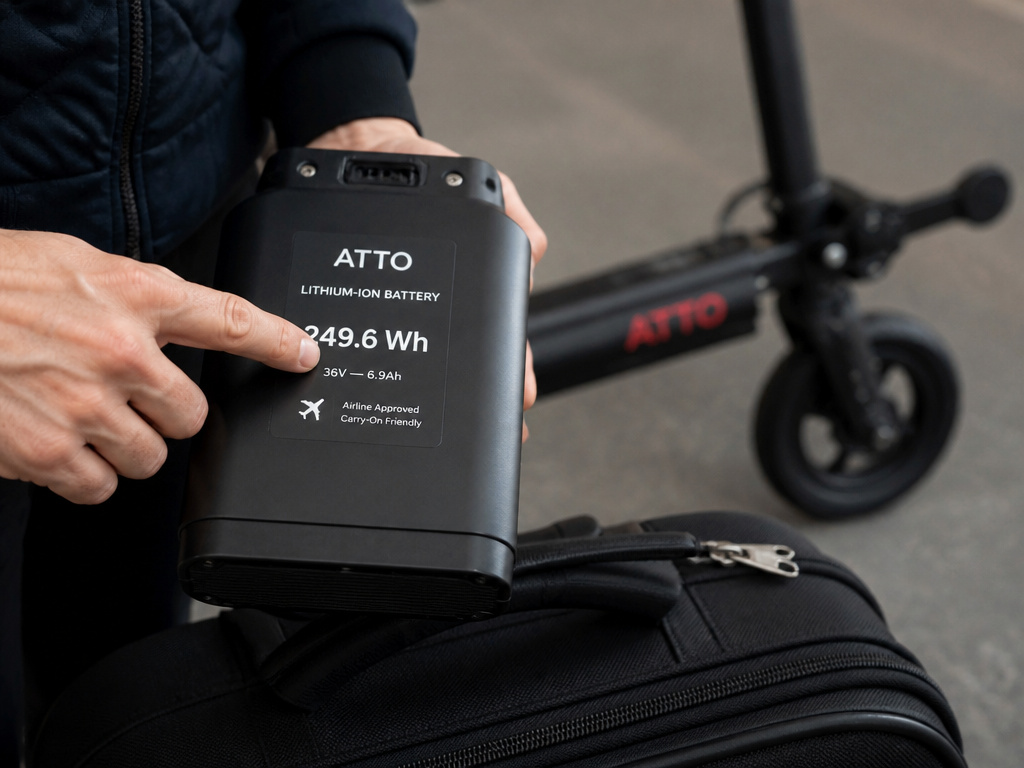
The ATTO runs on a removable lithium-ion battery pack. The standard pack is 48V, 5.2Ah (249.6 Wh), weighing 1.8 kg (4 lbs). An optional XL battery offers 482.4 Wh for extended range.
Range is conditional. The manufacturer’s figures assume a flat surface, a 75 kg rider, and optimal temperature. Here’s what the data sheet states:
- ATTO/ATTO Sport with standard battery: 20 km (12.5 miles)
- ATTO Sport MAX with standard battery: 17 km (10.5 miles)
- With XL battery: Ranges double to 40 km and 32 km respectively.
Slopes, colder weather, and higher user weight will reduce that. The scooter’s software will automatically slow down on slopes steeper than its maximum rated 6° to prevent motor strain.
For charging, the included charger (Input: 100-240V AC; Output: 54.6V DC, 2A) works worldwide. The manual has a strict warning: do not charge a frozen battery. Outside that, performance drops or stops.
The part nobody mentions: Long-term storage. You don’t just leave it plugged in. The manual instructs: charge to 60%, remove the battery pack, remove the battery’s fuse, and store everything in a dry, room-temperature (~22°C) environment. Done right, the battery can sit unattended for up to 6 months.
Travel Rule #1: The XL battery (482.4 Wh) is marked “Not Flight Approved” on the product data sheet. Airlines follow strict watt-hour limits for lithium batteries, typically capping carry-on batteries at 160-300 Wh. The standard 249.6 Wh battery is your only option for air travel. Always carry it in the cabin.
Who Is the ATTO For (And Who Should Look Elsewhere)?
The owner’s manual is explicit: the ATTO is for people “with temporary or permanent walking difficulties… Due to an injury, a physical disability, age, or a medical condition.” It’s a Class-A mobility scooter. Designated users should self-assess eyesight, reaction time, balance, posture, and ability to sit and concentrate for the duration of a trip. The manual goes further: “If you are eligible to be registered as severely sight impaired (blind), you should not drive a mobility scooter.”
The ATTO is a strong fit if:
- Your primary need is a folding scooter for travel, taxis, planes, trains, buses.
- You have a carer or companion to help with the two-part lift into a car, or you’re confident lifting ~40 lb sections yourself.
- You need an FDA-cleared medical device for insurance or reimbursement purposes.
- Your daily use is on mostly paved surfaces and indoors.
Look at other options if:
- You need to navigate very tight indoor spaces frequently. A YouTube reviewer noted its 120 cm length requires “a longer turn” and the width needs caution.
- You require full back support or extensive seat cushioning.
- You are a completely solo user with significant upper body strength limitations. The weight, even split, is real.
- Your terrain is often uneven, gravelly, or has slopes over 6°. The solid 8″ front / 9″ rear tires are durable but transmit more vibration than pneumatics.
For those comparing it to other portable models, our atto scooter review hub contrasts different brands and form factors.
Performance and Ride Quality: Setting Realistic Expectations
With a 250W brushless motor driving the front wheel, the ATTO provides adequate power for its purpose.
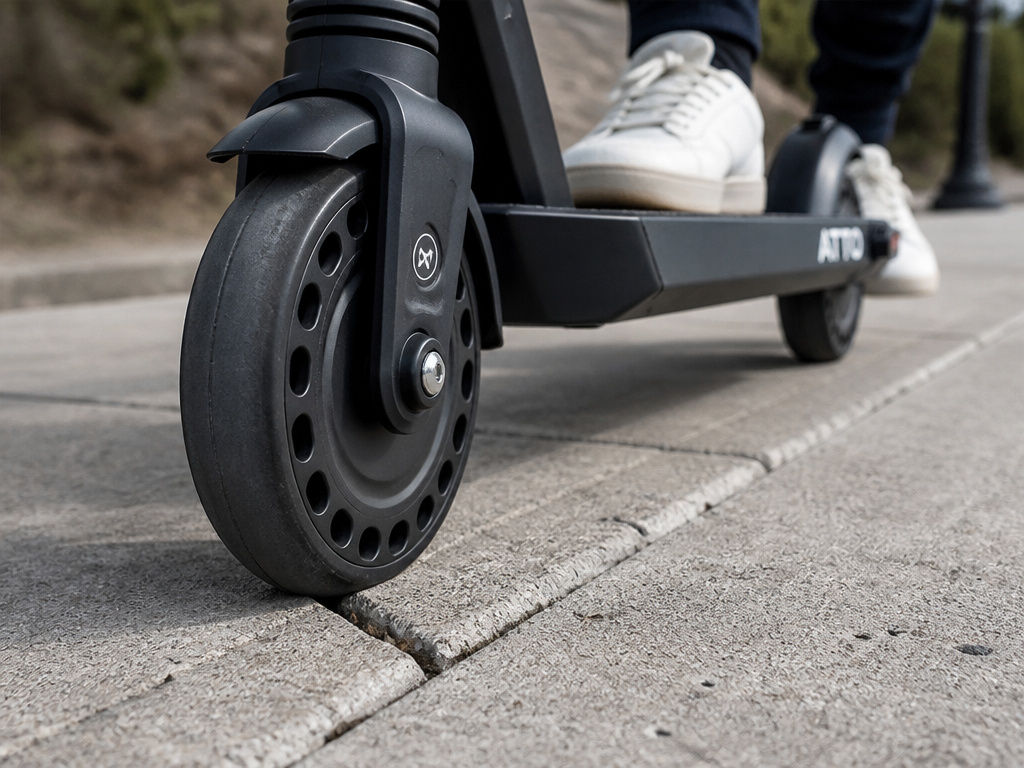
The ride is firm. The solid, airless tires won’t go flat, a major plus for reliability, but they don’t absorb bumps like pneumatic tires would. You’ll feel cracks in the sidewalk. This isn’t a scooter for off-road trails; it’s for smooth to moderately smooth pedestrian pathways.
One community-driven tip from Reddit atto scooter review: on 2021 models or newer, the reverse beeper can be disabled via a setup menu (hold Power and ‘+’ buttons to enter the menu). For users in quiet apartments or libraries, this is a valuable tweak.
On slopes, remember the 6° maximum rated incline. The scooter will automatically slow down as it detects a steeper slope to protect the motor. Pushing it beyond this on a regular basis will shorten component life. If your daily route includes a big hill, this might not be the right tool.
Customer service and company reputation
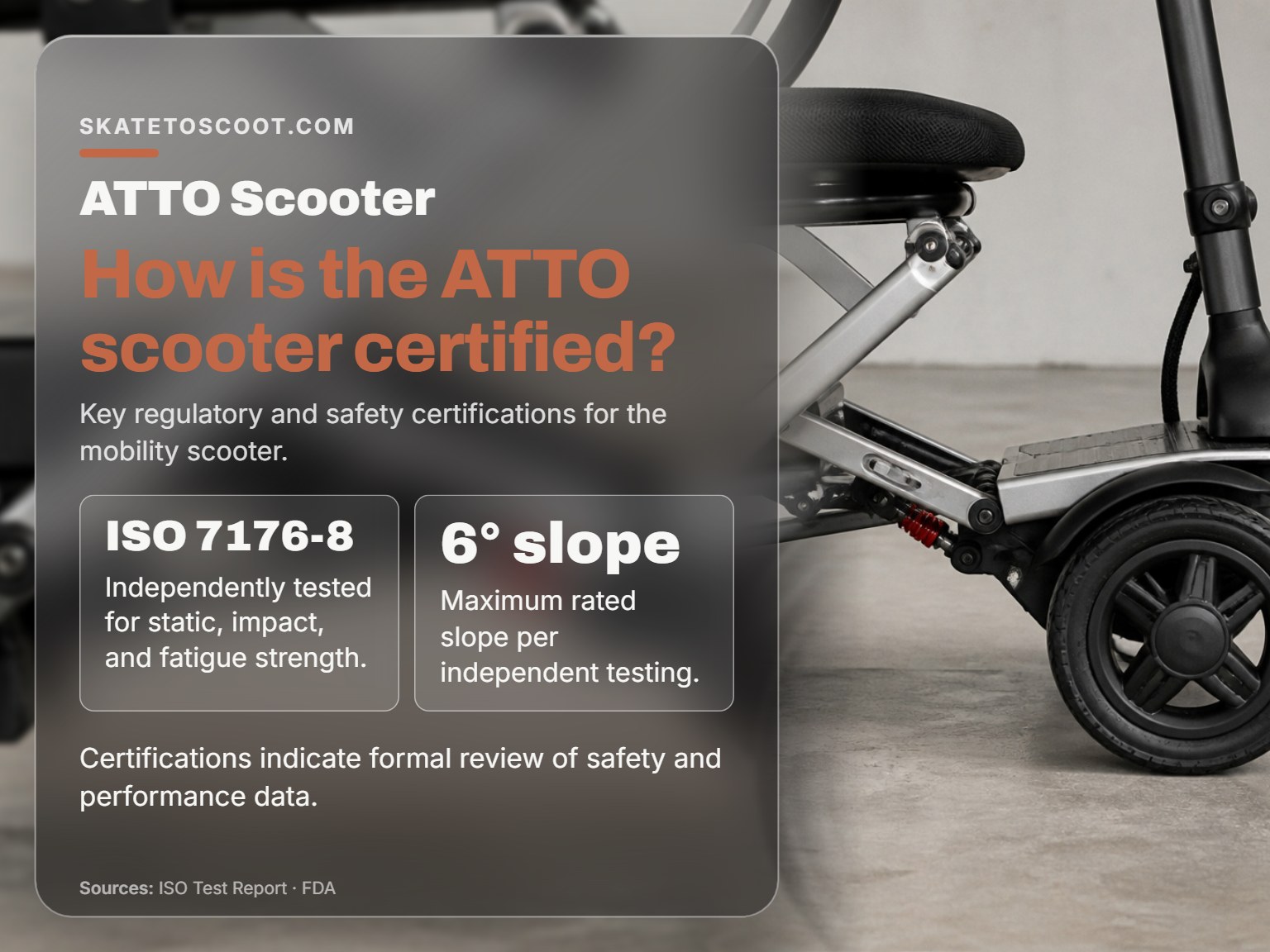
The original ATTO and its later models have received FDA 510(k) clearance, which is a formal process requiring submission of specific data. The scooters have also been independently tested for safety and durability against an international standard, ISO 7176-8, covering static, impact, and fatigue strength.
How the ATTO compares to other scooters
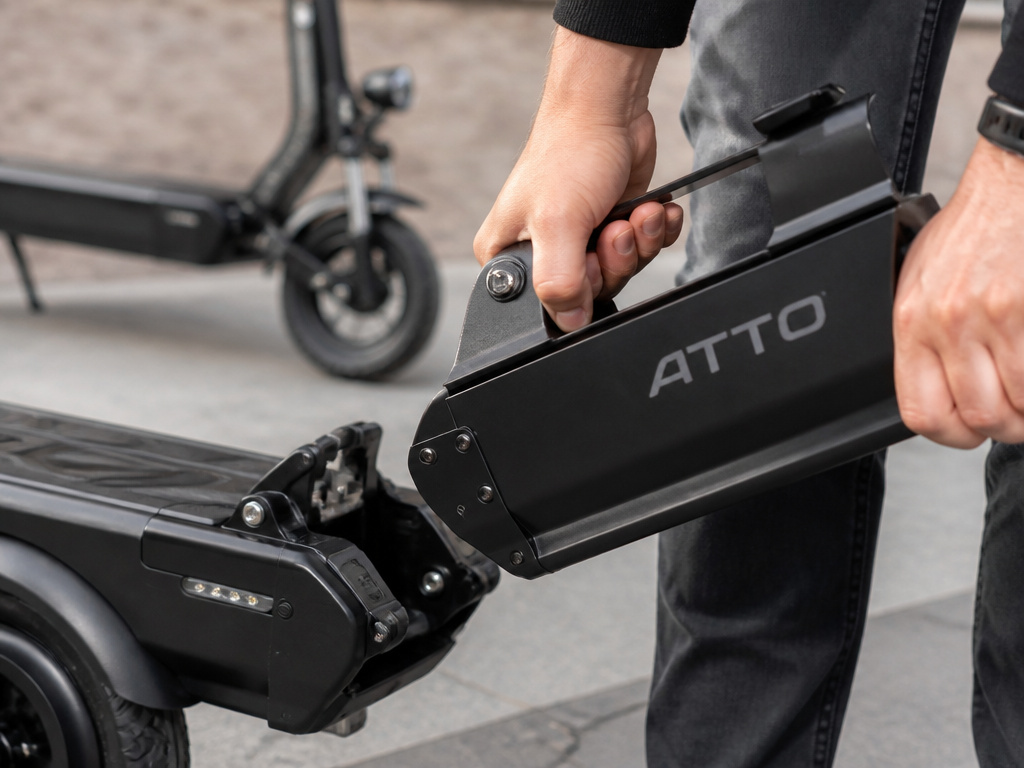
Comparing the ATTO line to other mobility scooters starts with its regulatory status as an FDA-cleared Class II medical device, which not all personal transport devices claim. Its construction is validated against specific ISO strength standards. The models vary internally: the ATTO Sport offers a higher top speed, while the ATTO Sport MAX supports a greater maximum user weight. All models share a folding design that splits into two main sections for transport, but the total weight is a key consideration. User experiences note that while portable, the weight can be challenging for a single person to lift. The solid tires reduce maintenance but offer a different ride feel compared to pneumatic options.
Frequently Asked Questions
Is an ATTO mobility scooter covered by Medicare?
Medicare Part B may cover a power-operated vehicle (POV), like a mobility scooter, if your doctor documents a medical need for it in your home. The scooter must be deemed “medically necessary” and you must be unable to use a cane, walker, or manual wheelchair. Always confirm with your supplier and insurance plan before purchasing.
Are ATTO mobility scooters any good?
“Good” depends on your metrics. For portability and travel, they are among the best-designed options, with verified FDA and ISO certifications adding safety credibility. For sheer comfort or heavy off-road use, they are less “good.” The seat is thin, the ride is firm, and the weight, while manageable in two parts, is real. It excels at its intended niche: a travel-ready, foldable mobility aid for paved surfaces.
How much does the ATTO Sport mobility scooter cost?
We do not publish specific prices as they change frequently and vary by retailer, package (battery size, accessories), and region. Always check with authorized dealers for current pricing and any package deals.
Can you take an ATTO scooter on a plane?
Yes, but with strict rules. The critical rule concerns the battery. You must use the standard 249.6 Wh lithium-ion battery; the larger XL battery is not flight-approved.
The Bottom Line
The ATTO scooter isn’t trying to be everything. It’s aiming to be the most portable, travel-ready, medically-certified folding scooter on the market. It largely succeeds.
Just match the model to your weight and speed needs, practice the two-part lift, and never forget the battery rules for air travel.
The ATTO knows its job. Make sure its job is yours.
