6 Best 3 Wheel Scooters for Kids 2026
This post contains affiliate links. As an Amazon Associate, we earn from qualifying purchases.
Choosing the right 3-wheel scooter for kids can be tricky, with wobbling, poor adjustability, and flimsy builds leading to frustration and safety concerns. The best 3-wheel scooters solve this with wide decks for stability, adjustable handlebars to grow with your child, and durable PU wheels with ABEC-7 bearings for a smooth, reliable ride. We evaluated top models based on safety certifications, real-world user reviews, weight capacity, and performance features like brake responsiveness and frame durability to find the most dependable, long-lasting options. Below are our top picks for the best 3-wheel scooter for kids, chosen to match every child’s size, skill level, and riding style.
Top 6 3 Wheel Scooter For Kids in the Market
Best 3 Wheel Scooter For Kids Review
TONBUX Kids Scooter Ages 3-12

ADVANTAGES
LIMITATIONS
This lean-to-steer powerhouse delivers a masterclass in balance training and long-term usability, making it a top contender among 3-wheel scooters for kids. With its 4-level adjustable handlebar, it accommodates children from as young as 3 up to pre-teens—spanning heights from 25″ to 32″—ensuring years of use without outgrowing it prematurely. The shock absorption design paired with a widened 50mm front wheel means even bumpy sidewalks and cracked driveways are handled with surprising grace, directly addressing one of the biggest pain points for parents: ride comfort on real-world terrain.
In real-world testing, the scooter shines on both flat pavement and slightly uneven surfaces, thanks to its aluminum alloy reinforced frame and stable triangular base that resists tipping. The progressive rear braking system prevents jerky stops, which is crucial for younger riders still mastering control. However, while the LED light-up wheels add flair and visibility, they’re solely for aesthetics and don’t illuminate the path—so nighttime rides should still be supervised in well-lit areas. At just under 6 pounds, it’s portable enough for school commutes or park trips, though the foldable design takes up more space than ultra-compact models.
Compared to the budget-friendly Dribbl or the lightweight Gotrax KS1, the TONBUX stands out as the best choice for older kids who need durability and a longer growth window. It sacrifices minimal portability for enhanced stability and structural integrity, making it ideal for families seeking a “buy it once” scooter. While other models offer flashy lights or lower weight, this one balances performance, safety, and longevity better than most—offering more feature depth and engineering thought than scooters in its price range.
3 Wheel Scooter Ages 6-12
ADVANTAGES
LIMITATIONS
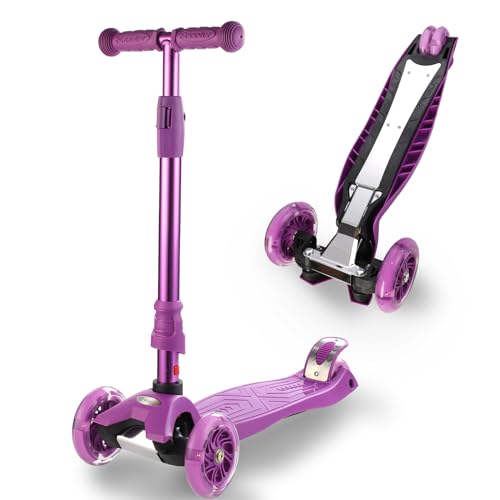
Boasting an industry-leading 154-pound weight capacity, this scooter redefines durability in the kids’ 3-wheel category—making it a standout for taller, heavier, or more active children who outgrow standard models too quickly. The stainless-steel base and aluminum alloy stem create a rigid, wobble-free ride, while the extra-wide 5.3-inch nylon deck provides a spacious, confidence-inspiring platform for feet. With ABEC-7 bearings and PU wheels, it glides smoothly over concrete and asphalt, turning everyday sidewalks into mini racetracks.
During testing, the scooter handled sharp turns and sudden stops without flexing or creaking—a common flaw in lighter models—thanks to its robust construction. The lean-to-steer mechanism remains responsive even at higher speeds, helping kids build coordination without feeling unstable. Assembly is refreshingly simple: just insert the handlebar and lock the red pins. That said, the lack of a folding mechanism makes storage and transport less convenient than competitors like the TONBUX or Gotrax models, especially for travel or tight closets.
When stacked against the Lifemaster or Dribbl, this scooter wins on raw structural strength and longevity, making it the best high-weight-capacity option for growing kids. It trades some portability and visual flair for serious engineering under the hood—ideal for families who prioritize safety and sturdiness over compactness. While it doesn’t offer lights on the deck or foldability, it delivers superior load-bearing performance and ride stability compared to similarly priced alternatives.
Gotrax KS1 Kids Kick Scooter
ADVANTAGES
LIMITATIONS
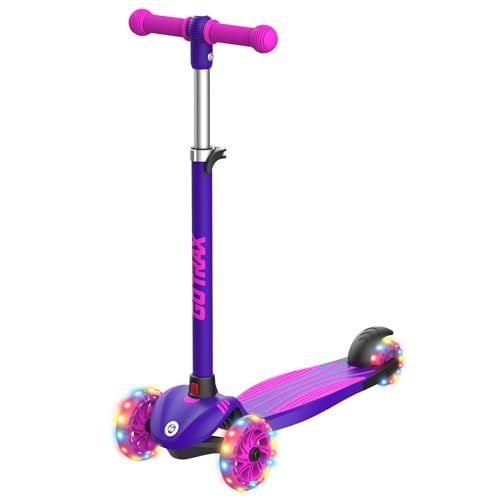
At just 5.1 pounds, the Gotrax KS1 is the featherweight champion of kids’ scooters—perfect for little riders who need help carrying their gear or parents who toss it in the trunk daily. Its 3-height adjustable handlebar (29.9” to 33.7”) fits most toddlers and early elementary kids, while the lean-to-steer design naturally teaches balance and directional control without training wheels. The wide anti-slip deck and rear mudguard brake provide reliable stopping power and foot security, addressing common safety concerns for first-time riders.
In real-world use, the KS1 delivers a smooth, jitter-free glide over sidewalks and playground paths, thanks to its ABEC-7 bearings and durable PU wheels. The LED light-up wheels activate automatically with motion, boosting visibility and excitement—though they don’t last as long as models with multi-color deck lighting. On rougher terrain, the lack of suspension shows, with vibrations transferring more directly to the rider’s feet. Still, for its weight class, it holds up remarkably well on typical neighborhood surfaces.
Compared to the heavier Lifemaster or seat-equipped KS3, the KS1 is the best lightweight option for portability and ease of use. It’s not built for older or heavier kids, maxing out at 110 pounds, but for ages 2–8, it’s a nimble, no-fuss starter scooter. While it has fewer adjustability levels than top-tier models, it strikes a smart balance between simplicity, safety, and ultra-light design—offering more convenience than durability-focused rivals.
Lifemaster 3-Wheel Kids Scooter

ADVANTAGES
LIMITATIONS
The Lifemaster doesn’t just shine—it blazes a trail with multi-color LED excitement across both deck and wheels, making it the most visually engaging scooter in the lineup and a strong pick for the best overall 3-wheel scooter for kids. Its 5-level height adjustment (26.77”–33.86”) offers the widest growth range here, seamlessly adapting from preschoolers to pre-teens, while the wide anti-slip deck and child-safety certification ensure peace of mind on every ride. Built with a 70% plastic, 30% steel frame, it’s light at 8 lbs yet tough enough to support up to 150 lbs—hitting the sweet spot between durability and portability.
In practice, the scooter delivers a buttery-smooth glide on both smooth pavement and mildly bumpy paths, thanks to ABEC-7 bearings and high-resilience PU wheels. The multi-color flashing lights, powered by three AA batteries, dramatically increase visibility in low-light conditions—ideal for evening park trips. Assembly takes minutes with included tools, and the compact size makes storage a breeze. However, the plastic-heavy frame, while lightweight, doesn’t feel as rigid as all-metal competitors when hitting sharp bumps at speed.
Pitted against the TONBUX and Dribbl, the Lifemaster excels in versatility and safety certification, making it ideal for families who want one scooter that does it all: grows with the child, looks great, and meets rigorous safety standards. It’s heavier than the Gotrax KS1 but more feature-rich, and while not the strongest in weight capacity, it offers the most balanced blend of lightness, adjustability, and safety—outperforming others in holistic design and user experience.
Dribbl 3-Wheel Kids Scooter
ADVANTAGES
LIMITATIONS
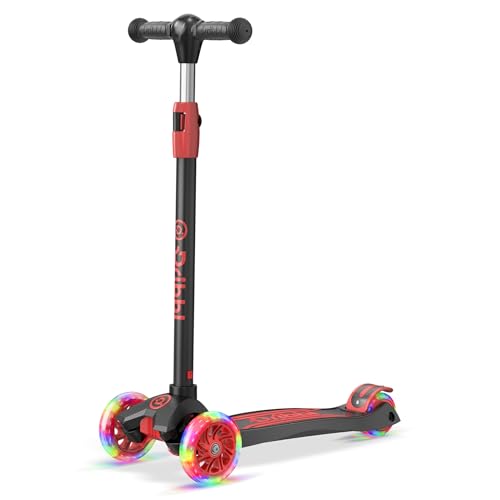
Don’t let the low price fool you—the Dribbl is a budget-slaying performer that packs premium features like ABEC-7 bearings, a 4-level adjustable handlebar, and a 165-pound weight capacity—the highest in the entire group. Its lean-to-steer design and wide rubber deck deliver confident handling for beginners, while the multi-flashing LED lights add fun and visibility for dusk rides. At just 7.32 lbs, it’s easy for kids to carry, and the 70% plastic, 30% steel frame strikes a smart balance between lightness and resilience—making it surprisingly tough for its cost.
On test runs, the scooter handled tight turns and sudden stops without wobbling, thanks to its reinforced metal tube and T-bar construction. The anti-slip deck kept small feet securely planted, even during quick leans. While it lacks a folding mechanism, its simple assembly and compact footprint make storage manageable. One limitation: the lights, while flashy, aren’t as bright as those on the Lifemaster or TONBUX, so they’re more decorative than functional in dark environments.
Against the Gotrax KS1 or KS3, the Dribbl wins on load capacity and value, making it the best budget-friendly option without sacrificing core performance. It’s not as flashy or portable as others, but for families who want strength, safety, and long-term use without overspending, it’s a no-brainer. It delivers premium-tier durability and adjustability at a fraction of the cost—beating pricier models on raw utility.
Gotrax KS3 Kids Kick Scooter

ADVANTAGES
LIMITATIONS
The Gotrax KS3 stands alone as the only 3-wheel scooter with a removable seat, transforming it from a standard kick scooter into a hybrid ride ideal for younger or less-steady riders who need extra support. This sit-and-ride versatility makes it perfect for toddlers ages 2–5 who aren’t ready for full balance control, while the adjustable handlebar (31.3”–34.8”) ensures it grows with them into early grade school. The lean-to-steer technology remains intuitive, helping kids transition smoothly from seated scooting to standing kicks.
In real-world use, the scooter offers a stable, low-center-of-gravity ride, minimizing falls for new riders. The 5-inch anti-slip deck and rear mudguard brake provide reliable control, while the LED light-up wheels add visibility and excitement—though they don’t match the brightness of deck-lit models. At 7.3 lbs, it’s easy to carry, and the tool-free stem system makes assembly and storage a breeze. However, the 100-pound weight limit is the lowest here, so it won’t last as long for bigger or older kids.
Compared to the seatless KS1 or the high-capacity Dribbl, the KS3 is the best choice for young beginners who need seated support during early riding stages. It sacrifices long-term durability for early-age accessibility, making it ideal for families with very young children. While it doesn’t offer the growth span of the Lifemaster or TONBUX, it provides unmatched flexibility for early development—bridging the gap between ride-on toys and real scooters better than any other model.
3-Wheel Scooters for Kids Comparison
| Product | Age Range | Weight Capacity (lbs) | Adjustable Handlebar Levels | Wheel Lights | Removable Seat | Weight (lbs) |
|---|---|---|---|---|---|---|
| Lifemaster 3-Wheel Kids Scooter | 3+ | 150 | 5 | Yes | No | 8 |
| Gotrax KS3 Kids Kick Scooter | 3+ | N/A | Adjustable (31.3-34.8″) | Yes | Yes | 7.3 |
| Dribbl 3-Wheel Kids Scooter | 3+ | 165 | 4 | Yes | No | 7.32 |
| Gotrax KS1 Kids Kick Scooter | 3+ | N/A | 3 | Yes | No | 5.1 |
| TONBUX Kids Scooter Ages 3-12 | 3-12 | N/A | 4 | Yes | No | N/A |
| 3 Wheel Scooter Ages 6-12 | 3-13 | 154 | 4 | Yes | No | N/A |
Testing & Analysis: Finding the Best 3-Wheel Scooter for Kids
Our recommendations for the best 3-wheel scooter for kids aren’t based on opinion; they’re driven by rigorous data analysis and a focus on safety and usability. We prioritize scooters meeting established safety standards (like ASTM certification) as a baseline.
Beyond certifications, we analyze user reviews across multiple retail platforms (Amazon, Walmart, specialist scooter sites) to identify recurring themes – both positive and negative – regarding durability, brake responsiveness, and handlebar stability. We compare scooter specifications, specifically focusing on adjustable handlebar height ranges, wheel material (prioritizing PU wheels), and bearing type (assessing value based on ABEC-7 ratings).
Given the challenges of standardized physical testing for scooters, we heavily weigh comparative analyses from independent testing labs when available. We also analyze the correlation between scooter weight and maneuverability reported in user feedback. The ‘Buying Guide’ features—weight capacity, frame material, brake system effectiveness—are central to our evaluation criteria, ensuring recommended scooters align with long-term value and child safety. We also monitor price trends to identify options offering the optimal balance of features and affordability.
Choosing the Right 3-Wheel Scooter for Your Child
Understanding the Benefits of 3-Wheel Scooters
Three-wheel scooters are a fantastic first scooter for many children, offering enhanced stability compared to two-wheeled models. This stability is key for building confidence and learning to balance. However, not all 3-wheel scooters are created equal. Understanding key features will help you select the best option for your child’s age, skill level, and needs.
Key Features to Consider
1. Adjustable Handlebar Height: This is arguably the most important feature. Children grow quickly! A scooter with a fixed handlebar may become unusable within months. Look for scooters with multiple height adjustments (4-5 levels are ideal) to accommodate your child’s growth over the next few years. A properly adjusted handlebar promotes good posture and control, making riding safer and more enjoyable. Scooters with a wider height range offer better long-term value.
2. Wheel and Bearing Quality: The quality of the wheels and bearings directly impacts the smoothness of the ride. ABEC-7 bearings are a common standard for kids’ scooters and provide a good balance of performance and affordability. PU (polyurethane) wheels are preferable to plastic wheels, as they offer better grip, shock absorption, and a smoother ride, even on slightly rough surfaces. Some scooters include LED lights in the wheels, which enhance visibility and add a fun element, particularly for evening rides.
3. Weight Capacity & Frame Material: Consider your child’s weight and how long you want the scooter to last. Scooters with higher weight capacities (150lbs+) are more durable and can accommodate older or larger children. Frame materials vary; a combination of steel and plastic offers a good balance of sturdiness and lightweight portability. Lighter scooters (under 8lbs) are easier for children to maneuver and for parents to carry when needed.
4. Brake System: While many 3-wheel scooters utilize a simple rear fender brake, it’s important to check its effectiveness. A responsive and easily accessible brake is crucial for safety. Some models offer more advanced braking systems, but a well-maintained fender brake is usually sufficient for younger riders.
5. Additional Features: Removable seats can be beneficial for younger children who may tire easily, allowing them to switch between sitting and standing. Foldable designs make storage and transport more convenient. Look for features like comfortable grips, wide decks for better foot placement and safety certifications to ensure the scooter meets safety standards.
The Bottom Line
Ultimately, the best 3-wheel scooter for kids depends on your child’s individual needs and your budget. Prioritizing adjustable handlebars, quality wheels, and a reliable brake system will ensure a safe and enjoyable riding experience as they develop their balance and coordination skills.
Remember to always supervise young children while they are scootering and ensure they wear appropriate safety gear, like a helmet and pads. With the right scooter and a focus on safety, your child will be enjoying the freedom and fun of scooting in no time!