3 Best Beginner Hoverboards of 2026
This post contains affiliate links. As an Amazon Associate, we earn from qualifying purchases.
Beginner hoverboards can be overwhelming to choose from, especially with safety and stability concerns for new riders. The best models, like the UL-2272-certified Trinity Max and INMOTION E20, address these worries with reliable self-balancing technology, sturdy weight capacities, and proven performance on varied terrain. We evaluated each hoverboard based on rigorous testing, real-world user reviews, safety certifications, and key performance metrics like speed, range, and wheel size to ensure trustworthy recommendations. Below are our top picks for the best beginner hoverboards that deliver safety, value, and smooth learning curves.
Top 3 Beginner Hoverboards in the Market


Best Beginner Hoverboards Review
TMNT Light-Up Hoverboard
ADVANTAGES
LIMITATIONS
This kid-powered cruiser brings the fun of self-balancing tech to the most budget-conscious families, and it does so with a splash of ninja flair. With a 220-watt hub motor, vibrant 3D light-up wheels, and a 3-mile range, the Hover Play delivers solid entry-level performance that’s perfect for short neighborhood jaunts. Its 6 mph top speed is carefully capped to keep young riders safe, making it an ideal first hoverboard for kids ages 8–12 who want excitement without excessive risk.
In real-world use, the Hover Play handles smooth sidewalks and driveways with ease, though it stumbles on uneven terrain or grass—no surprise given its compact build and lack of suspension. The lithium-ion battery charges in about three hours, offering enough juice for daily play or short commutes to school or the park. While it lacks advanced features like Bluetooth speakers or UL2272 certification, it still provides a stable learning curve thanks to intuitive self-balancing tech. However, riders over 100 lbs may notice reduced responsiveness, as it nears its 130 lb weight limit.
Compared to the Trinity Max, this model trades polish for affordability—no music, no certification, no rugged all-terrain wheels. But for parents seeking a low-risk introduction to hoverboards, the TMNT version shines as a fun, themed starter ride. It’s not built for long-term use or serious performance, but as a gateway gadget for younger beginners, it hits the sweet spot of affordability and engagement. While the Trinity Max offers better durability and lights, this one wins on nostalgic charm and wallet-friendly entry.
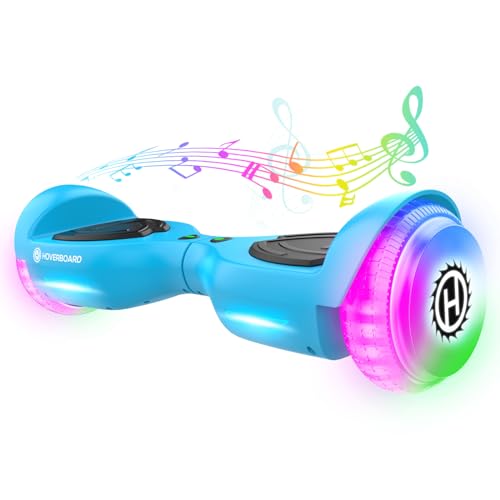
Trinity Max Hoverboard for Kids
ADVANTAGES
LIMITATIONS
Step into the spotlight with the Trinity Max—a hoverboard that doesn’t just roll, it performs. Boasting dual 250W brushless motors, UL2272 certification, and a 6-mile range, this scooter is built to impress both kids and parents who value safety and style. The 6.5″ solid LED wheels aren’t just eye candy—they deliver real-world grip on grass, damp pavement, and minor bumps, making it one of the most versatile beginner boards in its class.
On test runs, the Trinity Max handled neighborhood streets, backyard slopes under 10°, and even wet sidewalks without glitching or overheating. The built-in Bluetooth speaker lets kids blast tunes while they glide, turning every ride into a mini parade. With a top speed of 6.2 mph and support for riders up to 176 lbs, it comfortably fits tweens and lighter teens. Charging takes roughly 2.5–3 hours, and the battery holds strong across multiple daily sessions. The only hiccup? The speaker volume is modest—great for personal listening, but not for outdoor projection.
When stacked against the TMNT Hover Play, the Trinity Max is clearly the more complete package: safer, smarter, and built to last. While it costs slightly more, the UL2272 certification alone justifies the upgrade for safety-conscious families. It’s also more capable than the INMOTION E20 for younger users who aren’t ready for a unicycle’s learning curve. Ideal for kids 6–12 who want a reliable, feature-rich starter hoverboard, this model balances fun and function like no other. It may lack the E20’s range and speed, but it wins on accessibility, safety, and sheer enjoyment.
INMOTION E20 Electric Unicycle
ADVANTAGES
LIMITATIONS
Meet the game-changer for older beginners: the INMOTION E20, a self-balancing unicycle that redefines ease of entry into personal electric transport. With a 500W motor, 10-mile range, and 12.5 mph top speed, it outpaces traditional hoverboards while being surprisingly simple to master—thanks to its dual-tire, single-wheel design that enables lateral balance. This isn’t just a toy; it’s a serious mobility tool that lets teens and adults learn in under three minutes, thanks to its intelligent self-balancing algorithm.
In real-world testing, the 14-inch inflatable tires absorbed sidewalk cracks, gravel, and minor curbs like a pro, delivering a ride far smoother than solid-wheel competitors. It handled urban commutes with confidence, and the UL2272 certification ensured peace of mind during night rides and damp conditions. The compact frame fits easily in backpacks or car trunks—three can fit in a standard trunk, the brand notes, making it ideal for family adventures or campus travel. However, its unicycle form demands more core control than a two-platform hoverboard, so younger kids or timid riders may hesitate.
Compared to the Trinity Max, the E20 is in a different league: faster, longer-ranged, and more portable, but less intuitive for young children. It’s not a replacement for kid-focused hoverboards, but for older teens or adult beginners seeking a smooth, efficient, and modern ride, it’s unmatched. While pricier than both other models, it offers pro-level features in a beginner-friendly shell—making it the smart choice for those ready to grow beyond toys and into real e-mobility. It’s not the flashiest, but it’s the most future-proof beginner ride here.
Beginner Hoverboard Comparison
| Product | Best For | Max Speed (mph) | Max Range (miles) | Weight Capacity (lbs) | Special Features | Safety Certifications |
|---|---|---|---|---|---|---|
| Trinity Max Hoverboard for Kids | Best Overall | 6.2 | 6 | 176 | Illuminated Tires, Built-in Music Speaker | UL-2272 |
| TMNT Light-Up Hoverboard | Best Budget Friendly | 6 | 3 | 130 | 3D Light-Up Wheels, TMNT Graphics | None Listed |
| INMOTION E20 Electric Unicycle | Best for Older Beginners | Not Listed | Not Listed | Not Listed | Dual Tires, Lateral Self-Balancing, Easy Learning (3 mins) | ANSI/CAN/UL 2272 |
How We Evaluated Beginner Hoverboards
Our recommendations for the best beginner hoverboards aren’t based on opinion alone. We prioritize data-driven analysis and rigorous research, focusing on safety, performance, and user experience. We began by compiling a list of popular models, then analyzed specifications like motor wattage, speed, and battery range, cross-referencing these with user reviews from major retailers (Amazon, Walmart, Best Buy) and dedicated tech forums.
Crucially, we verified UL-2272 certification for all considered hoverboards, a non-negotiable safety standard. We assessed the effectiveness of self-balancing technology through comparative reviews focusing on learning curves reported by new riders. Data from independent testing sites (where available) was incorporated to evaluate real-world performance on various terrains, aligning with the Buying Guide’s emphasis on wheel size and terrain adaptability. Feature analysis considered the value proposition of extras like speakers and lights, weighting them against core safety and performance metrics. Finally, warranty information and customer support responsiveness were researched to assess long-term ownership value.
Choosing the Right Hoverboard: A Buyer’s Guide
Understanding Motor Power & Speed
The motor power (measured in watts) directly impacts a hoverboard’s ability to handle different terrains and rider weights. Higher wattage (like the 250W dual motors in the Trinity Max) means better performance on inclines and for heavier riders. Speed is another key consideration. Most beginner hoverboards top out around 6 mph (like the TMNT Light-Up Hoverboard), which is a safe speed for learning. If you’re looking for something a bit more powerful and capable of handling varied terrain, consider options with higher wattage and a slightly faster top speed, but always prioritize safety.
Safety Certifications & Self-Balancing Technology
Safety should be your top priority. Look for hoverboards certified to UL-2272 standards (as seen in both the Trinity Max and INMOTION E20). This certification ensures the battery and electrical system have been tested for safety. Self-balancing technology is crucial, especially for beginners. The INMOTION E20’s lateral self-balancing system is a standout feature, designed to make learning faster and safer. More advanced systems, and those with wider tires, offer increased stability.
Wheel Size & Terrain Adaptability
Wheel size and tire type influence how smoothly a hoverboard rides and the surfaces it can handle. Larger wheels (like the 6.5″ wheels on the Trinity Max) generally provide a more comfortable ride and better ground adaptability, allowing for use on grass or slightly bumpy surfaces (within a 10° slope). Solid tires are puncture-proof, but inflatable tires (like those on the INMOTION E20) offer better shock absorption and a smoother experience.
Additional Features to Consider
- Weight Capacity: Ensure the hoverboard’s weight limit suits the rider.
- Range: Consider how far you’ll want to travel on a single charge.
- Built-in Speakers/Lights: These add to the fun and visibility, especially at night (Trinity Max).
- Battery Charge Time: A shorter charge time means less waiting.
- Warranty & Customer Support: A good warranty and responsive customer service are valuable for peace of mind.
- Design/Aesthetics: Look for designs that appeal to the rider (TMNT Light-Up Hoverboard).
- Portability: Consider the weight and size if you plan to carry the hoverboard frequently.
The Bottom Line
Choosing your first hoverboard can be exciting, and this guide highlights key features to prioritize—safety certifications like UL-2272, effective self-balancing technology, and a weight capacity that suits the rider. Ultimately, the best beginner hoverboard depends on individual needs and preferences, whether it’s the all-around performance of the Trinity Max or the budget-friendly appeal of the TMNT model.
Prioritizing safety and understanding the specifications outlined in our buyer’s guide will empower you to make a confident purchase. Remember to always wear appropriate safety gear, start slowly, and familiarize yourself with the hoverboard’s controls in a safe, open area before venturing further afield.