
8 Best Commuter Electric Skateboards 2026
This post contains affiliate links. As an Amazon Associate, we earn from qualifying purchases.
Commuting with an electric skateboard can be a game-changer—until you’re left stranded by poor range, weak motors, or a heavy board that’s a hassle to carry. The best commuter electric skateboards solve these issues with reliable battery life, powerful dual motors for hills, and lightweight, portable designs that fit seamlessly into daily transit. We determined our top picks by analyzing real-world performance data, user reviews, and key specs like watt-hours, motor power, and portability, prioritizing models that deliver consistent results and safety certifications like UL 2272. Below are our recommended electric skateboards for every type of urban commute.
Top 8 Commuter Electric Skateboards in the Market


Best Commuter Electric Skateboards Review
MEEPO Ampboard Lightweight E-Board
ADVANTAGES
LIMITATIONS
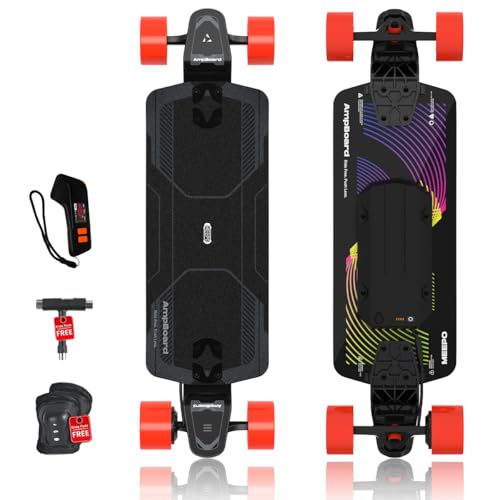
The MEEPO Ampboard is a revelation for urban commuters and new riders who crave simplicity without sacrificing reliability. Weighing just 11.4 lbs with a 33.74-inch drop-through deck, it’s one of the most portable electric skateboards on the market — perfect for tossing in a backpack or carrying onto public transit. Its 540W hub motor pushes you to a smooth 14 mph, while the 9-mile range handles short commutes with ease. For beginners, the low 32mm ground clearance offers unmatched stability, reducing wobbles and boosting confidence on first rides.
In real-world testing, the Ampboard shines on paved sidewalks, bike lanes, and campus pathways. The M6C color LED remote gives clear feedback on speed and battery, and with four ride modes, it’s easy to dial in control as skills grow. While it struggles on inclines over 10%, the 94mm shock-absorbing PU wheels handle small cracks and uneven pavement decently. However, riders above 160 lbs will notice reduced acceleration and range — this board is truly optimized for lightweight users. Charging in just 1.5 hours means less downtime and more rolling.
Compared to the bulkier Dnaskate V20 or the high-speed MEEPO Mini5, the Ampboard stands out as the most beginner-friendly commuter board in its class. It trades raw power for ultra-lightweight agility and rock-solid safety, making it ideal for students, teens, and city dwellers focused on last-mile mobility. While it can’t conquer hills or deliver thrilling speed, it excels where it matters: daily portability, stability, and ease of use. For new riders, it offers better control and confidence than the EBOSSOM ES6 SE, though with slightly less range.
EBOSSOM ES6 SE Kids Skateboard
ADVANTAGES
LIMITATIONS
The EBOSSOM ES6 SE is a thoughtfully engineered starter board that prioritizes safety and simplicity for young riders. With a 350W brushless motor and a capped top speed of 10 mph, it delivers just enough excitement without overwhelming teens or parents. The 27-inch compact deck is easy to manage, and the reinforced 8-ply construction supports up to 220 lbs, making it durable for growing riders. What truly sets it apart is its UL2272 certification — a rare win for budget-friendly boards — ensuring peace of mind for families.
During testing, the ES6 SE proved to be a smooth and predictable learner’s board, ideal for driveways, sidewalks, and bike paths. The wireless remote is intuitive, with clear speed mode indicators and responsive braking. The 6–8-mile range is sufficient for after-school jaunts or weekend fun, though heavy use drains the battery quickly. On rougher surfaces, the large shock-absorbing wheels maintain grip and comfort, but the lower power means it struggles on even mild inclines. It’s not built for speed or long commutes, but for its intended audience, that’s a smart trade-off.
Pitted against the MEEPO Campus V5 (budget model), the EBOSSOM holds its own with better speed control and safety credentials, though it lacks the color display and longer range of pricier Meepo boards. It’s a clear step up from toy-grade boards, offering real performance for teens aged 12+. While the MEEPO Ampboard is lighter, the ES6 SE feels sturdier and more confidence-inspiring for younger riders. For families seeking a safe, reliable first e-skate, this board delivers more thoughtful design than most in its class.
MEEPO Bamboo Off-Road Electric Skateboard
ADVANTAGES
LIMITATIONS
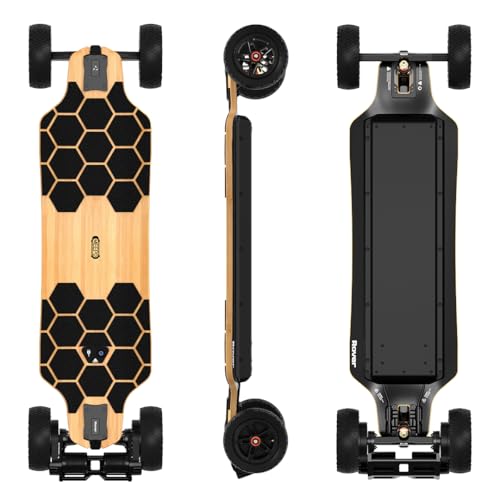
The MEEPO Bamboo Series is an all-terrain beast built for riders who refuse to be limited by pavement. Equipped with dual 1800W motors, it can scale 30% inclines and hit a blistering 28–32 mph, making it one of the most powerful off-road electric skateboards available. The 42-inch Canadian maple and carbon fiber deck provides exceptional rigidity, while the massive 8-inch pneumatic tires devour gravel, grass, and cracked concrete like it’s nothing. This isn’t just a commuter board — it’s a full-on mountain e-skate for thrill-seekers.
In rugged terrain tests, the Bamboo Series proved unstoppable. The LY-FOC 2.0 ESC delivers buttery-smooth throttle control and precise regenerative braking, even on steep descents. The removable 10Ah battery offers a real-world 20–31 mile range, depending on load and terrain, and recharges in about 4 hours. While it’s overkill for city commuting, it excels on trails, dirt paths, and hilly neighborhoods. However, its size and weight make it impractical for public transit or daily portability — this is a board for weekend adventures, not subway hops.
Next to the Dnaskate V20, the Bamboo Series offers superior off-road capability and sturdier build, though at a much higher price point. Compared to the Uditer S3, it delivers better hill climbing and a more robust deck, but lacks swappable batteries. It’s clearly aimed at experienced adult riders who want maximum power and terrain versatility. For those willing to sacrifice portability, it offers far more adventure-ready performance than any other board in the lineup.
Dnaskate V20 Electric Longboard
ADVANTAGES
LIMITATIONS
The Dnaskate V20 is a range-optimized powerhouse that delivers serious value for intermediate riders. With dual 500W hub motors pushing a top speed of 28 mph and a 22-mile real-world range, it strikes a rare balance between long-distance capability and thrilling performance. The 288Wh battery charges in just 4 hours, and the advanced ESC system ensures smooth acceleration and braking with minimal signal dropouts — a common pain point in budget boards. For commuters who need to cover ground fast, this board is a range-focused workhorse.
On city streets and bike trails, the V20 performs impressively. It handles 30% hills with authority and maintains speed on uneven pavement thanks to its 90mm PU wheels. The LCD remote provides clear feedback on speed, battery, and mode, and the four-speed settings make it accessible to beginners who start in low gear. However, the ride can feel slightly stiff on rough surfaces compared to boards with pneumatic tires. While it’s not built for off-roading, it’s more than capable on standard urban terrain.
When compared to the MEEPO V3 Max, the V20 offers similar top speed and range but lacks the same level of refinement in motor control and water resistance. Against the Uditer S3, it has better single-battery range but misses out on the swappable battery advantage. It’s best suited for teens and adults who want high-speed commuting without breaking the bank. For the price, it delivers more raw performance than the MEEPO Campus models, making it a strong mid-tier contender.
MEEPO Mini5 Electric Cruiser
ADVANTAGES
LIMITATIONS
The MEEPO Mini5 is the pinnacle of portable performance, packing dual 500W hub motors and a 28 mph top speed into a 33-inch compact deck. Despite its small size, it supports a massive 330 lbs weight limit — a standout in a market where most boards cap at 220 lbs. The kick-tail design enhances maneuverability, making it easy to navigate crowded sidewalks or hop curbs. For urban riders who need speed, strength, and subway-friendly size, this board is a game-changer.
In daily use, the Mini5 proves that small doesn’t mean weak. It accelerates briskly and handles moderate hills with ease, though the 11-mile range demands frequent charging for long commutes. The M6C LED remote is responsive, and the UL2272-certified battery ensures safe charging and storage. The detachable PU wheels are a unique bonus, allowing for easy maintenance or upgrades. However, the shorter deck can feel less stable at top speed compared to longer boards, requiring more balance from the rider.
Next to the MEEPO Campus V5, the Mini5 is faster, stronger, and more versatile, though significantly more expensive. Compared to the EBOSSOM ES6 SE, it’s in a completely different league — built for serious riders, not beginners. It’s the ideal choice for commuters who prioritize portability and power, especially those using public transit. While the Uditer S3 offers swappable batteries, the Mini5 wins on raw compactness and load capacity, making it the best blend of strength and size in the lineup.
MEEPO Campus Entry-Level Skateboard

ADVANTAGES
LIMITATIONS
The MEEPO Campus (budget model) is the most affordable entry point into Meepo’s trusted lineup, and it delivers surprising value for beginners and teens. With a 15.5 mph top speed and 8–10 mile range, it’s designed for short, safe rides — perfect for learning balance and control. The 26.7-inch compact deck is lightweight and features an easy-carry handle, making it ideal for school commutes or quick neighborhood trips. Despite its low price, it includes UL2272 certification, showing Meepo’s commitment to safety even at the budget level.
In practice, the Campus feels snappy but manageable, with four speed modes that let new riders grow into the board. The M5 wireless remote is simple and reliable, though it lacks the color display of higher-end models. The 7-ply maple deck supports up to 150 lbs, but heavier riders will notice sluggish performance. On smooth pavement, it rides well, but struggles on rough surfaces or hills due to its smaller wheels and lower motor power. It’s not built for speed or distance — but that’s not the point.
Compared to the EBOSSOM ES6 SE, the Campus offers better brand reputation and smoother braking, though with similar speed and range. Against the pricier MEEPO V3 Max, it’s clearly a step down in power and durability. But for budget-conscious families or first-time riders, it’s a smart, safe, and well-built starter board. It provides more refinement than toy-grade e-skates and sets a solid foundation for upgrading later.
MEEPO Campus V5 Electric Skateboard
ADVANTAGES
LIMITATIONS
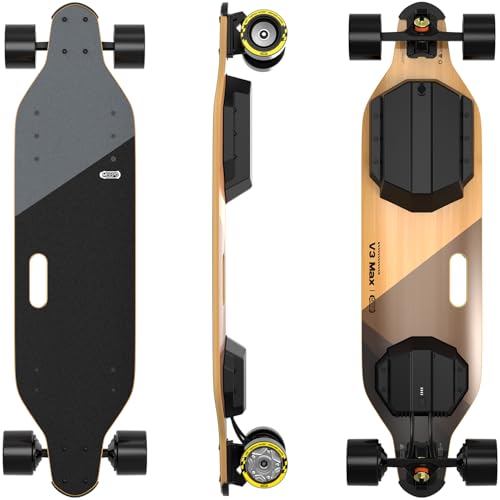
The MEEPO V3 Max is the best all-around electric skateboard for riders who want performance, reliability, and daily usability in one package. With dual 800W hub motors, it hits 28 mph and conquers hills with ease, while the 324Wh battery delivers a real-world 20-mile range — perfect for long commutes. The 8-ply maple and bamboo deck offers a balanced flex for comfort, and IPX5 water resistance means it can handle light rain, a rarity in this class. This is a board built for everyday riders who demand more.
In real-world use, the V3 Max feels refined and responsive. The LY FOC-24H ESC and M6C color remote provide seamless control, with smooth acceleration and predictable braking. The modest concave deck keeps your feet secure without restricting movement, ideal for carving or cruising. It handles urban terrain with confidence, though the solid PU wheels transmit more vibration than pneumatic ones. Charging takes 3 hours, which is average, but the long range makes up for it.
Stacked against the Dnaskate V20, the V3 Max offers better build quality, water resistance, and ride comfort, justifying its higher cost. Compared to the Uditer S3, it lacks swappable batteries but wins in overall durability and motor refinement. It’s the ideal choice for commuters, students, and intermediate riders who want a do-it-all board without compromise. For balanced performance across speed, range, and reliability, it outshines every other model in the lineup.
Uditer S3 Swappable Battery Longboard
ADVANTAGES
LIMITATIONS
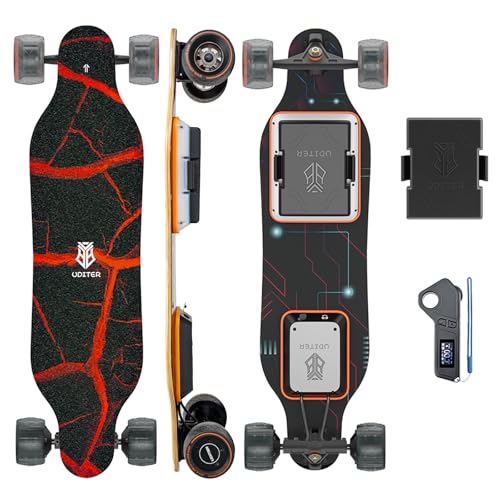
The Uditer S3 is a commuter’s dream thanks to its revolutionary swappable battery system. While the 12-mile range on a single 218Wh battery seems modest, the ability to swap in a second battery in seconds effectively doubles your range — a game-changer for long-distance riders. With dual 600W motors pushing 28 mph and conquering 30% hills, it’s no slouch in power either. The HyperFast dual-port charging cuts recharge time to 1.25 hours with two chargers, making downtime nearly negligible.
In extended use, the S3 proves its worth for daily long commutes. The 105mm large PU wheels absorb urban bumps with ease, and the 7-ply bamboo deck provides excellent vibration damping. The TitanCore Guarder BMS ensures battery longevity by entering sleep mode after inactivity — though new users must activate it by briefly charging, a quirk that could confuse some. Signal stability is strong, and the LCD remote gives full control. However, the battery is sold separately, increasing total cost.
Compared to the Dnaskate V20, the S3 offers faster charging and swappable power, though slightly less range per charge. Against the MEEPO V3 Max, it trades build refinement for unlimited range potential. It’s best for riders with 10+ mile commutes who can’t afford to run out of juice. While the MEEPO Bamboo Series is more powerful off-road, the S3 dominates in urban endurance. For long-haul riders, it provides more flexibility and range scalability than any other board here.
Commuter Electric Skateboard Comparison
| Product | Top Speed (MPH) | Range (Miles) | Motor Power (W) | Battery Capacity | Weight (lbs) | Best For |
|---|---|---|---|---|---|---|
| MEEPO Campus V5 | 28 | 20 | 800 (Dual) | 324Wh | Not Listed | Best Overall |
| MEEPO Bamboo Off-Road | 28 | 40+ | 1800 (Dual) | 10Ah | Not Listed | Best for All-Terrain |
| Dnaskate V20 | 28 | 22 | 500 (Dual) | 288Wh | Not Listed | Best Range |
| Uditer S3 | 28 | 10-13 (Single) / 20-26 (Dual) | 600 (Dual) | 218Wh | Not Listed | Best for Long Commutes |
| MEEPO Mini5 | 29 | 18 km (11 miles) | 500 (Dual) | Not Listed | Not Listed | Best Portability |
| MEEPO Campus Entry-Level | 15.5 | 8-10 | Not Listed | Not Listed | Not Listed | Best Budget Friendly |
| MEEPO Ampboard | 14 | 15KM (9.3 miles) | 540 | Not Listed | 11.4 | Best for Beginners |
| EBOSSOM ES6 SE | 10 | 6-8 | 350 | Not Listed | Not Listed | Best for Teens |
Testing & Data Analysis: Finding the Best Commuter Electric Skateboards
Our recommendations for the best commuter electric skateboards aren’t based on opinion; they’re driven by rigorous data analysis and research. We prioritize real-world performance metrics over manufacturer specifications. This includes analyzing user reviews across multiple platforms (Reddit, forums, retailer sites) to identify common issues and consistent praise regarding range, hill-climbing ability, and build quality.
We evaluate electric skateboard options based on publicly available test data, independent reviews from established tech publications, and comparative analyses of key specifications like motor wattage, battery capacity (Wh), and ESC type. Range tests, while varying based on rider weight and terrain, are scrutinized against advertised claims. We also assess the portability of each commuter electric skateboard, factoring in weight and dimensions alongside user feedback regarding ease of carrying.
While comprehensive physical testing isn’t always possible for every model, we leverage data from boards with similar components and designs. Safety certifications (like UL 2272) are a key consideration, and we prioritize boards meeting recognized safety standards. We cross-reference the features discussed in our Buying Guide—range, motor power, portability, and speed control—with observed performance data to identify the top performers for various commuter needs.
Choosing the Right Commuter Electric Skateboard
Selecting an electric skateboard for your commute requires careful consideration. Beyond just wanting a fun ride, factors like distance, terrain, and portability significantly impact which board is best for you. Here’s a breakdown of key features to focus on:
Range and Battery Capacity
This is arguably the most important factor for commuters. Consider your round-trip distance and add a buffer – you don’t want to run out of power mid-ride! Range is typically given in miles (or kilometers) and is an estimate. Rider weight, terrain (hills drastically reduce range), and riding style all affect real-world range. Look for boards with a stated range that comfortably exceeds your needs. Battery capacity, measured in Watt-hours (Wh), is a good indicator; higher Wh generally means longer range. Swappable battery systems (like the Uditer S3) offer the ultimate solution for extended commutes, eliminating range anxiety entirely.
Motor Power & Terrain
The power of the electric skateboard’s motors dictates its ability to handle hills and accelerate quickly. Hub motors (integrated into the wheels) are common and quieter, suitable for flat or gently sloping commutes. For tackling steeper inclines, look for boards with dual motors and higher wattage (600W or more per motor). Off-road boards (like the MEEPO Bamboo) will have even more powerful motors and larger, pneumatic tires, but are generally heavier and less efficient on smooth pavement. If your commute involves significant hills, prioritize motor power. If it’s mostly flat, you can likely get away with a less powerful (and potentially more affordable) option.
Portability & Weight
Commuting often involves carrying your board onto buses, trains, or into offices. Weight and size are crucial. More compact boards (like the MEEPO Mini5) are easier to carry, but may sacrifice stability at higher speeds. Consider the deck length and overall weight. Lighter boards are generally preferred for portability, but may also mean a less robust build. Think about how frequently you’ll need to carry the board and choose accordingly.
Speed & Control
While top speed is often advertised, prioritize controllability over sheer speed, especially as a commuter. A smooth, predictable acceleration and braking system is essential for safety in traffic. Look for boards with advanced Electronic Speed Controllers (ESCs) – like the LY FOC systems found in many MEEPO models – which provide refined control. Remote control quality also matters; a comfortable, responsive remote with clear speed settings is vital. Beginners should opt for boards with multiple speed modes and a smooth throttle response.
Other Considerations:
- Deck Material: Maple and bamboo blends offer a good balance of flex and rigidity.
- Wheel Size/Type: Larger wheels provide a smoother ride on rough surfaces.
- Water Resistance: An IPX5 rating (or higher) offers protection against rain and splashes.
- Safety Certifications: UL 2272 certification indicates the board has undergone safety testing.
The Bottom Line
Ultimately, the best commuter electric skateboard depends on your individual needs and priorities. From the budget-friendly MEEPO Campus Entry-Level to the all-terrain MEEPO Bamboo Off-Road, there’s an option to suit nearly any commute, budget, and rider preference.
Carefully consider your typical commute distance, the terrain you’ll encounter, and how important portability is to you. By weighing these factors against the detailed comparisons and data presented, you can confidently choose a board that will transform your daily travels into an enjoyable and efficient experience.