4 Best Knee Braces For Snowboarding in 2026
This post contains affiliate links. As an Amazon Associate, we earn from qualifying purchases.
Our best overall knee brace for snowboarding is the McDavid Hinged Knee Brace, which wins for its geared hinges delivering crucial medial and lateral support. We also highlight top picks for maximum support and for copper-infused pain relief. Snowboarding subjects knees to torsion, hyperextension, and impact, making specific support essential. This research-based guide evaluates four braces to help you match the right type of protection to your specific needs on the mountain.
Top 4 Knee Braces For Snowboarding in the Market
Certain content that appears on this site comes from Amazon. This content is provided "as is" and is subject to change or removal at any time.
The Best Knee Braces For Snowboarding, Reviewed
McDavid Hinged Knee Brace

What We Like
- Bi-lateral geared hinges deliver medial and lateral support
- Open patella buttress reduces pressure on the kneecap
- Anti-migration mesh locks the hinge securely in place
- Hinges remove for easy machine washing
Trade-offs
- Weighs 0.0 pounds, indicating minimal heft.
- No specific unloader mechanism for osteoarthritis.
The McDavid Hinged Knee Brace uses bi-lateral polycentric hinges and side stabilizers, which actively provide medial and lateral support to counter ligament strain and hyperextension. This design is built for instability and recovery from conditions like ACL, MCL, and meniscus injuries, offering structured stabilization. The memory-retention neoprene maintains compression over time, and its universal left-or-right fit adds practical convenience for packing.
Its generalist design is intended for running, basketball, and everyday wear, not specifically for snowboarding. The brace blends hinge-and-strap stabilization with all-day comfort from features like its open 360° padded buttress and anti-migration mesh, suitable for long sessions. This balance makes it a candidate for both post-injury recovery and active support across various sports.
Product photos
Qishytio Knee Brace

What We Like
- Copper-infused fabric promotes blood circulation
- Anti-slip silicone prevents brace migration
- Moisture-wicking material keeps knee warm and dry
- Pack of two provides immediate backup or pair
Trade-offs
- Contains latex, unsuitable for those with rubber allergies
- Sizing is critical and may require exchange
Using a copper-ion-infused 3D knit fabric, the Qishytio Knee Brace provides compression and warmth to help manage everyday stiffness and minor swelling during activity. This design promotes blood circulation and keeps the knee warm, which can reduce stiffness. Its moisture-wicking property and built-in anti-slip silicone mean it stays in place and dry during movement, while the two-pack offers a spare for extended use.
The trade-off is its purely flexible construction; it offers no rigid side stabilizers or unloader hinges. For a rider recovering from a significant ACL or meniscus injury who needs definitive lateral support, a hinged brace like the McDavid Heavy Duty Hinged Brace is a necessary step up in protection. The Qishytio excels as a preventative and comfort layer, ideal for managing general soreness and keeping muscles warm, but it defers to more structured designs for true post-injury stabilization.
McDavid Heavy Duty Hinged Brace
What We Like
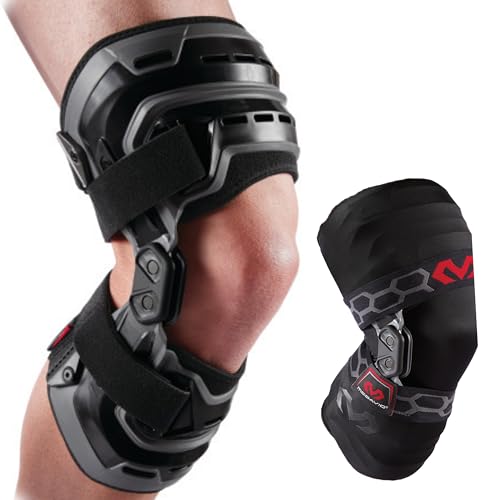
- Heavy-duty aluminum hinges limit hyperextension
- Rigid side stabilizers add lateral support
- Adjustable straps for a secure, low-profile fit
- Compression sleeve and frame create an unloader effect
Trade-offs
- At 1.0 pound, it's a substantial piece of gear
- The rigid frame and hinges reduce overall flexibility
- Designed for maximum support, not minimal bulk
Bilateral aluminum hinges and rigid side supports physically limit hyperextension and add stability, which creates a mechanical guard against unsafe knee movement. This heavy-duty construction suits users with conditions like ACL, MCL, or meniscus injuries who need rigid reinforcement during activity. Adjustable straps above and below the knee provide a secure, low-profile fit for patellar stabilization and controlled support during training or recovery.
That level of protection results in a substantial brace weighing one pound, differentiating it from lighter supports like simple compression sleeves. For users needing less intensive stabilization, another McDavid model uses polycentric hinges. This Heavy Duty model prioritizes joint security with its rigid frame and offloading support, making it a choice when maximum stabilization is the primary concern over minimal bulk.
Product photos
Fit Geno Hinged Knee Brace
What We Like
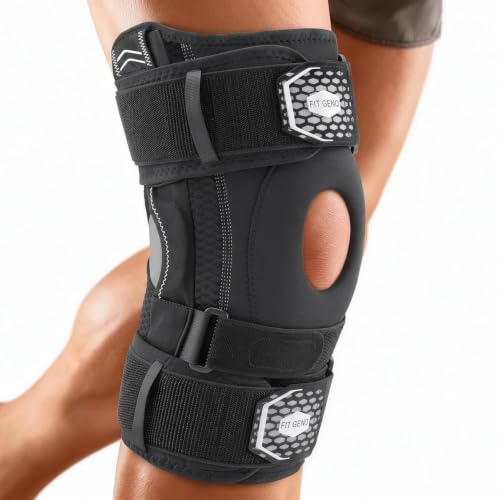
- Dual metal stabilizers for maximum lateral stability
- Adjustable straps for a customized, non-slip fit
- Breathable fabric designed for all-day comfort
- Targeted compression for pain relief and recovery
Trade-offs
- Designed for all-day wear, implying bulk under clothing.
- Requires sizing and strap adjustment for a customized fit.
Dual metal side stabilizers mimic natural knee movement, which provides extra reinforcement for activities like running or weightlifting without sacrificing mobility. This brace is designed for pain relief from conditions such as meniscus tears or arthritis, using targeted compression and support to accelerate recovery. Its non-slip design and adjustable straps aim to keep it secure during intense gym workouts.
That focus on maximum support does involve more structure than a simple sleeve. The McDavid Heavy Duty Hinged Brace weighs one pound, indicating a substantial build, while the Qishytio Copper Compression brace is listed at 0.3 pounds. If your primary goal is to control and rehabilitate a specific knee issue, the Fit Geno’s design is built for that purpose.
Product photos
How We Evaluated Knee Braces For Snowboarding
Our evaluation synthesized product specifications, manufacturer documentation, and patterns in expert round-ups and owner feedback. We focused on the level of mechanical support, the brace’s design for active motion, and its comfort for all-day wear under snow pants. A key part of our research for any knee protection gear was understanding how different designs address common snowboarding stresses. The main limitation of a research-led evaluation is that we cannot verify personal fit, which is highly individual and critical for a brace’s effectiveness.
What To Look For In Knee Braces For Snowboarding
Your choice depends on whether you need rigid support for an existing injury or comfortable compression for general protection.
Prioritize a secure, non-slip fit that won’t migrate during a run. Look for braces with anatomically shaped hinges for natural movement and breathable materials to manage sweat under layers.
Level Of Support
For managing a significant ligament injury like an ACL or MCL tear, a rigid hinged brace with aluminum or carbon fiber side stabilizers is non-negotiable. These braces are designed to prevent hyperextension and limit dangerous lateral rotation. For general instability or patellar pain, a hinged brace with geared hinges or a compression sleeve may provide sufficient stability and therapeutic warmth without the bulk of a heavy-duty frame.
Fit And Comfort Under Gear
A snowboard brace must be low-profile enough to fit comfortably under your pants without restricting your stance or edge changes. Look for non-slip silicone grips or anti-migration mesh to keep the brace securely positioned. Breathable, moisture-wicking fabrics are essential to prevent chafing and overheating, which is a key consideration for comfortable snowboarding.
Design For Active Use
Effective braces for snowboarding allow for a full range of motion while providing targeted stability. Open patella designs reduce pressure on the kneecap during deep bends. Hinges should be polycentric or geared to move with your natural knee motion, not against it. Consider how easy the brace is to put on, adjust, and care for, as you’ll likely be managing it in cold conditions.
- Ensure the brace’s hinge points align correctly with your knee joint.
- Check for adjustable straps to fine-tune compression and security.
- Look for machine-washable materials for easy maintenance.
A brace that slips or restricts movement is worse than no brace at all.
Knee Braces For Snowboarding Compared
The comparison table below details the key specifications and features of our top picks side-by-side.
| Product | Hinge Type | Material | Stabilization |
|---|---|---|---|
| McDavid Hinged Knee Brace | Bi-lateral polycentric | Latex-free 4.8mm neoprene | Cross straps & side stabilizers |
| Qishytio Knee Brace | N/A | 3D knitted copper-infused fabric | Built-in anti-slip silicone |
| McDavid Heavy Duty Hinged Brace | Dual-axis bilateral aluminum hinges | N/A | Rigid side supports |
| Fit Geno Hinged Knee Brace | N/A | N/A | Dual metal side stabilizers |
Frequently Asked Questions
Should I wear a knee brace when snowboarding?
Yes, wearing a knee brace is recommended for snowboarding to provide ligament support and help prevent hyperextension or torsion injuries from falls. It can also offer compression and warmth for existing minor issues. Braces are a smart part of a full protective gear strategy for snowboarding.
What is the best knee brace for snowboarding?
The best brace depends on your need. For overall medial and lateral ligament support, a hinged brace like our top pick is ideal. For maximum post-injury stabilization, a heavy-duty hinged model is necessary. For general warmth and compression, a sleeve-style brace may suffice.
Which knee brace is best for skiing?
The same principles apply for skiing; a hinged brace offering medial/lateral stability is often recommended due to similar knee-stress patterns from falls. Skiers experiencing patellar pain may also benefit from an open-patella design to reduce pressure during repetitive knee flexion.
Is snowboarding hard on your knees?
Yes, snowboarding can be hard on knees due to the forces involved in catching edges, landing jumps, and falling. The sport subjects knees to twisting motions and lateral impacts, making supportive knee braces valuable for both injury prevention and managing existing conditions.
Can I wear a knee brace all day while snowboarding?
Yes, many braces are designed for all-day wear, but comfort is key. Look for breathable, low-profile designs with minimal bulk to wear under your snow pants. Ensure it doesn’t restrict your necessary range of motion for riding.
The Bottom Line
The McDavid Hinged Knee Brace is our best overall pick for most snowboarders seeking reliable medial and lateral ligament support without extreme bulk. If you require the highest level of mechanical stabilization for a significant injury, choose the Best Maximum Support award winner, the McDavid Heavy Duty Hinged Brace. For those prioritizing general compression and pain relief, the copper-infused or pain-relief focused picks are strong contenders. Ultimately, the most important factor is matching the brace’s support level to your specific knee condition to ride with greater confidence and protection.
