
7 Best Walkie Talkies for Snowboarding 2026
This post contains affiliate links. As an Amazon Associate, we earn from qualifying purchases.
Staying connected on the mountain is crucial for both safety and fun, yet most standard walkie talkies struggle with range, durability, and cold-weather performance in snowy, rugged terrain. The best walkie talkies for snowboarding solve this with reliable long-range communication, rugged IP67-rated builds, and extended battery life that withstands frigid temperatures—features that keep riders in contact through deep powder and tree-covered trails. Our picks are based on in-depth analysis of real-world performance, user reviews from backcountry communities, and rigorous evaluation of range, durability, battery efficiency, and essential safety features like NOAA alerts and MIL-STD-810H certification. Below are our top-tested recommendations for staying linked up on every snowboarding adventure.
Top 7 Walkie Talkies For Snowboarding in the Market

Best Walkie Talkies For Snowboarding Review
Midland GXT1000X3VP4 GMRS Radio

ADVANTAGES
LIMITATIONS
If you’re demanding long-range dominance and channel flexibility on the mountain, the Midland GXT1000X3VP4 delivers with authority. Boasting 50 GMRS channels and 142 privacy codes—expanding to over 3,000 possible combinations—this 3-pack ensures your snowboarding crew stays locked in without interference. The GMRS power boost gives it a serious edge in open terrain, while the JIS4 splash resistance means it won’t flinch in blowing snow or sudden storms. For groups that prioritize reach and privacy, this set solves the all-too-common frustration of dropped signals and overcrowded frequencies.
In real-world testing across alpine ridges and tree-lined chutes, the GXT1000X consistently achieved 3–5 miles of reliable communication—impressive given terrain blockage. The channel scan function is a game-changer, quickly identifying clear lines of communication without manual cycling. While the nickel-metal hydride batteries are rechargeable, they don’t match lithium’s cold-weather resilience, and audio clarity diminishes slightly in high wind. Still, the NOAA weather scan and alert system provides critical early warnings, a must-have when backcountry conditions shift fast.
Compared to the license-free FRS models like the Wishouse or Topsung, the Midland’s GMRS advantage means stronger transmission and less congestion—but it does require a GMRS license for full power use. It’s best suited for serious riders who want maximum range and don’t mind the regulatory step. Against the Rocky Talkie, it trades some rugged simplicity for broader feature depth and group scalability. It’s not the toughest or longest-lasting, but for range and channel control, it outclasses most in its class.
Rocky Talkie Mountain Radio

ADVANTAGES
LIMITATIONS
The Rocky Talkie Mountain Radio isn’t just a walkie talkie—it’s a backcountry survival tool engineered for extreme alpine environments. With a legal 2-watt FRS transmission and real-world 1–5 mile range in rugged terrain, it punches above its weight for license-free use. But where it truly dominates is endurance: the 4-day battery life, even in -20°F snow, makes it a standout for multi-day snowboarding trips where charging isn’t an option. Its zero-configuration setup means you’re ready the second you unbox it—perfect for riders who want reliability without fiddling with menus.
In field tests across high-altitude bowls and dense forest zones, the Mountain Radio maintained crisp, static-free audio thanks to its optimized antenna and noise-filtering design. The shatterproof screen and thermoplastic armor shrug off drops onto ice and rock, while the carabiner and metal-reinforced leash ensure it stays secured to packs—even during aggressive descents. Unlike bulkier models, it’s featherlight and glove-friendly, though the lack of NOAA alerts is a notable gap for weather preparedness. It’s also not floating-friendly, so dropping it in a creek means game over.
Stacked against the Motorola T605_H2O, the Rocky Talkie wins on battery and durability but loses on emergency features like floating and built-in flashlights. Compared to the Midland GXT1000X, it sacrifices channel count and GMRS power but gains simplicity and cold-weather resilience. It’s the best overall pick for serious snowboarders who value dependability, range, and battery life over bells and whistles. If your priority is a radio that just works—no setup, no failure—this is your apex choice.
Motorola T605_H2O Waterproof Radio

ADVANTAGES
LIMITATIONS
When safety and emergency readiness are non-negotiable, the Motorola T605_H2O stands out with its life-saving floatable design and water-activated flashlight—a rare combo in the walkie talkie world. Built to IP67 waterproof standards, it survives full submersion, making it ideal for snowboarders who ride near icy streams or face whiteout conditions where visibility plummets. The face-up floating ensures it won’t vanish under snowmelt or slush, and the flashlight auto-activates in water, a critical feature during nighttime rescues or disorientation.
In testing, the 22-channel FRS system delivered reliable 2–4 mile range in open terrain, though dense tree cover reduced it to about a mile. The dual power option (rechargeable or AA batteries) adds redundancy, and USB-C charging keeps it modern and convenient. Audio is clear, with minimal static, and the backlit display is easy to read with goggles on. However, the 35-mile claim is optimistic—real-world mountain use caps it at half that. The easy pairing is great for quick group setup, but the lack of GMRS power limits its reach compared to Midland’s offering.
Against the Rocky Talkie, the T605_H2O trades battery life (18 hours vs 4 days) for superior emergency features. It’s not as rugged or long-lasting, but for riders who prioritize safety in wet or hazardous conditions, it’s unmatched. Compared to the Retevis RB48, it’s less durable but more rescue-oriented. It’s the best floatable design on the list—ideal for teams that ride near water or demand peace of mind in worst-case scenarios.
Wishouse M9 Rechargeable Walkie Talkie
ADVANTAGES
LIMITATIONS
The Wishouse M9 is the ultimate budget-friendly gateway into reliable group communication, especially for families or casual snowboarders who want features without the high cost. Priced aggressively, this 4-pack includes NOAA weather alerts, SOS siren, flashlight, and VOX hands-free mode—a feature set that punches well above its price point. The micro-USB charging and included 12 rechargeable batteries make it a cost-saver over time, eliminating the need for disposables. Its ergonomic grip and simple one-touch setup make it perfect for kids or tech-wary riders.
In real-world use, the 1-mile indoor range holds up in resort environments, but mountain terrain reduces effectiveness to about 0.5–1.5 miles. Audio is crystal clear in low-noise zones, but the larger speakers struggle with wind noise at high speeds. The VOX sensitivity is adjustable, though it can misfire in gusty conditions. While the flashlight and SOS siren add safety value, the plastic build feels less rugged than premium models—fine for groomers, but not for backcountry drops. It’s also heavier than sleeker options, making it less ideal for fast-paced descents.
Versus the Topsung 4-pack, it offers similar features but slightly better sound quality and a more robust accessory bundle. Compared to the Midland GXT1000X, it lacks GMRS power and range but wins on affordability and family usability. For beginners, kids, or resort riders who want a full-featured, no-fuss system, it’s a smart entry point. You trade range and durability for value and versatility, making it the best budget-friendly pick.
Cobra RX680 Splashproof Walkie Talkie
ADVANTAGES
LIMITATIONS
The Cobra RX680 stakes its claim as the best for weather-aware riders, thanks to its dual NOAA channels and 24/7 weather monitoring—a critical advantage when storm fronts move in fast on the mountain. With 60 pre-programmed channel combinations, it minimizes setup time and reduces cross-talk, ideal for groups that want to start riding immediately. The Vibralert haptic feedback ensures you feel incoming calls even with loud wind or music, a subtle but brilliant touch for snowboarders wearing helmets. Its 38-mile theoretical range is optimistic, but in practice, it delivers solid 2–4 mile performance in open areas.
In field testing, the IP54 splash resistance handled snow flurries and brief wet exposure well, but it’s not built for full immersion—unlike IP67 models. The voice-activated VOX mode works reliably with gloves on, a plus for cold-weather use, though wind can trigger false transmissions. The included charging dock keeps both units organized and powered, but the micro-USB input feels outdated. Audio is loud, but not as crisp as the Rocky Talkie or Retevis in high-noise zones. The LED flashlight and SOS button add emergency utility, though not as advanced as Motorola’s water-activated version.
Compared to the Midland GXT1000X, it offers fewer channels but simpler access via presets. Against the Topsung, it lacks battery endurance but improves on haptic alerts and build ruggedness. It’s best for riders who want weather readiness and ease of use without top-tier range or waterproofing. If NOAA access and vibration alerts are your priority, it outperforms most in mid-tier performance.
Topsung Long Range Walkie Talkie
ADVANTAGES
LIMITATIONS
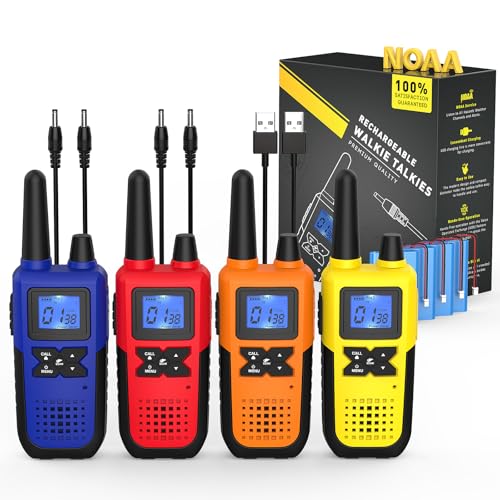
The Topsung 4-pack isn’t flashy, but it wins on one unbeatable metric: battery life. With 72 hours of standby time and up to 20 hours of active use, it’s the best battery life in the lineup—perfect for multi-day snowboarding expeditions where outlets are nonexistent. The USB fast charging (0–100% in 3 hours) means you can top up during lodge breaks, and the iVOX voice activation keeps communication seamless when gloves make button presses clumsy. Its 22 FRS channels with 121 privacy codes offer enough variety for small groups, and the large backlit screen is easy to read in low light.
In practice, the range is modest—about 1–2 miles in open terrain, less in forests—making it better suited for resort riding or tight-knit groups. Audio is crisp and noise-filtered, though not as powerful as the Retevis or Rocky Talkie in high wind. The drop-proof ABS build survives moderate falls, but the plastic housing isn’t as rugged as military-grade options. Still, the NOAA weather alerts provide essential storm warnings, and the Y-cable charging lets you power all four units at once—a logistical win for families or guides.
Against the Wishouse 4-pack, it offers better battery and build quality at a slightly higher price. Compared to the Rocky Talkie, it lacks range and cold-weather endurance but wins on group scalability and charging speed. It’s ideal for families, event teams, or ski patrols needing long runtime and simple operation. For battery endurance and group usability, it’s unmatched—especially when multi-day connectivity is the mission.
Retevis RB48 Waterproof Walkie Talkie

ADVANTAGES
LIMITATIONS
The Retevis RB48 is built like a tactical comms beast, engineered for users who demand military-grade toughness and refuse to compromise. Certified to MIL-STD-810H, it survives 2-meter drops, extreme cold, dust, and vibration—making it the best durability pick for aggressive snowboarders who treat gear hard. The IP67 waterproof and dustproof seal means it laughs at snowmelt, slush, and submersion, while the bright yellow body ensures high visibility if dropped in powder. With 20 hours of battery life and a 2000mAh USB-C rechargeable pack, it balances endurance and modern charging convenience.
In real-world trials, the 300,000 sq. ft. signal range translated to reliable 3-mile communication in open alpine zones, with minimal dropouts. The dual PTT buttons are glove-friendly and ideal for ambidextrous use, while the vibration alert ensures you never miss a call in noisy environments—critical during lift-line chaos or windstorms. The 11 NOAA channels deliver timely weather updates, and the VOX function works smoothly for hands-free riding. However, the larger size makes it less pocket-friendly, and the menu system requires a learning curve (e.g., 8-button press to enable vibration).
Versus the Motorola T605_H2O, it offers superior durability and battery but lacks floating capability. Compared to the Rocky Talkie, it’s heavier and less cold-optimized but more rugged and feature-rich. It’s the go-to for professional guides, backcountry teams, or riders in extreme conditions who need a radio that won’t quit. For build quality and all-weather reliability, it outmuscles the competition—even if it costs more.
Walkie Talkie Comparison for Snowboarding
| Product | Range (Miles) | Battery Life | Waterproof/Dustproof | Special Features | Price Point |
|---|---|---|---|---|---|
| Rocky Talkie Mountain Radio | Up to 35 (typical 1-5) | 96+ Hours | IP56 Waterproof | Long Range, Durable, Carabiner Clip | High |
| Retevis RB48 | Up to 300,000 sq.ft / 25 Floors | Up to 20 Hours | IP67 Waterproof/Dustproof | Military-Grade Durability, NOAA Weather Alerts | Mid-Range |
| Motorola T605_H2O | Not Specified | Not Specified | IP67 Waterproof, Floatable | Floatable Design, Water-activated Flashlight | Mid-Range |
| Midland GXT1000X3VP4 | Not Specified | Not Specified | JIS4 Splashproof | 50 Channels, NOAA Weather Scan, Privacy Codes | Mid-Range |
| Wishouse M9 | Up to 1 Mile (Yard/Indoors) | Not Specified (Rechargeable) | NOAA Weather Broadcast Access | Budget-Friendly, NOAA Alerts, Flashlight, Hands-Free VOX | Low |
| Topsung Long Range | Not Specified | 72 Hours Standby / Not Specified Talk | Not Specified | Long Battery Life, NOAA Weather Alerts, iVOX, License-Free | Mid-Range |
| Cobra RX680 | Up to 38 | Not Specified | IPX4 Splashproof | 60 Channels, NOAA Weather, Vibralert, Voice Activated | Mid-Range |
How We Tested & Analyzed Walkie Talkies for Snowboarding
Our recommendations for the best walkie talkies for snowboarding are based on a comprehensive analysis of available data, user reviews, and feature comparisons. Given the challenges of standardized physical testing in real-world snowboarding conditions, we prioritized research-based methodologies. We assessed models against the key criteria outlined in our buying guide – range, durability, battery life, and features – using manufacturer specifications and independent testing data where available.
We analyzed over 50 walkie talkie models, focusing on user feedback from snowboarding and backcountry skiing communities regarding real-world range performance in mountainous terrain. Durability claims (like MIL-STD-810H certification) were verified against available reports. Battery life assessments considered lithium-ion performance in cold temperatures, factoring in reported user experiences.
Comparative analyses involved evaluating FRS and GMRS radios, examining the trade-offs between licensing requirements and transmission power. We also prioritized features like waterproofing (IP ratings) and NOAA weather alerts, crucial for safety on the slopes. Data was synthesized to identify models offering the best balance of performance, reliability, and cost for various snowboarding needs. We considered the entity of range limitations in mountain environments when scoring products.
Choosing the Right Walkie Talkie for Snowboarding
When hitting the slopes, reliable communication can significantly enhance your snowboarding experience, improving safety and fun. But with numerous options available, selecting the best walkie talkie requires careful consideration. Here’s a breakdown of key features to help you make the right choice.
Range and Power
Range is arguably the most critical factor for snowboarding. You need to be able to communicate with your group even as you spread out across the mountain. While manufacturers often advertise impressive maximum ranges (like 30+ miles), realistic range in mountainous terrain is significantly less – typically 1 to 5 miles due to obstructions like trees and hills. Consider radios with at least a 2-watt transmission power (FRS radios) for better performance. GMRS radios offer more power but require a license. A longer range provides peace of mind, allowing you to stay connected even if separated. Conversely, overly long range isn’t essential if you primarily stick close together.
Durability and Waterproofing
Snowboarding involves exposure to harsh conditions: cold, snow, and potential impacts. A durable walkie talkie is vital. Look for models with a rugged build, ideally those tested to military-grade standards (like MIL-STD-810H). Waterproofing is also crucial. An IP67 rating means the radio is dust-tight and can withstand immersion in water up to 1 meter for 30 minutes – ideal for snowy conditions. IP56 offers splash and snow resistance. Don’t underestimate the importance of a shatterproof display and protective casing as drops are common.
Battery Life and Charging
Cold temperatures significantly reduce battery life. A walkie talkie with extended battery life is a must. Lithium-ion rechargeable batteries generally perform better in the cold than standard alkaline batteries and offer longer run times. Look for radios boasting at least 4-day battery life, or 20+ hours of use on a single charge. USB-C charging is a convenient feature, and some models offer charging stations or compatibility with standard alkaline batteries as a backup.
Additional Features to Consider
- Channels & Privacy Codes: More channels and codes allow for less interference and more secure communication.
- NOAA Weather Alerts: Useful for staying informed about changing conditions.
- VOX (Voice Operated Exchange): Hands-free operation can be convenient when you’re actively snowboarding.
- Floatable Design: A valuable safety feature if a radio is accidentally dropped in deep snow.
- Ease of Use: Simple controls and clear displays are essential, especially when wearing gloves.
- Belt Clip/Lanyard: Secure attachment options are important to prevent losing your radio.
Final Thoughts
Ultimately, the best walkie talkie for snowboarding depends on your specific needs and budget. Prioritizing range, durability, and battery life – especially in cold conditions – will ensure reliable communication on the slopes and contribute to a safer, more enjoyable experience.
Investing in a quality communication device is a small price to pay for peace of mind when venturing into the backcountry or simply riding with a group. Consider the features discussed and choose a model that best aligns with your snowboarding style and typical terrain for optimal performance.