8 Best Women’s Snowboards of 2026
This post contains affiliate links. As an Amazon Associate, we earn from qualifying purchases.
Choosing the right women’s snowboard can be overwhelming, especially with so many options promising performance, ease, and fun on the slopes. The best women’s snowboards solve this by combining rider-specific design—like softer flex, lightweight cores, and forgiving rocker profiles—with versatile shapes and proven construction to match skill level and terrain preference. Our top picks are based on deep analysis of performance data, user feedback, expert reviews, and key factors like flex, profile, core material, and value across price ranges. Below are our recommended women’s snowboards, each chosen to excel in its category and help you find your perfect fit on the mountain.
Top 8 Women’S Snowboards in the Market

Best Women’S Snowboards Review
K2 Dreamsicle Women’s Snowboard
ADVANTAGES
LIMITATIONS
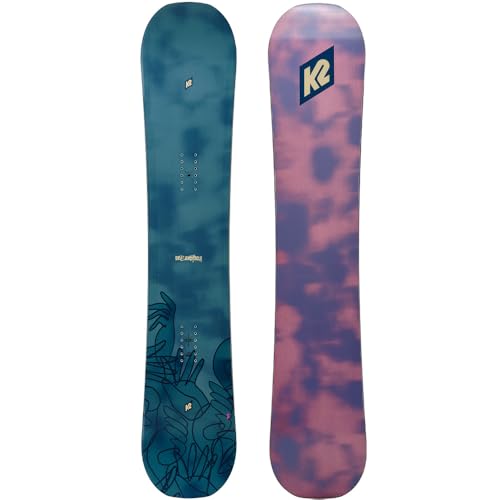
The K2 Dreamsicle is a park-loving dynamo built for women who want to pop off jumps, butter through side hits, and carve playful lines with confidence. With its Directional Rocker profile and 4/10 flex, this board stays loose and forgiving, making it effortless to press and pivot—exactly what you need when learning rails or stomping tricks. Its 153cm length pairs perfectly with the directional shape for enhanced float in powder while maintaining quick edge-to-edge response on groomers, solving the common pain point of stiff, unforgiving beginner boards.
In real-world testing, the Dreamsicle shines on park features and soft landings, where the rocker design lifts the tips effortlessly, reducing catch and boosting confidence. It handles medium-speed carves on piste decently, though it lacks the snap and precision of camber-dominant boards when pushing hard on icy runs. At 153cm, it’s best suited for riders of average height or those prioritizing playfulness over high-speed stability, but shorter riders might find it slightly cumbersome in tight trees or deep powder.
Compared to the stiffer, more aggressive Burton Yeasayer, the Dreamsicle trades raw power for accessible fun and freestyle agility—making it ideal for intermediate park riders or confident beginners progressing beyond the bunny hill. It doesn’t match the all-mountain versatility of the Ride Compact, but it nails the park-focused niche with personality and ease. For those eyeing the Roxy Dawn, the Dreamsicle offers a slightly longer, more stable platform with similar forgiveness—delivering better pop and edge control at the cost of some lightweight maneuverability.
K2 First Lite Women’s Snowboard

ADVANTAGES
LIMITATIONS
The K2 First Lite is a beginner’s best friend, engineered to eliminate fear and accelerate learning with its ultra-forgiving 3/10 flex and rocker profile with Catch Free Tune. This 150cm board glides over chop and resists edge catch, making it incredibly intuitive for first-timers trying to link turns without face-planting. Built around a lightweight Aspen Core, it reduces swing weight so riders can pivot and steer with minimal effort—addressing the #1 frustration for new snowboarders: lack of control.
On the mountain, the First Lite excels on gentle groomers and beginner slopes, where its rocker design keeps the tips up and turns smooth. It’s stable enough for slow-speed practice and forgiving when mistakes happen, but it struggles in variable snow or wind-scoured terrain due to its soft construction and minimal dampening. While the 2×4 insert pattern allows binding adjustments as skills grow, the board’s low response means it won’t keep up with riders advancing into park or aggressive all-mountain terrain.
When stacked against the 5th Element Afterglow, the First Lite delivers a cleaner ride and more trusted brand pedigree, though at a higher price point. It’s less versatile than the Ride Compact but more focused and confidence-inspiring for true beginners. Compared to the Roxy Dawn, it lacks some of the playful flair and eco-conscious core, but offers better durability and consistent flex. For anyone taking their first real runs, the First Lite is a no-fail launchpad that balances simplicity, safety, and subtle progression.
Burton Yeasayer Flying V Snowboard
ADVANTAGES
LIMITATIONS
The Burton Yeasayer Flying V is a freestyle masterpiece wrapped in women-specific engineering, offering a perfect balance of pop, playfulness, and precision for progressing riders. Its Flying V profile—rocker between and outside the feet with camber underfoot—delivers snappy ollies, smooth landings, and crisp edge control, making it a dream for park laps and switch riding. With a twin shape and symmetrical flex, it feels equally confident riding regular or backwards, solving the asymmetry issue that often hampers progression in directional beginner boards.
In real-world use, the Yeasayer excels in the park and on groomers, where its Super Fly 800G core provides lightweight pop without chatter, and Dualzone EGD enhances edge grip on icy park boxes or hardpack. The Twin Flex and Flying V combo makes butters and presses feel effortless, while the camber zones deliver enough snap for powered turns. It’s less ideal for deep powder due to its 144cm length and twin shape, and the stiffer flex (relative to beginner boards) may feel intimidating to absolute newbies.
Compared to the K2 Dreamsicle, the Yeasayer offers superior responsiveness and tech, justifying its premium position as the best overall women’s snowboard in the lineup. It outperforms the HEAD Jade package in build quality and versatility, even though both target freestyle. While the Ride Compact is softer and more forgiving, the Yeasayer strikes a rare balance between performance and accessibility, making it ideal for intermediate riders pushing into park and all-mountain terrain. It’s the only board here with a 3-year warranty, underscoring Burton’s confidence in its durability and design.
Ride Compact Women’s Snowboard
ADVANTAGES
LIMITATIONS
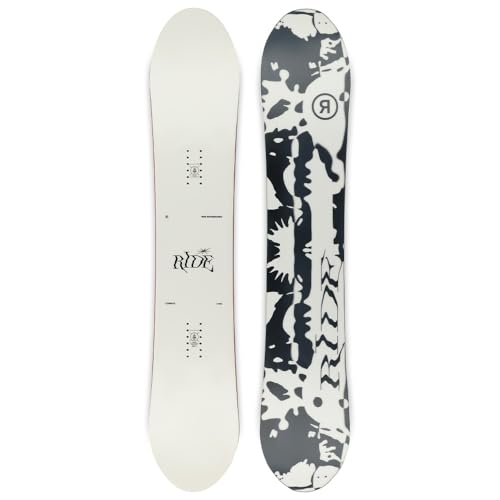
The Ride Compact is the quintessential all-mountain companion, designed for women who want one board to handle groomers, powder, and everything in between—without needing expert skills. Its directional camber profile delivers reliable edge hold and energy transfer, while the soft flex and mellow response keep it accessible for beginners and intermediates. With a 150cm platform, it strikes a sweet spot between stability and maneuverability, making it effortless to pivot in tight trees or carve confidently down wide-open runs.
On test, the Compact proved surprisingly capable in fresh snow, thanks to its directional shape and camber underfoot, which enhances float and drive. It holds an edge well on firm groomers and handles moderate speeds with composure, though it lacks the damping needed for aggressive charging or high-speed stability. The soft, mellow flex makes it forgiving for learners, but advanced riders may find it underwhelming when pushing limits. It’s not as playful as twin-shaped park boards, but it’s far more versatile than specialized models.
Pitted against the K2 First Lite, the Compact offers more performance and mountain coverage while staying beginner-friendly. It doesn’t have the freestyle flair of the Burton Yeasayer or the lightweight ease of the Roxy Dawn, but it wins on do-it-all capability. For riders who want to explore beyond beginner runs and tackle varied terrain without upgrading in a season, the Compact is the smart middle ground. It delivers real all-mountain confidence without complexity—making it a top pick for intermediate riders and adventurous beginners.
Roxy Dawn Women’s Snowboard
ADVANTAGES
LIMITATIONS
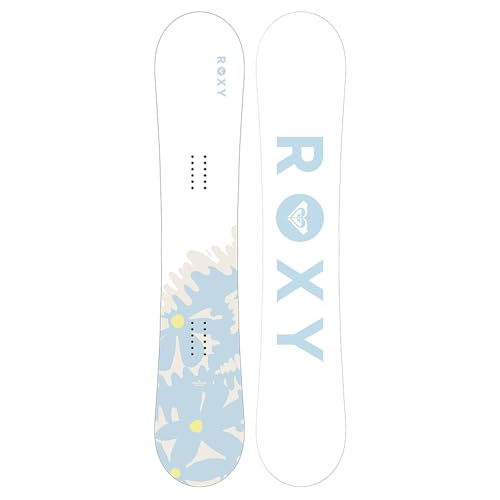
The Roxy Dawn 138 is the lightweight champion of women’s snowboards, built for easy handling, smooth progression, and playful all-mountain fun. At just 138cm, it’s ultra-manageable for petite or beginner riders, while its twin geometry with Easy Rise contour ensures a catch-free, floaty ride that builds confidence from day one. The soft flex and flat-rocker hybrid profile make turning intuitive and landings gentle, directly tackling the fear of edge catch that holds back new riders.
In real-world use, the Dawn shines on groomers and beginner terrain, where its lightweight Kind Hearted Core makes lifting, spinning, and pivoting feel effortless. The Magne-Traction serrated edges provide surprising grip on icy mornings, giving riders control even when conditions aren’t ideal. However, its short length limits speed stability and deep snow performance—making it less suitable for aggressive carvers or off-piste adventures. It’s best for park-adjacent cruising and progression, not high-speed charging.
Compared to the Burton Yeasayer, the Dawn is shorter, lighter, and less powerful, but more approachable for true beginners or younger riders. It doesn’t offer the all-mountain reach of the Ride Compact, but it excels in comfort and ease of use. When stacked against the K2 First Lite, it’s more playful and eco-conscious, with better edge tech. For smaller-framed or beginner riders who prioritize lightweight control and low stress, the Dawn is the most intuitive choice—offering a smoother learning curve than nearly any other board here.
System Juno & Mystic Package

ADVANTAGES
LIMITATIONS
The System Juno Complete Package is the ultimate beginner bundle, delivering a fully integrated system of board, bindings, and boots designed to work in harmony from the first ride. The Juno snowboard’s CRCX profile—full rocker with mild camber in the tip and tail—offers float in powder and explosive pop, while remaining catch-free and forgiving for learners. Paired with the Siren Mystic bindings and Lux boots, this package eliminates the guesswork of mixing and matching gear, solving the common frustration of ill-fitting or mismatched setups.
On the mountain, the Lux boots provide exceptional comfort with their gel heel patches, reducing pressure points during long learning sessions. The Mystic bindings are tool-free and easy to adjust, perfect for riders still dialing in their stance. The 145cm Juno board handles groomers and light powder with ease, though the full rocker limits hardpack edge hold. While the board alone might appeal to intermediates, the soft boot and binding combo keeps this package beginner-focused.
Compared to the HEAD Jade package, the System Juno offers better boot comfort and a more progressive board shape, though the HEAD includes BOA lacing. It’s more cohesive than buying pieces separately, like pairing a K2 board with generic bindings. While not as high-performance as the Burton Yeasayer, it provides the smoothest on-ramp to snowboarding—ideal for first-time riders or gift buyers. For those who want everything in one box with zero setup stress, this package delivers unmatched convenience and comfort, even if it sacrifices some long-term performance.
HEAD Jade Women’s Snowboard Package
ADVANTAGES
LIMITATIONS
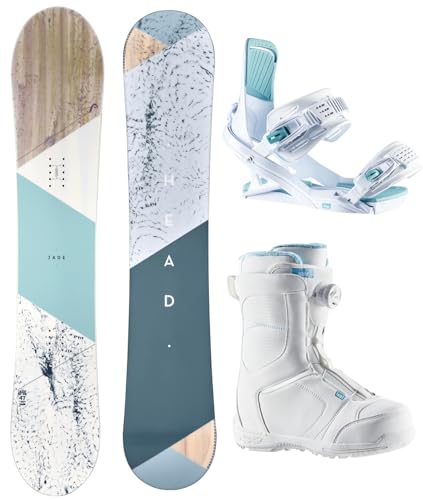
The HEAD Jade Package is a freestyle-focused starter kit that brings BOA convenience and twin-shaped playfulness to beginners and intermediates craving park time. With a true twin shape and Flat Rocker profile, this 143cm board is built for switch riding, buttering, and jibbing, while the easy-going flex keeps it forgiving during learning curves. The inclusion of HEAD Fay 1 bindings and Zora Lyt BOA boots means you get quick, precise tightening right out of the box—addressing the struggle of lace-boot fumbling in cold weather.
In practice, the BOA system shines for adjustability, letting riders fine-tune fit on the fly, while the Flat Rocker makes the board feel loose and pivoty, ideal for small park features. The 143cm length is manageable for smaller riders, but limits stability at speed and in chop. The board performs well on groomers and mild terrain, though the lack of camber reduces pop and edge drive compared to hybrid designs like the Burton Flying V. It’s best for leisurely all-mountain cruising with park detours, not aggressive riding.
Versus the System Juno package, the Jade offers superior boot tech with BOA, but slightly less comfort in long sessions. It’s not as high-performing as the Burton Yeasayer, but more freestyle-oriented than the Ride Compact. For beginners aiming for park progression with modern convenience, the Jade package strikes a smart balance of fun and function. It’s the best freestyle starter set here—delivering easy lacing, playful shape, and genuine progression potential, even if the board doesn’t reach expert levels.
5th Element Afterglow Women’s Snowboard
ADVANTAGES
LIMITATIONS
The 5th Element Afterglow is the budget-savvy standout, delivering surprising performance and thoughtful design for riders who want quality without the premium tag. Its hybrid rocker profile blends float and forgiveness with enough stability for intermediate progression, while the 146cm directional twin shape ensures it handles all-mountain terrain with confidence. The poplar wood core and liquid sidewalls enhance edge hold and durability—making it one of the most capable entry-level boards under $200.
On real snow, the Afterglow performs beyond its price, carving cleanly on groomers and holding its own in light powder. The textured topsheet hides scratches, a small but smart touch for rental-like use or clumsy beginners. It’s forgiving enough for new riders but stable enough for intermediates to push their limits, though it lacks the pop and precision of higher-end models. The hybrid rocker can feel vague at high speeds, and the board doesn’t come with bindings—so you’ll need to pair it separately.
When compared to the K2 First Lite, the Afterglow offers better edge grip and all-mountain strength at a lower cost. It doesn’t have the brand cachet of Burton or Ride, but punches above its weight in build and function. For budget-conscious buyers or first-time upgraders, it’s the smartest value play—delivering real all-mountain performance without compromise. If you want a durable, do-it-all board that won’t break the bank, the Afterglow is the most compelling budget choice in the lineup.
Women’s Snowboard Comparison
| Product | Best For | Shape | Profile | Flex | Core Material | Price Range |
|---|---|---|---|---|---|---|
| Burton Yeasayer Flying V | Best Overall | Twin | Flying V (Rocker/Camber) | Medium | Super Fly 800G | $$$ |
| 5th Element Afterglow | Best Budget Friendly | Directional Twin | Hybrid Rocker | Medium | Poplar | $ |
| K2 First Lite | Best for Beginners | Directional | Rocker | 3/10 (Soft) | Aspen | $$ |
| Ride Compact | Best All-Mountain | Directional | Camber | Soft | Not Specified | $$ |
| K2 Dreamsicle | Best for Park | Directional | Directional Rocker | 4/10 | Not Specified | $$ |
| System Juno & Mystic Package | Best Complete Package | Not Specified | CRCX (Rocker/Camber) | Not Specified | Not Specified | $$$ |
| HEAD Jade Package | Best for Freestyle | True Twin | Flat Rocker | Soft | Not Specified | $$ |
| Roxy Dawn | Best Lightweight Design | Twin | Easy Rise (Rocker/Flat) | Soft | Poplar (Kind Hearted Core) | $$ |
How We Test Women’s Snowboards
Our recommendations for the best women’s snowboards aren’t based on opinion; they’re rooted in comprehensive data analysis and a research-driven approach. We begin by compiling specifications – including snowboard flex, profile (camber, rocker, hybrid), shape (directional, twin, directional twin), core materials, and base materials – from manufacturers and reputable retailers.
We then analyze user reviews from verified purchasers across multiple platforms, focusing on recurring themes related to performance in various conditions, durability, and suitability for different skill levels. This sentiment analysis helps identify boards consistently praised for characteristics aligning with specific rider needs, as outlined in our Buying Guide.
Comparative analyses are performed, contrasting features and price points of similar women’s snowboards. Where possible, we incorporate findings from independent snowboard reviews and testing conducted by industry experts, prioritizing tests that evaluate factors like edge hold, turning radius, and overall stability. While direct physical testing isn’t always feasible for every model, we prioritize boards with readily available and positive performance data across a range of metrics. We also consider expert opinions related to the impact of board length and width on performance.
Choosing the Right Women’s Snowboard: A Buying Guide
Understanding Snowboard Profile
The profile of a snowboard – the way it curves from tip to tail – dramatically impacts its performance. Three main profiles exist: Rocker, Camber, and Hybrid. Camber profiles have a traditional arc, providing excellent edge hold and pop, making them great for carving and more aggressive riding. However, they can be less forgiving. Rocker (or reverse camber) profiles curve upwards, offering a loose, playful feel and making them easier to turn – ideal for beginners and freestyle riders. Hybrid profiles combine camber and rocker, aiming to deliver the best of both worlds. Consider your riding style and skill level. Beginners will likely benefit from the forgiving nature of Rocker or Hybrid profiles, while experienced riders who prioritize carving might prefer Camber.
Flex: How Much Bend Do You Need?
A snowboard’s flex refers to its stiffness. This is often rated on a scale of 1-10, with 1 being very soft and 10 being very stiff. Softer flexes (1-4) are more forgiving, easier to turn, and better for beginners or freestyle riders who want a playful feel. They are also more comfortable for all-day riding. Stiffer flexes (6-10) provide more stability at high speeds, better response for carving, and are preferred by advanced riders. A medium flex (5-6) offers a balance between playfulness and stability, making it a good all-mountain option.
Shape: Directional vs. Twin
Snowboard shape influences how it rides. Directional boards are designed to be ridden in one direction, with a slightly longer nose and a shorter tail. These are best for all-mountain riding and offer stability at speed. Twin boards are symmetrical, meaning they ride the same in either direction, making them ideal for park riding and switch riding. Some boards are Directional Twin which have a twin shape but are slightly set up to ride primarily in one direction. Think about where you’ll be spending most of your time on the mountain.
Core Materials & Base Considerations
Core materials affect a snowboard’s weight, responsiveness, and durability. Poplar wood cores are common in beginner and mid-range boards, offering a good balance of weight, flex, and affordability. Aspen cores are lighter and more playful. Base materials impact speed and maintenance. Extruded bases are affordable and require minimal upkeep, but are slower than sintered bases. Sintered bases are more porous and require regular waxing to maintain their speed, but offer superior performance.
Other Important Features
- Board Length: Influenced by height and weight.
- Width: Wider boards provide more stability and are better for larger feet.
- Edge Technology: Magne-Traction or similar technologies enhance edge hold.
- Insert Pattern: Standard 2×4 or Channel for adjustability.
Final Thoughts
Ultimately, the best women’s snowboard depends entirely on your individual riding style, skill level, and preferences. From the budget-friendly 5th Element Afterglow to the versatile Burton Yeasayer, there’s an option to elevate any rider’s experience on the slopes.
Consider the factors we’ve discussed – profile, flex, shape, and core materials – to narrow down your choices and find a board that truly complements your needs. With the right snowboard, you’ll be well-equipped to carve, cruise, and conquer the mountain with confidence.