Bintelli Scooter Review: The 500-Mile Service Rule
This post contains affiliate links. As an Amazon Associate, we earn from qualifying purchases.
A Bintelli scooter review finds a budget-friendly, Chinese-made scooter line with a standard 2-year warranty and a mix of name-brand components (NGK, Gates, Motobatt). Its value hinges on strict adherence to the 500-mile dealer service for warranty validation and navigating a parts system split by a 2016 factory change. Real-world reliability varies heavily with dealer support quality.
That 500-mile service clause is the pivot point. It’s not a suggestion; it’s a warranty gate. Miss it, and you’re on the hook for any future engine work, which can turn a $1,200 scooter into a $2,000 project faster than a seized valve.
What follows is a breakdown of the specs that matter, the maintenance schedule you can’t skip, the common failure points owners actually report, and the real cost of ownership beyond the sticker price as detailed in a typical Bintelli scooter review. This isn’t about whether Bintelli scooters are “good” or “bad.” It’s about whether their specific trade-offs fit your willingness to follow rules and your proximity to a competent dealer.
Key Takeaways
- The first 500-mile service (oil change and valve adjustment) must be performed at an authorized Bintelli dealer to keep the engine warranty valid.
- For 150cc models like the Scorch, check your VIN, parts differ between pre-2016 ZNEN factory (VIN L5Y) and post-2016 JIAJUE factory (VIN LLP) bikes.
- The standard Motobatt 12V, 7A AGM battery reading below 12V signals an immediate need for charging to prevent no-start issues.
- Long-term storage (>1 month) requires draining fuel, oiling the cylinder, and using a trickle charger; skipping the charger specifically causes electric start failures.
- Owner forums show real fixes for “starts, idles, dies” issues often trace to yellow gunk (phase-separated gas) in the Deni carburetor, a repair the manual says only a dealer should do.
The 500-Mile Service Rule That Decides Your Warranty
Bintelli’s warranty is a two-year limited promise, but it comes with a string attached you can’t cut. The OEM service manual states the first 500-mile service, specifically an oil change and a valve adjustment, must be performed at an authorized service center. This isn’t a recommendation for optimal performance. It’s a condition of the engine warranty.
The manual is explicit: skipping this dealer-performed service invalidates the engine warranty. This single clause shifts the cost of any major future repair, think timing chain, top-end work, from Bintelli to you.
Why the hard line? The 50cc models (Sprint, Breeze, Edge) use the BN139QMB engine with a 10.4:1 compression ratio. The 150cc Havoc uses the BN157QMJ at 9.5:1. Both are simple air-cooled mills, but their valve clearances are tight and critical. A dealer adjustment at 500 miles sets the baseline and proves the scooter was maintained “by the book.” If you do it yourself or skip it, you have no proof, and the warranty claim dies.
The schedule after that first service is more forgiving: subsequent checks at 1000-1500 miles, then every 3000 miles, and a major service every 6000 miles. But that first one is the lock on the warranty door.
Common mistake: Thinking a local mechanic can do the 500-mile service. The manual marks certain items, including carburetor idle adjustment and timing chain service, with a ‘※※’ symbol, restricting them to authorized centers only. While a forum user might document cleaning their own carb, that act technically voids the warranty path for related components. The choice is between certified safety and potential savings.
Engine Specs & Real-World Performance: 49cc vs. 150cc
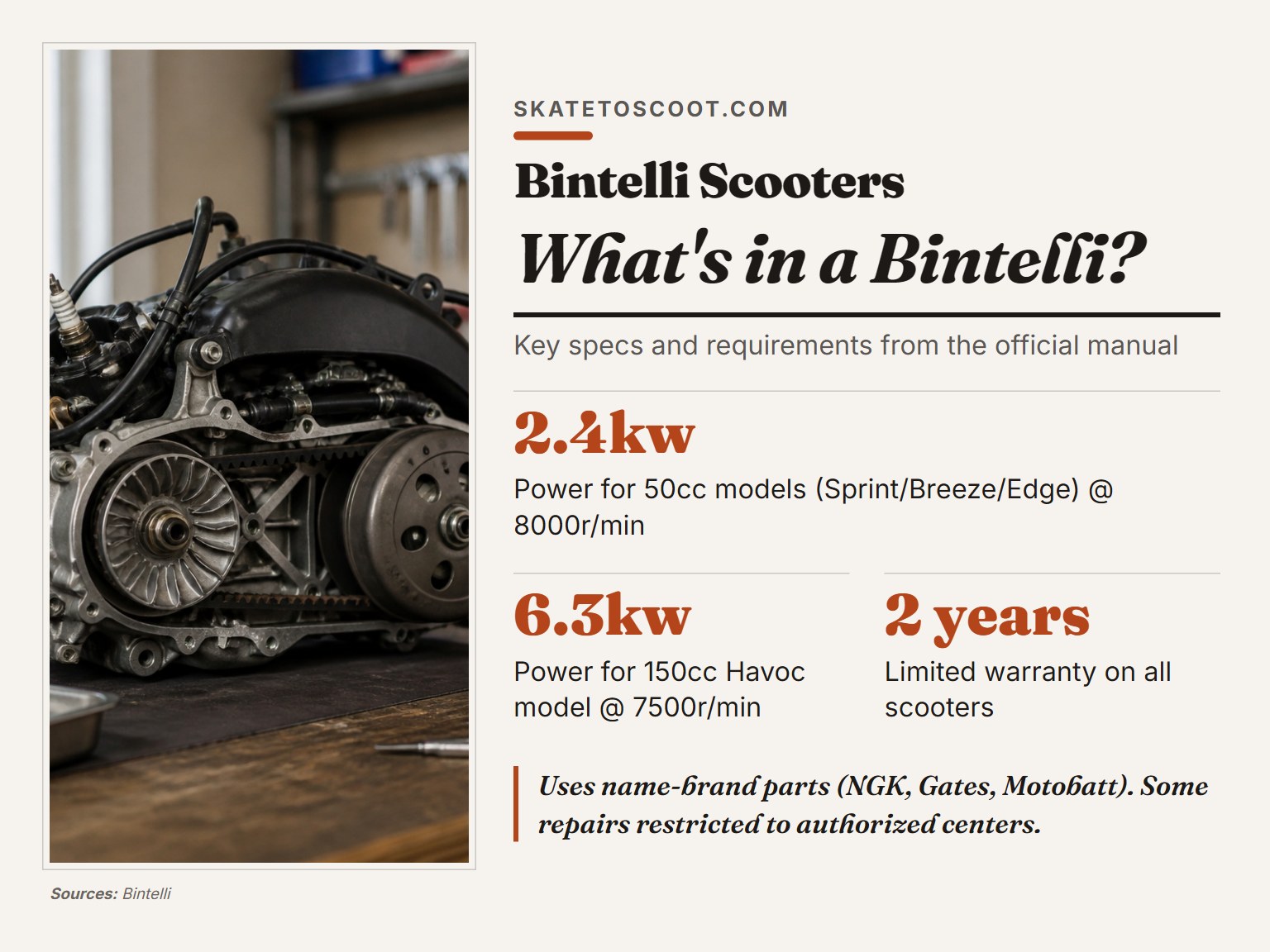
The numbers on paper tell one story; the seat-of-the-pants feel tells another, a nuance often highlighted in a Bintelli scooter review. For the 49cc models, the BN139QMB engine makes 2.4 kilowatts (about 3.2 hp) at 8000 RPM, with 2.8 Newton-meters of torque at 6500 RPM. The 150cc Havoc’s BN157QMJ makes 6.3 kW (8.4 hp) at 7500 RPM and 8.8 N.m of torque at 6000.
| Model | Engine | Power | Torque | Best For | Limitation |
|---|---|---|---|---|---|
| 49cc (Sprint/Breeze/Edge) | BN139QMB | 2.4 kW @ 8000 RPM | 2.8 N.m @ 6500 RPM | Flat urban commutes, short trips | Struggles on sustained hills, top speed ~35 mph |
| 150cc Havoc | BN157QMJ | 6.3 kW @ 7500 RPM | 8.8 N.m @ 6000 RPM | Heavier riders, mild inclines | Still not a highway machine; larger, heavier chassis |
The 150cc unit produces more power and torque, which provides better performance on inclines. The 150cc model provides significantly more power and torque than the 50cc models.
Both engines use specific, quality components from the factory: an NGK CR7HSA spark plug, a Deni carburetor, and a Gates belt (669mm for 50cc, 835mm for 150cc). These are legitimate upgrades over no-name parts, but they don’t make the scooter invincible. They just mean when something fails, you’re replacing a known brand with a known spec, not hunting for a mystery component.
Common Problems & Owner-Reported Fixes
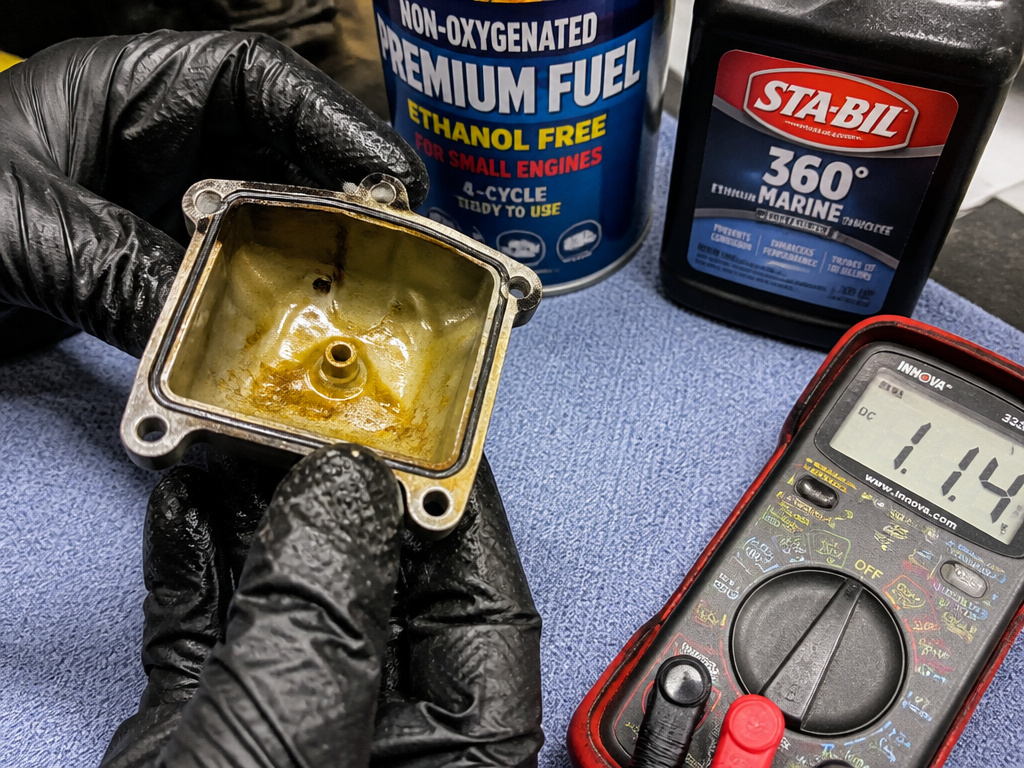
Owners don’t complain about horsepower. They complain about things that stop the scooter from moving.
The most documented mechanical issue is the “starts, idles, dies” cycle. A forum thread on a 2013 Bintelli Sprint traced this to “yellow gunk” in the carburetor bowl, a symptom of phase-separated ethanol gasoline sitting in the tank. The fix was a full carb clean, tank flush, and a switch to ethanol-free fuel or a stabilizer. The manual says carb work is dealer-only, but the forum user did it themselves. That’s the conflict: the official policy versus the owner’s reality.
Electrical gremlins often lead back to the battery. The stock Motobatt AGM unit is decent, but let it sit discharged. The manual is clear: a reading below 12V means charge it now. For storage over a month, the manual insists on a trickle charger, warning that omission “will cause electric start problems.” This isn’t vague, it’s a direct cause-and-effect statement from the manufacturer.
Where this goes sideways: Letting a scooter sit with old gas and no battery tender. By month two, you’ll likely need a carb clean and a new battery, a combination repair that can wipe out the savings from buying a budget scooter.
More serious are the isolated but severe complaints on the BBB customer reviews page, like a 2024 Beyond golf cart failing at 80 miles. These highlight the dealer-dependent support model. Bintelli, as an OEM, states it “can not sell or service the retail public.” Your problem is your dealer’s problem. If your dealer is slow, unresponsive, or five hours away, your scooter becomes a very expensive lawn ornament. This risk is the hidden cost of the low price.
Parts & Long-Term Support: The 2016 Factory Split
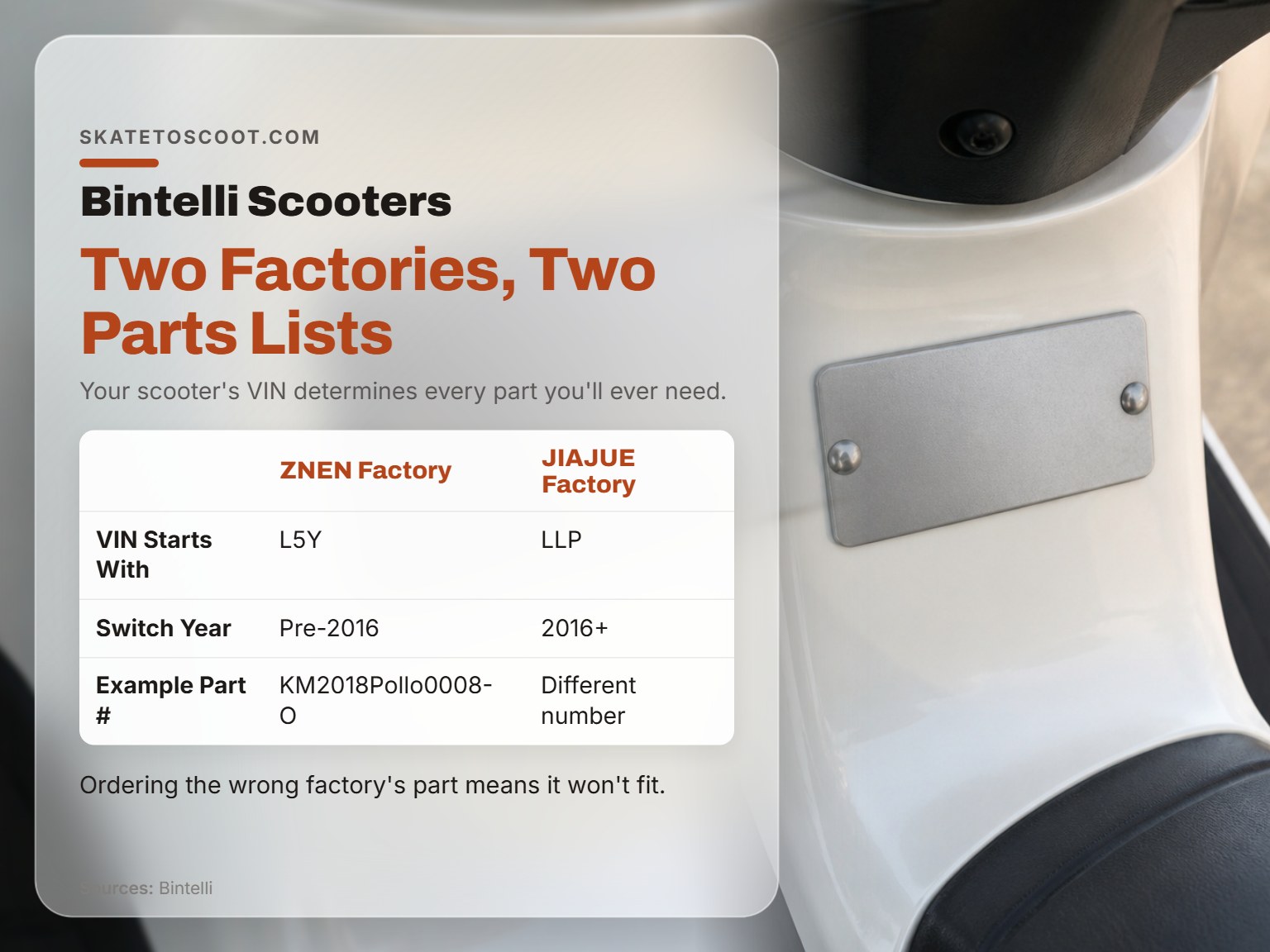
Here’s a nuance most reviews miss: Bintelli isn’t one factory. In 2016, they switched overseas manufacturing from the ZNEN factory (VIN starts with ‘L5Y’) to the JIAJUE factory (VIN starts with ‘LLP’). This isn’t just trivia. It dictates every replacement part you’ll ever order.
The parts list for a 150cc Scorch shows different numbers for the same component based on your VIN. A right-side body cover in orange is part number KM2018Pollo0008-O for a ZNEN scooter, and a completely different number for a JIAJUE scooter. Order the wrong one, and it won’t fit. Period.
| Factor | ZNEN Factory (Pre-2016, VIN L5Y) | JIAJUE Factory (2016+, VIN LLP) |
|---|---|---|
| Availability | Parts are legacy; may be NLA or on long backorder | Current production; theoretically better supply |
| Knowledge | Dealers who’ve been around know these bikes | Newer dealers may only know JIAJUE specs |
| Risk | Mismatched parts if you assume all Scorches are the same | Assuming your older scooter uses new parts |
A belt or brake pad that fits a TaoTao or a generic GY6 engine might not match your specific Bintelli. You must know your VIN and source parts from a dealer who asks for it.
The takeaway: Bintelli scooters are not a generic commodity. Their support ecosystem is fragmented by year and factory. Your long-term ownership cost depends less on the scooter’s inherent quality and more on your dealer’s ability to navigate this split and get the part for your scooter’s specific factory and year.
Maintenance Schedule & Owner Responsibilities
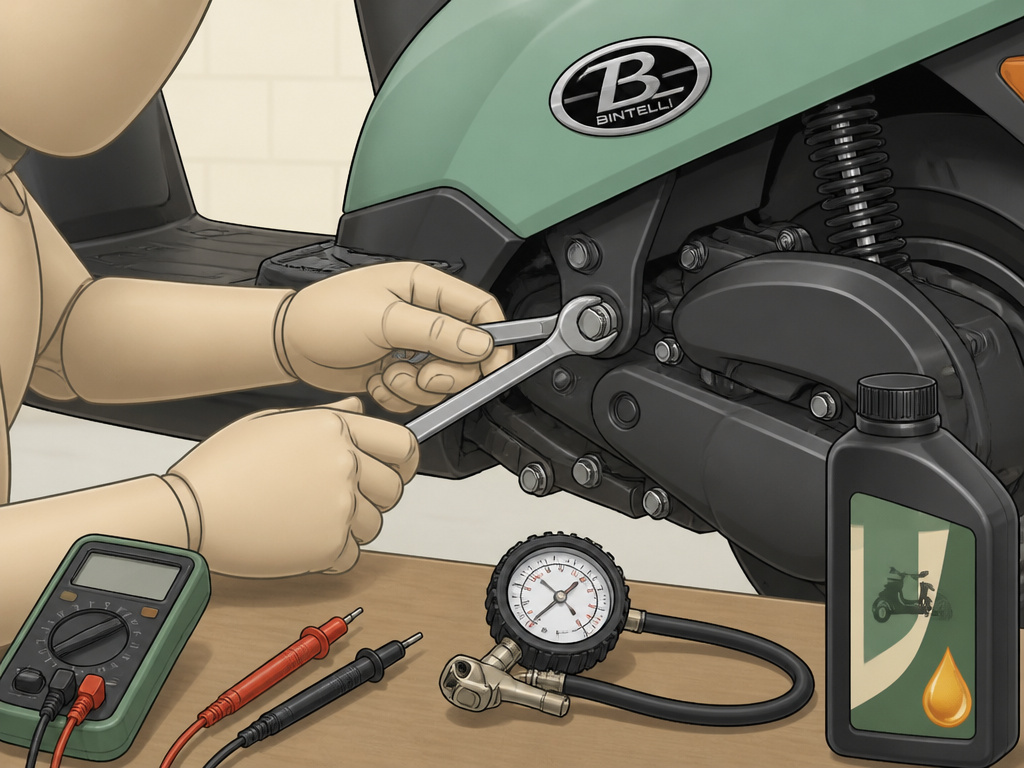
Beyond the warranty-critical 500-mile service, maintaining a Bintelli is a mix of owner-simple and dealer-mandated tasks. The schedule is rigid, but the tasks are clear.
What you can (and should) do yourself:
- Oil Changes: Every 1000-1500 miles after the first one. The 49cc engine requires an oil change as part of the service schedule.
- Tire Pressure: Check weekly. Maintain correct tire pressure for safety and efficiency.
- Battery Care: Keep the terminals clean and check voltage monthly with a multimeter. Below 12V, charge it.
- Chain/Belt Tension: Check the belt as part of regular maintenance.
- General Bolts: Vibration loosens everything. Go over critical fasteners (axles, brake calipers, engine mounts) with a wrench every few months.
What the manual says only a dealer should do (※※ items):
- Carburetor idle adjustment and overhaul.
- Brake shoe inspection and replacement.
- Timing chain inspection and adjustment.
The reality, as seen in forums, is that some owners perform carb cleans themselves, as one forum user did, contradicting the manual’s rule that such work must be done by an authorized service center.
For storage longer than a month, the manual procedure is specific: drain all fuel, add a teaspoon of oil into the cylinder via the spark plug hole, crank the engine to coat it, and remove the battery for trickle charging. Ignoring this, especially the trickle charger part, is asking for a springtime filled with frustration.
Bintelli vs. Other Budget Chinese Scooter Brands
How does Bintelli stack up against other names like TaoTao, Icebear, or Boom? It’s less about the metal and more about the structure.
Bintelli’s key differentiator is its stated use of name-brand components (NGK, Gates, Deni, Motobatt) and its dealer-only sales model. You can’t buy one direct online. This creates a theoretical layer of assembly quality control and point-of-sale support that anonymous online sellers lack. A Bintelli dealer should assemble, inspect, and test the scooter before you ride it.
However, this model also concentrates risk. A bad Bintelli dealer, slow, incompetent, or distant, makes ownership worse than dealing with a direct-from-China brand where you expect no support. Complaints about parts backorders and unresponsive dealers appear on the BBB profile.
It’s above the absolute bottom-dollar online specials but below established names like Genuine Scooter Company or Honda when comparing dealer network maturity and brand reputation. You’re paying a small premium for the brand-curated parts list and the warranty, but you are also tying your fortune to a specific dealership’s competence.
Bintelli Model Specs and Parts
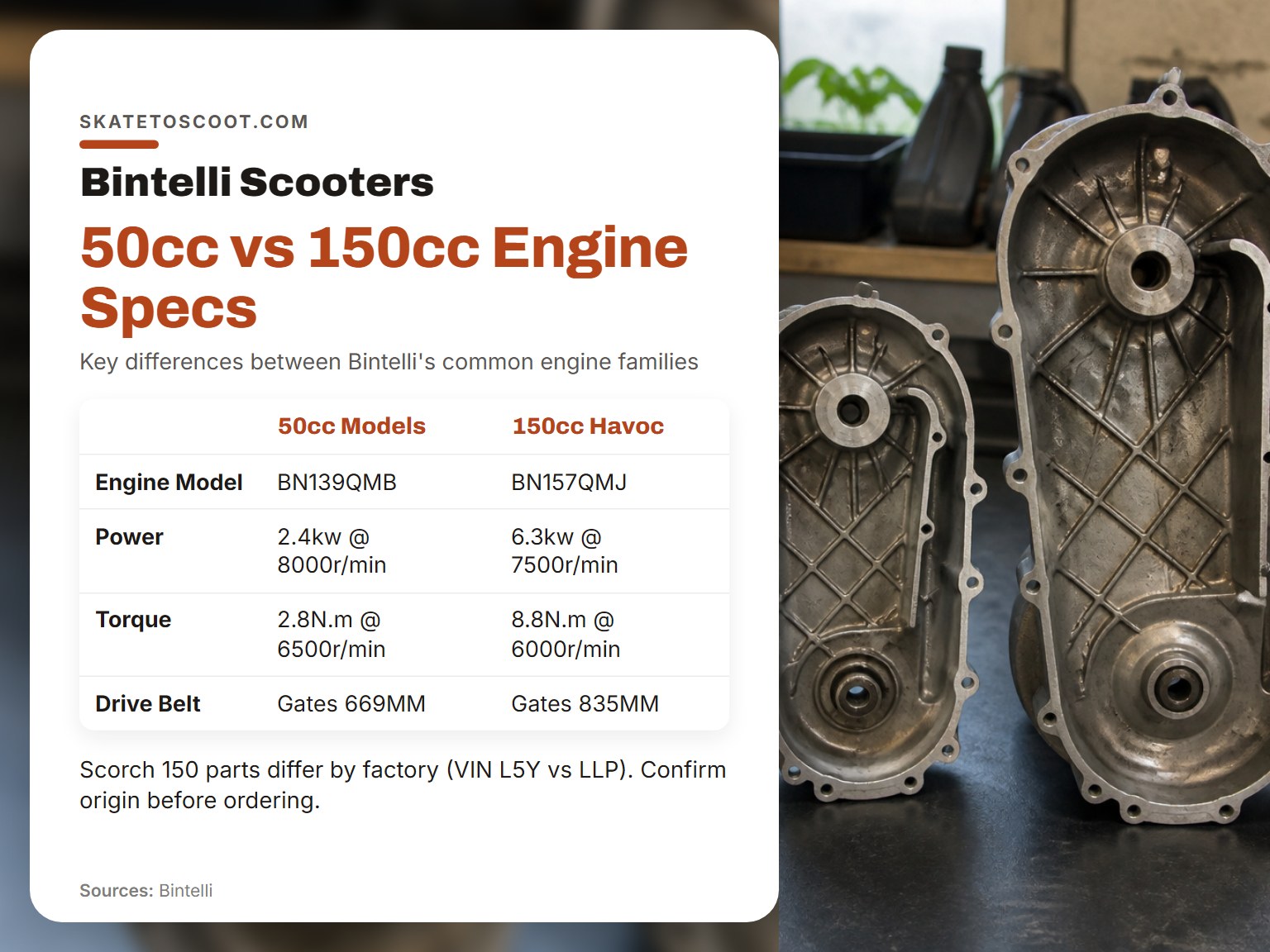
Bintelli scooters share common components like NGK spark plugs and Gates belts, but specs vary by model. The 50cc Sprint, Breeze, and Edge models use a specific engine with known power and torque figures, and require a specific spark plug and belt size. The 150cc Havoc and Scorch models use a different, more powerful engine with its own belt specification. A key detail for Scorch owners is that parts differ based on the factory where the scooter was built, identifiable by the VIN. This means you must confirm your scooter’s origin before ordering replacement parts to ensure compatibility.
Fuel Economy and Riding Range
Real-world fuel efficiency and range on a Bintelli scooter depend heavily on your riding habits, the scooter’s condition, and environmental factors. Aggressive throttle use, frequent stops and starts, carrying extra weight, and riding into strong headwinds will all reduce your miles per gallon. To maximize your range, maintain a steady speed and keep up with scheduled maintenance. A poorly tuned engine or under-inflated tires can silently drain your fuel tank faster. For the most accurate estimate, track your fuel consumption over several tanks under your normal riding conditions.
Frequently Asked Questions
Are Bintelli scooters reliable?
They can be, with strict adherence to the maintenance schedule and a dose of luck with dealer support. Their reliability is more conditional than inherent. The name-brand internals help, but the 500-mile service rule and the potential for fuel-system issues mean reliability is something you actively maintain, not something you passively receive.
What’s the most common problem with Bintelli scooters?
Fuel system problems stemming from stale gasoline are the most common owner-reported issue, manifesting as hard starting, poor idling, or dying under load. Electrical issues related to battery neglect are a close second. Both are largely preventable with proper storage and regular use.
Can I work on my own Bintelli scooter without voiding the warranty?
For basic maintenance like oil changes, tire changes, and bulb replacement, yes. For items the service manual marks with the ‘※※’ symbol, carburetor, timing chain, brake shoes, doing it yourself will void the warranty on those components. The first 500-mile service is a warranty checkpoint you cannot skip.
How does Bintelli compare to Apollo or Segway scooters?
It’s a different category. Bintelli makes gas-powered, road-legal scooters and golf carts. They don’t compete directly. For a gas-powered 50cc scooter, Bintelli’s competition is TaoTao, Icebear, and other Chinese imports.
Is the 2-year warranty worth it?
It’s a necessary safety net, but its value depends entirely on your proximity to a competent, responsive authorized dealer. The warranty doesn’t cover neglect (like a dead battery from lack of charging) or damage from improper repairs. It’s best viewed as coverage for manufacturing defects, which should show up early in those first 500 miles.
The Bottom Line
A Bintelli scooter is a calculus problem. The upfront cost is low. The component list is better than bargain-bin. The warranty exists. But the equation only balances if you satisfy all the variables: complete the 500-mile dealer service, use a trickle charger, buy ethanol-free gas or use stabilizer, and, most crucially, have an authorized dealer within a reasonable distance.
If any of those factors is a “no” for you, the total cost of ownership spikes. You’ll be paying out-of-pocket for repairs the warranty might have covered, waiting weeks for misordered parts, or towing the scooter long distances.
For the right person, a handy commuter with a local dealer who treats maintenance as an essential routine, a Bintelli can be a value-packed workhorse. For someone looking for a “ride-and-forget” appliance with ubiquitous support, it’s a gamble.
