Burton Wheelie Gig Snowboard Bag Review
This post contains affiliate links. As an Amazon Associate, we earn from qualifying purchases.
The Burton Wheelie Gig snowboard bag is a wheeled, padded travel bag designed to carry multiple boards and gear. It fits about 8 boards without bindings, or a combination of boards with bindings, boots, and clothing, within the common 50lb airline weight limit. The bag uses an IXION™ Skate Wheel System, has lockable zips, and Burton offers a lifetime warranty, though coverage is limited to bags from 2009 onward.
That capacity claim is the bag’s main selling point, but it’s also where most reviews stop. They don’t tell you what happens when you actually fill it to that limit and try to wheel it across an airport or load it into a car. The gap between the marketing “fits multiple boards” and the physical reality of a 23kg, awkwardly-shaped load decides whether this bag is a travel savior or a frustrating compromise. This is the core question for any Burton Wheelie Gig snowboard bag review.
What follows is a breakdown of the specs that matter, the durability reports owners aren’t shy about, and a direct comparison to its main rival. By the last section, you’ll know exactly how many boards you can realistically pack, what tends to wear out first, and whether the Wheelie Gig or a Dakine bag is the right tool for your specific trips.
Key Takeaways
- The Burton Wheelie Gig’s real-world capacity is about 8 boards without bindings, but packing 3 boards with bindings, boots, and clothing will hit the common 50lb airline limit.
- Burton’s official Lifetime Warranty has a critical caveat according to one retailer: coverage is limited to bags from 2009 to present, so verify your model’s eligibility.
- Material durability is contested: Burton’s official product page states the bag uses 900D Recycled Polyester with C0 DWR and PU Backing, while a review from UltimateGearLists.com cites 600D Polyester with TPE Backing.
- For a board significantly shorter than the bag’s length, the front can curve upward, making it more difficult to carry, a design quirk not mentioned in marketing.
- When comparing the Burton Wheelie Gig vs. Dakine Low Roller, the Dakine often wins for pure single-board travel, while the Burton’s larger volume is better for multi-board trips or carrying extra gear.
What’s the Real-World Capacity of the Burton Wheelie Gig?
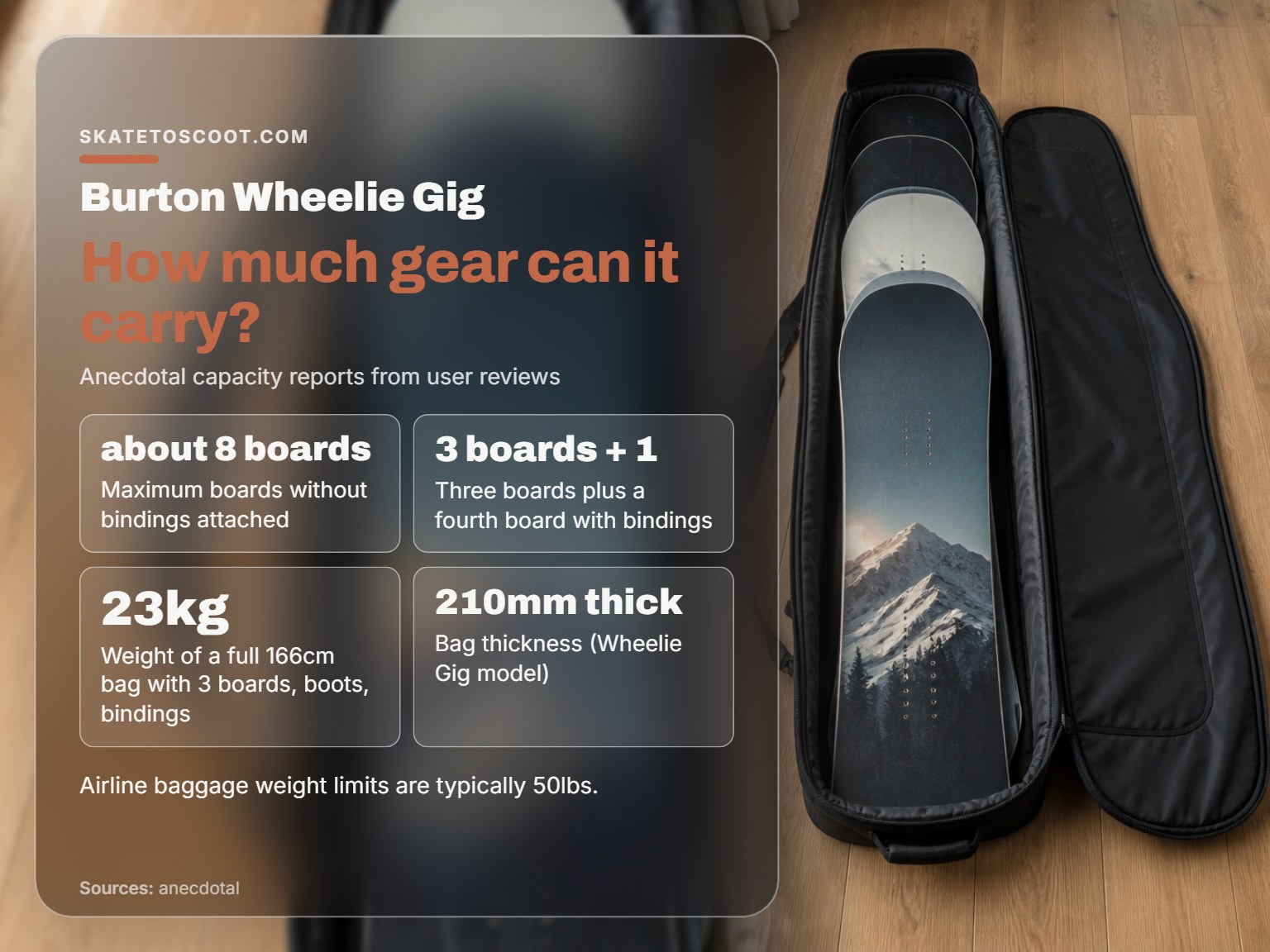
The marketing says “multiple boards.” Real users have pushed that to its literal limit. One long-term tester from The Good Ride reports carrying about 8 boards without bindings. For actual travel, the same source notes a more practical load: 3 boards with a fourth board that has bindings, or 1 board with bindings, a 2nd or 3rd board, boots, a second pair of bindings and even some outerwear.
The part nobody mentions: A 166cm Wheelie Gig can be filled to 23kg (about 50lbs) with 3 stacked boards, boots, and bindings, right at the typical airline checked-baggage weight limit. Go over that, and you’re paying a fee.
That 23kg figure isn’t a guess. It’s from a forum user who weighed their packed bag. It tells you the bag’s ultimate capacity is physically constrained by airline policy, not its volume. If you’re flying, your packing strategy isn’t “how much can I fit?” It’s “how do I distribute 50lbs of gear?”
Here’s how that capacity breaks down for different trip types:
| Trip Type | Recommended Packing Load | Why This Works |
|---|---|---|
| Solo Weeklong Trip | 1 board (bindings on), boots, helmet, outerwear, clothing. | Maximizes protection for your primary setup while staying under 50lbs. |
| Two-Person Trip (Driving) | 2 boards (one with bindings), 2x boots, shared outerwear. | Uses the bag’s full volume without weight anxiety; perfect for car travel. |
| Quiver Trip (Flying) | 2-3 boards (bindings removed), packed flat and separated by clothing. | Minimizes pressure points on top sheets and keeps weight manageable for check-in. |
The internal webbing strap is there for a reason. Use it to cinch your board stack tight in the center of the bag. Loose gear shifts in transit, and the edges of your top board can grind against a binding baseplate or a boot buckle. That’s how you get mystery top-sheet scratches.
A pro tip from the same long-term reviewer: for ultimate protection, keep boards individually bagged inside the Gig. A cheap sleeve or even a large plastic bag between boards adds a layer of frictionless buffer that stops vibrations and minor impacts from transferring directly to your deck.
Breaking Down the Specs: Materials, Wheels, and Warranty Fine Print
You’ll find two different material specs published. Burton’s official product page states the bag is made from 900D Recycled Polyester with C0 DWR and PU Backing. Another reputable review source, UltimateGearLists.com, lists it as 600D Polyester with TPE Backing. This isn’t a typo you can ignore, it likely indicates a material change across different production years or a discrepancy in testing.
Why does the denier number (600D vs 900D) matter? It’s a measure of fabric thread thickness and density. A higher denier generally suggests a heavier, more abrasion-resistant material. The backing (PU vs TPE) affects waterproofing and flexibility. This spec confusion coincides with the most common owner complaint in any Burton Wheelie Gig snowboard bag review: perceived thinning of materials on newer models compared to vintage Burton bags.
The wheel system is one spec with no debate. Burton uses its IXION™ Skate Wheel System. Burton uses its IXION™ Skate Wheel System.
The bag features lockable zips, a full-length opening for easy packing, and multiple carry handles including a removable shoulder strap. An internal webbing strap secures your board stack.
Now, the warranty. Burton proudly advertises a Lifetime Warranty. The fine print, as listed on retailer Tactics.com, adds: “Coverage is limited to bags from 2009 to present.” This is critical. If you buy a used bag or find an old-new-stock model from before 2009, it may not be covered. A lifetime warranty is only as good as its start date.
Long-Term Durability: What Owners Report After 3+ Seasons
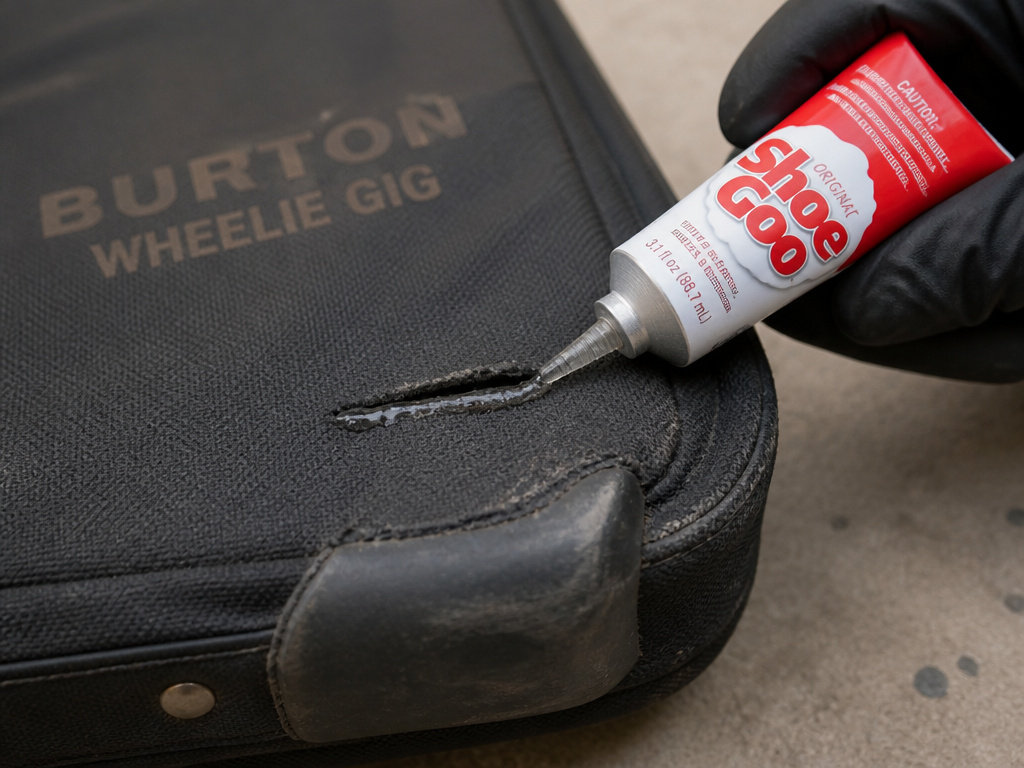
The forum threads don’t lie. They’re where you find the multi-year reports that no launch review can provide. One user reported their circa 2004 Burton Gig Bag developed tears after ~19 years of faithful service. That’s a win. But the same thread holds the counterpoint: a 3-season-old Wheelie Gig Bag developed two slits in the material, requiring a repair with Shoe Goo.
The user’s direct observation? The new material is ‘WAY thinner’ compared to older models.
This isn’t about one bad bag. It’s a pattern that points back to the material spec confusion. If the fabric has changed, the long-term durability profile has changed with it. The wheels and zippers, however, consistently get high marks for longevity. The weak point, when it appears, is the outer shell fabric on specific models or production runs.
Where this goes sideways: Assuming the “Lifetime Warranty” means no-questions-asked coverage. The warranty is for manufacturing defects, not airline-inflicted trauma or wear-and-tear from overpacking. Filing a claim requires proof of purchase and the bag falling under the 2009+ clause.
So, what fails first? Based on aggregated reports:
- The outer fabric at high-stress points (corners, areas over internal hardware) can slit if severely overloaded and abused.
- The zipper, while robust, needs to be handled with care to last years, don’t force it when the bag is overstuffed.
- The stitching on handles and straps holds up well, a testament to the overall construction quality.
The takeaway: the Burton Wheelie Gig is durable for a travel bag, but it’s not indestructible. Treat it like a protective shell, not a bulletproof crate. Pack smart, don’t exceed its physical limits, and use those lockable zips to deter casual pilfering.
The Burton Wheelie Gig vs. Dakine Low Roller: Which Should You Buy?
This is the comparison everyone making a decision wants after reading a Burton Wheelie Gig snowboard bag review. The Dakine Low Roller is the other top contender in the wheeled snowboard bag arena. Choosing between them isn’t about which is “better,” but which is better for you.
Here are the details. The Burton Wheelie Gig is a volume-first design. Its shape and internal layout are built to swallow more gear. The Dakine Low Roller is the other top contender in the wheeled snowboard bag arena.
| Feature | Burton Wheelie Gig | Dakine Low Roller |
|---|---|---|
| Best For | Travelers carrying multiple boards or maximizing gear in one bag. | Travelers with one primary board who value organization and streamlined travel. |
| Key Advantage | Raw, flexible volume. Can reconfigure packing for different trips. | |
| Wheel Feel | IXION™ skate wheels – stable, smooth roll. | |
| Common Owner Note | Can feel “saggy” when loaded with a very short board. |
But if you’re the rider who brings a powder board, a park board, and a spare set of bindings “just in case,” the Burton’s extra cubic inches earn their keep.
Another angle is brand loyalty and warranty experience. Both companies stand behind their products. Burton’s lifetime warranty is straightforward if your bag qualifies. You’re not choosing between a warranty and none; you’re choosing between two reputable programs.
Consider your most common trip. Is it a weekend fly-to-Utah with one board? Or is it a month driving around Japan with your whole quiver? The answer points directly to which bag is better for your specific needs.
How to Pack It Right: Avoiding Airline Fees and Damage
Packing a snowboard bag is a skill. Do it wrong, and you pay overweight fees or open a bag to find a delaminated tail. Do it right, and your gear arrives ready to ride.
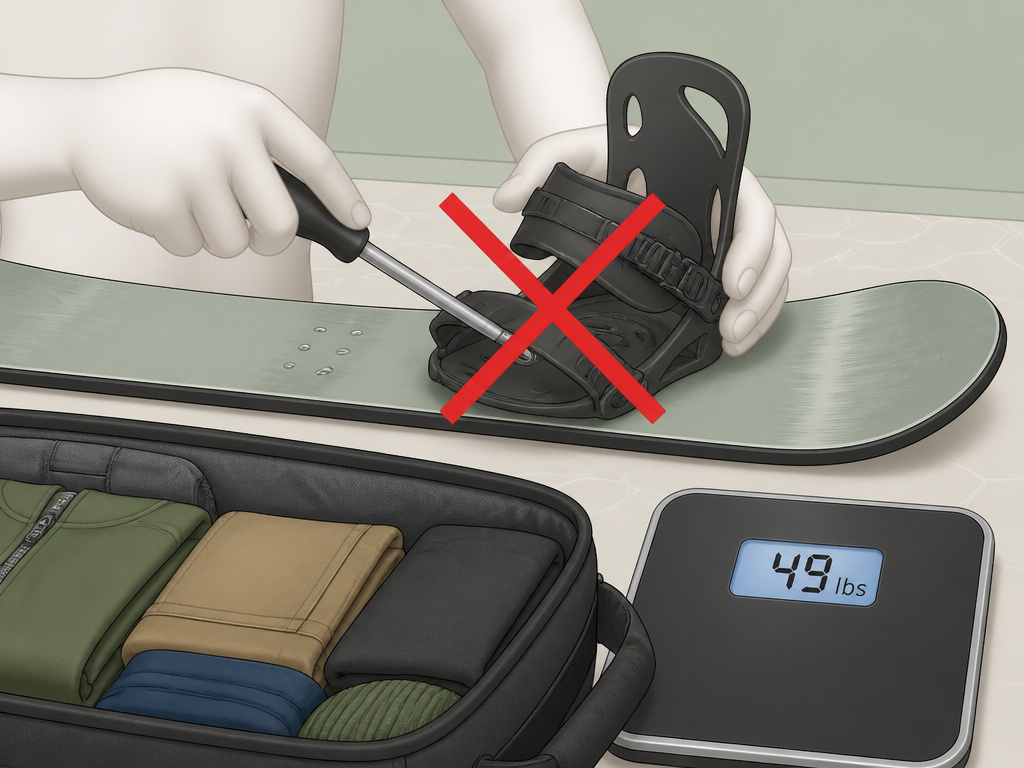
First, the weight limit. Airlines typically set a 50lb (23kg) limit for checked bags. Your goal is to hit 49lbs. A simple bathroom scale is your best pre-trip investment. Weigh your packed bag before you leave for the airport. The $30 scale is cheaper than a $100 overweight fee.
Here’s a step-by-step method to pack a Wheelie Gig for a flying trip with one board:
- Remove your bindings. This step is essential. This allows the board to lie flat, prevents the bindings from snapping, and creates more space.
- Layer the bottom. Start with your softest items, snow pants, jacket, base layers, laid flat in the bottom of the bag.
- Place your board. Set your board, base-down, onto the clothing. If carrying a second board, place it base-to-base with the first, separated by more clothing.
- Fill the voids. Pack your boots (in a boot bag if you have one), helmet, gloves, and other gear around the board’s nose and tail. These areas are vulnerable to impact.
- Secure the stack. Use the internal webbing strap to pull the board stack down tight. Loose gear is damaged gear.
- Top it off. Place your bindings in their own bag or wrapped in a sweater, and place them on top.
- Zip and lock. Close the zipper carefully, ensuring no fabric is caught. Use a TSA-approved lock on the lockable zips.
Common mistake: Leaving bindings on. The leverage from a long baggage throw can snap a highback or crack a baseplate. The force isn’t on the board; it’s on the binding.
For a multi-board driving trip, you can be more aggressive. You can leave bindings on one board, stack boards with towels between them, and use the extra space for camp gear or a second person’s outerwear. The weight limit is your car’s suspension, not an airline’s policy.
Frequently Asked Questions
What are the size options for the Burton Wheelie Gig?
The Burton Wheelie Gig comes in four lengths: 146 cm, 156 cm, 166 cm, and 181 cm. Always choose a bag at least 5-10cm longer than your longest snowboard to accommodate packing material and bindings (if left on).
Can the Burton Wheelie Gig fit skis and a snowboard?
Technically, yes, due to its volume. But it’s not recommended by experienced travelers. Skis have sharp metal edges that can gouge a snowboard’s top sheet or sidewall during transit. If you must, pack them separately or ensure multiple thick layers of padding (like a foam sleeping pad) are between them.
How does the Burton Wheelie Gig compare to the Burton Wheelie Locker?
The Wheelie Locker is thicker (290mm vs 210mm) and designed as a near-rigid, maximum-protection case. The Wheelie Gig is a more flexible, volume-optimized bag. The Wheelie Locker is thicker (290mm vs 210mm) and designed as a near-rigid, maximum-protection case. The Wheelie Gig is a more flexible, volume-optimized bag.
Is the Burton Wheelie Gig waterproof?
The bag is made with a DWR (Durable Water Repellent) finish and a waterproof backing (PU or TPE). This makes it highly water-resistant, suitable for snow and rain during airport transfers. The bag is made with a DWR (Durable Water Repellent) finish and a waterproof backing (PU or TPE). This makes it highly water-resistant, suitable for snow and rain during airport transfers.
What is the best way to repair a small tear in the bag?
For small slits or tears, a product like Shoe Goo or a clear, flexible adhesive applied to the inside of the fabric can create a solid, long-lasting patch. For larger damage, contact Burton’s warranty department to see if a repair or replacement is covered under their lifetime warranty.
Before You Go
The Burton Wheelie Gig’s promise is simple: one bag for your board and everything else. It delivers on that promise, provided you understand its limits. That 23kg airline ceiling is the real governor, not the bag’s seams. The lifetime warranty is a strong safety net, as long as your bag isn’t a museum piece from 2008.
For the rider who consistently travels with more than one board, or who wants the option to carry a friend’s gear on a road trip, the Wheelie Gig’s volume is its winning feature. It’s the bag you grow into, not out of.
Your final check before buying: measure your longest board, envision your typical trip load, and be honest about how much weight you’re willing to wheel through a terminal. The right bag is the one that fits your gear and your travel style, not just the one with the most five-star reviews.
