Can You Drive a Scooter on the Highway? Engine Size & Laws
This post contains affiliate links. As an Amazon Associate, we earn from qualifying purchases.
You can drive a scooter on the highway only if it meets specific legal requirements for engine size, top speed, licensing, and equipment, and only where local laws permit it. A 50cc scooter is prohibited everywhere; a 150cc scooter is the minimum in some US states and European countries like Italy, but many states require 250cc or more. Legality is useless without safety, a scooter must also sustain highway speeds without strain, and you need the right license and insurance.
The gap between what’s legal and what’s survivable is where most riders get hurt, especially when they haven’t fully researched the can you drive a scooter on the highway question. A law might say a 150cc scooter is highway-legal, but if it can only hit 65 mph downhill with a tailwind, merging into 75 mph traffic is a death wish. The rules exist for a reason, and they differ wildly the moment you cross a state or country line.
What follows is the checklist every rider needs before even thinking about a highway on-ramp. We’ll break down the legal thresholds by engine size, explain the critical difference between a scooter’s advertised speed and its real-world highway capability, and walk through the licensing and equipment you can’t skip. By the end, you’ll know exactly how to check if your scooter, and you, are actually ready.
Key Takeaways
- Check your scooter’s engine size first. In some jurisdictions, like Italy, 150cc is the legal minimum for highway access, while in others, like New Jersey (according to a user) the minimum is 250cc or more, and in California a user states 150cc scooters are “certainly not allowed” on freeways.
- Top speed is a legal trap. A scooter must be capable of the highway’s minimum speed, which is 60 km/h (37 mph) in Austria and 61 km/h (38 mph) in Germany. Your scooter’s “max speed” spec is often optimistic.
- Licensing is required. Operating a highway-legal scooter nearly always requires a full motorcycle endorsement on your driver’s license, not a standard car license.
- Local laws override everything. Texas law may allow scooters on roads with a 35 mph limit, while UK law completely bans mobility scooters from motorways. Know your specific jurisdiction.
- Safety gear is your only margin. On a highway, a full-face helmet, armored jacket, gloves, and boots are essential gear that determines the outcome of a crash.
The Legal Checklist (Every Rider’s First Step)
Before you look at a map, answer these questions in order, starting with the core can you drive a scooter on the highway inquiry. Skip one, and you’re planning a trip to the impound lot or the emergency room.
The UK Highway Code states: Class 3 mobility vehicles have a maximum speed of 8 mph (12 km/h) and are prohibited from motorways.
1. What is your scooter’s true engine size? This is the first number any law enforcement officer or law book will check. It’s not about power; it’s about classification. 2. What is your scooter’s real-world top speed? Not the spec sheet fantasy, but the speed it can honestly maintain on a flat highway for miles. Can it do 10 mph over the flow of traffic? 3. What is the minimum speed limit on your target highway? This is the law’s benchmark. In Germany, a vehicle must be legally capable of 61 km/h or more to use the Autobahn. In Austria, the floor is 60 km/h. 4. Do you have the correct license? In almost all cases, a highway-legal scooter requires a motorcycle license (Class M). Your standard driver’s license won’t cut it. 5. Is your scooter registered and insured? It must have a license plate and valid insurance that covers highway use. Many basic policies exclude it. 6. What are the local laws? A state like Texas may prohibit motor-assisted scooters on roads with a speed limit over 35 mph, while Georgia bans them from sidewalks, forcing them into traffic.
If you answered “I don’t know” to any of these, your next step is research, not riding. The consequences for guessing are severe and layered.
Engine Size: The 50cc, 150cc, and 250cc Thresholds
Engine size, measured in cubic centimeters (cc), is the primary legal filter. The law uses it as a proxy for speed and stability.
50cc scooters are not highway-legal in the jurisdictions covered by our sources. and are designed for city streets. Norwegian law explicitly bans 50cc mopeds from highways because they are limited to 45 km/h. In the US, they are generally prohibited from interstate highways.
The 150cc debate is where confusion lives. Italian law sets 150cc as the minimum engine size for a scooter to enter the highway, while a Reddit user states that in Western Europe, lots of 125cc scooters cruise on freeways. However, a Reddit user from California states that 150cc scooters are “certainly not allowed” on freeways there. Another user notes that in New Jersey, the minimum for highway use is 250cc. These are jurisdictional differences. The law in one place does not bind another.
250cc and above is the safe zone for US interstates. If your goal is consistent highway travel in the United States, this is the realistic starting point. A 250cc scooter is generally considered to have sufficient power for highway speeds., meeting the speed requirements of most interstate highways. It’s also the engine size where you start to get the wheel size and frame weight that feel less terrifying next to an 18-wheeler.
The takeaway is simple: check your state’s vehicle code. Don’t rely on forums or hearsay. Look for phrases like “minimum engine displacement for freeway use” or “motorcycle access” in your local laws. Your scooter’s legal classification as a motor vehicle hinges on this number.
Speed: The Law vs. Your Scooter’s Lie
The legal speed requirement is a mandatory physical threshold for avoiding road hazards.
European laws are precise. Germany’s 61 km/h Autobahn rule and Austria’s 60 km/h minimum exist because driving too slowly on a high-speed road is dangerously disruptive. You become a moving chicane. A scooter that can only manage 50 mph (80 km/h) in a 70 mph (113 km/h) zone is not just illegal; it’s a target.
Where this goes sideways: Assuming your scooter’s advertised top speed is its highway cruising speed. Most scooters hit their max speed under ideal conditions, full throttle, no headwind, flat road, light rider. Add a hill, a backpack, or a stiff breeze, and that number drops 10-15%. Your scooter’s real-world cruising speed is often lower than its advertised maximum. That’s not highway speed.
This is why engine size alone is a flawed guide. A lightweight 150cc scooter might technically reach 70 mph, but the engine will be screaming at maximum strain, leaving no power in reserve for passing or emergency acceleration. The vibration through the handlebars at that RPM is brutal, and the small wheels make every pavement seam feel like a curb.
For electric scooters, the rules are even stricter. British Columbia’s pilot regulation (BC Reg 90/2021) caps electric kick scooters at 24 km/h and a motor power of 500W, explicitly banning them from highway-like environments. If you’re looking for electric scooters that reach 50 mph, know that they often fall into a legal grey area, rarely approved for full highway use.
Licensing, Registration, and Insurance: The Paperwork Barrier
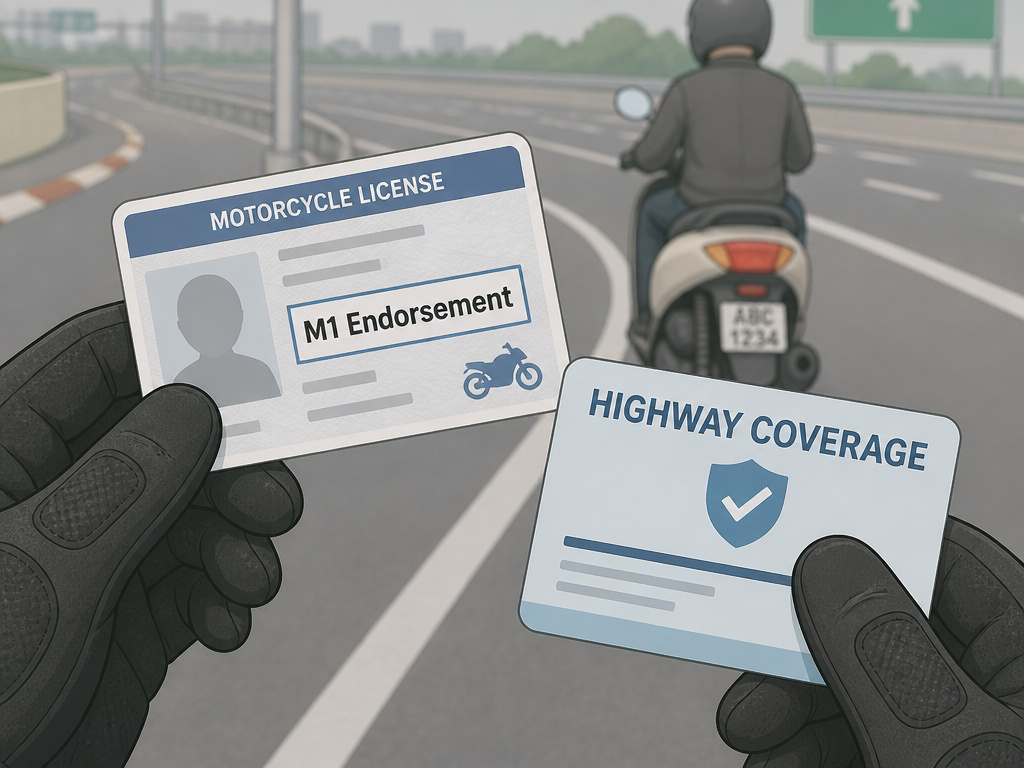
If your scooter meets the size and speed rules, the next hurdle is bureaucratic. This is where many riders get stopped cold.
Licensing: Operating a highway-legal scooter almost always requires a motorcycle license endorsement. You can’t use a standard driver’s license. The process involves passing the required motorcycle licensing tests. Always verify your local license requirements for scooters.
Registration: Your scooter needs a Vehicle Identification Number (VIN) and must be registered with your state’s Department of Motor Vehicles. It receives a license plate. This step legally transforms it from a “motorized device” into a “motor vehicle.” Without a plate, you have no right to the roadway.
Insurance: You must carry valid liability insurance. Crucially, you need to confirm your policy covers highway use. Some basic scooter policies are written for “local roads only” and will deny a claim if an accident occurs on an interstate.
Skipping any of these three steps turns a legal ride into a multiple violation. The fines stack up quickly, and driving without insurance opens you up to significant personal liability.
State and International Law: Your Location Decides Everything
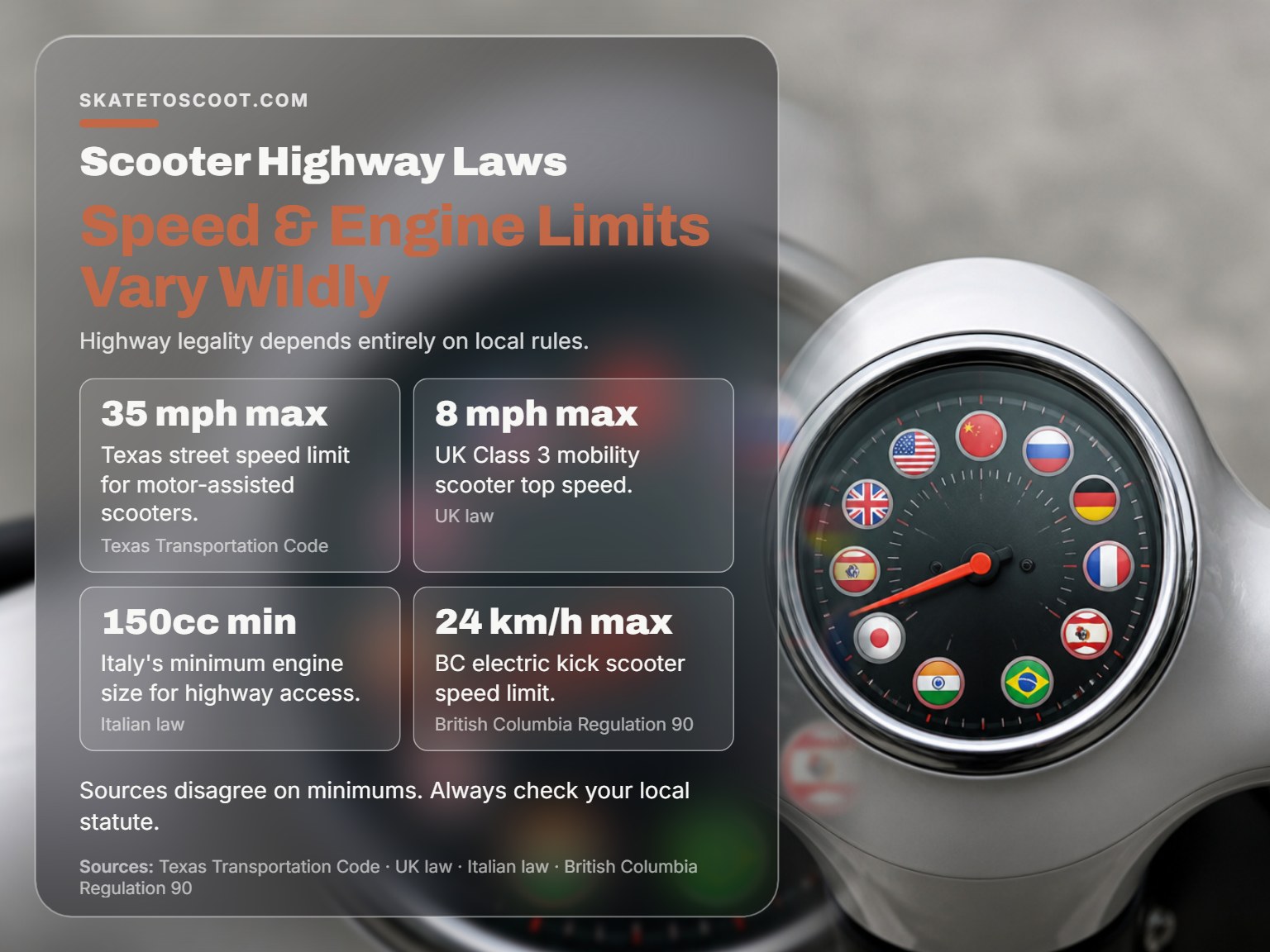
The most critical variable in the entire equation is your geographic location. A rule in one place is nonsense in another.
| Jurisdiction | Key Highway Law for Scooters | Practical Implication |
|---|---|---|
| Texas, USA | Motor-assisted scooters may only operate on streets with a posted speed limit of 35 mph or less (Texas Transportation Code). | Even if you have a street legal gas scooter, you cannot legally take it on a highway with a 65 mph limit. |
| California, USA | Based on user reports, 150cc scooters are not allowed on freeways, but specific state laws should be consulted. | The California scooter operation rules make most highway riding illegal. |
| United Kingdom | Mobility scooters (Class 3) have a max speed of 8 mph and are prohibited from motorways (UK Highway Code Rule 46). Their use on dual carriageways is a point of disagreement; the Highway Code advises against it on roads over 50 mph, while RoSPA states it’s legal with a flashing amber beacon. | Even the fastest mobility scooter is not a highway vehicle. |
| Italy | Minimum 150cc engine size for highway access. | This is the benchmark for much of Southern Europe, but it assumes the scooter can also maintain minimum speeds. |
| British Columbia, Canada | Electric kick scooters are limited to 24 km/h, 500W motors, and 45 kg weight (BC Reg 90/2021). | These BC government scooter operation rules explicitly design them for low-speed, local travel only. |
The pattern is undeniable. Local law is king. A blanket statement like “scooters can go on the highway” is dangerously misleading. You must research the specific laws for your state, province, or country. Forums can point you in a direction, but the actual statute, like the California Vehicle Code or BC Regulation, is the only source that holds up.
Practical Tips If You Are Highway-Legal
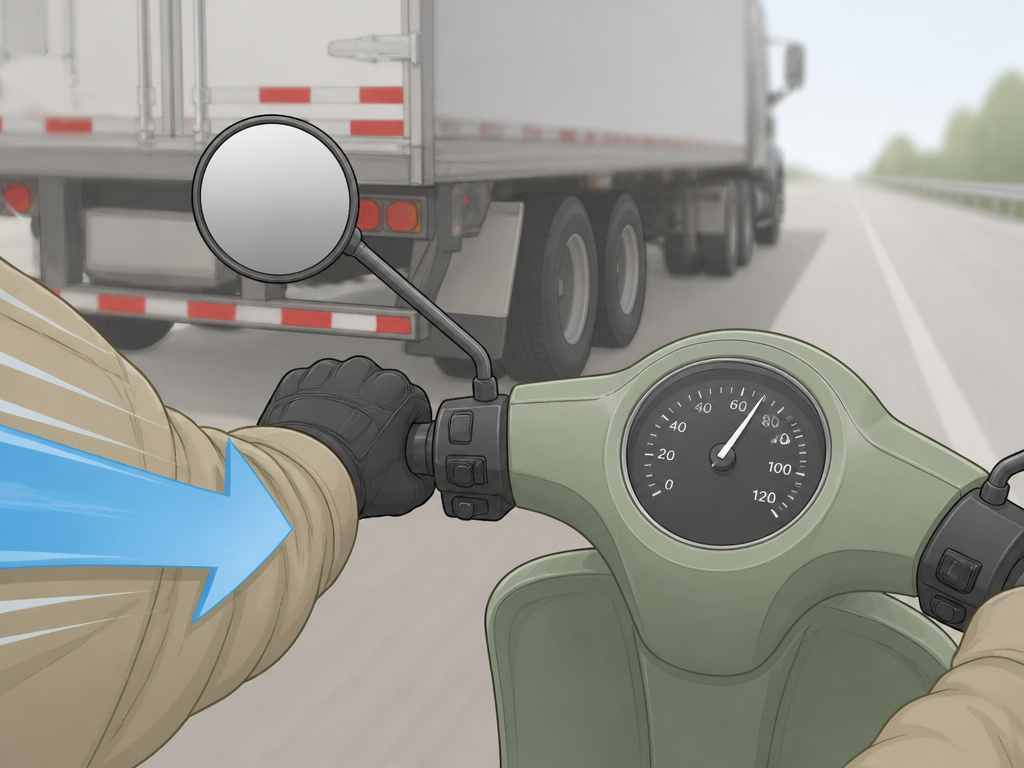
So your scooter is 250cc, you’ve got your M endorsement, your plate is shiny, and your insurance says “highway approved.” Now what? The law says you can go, but physics and traffic are the final judges.
Position yourself in the lane. Don’t hug the shoulder. Ride in the left third of the right-hand lane. This makes you more visible to cars behind you and gives you an escape route to the right if needed. It also avoids the oily, debris-strewn “gutter” of the lane.
Manage the wind. This is the sensory reality no one talks about until they’re there. Passing a semi-truck at 70 mph is both loud and a physical shove. The bow wave of air hitting you feels like a hand pushing your handlebars sideways. Then, as you pass the cab, you get sucked into the vacuum behind it. Grip the tank with your knees, keep your arms relaxed but firm, and expect the bike to move. It will.
Have an exit strategy. Always know where you’ll go if the car in front of you slams its brakes. Is the shoulder clear? Is there a gap between lanes? On a scooter, you can’t out-brake a car. Your only advantage is size and agility. Use it.
Dress for the high-speed slide. Jeans vaporize on pavement at 30 mph. At 70 mph, they’re gone before you finish thinking “oh no.” A motorcycle jacket with armor, full-finger gloves, over-the-ankle boots, and a full-face helmet are your actual riding gear. Anything less is a costume.
The goal is to align your confidence with the real demands of the environment. Highway riding on a scooter is an advanced skill. It demands more attention, more skill, and better gear than puttering around town. If that sounds like more than you bargained for, there’s no shame in sticking to surface streets. Many highway-capable scooters are brilliant for longer country roads that bypass the interstate altogether.
The Risks and Consequences of Illegal Highway Use
Suppose you decide to roll the dice. Your 150cc scooter isn’t technically legal for the interstate, but you just need to go two exits. What’s the worst that can happen?
The traffic stop is the best-case scenario. You’ll get multiple tickets: for operating an unauthorized vehicle on a controlled-access highway, for not having the proper registration/plate, and likely for not having the correct license. You will face fines. Your scooter may be impounded on the spot.
The insurance denial is the financial catastrophe. If you cause an accident, or even if someone hits you, your insurance company will investigate. The moment they determine you were riding illegally on a highway, a clause in your policy will allow them to deny the claim entirely. You become personally liable for all vehicle damage and medical bills.
The crash is the physical reality. A scooter not designed for highway speeds is unstable. Small wheels, a short wheelbase, and a light frame get buffeted by wind gusts. High-speed wobbles can set in. Braking power is often inadequate. In a collision at 70 mph, the odds of survival on a small scooter are catastrophically low. You are the crumple zone.
The equation is brutally simple. The reward, saving a few minutes, is microscopic compared to the potential cost. The law isn’t being arbitrary; it’s drawing a line most small scooters physically cannot cross safely.
What types of scooters are allowed on highways?
The law draws sharp lines between scooter types, and those lines decide highway access. In many places, a vehicle’s top speed is the critical factor. For example, Austrian law requires vehicles to drive at least 60 km/h on highways, and German law requires a vehicle to be legally capable of 61 km/h or more to use the Autobahn. Engine size is another common benchmark, with rules in some regions setting a minimum of 150cc for highway entry. This immediately excludes most electric kick-scooters, which are often limited by law to speeds well below highway minimums, and smaller mopeds. A maxi-scooter, with its larger engine, is typically designed to meet these thresholds. Always check your local vehicle code for the specific speed or engine size requirements that apply to motorized two-wheelers.
What makes a scooter highway-legal?
A highway-legal scooter must first meet the minimum performance standards set by law, which usually involve a specific engine size or a proven top speed capability. Beyond that, the scooter needs the equipment to safely keep up with high-speed traffic. This means having a braking system powerful enough to stop effectively from highway speeds. Proper lighting is required, with a front lamp visible from a long distance and a rear red light for night riding. The scooter must also be registered and insured as a motor vehicle in most jurisdictions. Crucially, the rider must hold the correct motorcycle license endorsement. Simply owning a fast scooter isn’t enough; it must be legally classified as a motorcycle.
Frequently Asked Questions
Can I ride a 50cc scooter on the highway?
No. A 50cc scooter is prohibited from highway use in jurisdictions like Norway, where 50cc mopeds (limited to 45 km/h) cannot drive on highways, and Austria, where vehicles must drive at least 60 km/h on highways. It is legally classified as a moped or limited-speed vehicle, which is banned from controlled-access highways.
Can a 300cc scooter go on the highway?
Yes, a 300cc scooter is generally highway-legal in jurisdictions where it meets the minimum speed or engine size requirements. And you have the proper motorcycle license, registration, and insurance. It is a common choice for riders who need reliable highway commuting.
Is it safe to ride a scooter on the highway?
It can be safe if three conditions are met: 1) The scooter is designed for highway speeds (250cc+ for sustained travel), 2) The rider is highly experienced and has advanced training, and 3) The rider wears full protective gear (armored jacket, pants, gloves, boots, full-face helmet). Without all three, the risk is severe.
What’s the difference between a highway and a freeway for scooters?
Legally, the terms are often used interchangeably to mean a controlled-access, multi-lane road with high speed limits. The key distinction is access: these roads have on-ramps and off-ramps, not intersections. The specific laws prohibiting scooter use will refer to “controlled-access highways” or “interstates,” which include both highways and freeways.
Do I need a special license to take my scooter on the highway?
Almost always, yes. You need a motorcycle license endorsement (Class M) on your driver’s license. A standard automobile driver’s license does not permit you to operate a motorcycle or highway-legal scooter. You must pass a separate written and riding test.
Before You Go
The question isn’t really “can you drive a scooter on the highway?” It’s “should you?” The legal checklist gives you the binary yes or no. The safety realities answer the second part.
If your scooter is a 150cc model and your state’s law says it’s okay, but you’ve never ridden faster than 45 mph, the answer is no. Not yet. Build your skills on fast country roads first. Get used to the wind, the vibration, the focus required. Upgrade your gear.
If you’re on a street-legal scooter that clearly meets all the criteria, then your preparation is what separates a successful trip from a statistic. Map your route to avoid the widest, fastest interstates when possible. Take breaks every hour, highway riding is fatiguing. And never, ever let the legality of it make you feel invincible. The asphalt doesn’t care about your registration.
The highway will always be there. Make sure you’re ready for it.
