Deeluxe Snowboard Boots Review: The Bottom Line
This post contains affiliate links. As an Amazon Associate, we earn from qualifying purchases.
Deeluxe snowboard boots use Mondo Point sizing (centimeter-based) for a consistent fit, offer a medium-width last, and are known for heat-mouldable liners first introduced in 1997. Their flex ranges from mid-soft (Team ID Ltd) to a stiffer 7/10 (ID-Y20), with lacing options including Dual BOA and traditional Lace Smart systems. A 2016 U.S. CPSC recall applied to specific models with a defective Boa reel, but free repair kits were issued.
That sizing detail. Mondo Point, is the whole game. It’s not a suggestion or a rough guide. It’s a centimeter-based measurement system that cuts through the chaos of international shoe sizes, and Deeluxe builds every boot around it. Get that number wrong, and nothing else about the boot matters. For a detailed assessment, check out the latest Deeluxe snowboard boots review.
What follows is a breakdown of where Deeluxe boots shine, where they’ve stumbled, and which of their dozen-plus models actually fits the riding you do. We’ll cover the exact fit, the real-world durability reports that don’t make it into marketing copy, and how to decode their liner and lacing tech.
Key Takeaways
- Deeluxe boots are built on a medium-width last, they fit true-to-size for average feet.
- The brand pioneered the heat-mouldable thermo liner in 1997, a feature still central to their custom-fit approach.
- A 2016 U.S. CPSC recall affected Deeluxe Spark Summit and Vicious models with a specific M3v2 Boa reel; free repair kits were offered.
- For all-mountain versatility, the ID series is the default pick; for creative, jib-focused riding, look at the DNA.
- Always use the official Deeluxe Mondo Point sizing chart, guessing your size based on street shoes is a guaranteed path to foot pain.
How Do Deeluxe Boots Fit? (True-to-Size or Not?)
You need your Mondo Point. That’s the centimeter length of your foot, and it’s the only number Deeluxe cares about. Their official sizing page converts that to their boot size. Skip this step, and you’re buying blind.
Deeluxe boots are measured in Mondo Point sizes, which go off the length in CM. This ensures you’ll get the same fit in each boot.
The company states all DEELUXE boots are medium width. That’s their standard, born from years of research. In practice, owners with very wide feet often report a snug, performance-oriented fit that requires break-in or heat-moulding to avoid pressure points. If you have a notably narrow heel, some models with aggressive internal J-bars might feel too roomy before customization.
Common mistake: Assuming your street shoe size translates directly. It doesn’t. A US 10 sneaker could be a Mondo 28, a 28.5, or even a 27.5 in a snowboard boot. Measure your foot, find your Mondo Point, then trust the chart.
The liners are where the magic, and the customization, happens. Deeluxe was the first brand to bring a thermo-mouldable liner to market in 1997. Today, that means most of their liners can be heated and formed to the exact contours of your foot, addressing hotspots and improving heel hold. For a truly custom fit, every DEELUXE boot model is also available with customizable Thermo-Flex liners.
Durability & Longevity: What Long-Term Owners Report
Durability questions usually surface after the first season. The answers aren’t uniform; they depend heavily on the model and how you ride.
Forum threads and a Deeluxe snowboard boots review paint a nuanced picture. Some riders get multiple seasons out of ID models with only cosmetic scuffs. Others, particularly those riding park and hitting rails, report accelerated wear. Long-term reviews and forum threads report that aggressive park riding can lead to accelerated wear and scuff marks on some Deeluxe models. The community response was split, some blamed overtightened bindings, others questioned the soft-shell material on that specific model.
This isn’t just about aesthetics. Abrasion on the upper cuff can compromise the boot’s support over time.
Where this goes sideways: Cranking bindings over a soft boot material not designed for extreme park abuse. The straps win every time, leaving the boot structurally weakened and the rider questioning the purchase by day 40.
More concerning are historical failure modes noted in a professional Deeluxe snowboard boots review from long-term field testing. This is a specific, high-stress edge case, but it highlights that these boots are designed for snowboarding, not mixed alpine climbing.
Flex Rating & Stiffness Across the Lineup
Deeluxe offers a spectrum, but their heart lies in the middle. They excel at building boots that balance response with comfort, avoiding the extremes of noodle-soft park boots or unforgiving freeride planks.
| Model | Stated Flex | Best For | Key Tech Notes |
|---|---|---|---|
| ID-Y20 (2025/26) | 7/10 | All-mountain, advanced resort riding | ‘Future flex’ shell, Dual BOA, Stage 5 liner |
| Team ID Ltd | Mid-soft | Freestyle, park, playful all-mountain | Choice of two liners, classic ID silhouette |
| DNA | Soft | Jib-focused freestyle, creative riding | Heat-moldable thermoliner, dual zone BOA, skate-inspired look |
| ID Dual Boa | Medium | Versatile freestyle/all-mountain | Dual BOA for independent top/bottom tightening |
The ID-Y20’s 7/10 flex is its standout spec. In the brand’s language, that places it firmly in the medium-stiff category, designed for riders who drive turns and want energy return out of their carves. Deeluxe claims its new ‘Future flex’ shell construction is packout-resistant for life, aiming to keep that rating consistent over time.
Conversely, the DNA boot features a heat moldable thermoliner, dual zone lacing with heel lock from BOA, and a power strap, and is often chosen for creative, jib-focused riding.
Bottom line: If you want one answer and you ride a bit of everything, the ID series is the default. Its middle-of-the-road flex is the reason it’s been a fan favorite for over two decades.
Lacing Systems: Boa vs. Lace Smart
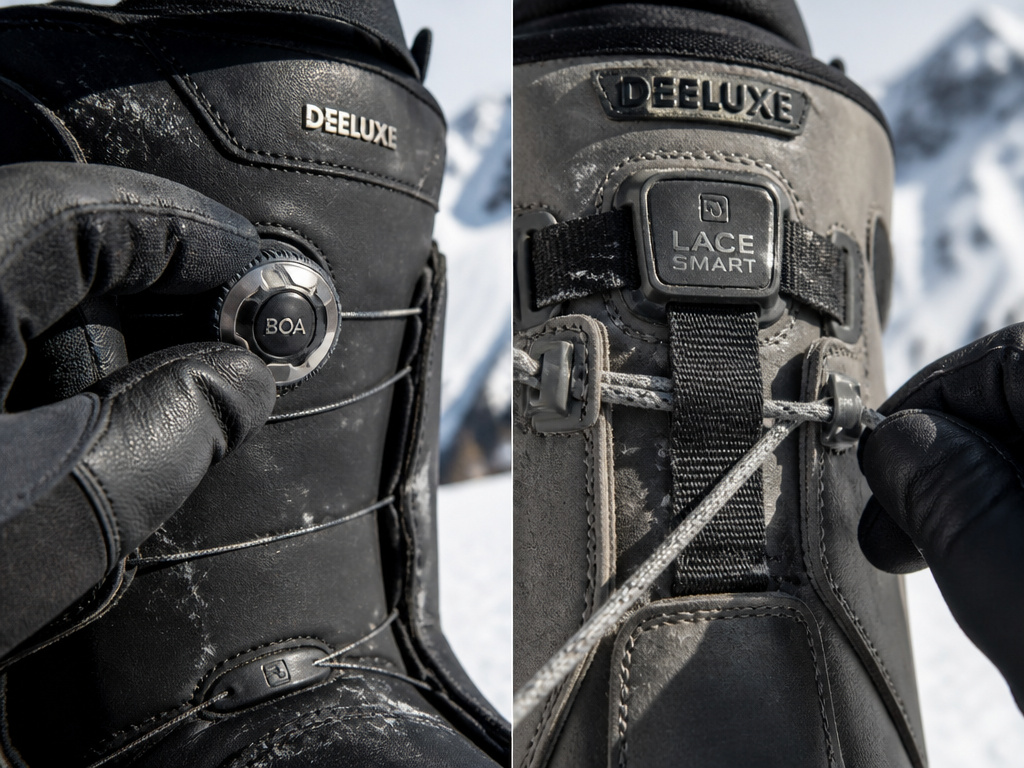
Your choice here is about convenience versus customization. Boa offers speed and micro-adjustments mid-ride. Traditional laces, especially Deeluxe’s Lace Smart system, offer granular, zone-by-zone control.
The Dual BOA system, used on models like the ID-Y20 and ID Dual Boa, allows independent tightening of the upper cuff and the lower forefoot. This is huge for dialing in heel hold without crushing your instep.
The Lace Smart system is Deeluxe’s traditional lace setup. It’s not a single-pull speed lace; it’s a full-length lace that threads through a specific harness. The benefit is the ability to create variable tension along the length of your foot, crank the ankle area tight while leaving the toe box a hair looser. The downside is time and frozen fingers.
If a Lace Smart system breaks, Deeluxe directs you to fill out a warranty form on their website for spare parts. If a Lace Smart system breaks, Deeluxe directs you to fill out a warranty form on their website for spare parts.
I’ve seen both systems fail. A Boa reel jamming open was the specific issue behind a 2016 recall. Which headache would you rather have?
But for purists and those with uniquely shaped feet, the precision of a well-executed lace system is still unmatched.
Specific Model Reviews: ID vs. Team ID vs. DNA
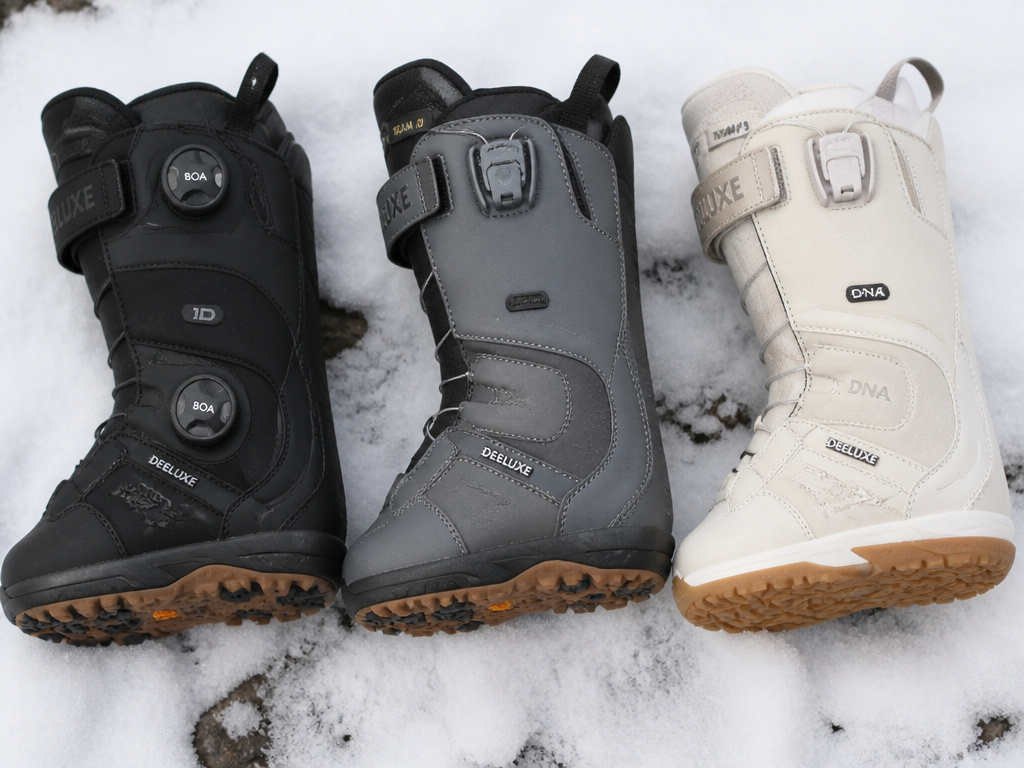
It’s easy to get lost in Deeluxe’s alphabet soup. Here’s what separates their core models.
The ID (Independent Design) is the all-rounder. It’s the foundation. The current ID-Y20 iteration packs the latest tech: a Future flex shell, Dual BOA, and a premium Stage 5 liner with extra calf padding and reflective under-sole material. It’s the boot for the rider who doesn’t want a specialized tool but a competent one for every part of the mountain.
The Team ID is the ID’s more playful sibling. It often shares the same shell but pairs it with a different liner, like a Stage 3 option in the Team ID Ltd, and may have a slightly softer flex rating. Think of it as the ID with a park pass.
The DNA is a different animal. It’s unapologetically soft, built for flex and style, with a heat-moldable thermoliner and often a distinctive aesthetic.
When comparing Deeluxe boots to other brands, their focus is clear. They aren’t trying to be the widest (like some best wide boots) or the absolute stiffest (like dedicated best stiff boots).
Heat Moldability & Heel Hold
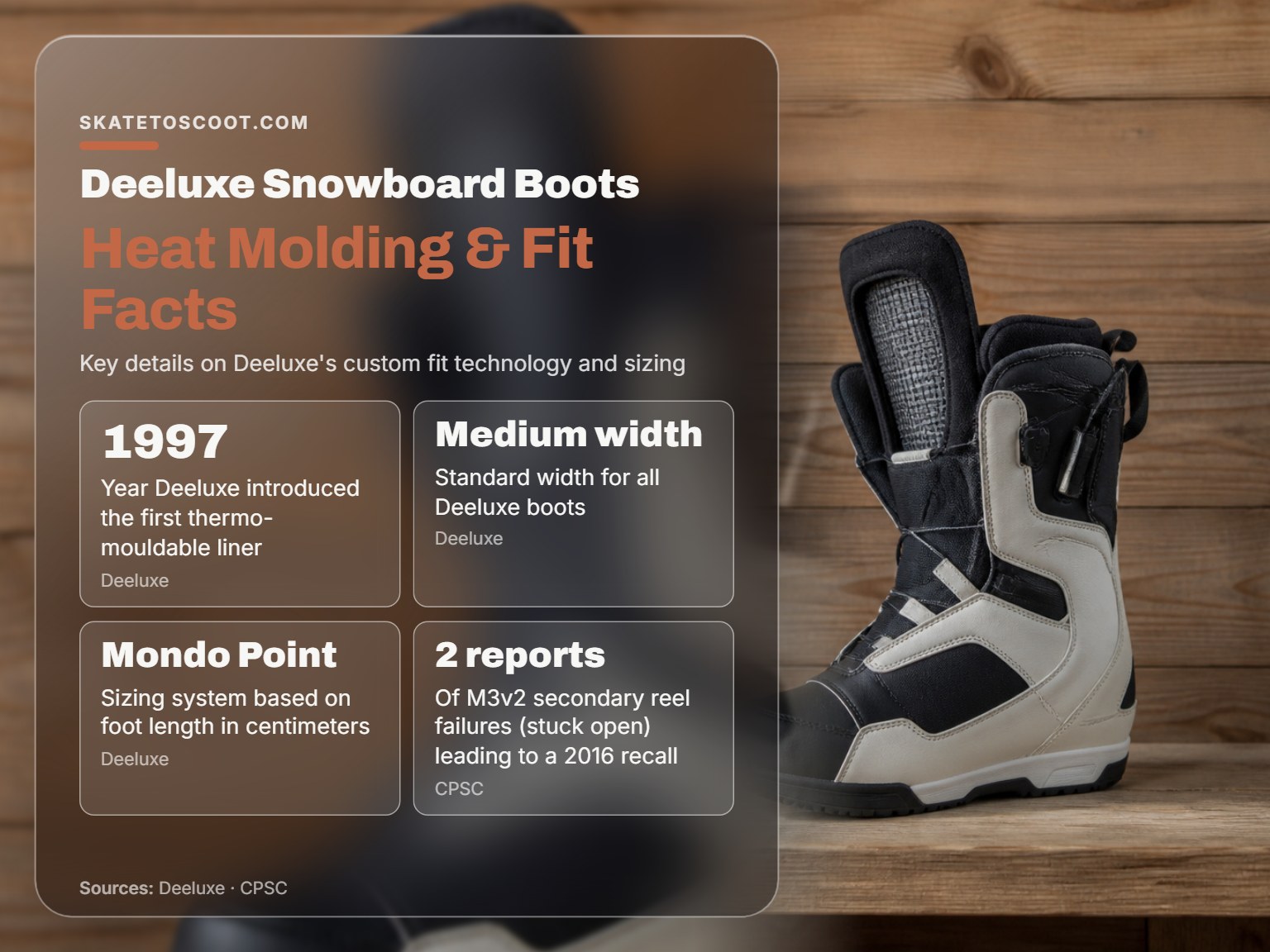
This is Deeluxe’s heritage. Their thermo-mouldable liners started a major shift in the industry, and they’ve spent decades refining the process.
The principle is simple: heat softens the liner’s foam, allowing it to expand. As it cools around your foot, it contracts into a custom shape. This can eliminate pressure points, close gaps around the ankle, and dramatically improve comfort. It’s not a substitute for proper sizing, but it’s a powerful fine-tuning tool.
Heel hold is the direct beneficiary. A loose heel is the fastest way to kill control and confidence.
Worth knowing before you start: Heat moulding is permanent. If you have a minor imperfection in your foot or suspect the boot might be a half-size off, ride it for a day or two first. Once you mould it, there’s no going back.
The 2016 Boa Recall & What It Means for You
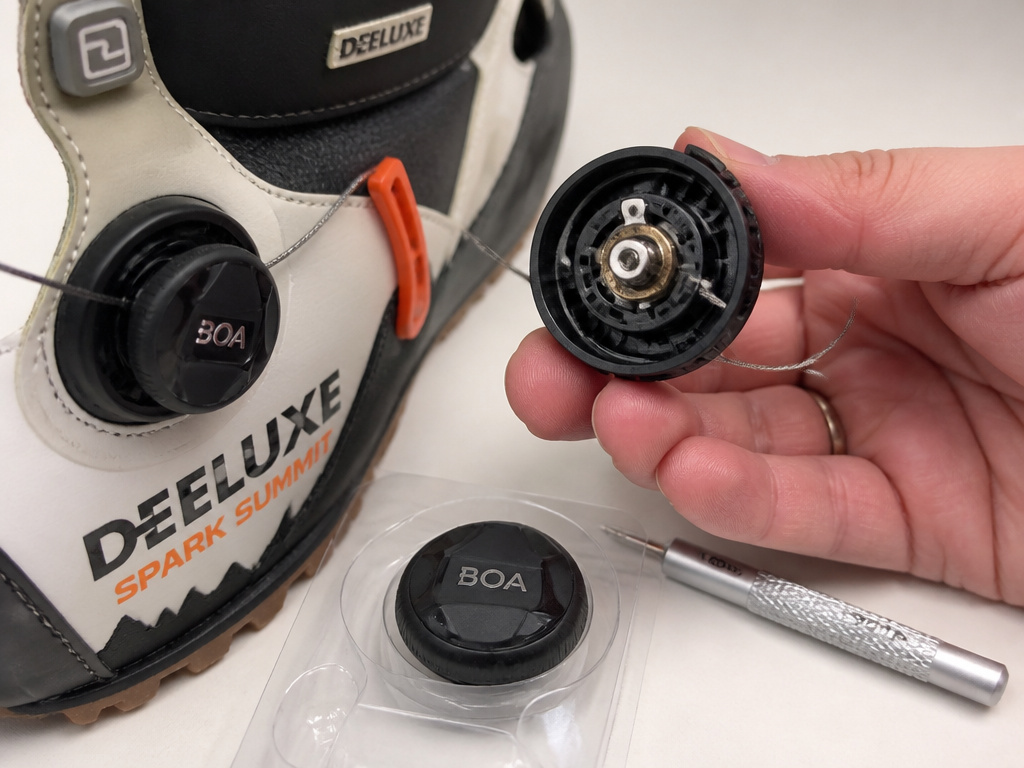
This isn’t ancient history; it’s a documented fact that informs how you should check a used pair. In February 2016, the U.S. Consumer Product Safety Commission announced a recall of snowboard boots, including specific Deeluxe models, due to a defective Boa M3v2 secondary reel dial.
The recall applied to Deeluxe Spark Summit and Vicious models equipped with that specific reel. The defect could cause the reel to stick in the open position, preventing the boot from tightening. Boa Technology had received two reports of the failure at the time.
The remedy was straightforward: consumers were told to stop using the boots and contact Boa or the retailer for a free repair kit. Replacement reels and a tool were provided.
Why does this matter now? If you’re looking at used Deeluxe boots from that era, check the model and the reel. The official CPSC snowboard boot recall notice has the full details. More broadly, it highlights that all mechanical systems can fail. Boa’s lifetime warranty exists for this reason.
Are Deeluxe boots good quality?
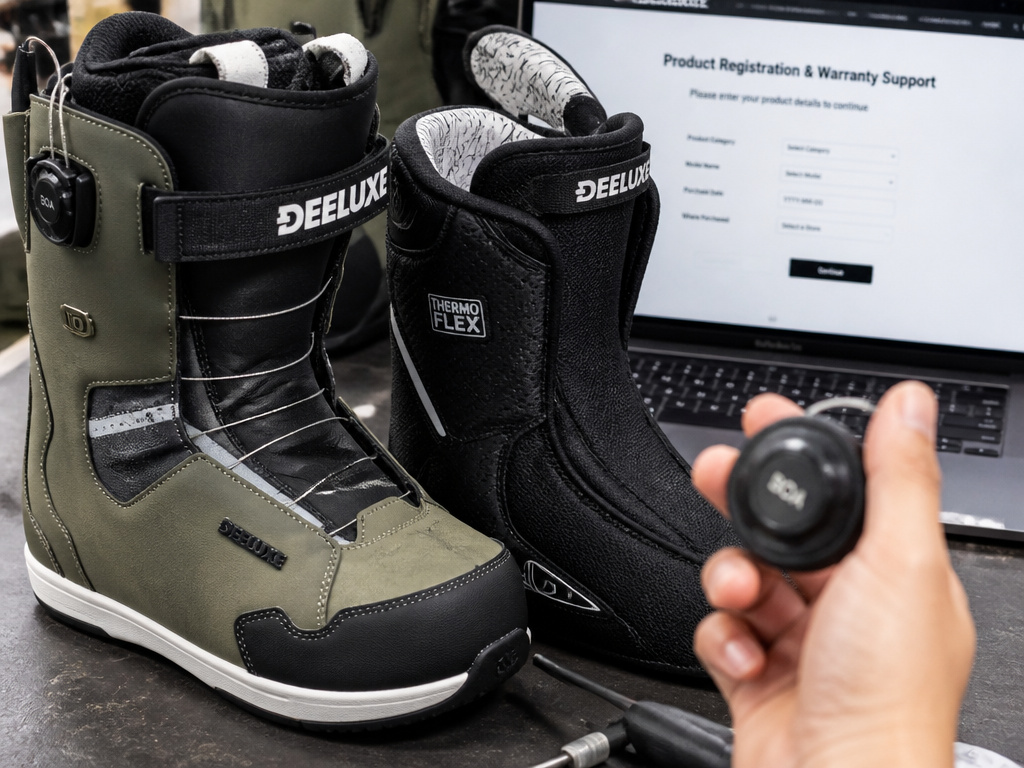
Deeluxe has a long history of innovation, being the first brand to bring a thermo-mouldable liner to market back in 1997. Their current models continue this focus on customizable fit, with options like customizable Thermo-Flex liners and specific features like the ID-Y20’s packout-resistant shell. However, quality isn’t just about features. A 2016 recall affected certain Deeluxe models with a specific Boa reel system. While isolated, such events underscore the importance of checking for any active recalls on older gear and registering new products for warranty support directly through the brand’s official channels.
How much do Deeluxe boots cost?
Deeluxe positions itself in the premium segment of the market. Their latest flagship models carry a price tag that reflects advanced materials and proprietary technologies like their ‘Future flex’ shell and high-spec liners with extra padding. For riders who prioritize a precise, heat-moldable fit and are willing to invest in boots built to resist packing out, the cost can be justified. It’s a commitment to gear designed for the long haul.
Frequently Asked Questions
Are Deeluxe boots good for wide feet?
Deeluxe states all their boots are a medium width. They are not typically recommended as best wide boots or specifically designed for wide feet. Riders with moderately wide feet often succeed with heat-moulding to create more volume. Those with very wide feet may find better options from brands that offer dedicated wide fits.
What is the difference between Deeluxe ID and Team ID?
The ID is the core all-mountain model, often with the latest tech and a medium-stiff flex. The Team ID is typically a variation built on the same shell but tuned for freestyle, sometimes with a slightly softer flex and a different liner (like a Stage 3 instead of a Stage 5). The Team ID is the choice for park-focused riders who still want ID-series support.
How long do Deeluxe boots last?
There is no single answer. Durability depends on the model, how many days you ride per season, and your riding style. Durability depends on the model, how many days you ride per season, and your riding style. The liners will pack out and soften long before the shell fails.
Can you heat mold Deeluxe boots at home?
Yes, many Deeluxe thermo liners can be molded at home using methods like wearing them with thick socks and using a hairdryer to warm the foam. However, the most precise and consistent results come from using the specialized ovens and expertise at a certified snowboard shop. An improper home mold can ruin a liner.
What is Mondo Point sizing?
Mondo Point is a standardized footwear sizing system based on the length of your foot in centimeters. It is the metric used by most snowboard boot manufacturers to ensure consistency across brands and countries. To find your Deeluxe size, you must measure your foot in CM and use their official conversion chart.
The Bottom Line
Deeluxe boots are a specialist’s choice for the rider who values precision fit and a balanced, responsive feel. Their legacy in heat-mouldable liners is real, and their Mondo Point sizing removes guesswork. They are not the widest, nor the cheapest, nor the most bombproof park boots on the market.
They are, however, consistently among the best-engineered boots for the rider who wants one reliable pair to handle 90% of what a mountain throws at them. Start with your Mondo Point measurement. From there, match the model to your flex needs: the stiff ID-Y20 for driving turns, the playful DNA for the park, or the versatile Team ID for a bit of both. And if you find a deal on a used pair from around 2016, check that Boa reel against the recall list first.
That’s the whole process. Measure, match your style, and let their liner tech handle the rest.
