Electric Scooter With Seat Review: How to Choose
This post contains affiliate links. As an Amazon Associate, we earn from qualifying purchases.
An electric scooter with a seat is a moped-style electric vehicle designed for seated riding, not a standing scooter with a bolt-on accessory. Key specs like the SEAT eScooter‘s 5.6 kWh battery and 85-mile range or the Razor UB1‘s 220 lb weight limit define real capability, but the CPSC’s federal safety analysis shows the main hazards are mechanical, electrical, and human factors, not the seat itself.
That distinction between a purpose-built seated vehicle and an adapted one changes everything about safety, performance, and even how the law sees it. Most reviews list top speeds and ranges, which matter. But they skip the part where a seat changes the center of gravity, the legal classification, and the kind of maintenance the battery actually needs. This is precisely why a thorough electric scooter with seat review is so critical.
What follows is a breakdown of the specs that count, the safety rules you can’t ignore, and the real-world trade-offs between comfort and capability that the manuals spell out but most electric scooter with seat review articles gloss over.
Key Takeaways
- A true seated scooter like the SEAT eScooter is designed for seated riding.
- Check the weight capacity first, the Razor UB1 manual states a 220 lb (100 kg) limit. Exceed it and you risk frame stress and brake failure, not just slower speed.
- Battery care conflicts exist: The SEAT manual requires a 100% charge monthly to keep the warranty, while general lithium-ion wisdom says store at 40-60% for longevity. You must pick one.
- Federal safety jurisdiction hinges on specs: The CPSC governs scooters under 20 mph without seats; the NHTSA may claim those over 20 mph with street-ready features like lights.
What Makes a Real Seated Scooter?
Forget the bolt-on seats for a second. A real seated scooter is built from the ground up for sitting. The frame geometry, the battery placement, the wheelbase, all of it assumes your weight is on a seat, not a deck. The SEAT eScooter is a clear example. Its 41 kg battery is positioned low and central, and the whole thing looks like a miniature motorcycle.
A standing scooter with a seat kit attached is a different beast. The deck is short, your knees might be in your chest, and the center of gravity shifts. That changes how it handles, especially in a turn. Reddit threads are full of owners who bought cheap seated models only to find them “terrible” for anything but slow neighborhood puttering. The difference isn’t minor. It’s the difference between a vehicle and a toy.
Common mistake: Assuming any scooter with a seat is designed for seated riding. Many are standing scooters with an add-on that creates a cramped, unstable riding position. The true test is whether the manufacturer’s manual shows and specifies the seated configuration.
The Seat vs. Specs Trade-Off
You want comfort, but the specs dictate what’s possible. Here are two real models from the fact sheet.
| Model | Key Spec | Why It Matters for a Seat |
|---|---|---|
| SEAT eScooter | Battery: 5.6 kWh, 41 kg | The heavy, high-capacity battery is a core part of the frame. It provides a low center of gravity for stable seated riding, but makes the scooter non-portable. |
| Razor UB1 | Weight Limit: 220 lb (100 kg) | This isn’t a suggestion. Exceeding this limit, per the manual, “could injure the rider and damage the UB1.” The seat, frame, and brakes are rated for this max. |
The SEAT eScooter’s manual lists a maximum driving distance of 85 miles. With a rider on the seat, plus hills, wind, and stop-and-go traffic, real range may be lower. The manual itself says the display shows an estimate that “depends on driving style.” Trust the spec as a ceiling, not a guarantee.
But you trade off that solid, moped-like feel. The folding mechanism adds a point of potential flex, and the smaller battery means less range. It’s a classic trade: portability versus planted stability.
Speed, Range, and the Law
How fast do you really need to go? This question ties directly to safety and legality. The federal government draws a line at 20 mph.
According to the CPSC micromobility product report, the National Highway Traffic Safety Administration (NHTSA) does not consider a scooter a “motor vehicle” under its jurisdiction if it lacks a seat or is incapable of a top speed of 20 mph or greater. This is a crucial detail.
Translation: A seated scooter that goes 19 mph is a consumer product under the CPSC. A seated scooter that goes 21 mph, especially if it has headlights, mirrors, or brake lights, might be considered a motor vehicle (like a moped) by the NHTSA. That can mean registration, licensing, and helmet laws you didn’t expect.
The Razor UB1 manual lists a “normal powered top speed” of approximately 13.5 mph. That keeps it firmly in CPSC territory. The SEAT eScooter doesn’t list a top speed in the provided manual excerpts. You have to check your local laws. A scooter legal in one state can be classified as a motorcycle in another.
Where this goes sideways: Buying a scooter that exceeds 20 mph without understanding your state’s vehicle codes. You could be ticketed for riding an unregistered motor vehicle on the road, or banned from bike paths.
Who Are These Scooters Really For?
This is where weight capacity and intended use collide. The manuals are blunt.
- Razor UB1: “NOT FOR RIDERS UNDER AGE 14 OR HEAVIER THAN 220 LB (100 KG).” It’s right there in the safety warnings.
- General Implication: Most seated scooters for adults need to handle at least 220-250 lbs to be practical. If you’re a larger rider, you must look for scooters for heavy adults with a stated limit well above your weight.
Why? It’s not just about the motor straining. It’s about brake effectiveness, suspension bottoming out, and frame integrity. A scooter at its max weight limit will have reduced range and slower acceleration. The manual warnings are there because the engineering tolerances end there.
Battery Care Beyond the Charger
Here’s where the fact sheet reveals a direct conflict between manufacturer rules and common knowledge.
The SEAT eScooter manual has two non-negotiable battery rules for warranty:
- “Fully charge the battery (to 100%) at least once a month.”
- “The eScooter should be fully charged before it is left parked for more than one week.”
Meanwhile, anyone familiar with lithium-ion batteries in phones or laptops knows the opposite: for long-term storage and cell longevity, you keep the charge between 40% and 60%. A constant 100% charge stresses the cells.
So who do you listen to? The manufacturer holding your warranty, or the general best practice? You can’t do both. My take is to follow the manual while under warranty. After that, for long parking periods, consider a partial charge.
Temperature Is a Hard Limit
Batteries hate the wrong temperature. The manuals give specific numbers:
| Condition | Razor UB1 Manual | SEAT eScooter Manual |
|---|---|---|
| Do Not Charge Below | 32°F (0°C) | Battery will not charge below 32°F (0°C) |
| Operating Range | -10° to 40°C (14° to 104°F) | Use “at temperatures above 32°F (0°C)” for optimal conditions |
Notice the disagreement? Razor says you can operate down to 14°F, but never charge that cold. SEAT recommends not using it below freezing for optimal conditions. The takeaway is universal: never charge a cold battery. Bring it indoors, let it warm to room temperature, then plug it in. A battery charged below freezing can form permanent, conductive lithium metal plates inside, a process that can lead to short circuits and failure.
The part nobody mentions: A “dead” battery might be permanently dead. The SEAT manual states, “Batteries that fall below a certain level of voltage no longer work on their own, meaning they cannot be charged and must be taken to an official technical service.” If you let your scooter sit for months completely discharged, you might be buying a new battery.
Safety: It’s More Than a Helmet
The CPSC report breaks down hazards into three areas: mechanical, electrical, and human factors. For a seated scooter, each has a specific flavor.
- Mechanical: Frame failure is a bigger risk if weight limits are ignored. Brake failure is highlighted in the report as a frequent issue. A seated rider can’t easily jump off like a stand-up rider.
- Electrical: The report notes over 330 fire-related incidents with self-balancing scooters from 2015-2019, mostly during charging. Using the correct charger and not charging unattended or on flammable surfaces isn’t paranoid, it’s based on incident data.
- Human Factors: This is the big one. A seat can create a false sense of security. Riders might skip a helmet, attempt higher speeds, or ride in traffic they shouldn’t. The report specifically mentions “user expectations” as a hazard.
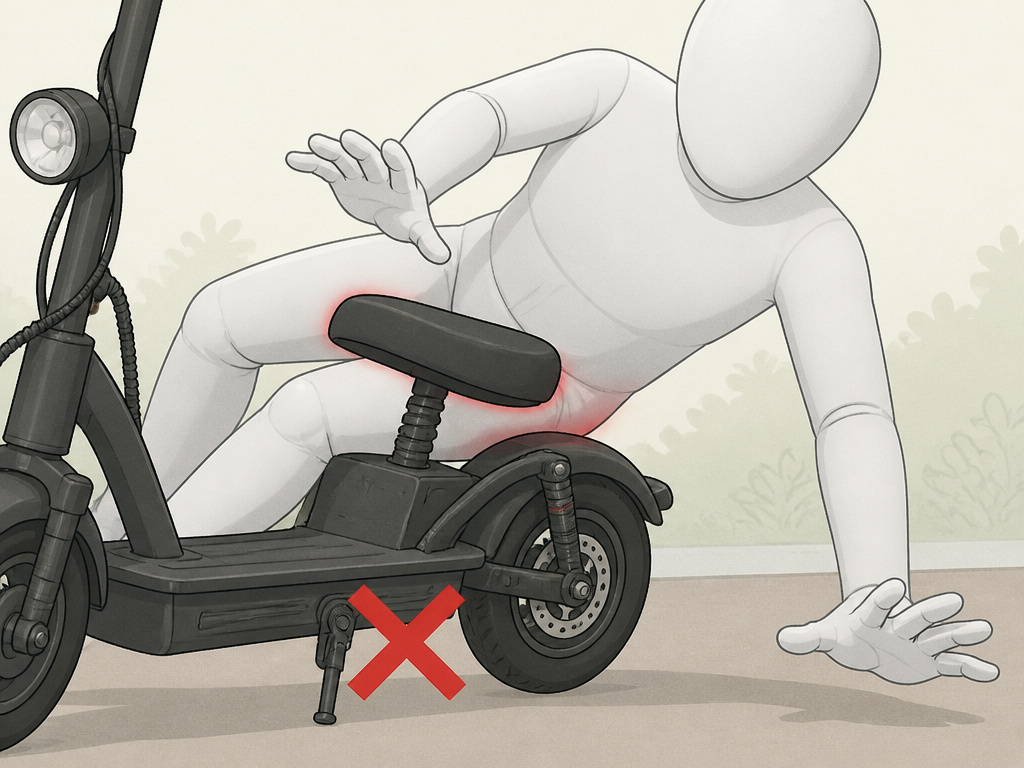
The physical act of mounting a seated scooter is its own risk. You’re not stepping onto a deck; you’re sitting down onto a sometimes-unstable seat. If the side stand isn’t fully engaged, the whole thing can tip. A slow-motion tip-over is still embarrassing and can cause injury.
Maintenance You Can’t Skip
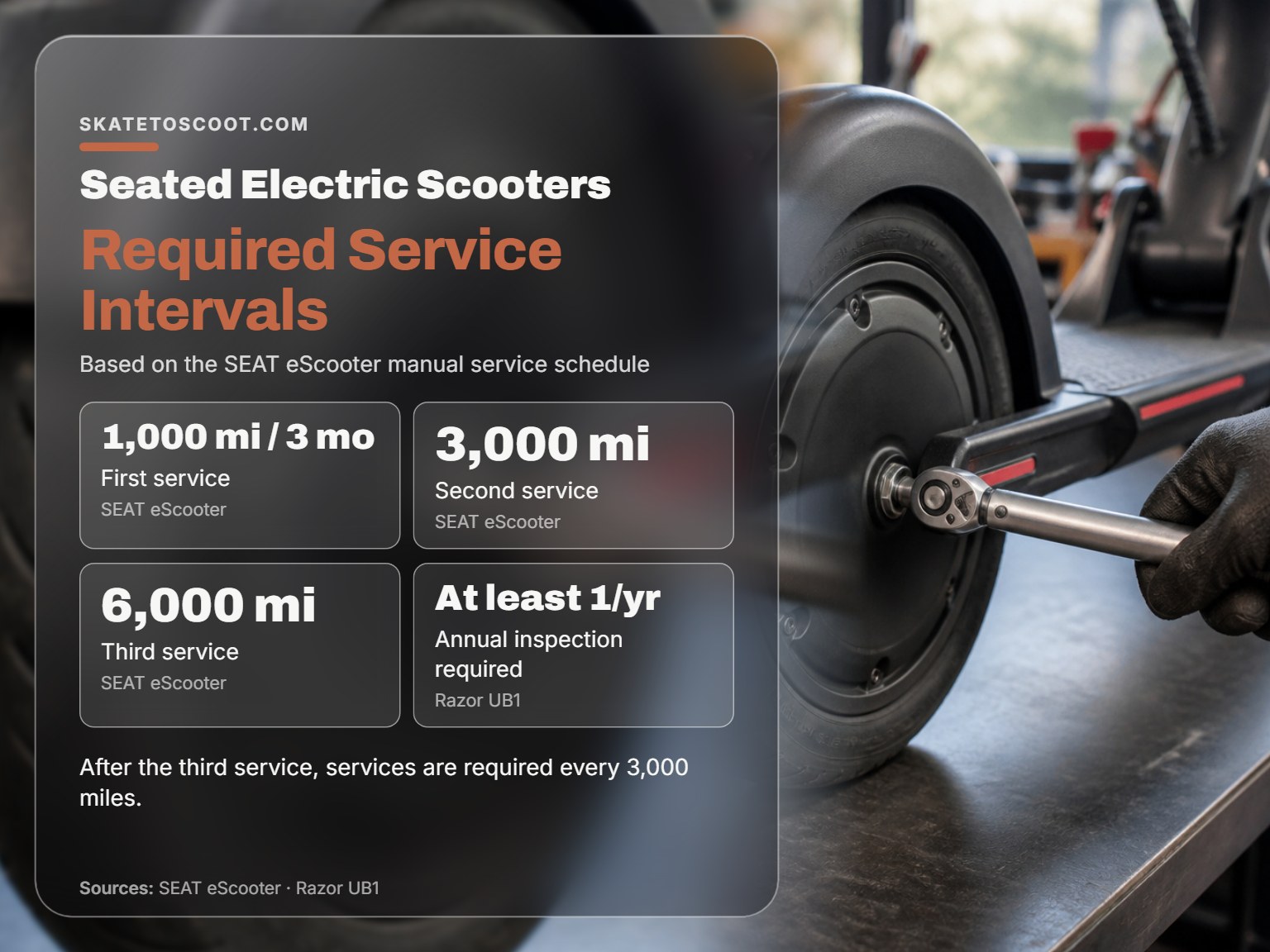
A seated scooter isn’t a “ride it until it breaks” product. The SEAT eScooter manual lays out a strict inspection schedule:
- First service: 1,000 miles or 3 months.
- Second: 3,000 miles.
- Third: 6,000 miles.
- Then every 3,000 miles after that.
- And: “Inspections of the eScooter must be done within one year of the previous inspection (at least one per year).”
This is for a vehicle with a 5.6 kWh battery and complex electronics. Cheaper sit-down electric scooters might not have a formal schedule, but the principle holds. Check tire pressure monthly. Listen for new creaks or rattles from the seat mount. Look for brake pad wear.
For senior-friendly scooters or those used by riders with limited mobility, this is doubly important. A sudden mechanical failure isn’t just an inconvenience; it’s a fall hazard.
What are some good electric scooter with seat models?
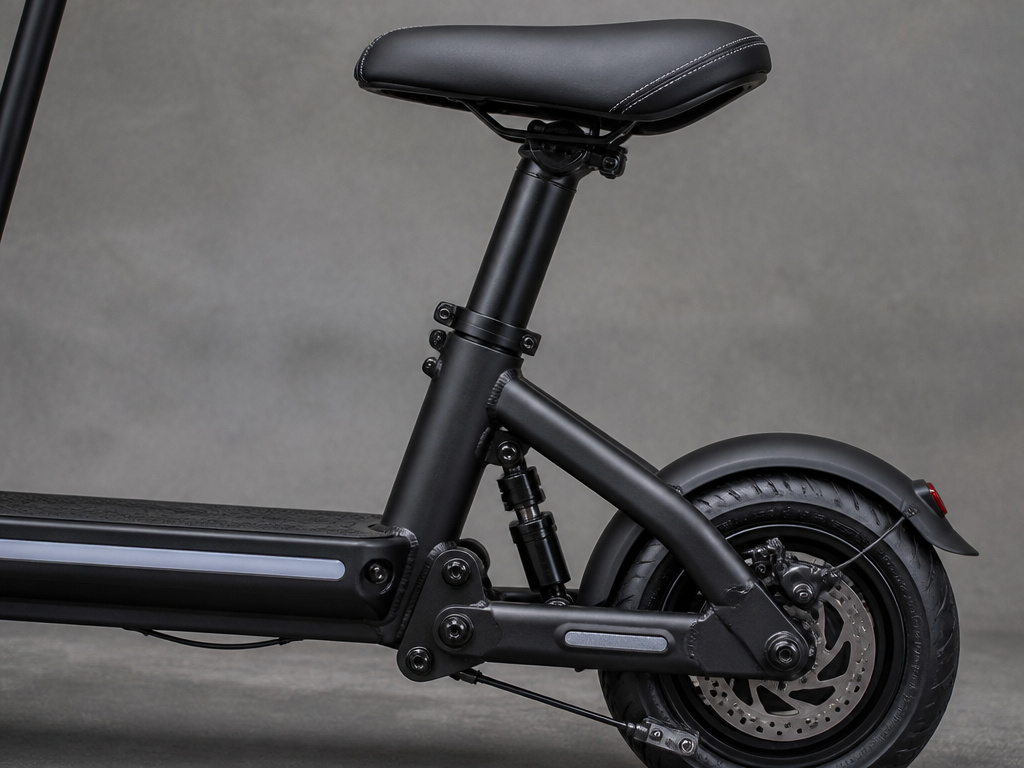
When looking for a seated scooter designed for sitting, focus on models designed from the ground up for sitting, not standard scooters with a seat bolted on. These will have a longer wheelbase and a frame geometry that properly distributes your weight. The SEAT eScooter is one such model, built with a 41 kg battery. For lighter-duty use, some brands offer seated versions of their popular upright models, but always check the manufacturer’s stated weight limit and age recommendations, such as the Razor UB1’s limit of 220 lb (100 kg) for riders 14 and over.
How much should I spend on an electric scooter with a seat?
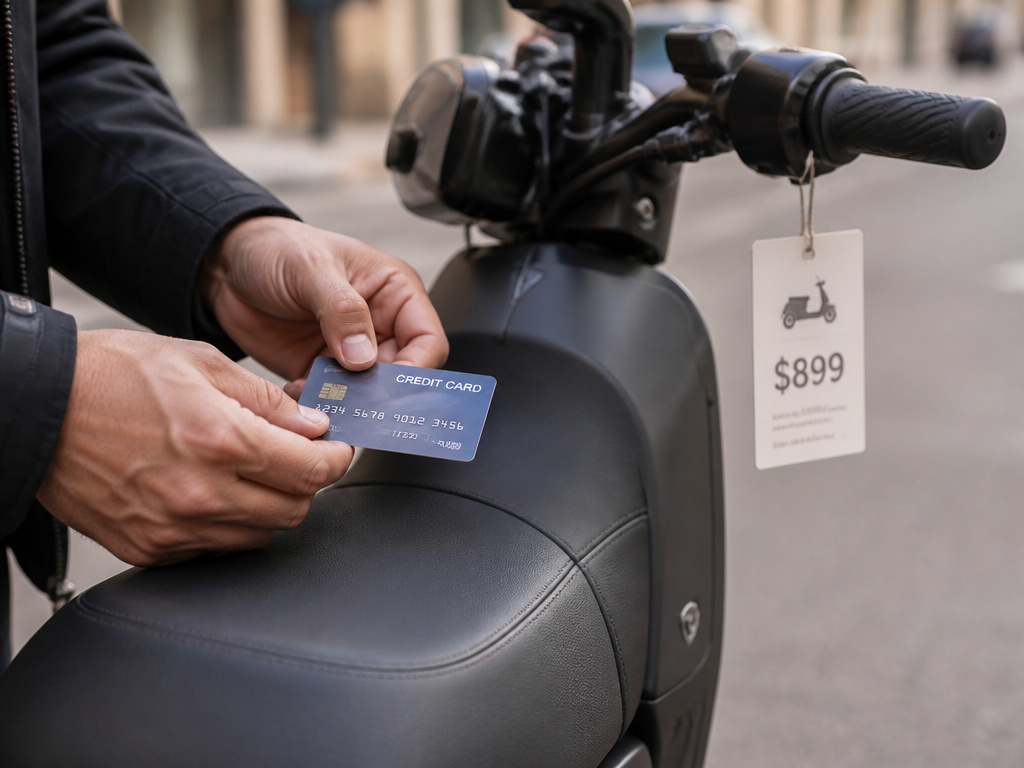
Electric scooters with seats span a wide price range. At the lower end, you’ll find basic models suitable for short trips and lighter riders, often with simpler construction and shorter ranges. Mid-range options typically offer better build quality, more comfortable seats, and longer battery life, making them practical for regular commuting. Some models, like the SEAT eScooter, require specific maintenance, like a monthly full charge to keep the warranty valid. Your budget should align with how far and how often you plan to ride.
Frequently Asked Questions
What is the best electric scooter with a seat for adults?
There is no single “best.” It depends on your primary need. For a car-replacement feel and max range, a moped-style scooter like the SEAT eScooter is top-tier. Always cross-reference the manufacturer’s weight limit and range claims with your own weight and typical trip length.
Are seated electric scooters legal on bike paths?
It depends entirely on local laws and the scooter’s specs. In many jurisdictions, electric scooters (seated or standing) under 20 mph are allowed on bike paths. However, some cities ban all motorized vehicles on certain paths. A seated scooter that looks like a moped might attract more attention from law enforcement than a standing one. Always check your city’s specific ordinances.
How much weight can a seated electric scooter hold?
Check the manual, never guess. Common limits are 220 lb (100 kg), 264 lb (120 kg), and 300+ lb (136+ kg). The Razor UB1 is firm at 220 lb. Exceeding the limit voids warranties and risks component failure. If you’re near the limit, look for scooters with high weight limits designed for that load.
Is it worth buying a cheap seated scooter from Amazon?
It’s a gamble. Cheap scooters often use lower-grade batteries that may degrade quickly and have less robust frames. They can be fine for very occasional, light-use rides on perfect pavement. For daily use or any distance, investing in a known brand with a clear manual and available customer support is wiser. You often pay more upfront to avoid replacing the entire unit in 12 months.
Can you add a seat to any electric scooter?
Technically, you can bolt a seat to many stand-up scooters. However, most manufacturers do not design or test for this, and it will void your warranty. It dramatically changes the scooter’s handling and stress points. Purpose-built electric scooters designed for seated riding are always the safer, more stable choice.
The Bottom Line
Choosing an electric scooter with a seat means navigating a three-way check between the spec sheet, the safety manual, and the law. The numbers in the manual, the 220 lb limit, the 0°C charging floor, the 3,000-mile service interval, are your real guide. They’re not marketing; they’re the edges of the engineering envelope.
Start with your weight and your regular route distance. Let that narrow the field to models that can actually do the job. Then, read the manuals for those models. The conflict between monthly 100% charges (for warranty) and 40% storage charges (for battery life) is a decision you have to make consciously. There’s no right answer, only your choice.
Finally, assume your real-world range may be lower than the advertised maximum, and never charge a battery that’s cold to the touch. That alone will save you from the most common early failures. A seated scooter is a fantastic tool for mobility, but it’s a tool that comes with a literal manual for a reason. Use it.
