Gotrax Scooter Review: G4, G5, and Apex Max Compared
This post contains affiliate links. As an Amazon Associate, we earn from qualifying purchases.
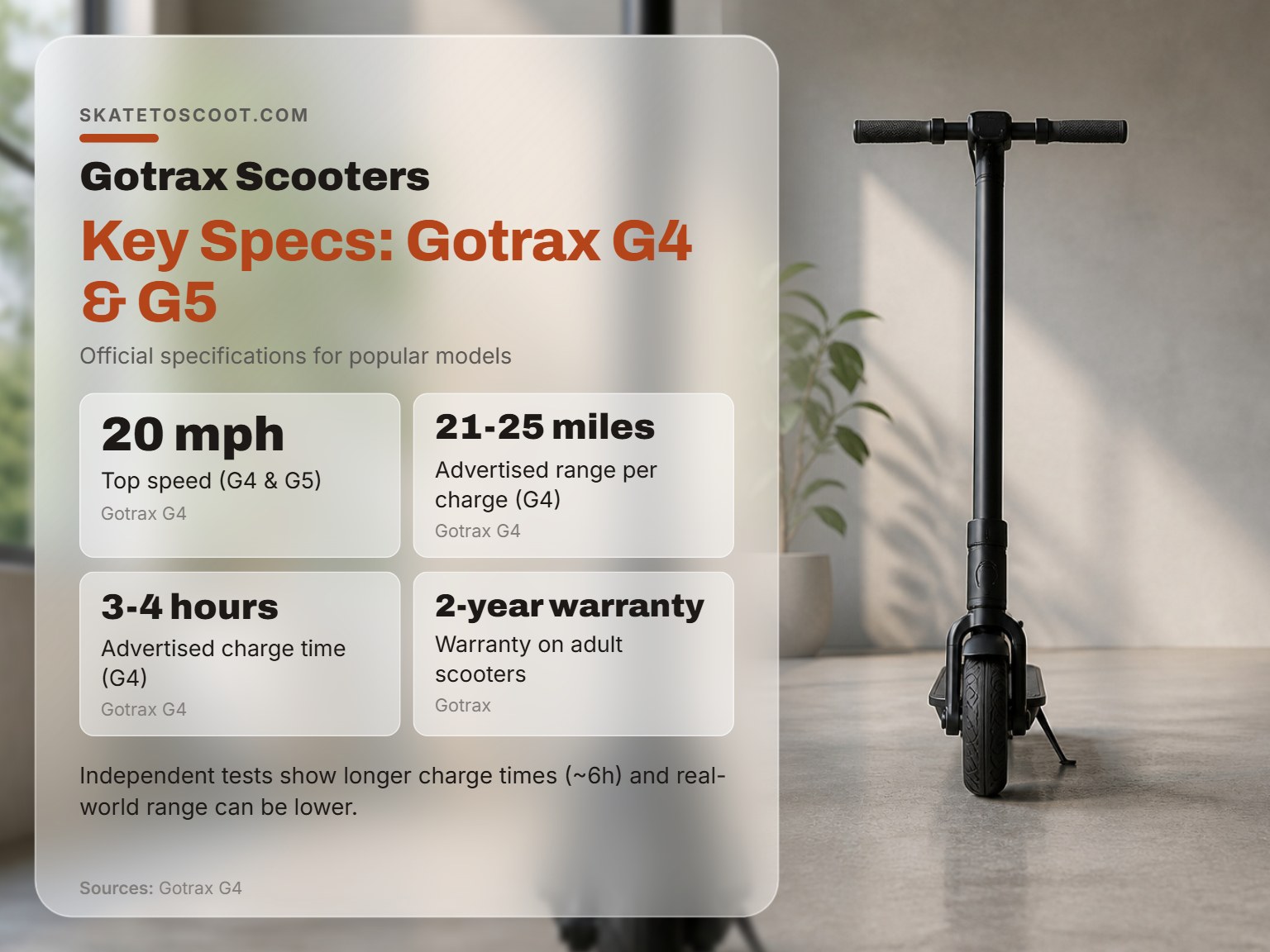
Gotrax scooters offer a 20 mph top speed and a 21-25 mile advertised range, but real-world results depend heavily on rider weight, terrain, and temperature. The brand’s value lies in its competitive pricing and 2-year warranty, but owners report a higher-than-average incidence of early component failures and inconsistent customer support. For a casual commuter on flat ground, they can work; for daily riders or hilly routes, the performance gap is significant.
That 20 mph figure is the ceiling, not the average. Your actual speed on a slight incline or with a backpack drops fast. The range claim assumes ideal conditions with a light rider, no stops, and moderate temperatures. Most commutes aren’t that, a point often noted in a typical Gotrax scooter review.
This Gotrax scooter review walks through the hard specs from the manuals, the real-world data from testers like TechGearLab, and the long-term gripes from owner forums. This review looks at the G4, G5, and Apex Max models, their common failure points, and whether the two-year warranty is truly valuable. By the end, you’ll know exactly what you’re signing up for.
Key Takeaways
- Advertised range is a best-case scenario. Independent reviews, such as DuoDian’s analysis of the G3 Plus, suggest real-world mileage can be significantly lower than the manual’s claim.
- They are not waterproof. The manuals explicitly state water damage voids the warranty, so a sudden downstorm can turn into a very expensive repair.
- Charge time is a point of contention. Gotrax says 3-4 hours for a G4, while TechGearLab’s independent test measured closer to six hours. Plan accordingly.
- Hill performance has strict limits. The G4 handles a 3.5% grade at 17.5 mph but slows to 5-6 mph on a 10.5% grade and won’t move on a 15% slope.
- Customer service experiences are polarized. While some get quick, no-cost replacements for out-of-warranty parts, the BBB and Reddit are full of reports of ignored claims and month-long delays.
The Gotrax G4: A Deep Dive on the Flagship
The Gotrax G4 is the model most people picture. Its manual lists a 20 mph top speed and a 21-25 mile range from its 36V 10.4Ah (374.4 Wh) battery. The maximum rider weight is 220 lbs.
Independent testing adds crucial context. TechGearLab ran the G4 on a mixed route with stops and starts. Their rider covered 22 miles in one hour and 54 minutes before the battery died. That’s within the advertised window, but it required efficient, continuous riding. In their hill climb test, the G4 charged up a 3.49% grade at 17.5 mph. On a steeper 10.5% grade, speed dropped to 5-6 mph. On a 15% grade, it didn’t move.
A 2024 TechGearLab update noted a new security feature: the scooter now has a digital passcode that must be typed before riding. Starting the scooter takes an extra 15 seconds.
That’s the trade-off. You get the advertised performance if your commute is flat and you ride conservatively. Add hills, headwinds, or a heavier rider, and the numbers drop fast. The 10-inch pneumatic tires help with comfort, but the lack of suspension means you feel every crack in the pavement.
Where this goes sideways: Trusting the range estimate for a hilly 10-mile round trip. If your route has any incline, the battery will drain significantly faster, potentially leaving you to kick-push the last mile home.
| Claim (G4 Manual) | Real-World Test (TechGearLab) | Practical Implication |
|---|---|---|
| Range: 21-25 miles | Range: 22 miles (ideal, continuous) | Achievable only on flat, uninterrupted rides. |
| Charge Time: 3-4 hours | Charge Time: ~5 hours 50 min | Nearly double the time; plan charging overnight. |
| Hill Climb: Not specified | 10.5% Grade: 5-6 mph | Steeper neighborhood hills will crawl. |
| Top Speed: 20 mph | Top Speed: 19.8 mph | Matches claim closely. |
Gotrax G5 and Apex Max: Stepping Up (And Where They Stop)
The G5 and Apex Max represent different rungs on Gotrax’s ladder. The G5 steps up to a 48V system, with a claimed 24.8-mile range and a higher 264 lb weight limit. The Apex Max is a 350W model with an 18 mph top speed and an “up to 18 mile” range.
The specs in a Gotrax scooter review tell a clear story of segmentation. The G5’s larger 48V 10Ah battery provides a higher voltage system. The Apex Max has a lower top speed of 18 mph.
Common mistake: Assuming “up to 18 miles” means 18 miles. For the Apex Max and similar budget models, independent reviews suggest a significant shortfall. DuoDian’s analysis of the similar G3 Plus cited community reports of just 7-10 miles of real-world range.
A product page review for the Apex Max highlights a common durability pattern. One owner wrote: “the rear fender broke off within the first week… About a month later the charger port completely snapped off… After about 5 months the throttle started to cut out.” Gotrax sent replacement parts under warranty, which is good, but the frequency of issues is the data point.
The bottom line: The G5 is the more capable commuter of the two, on paper. The Apex Max fits a tighter budget but comes with tighter performance margins and more frequent owner-reported build quality issues. For either, expect real-world range to be lower than the advertised claim.
What Most People Get Wrong: Maintenance and Charging
The manual has rules. People skip them. Then they post on Reddit about a dead battery or a fried controller.
First, charging. The G4 manual is specific: charge in conditions between 32°F and 104°F. Store the scooter and power adapter between -4°F and 122°F. The official FAQ adds more: never leave it charging unattended or overnight, and don’t charge on or near flammable materials. With proper care, GOTRAX batteries should maintain about 80% of their capacity after 500 charge cycles.
Before you start: The charger is not universal. Only use the approved GOTRAX power adapter (DC 42V 2.0A for G4, DC 54.6V 2A for G5). A mismatched charger can cause a fire or permanently damage the battery, which is not covered under warranty.
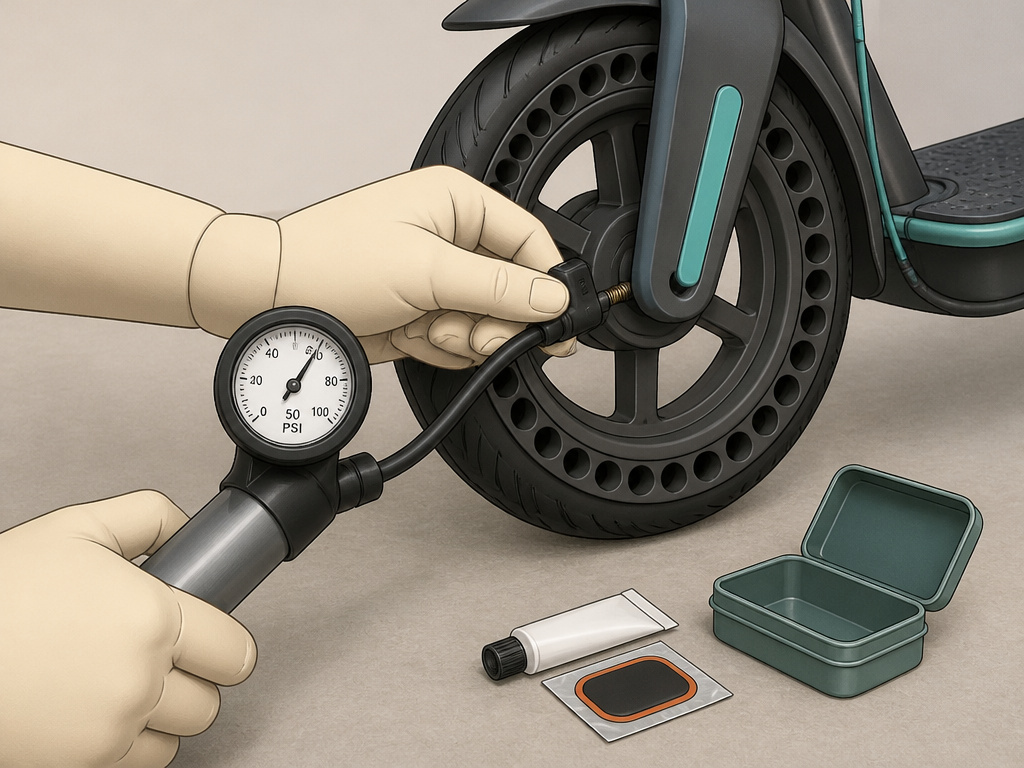
Second, tire pressure. The GXL V2 guide says check daily and keep at 50 PSI. Let that slide, and you increase the risk of pinch flats and drag down your range. A soft tire makes the motor work harder. You’ll hear a faint, gritty whirring sound when rolling a under-inflated tire by hand.
Third, cleaning. A soft damp cloth only. No corrosive solvents, no pressure washers. Water pressure can force itself past seals that are only designed to resist splashes, not jets. Gotrax scooters are not waterproof, this is stated in multiple manuals, and water damage voids the warranty.
Here’s a simple weekly checklist that takes five minutes:
- Tire Pressure: Check with a gauge, pump to 50 PSI.
- Brakes: Squeeze the levers. They should engage firmly without touching the handlebar grip.
- Fasteners: Give the stem and handlebar clamp bolts a check for snugness (don’t overtighten).
- Charge: Plug in after your last ride of the week, unplug when the light turns green.
Skip this, and you’re borrowing performance from next month’s ride.
Common Issues and How to Avoid Them
Forum threads and official error code pages paint a clear picture of where these scooters tend to fail. This knowledge helps you prevent the problem or identify it quickly.
1. Overheating and Sudden Shutdown. Some owners report overheating issues leading to sudden shutdown. This points to a battery or controller issue. Often, it’s a battery or controller issue. Fix: Stop riding immediately. Let it cool completely. If it recurs, it’s a warranty claim for a battery or controller replacement.
2. Loose or Breaking Physical Parts. Fenders, kickstands, and charger ports are common failure points. The plastic can be brittle, and repeated stress from folding or kicking the stand cracks it. Fix: Inspect these parts weekly. Don’t force the kickstand or yank the charging cable straight out, wiggle it gently. If a part breaks, Gotrax will often send a replacement under warranty, but the repair requires basic tools.
3. Flat Tires. The 10-inch pneumatic tires are more comfortable but prone to flats from thorns or under-inflation. A tire at 35 PSI instead of 50 PSI will pinch the tube against the rim on a hard curb impact. Fix: Keep a small bike pump and a patch kit in your backpack. Check pressure before every other ride.
4. Customer Support Hurdles. The experience is famously mixed. One Reddit user praised Gotrax for sending a free console replacement well after the warranty expired. The BBB has historically reported customer service issues. Fix: Have your order number, scooter serial number, and a clear video of the problem ready when you contact support. Persistence matters.
Gotrax vs. The Competition: Where It Fits
Is Gotrax a good scooter brand? It’s a budget brand. It’s a budget brand. That’s the honest answer. They’ve sold over a million units by hitting low price points others can’t. You trade some refinement, consistent water resistance, and sometimes durability for that lower upfront cost.
Compare it to a Segway Ninebot Max. The Ninebot is heavier, often more expensive, and frequently praised for its bulletproof reliability and IPX5 water resistance rating. Other brands like Segway and NIU are often praised for build quality and support.
The value is there for a secondary scooter, for campus use, or for a rider who can afford downtime if a part fails and needs warranty service.
So, who is a Gotrax scooter for?
- The Casual Rider: Trips under 5 miles on mostly flat ground, a few times a week.
- The Budget-First Buyer: Who wants 20 mph speed and a semblance of range for the lowest possible cost.
- The Tinkerer: Who doesn’t mind basic maintenance and might even enjoy swapping out a console or brake pad.
The 2-year warranty is a legitimate advantage, but needing to use it repeatedly gets old fast.
Frequently Asked Questions
Is Gotrax a good scooter brand?
For the price, sometimes. They offer competitive specs on paper and a strong 2-year warranty. However, they have a documented history of quality control inconsistencies and customer support challenges. If your priority is the lowest upfront cost and you’re comfortable with potential repairs, they can be a viable option. For hassle-free daily transportation, more established brands often provide better long-term value.
How long do Gotrax scooters last?
With meticulous care, a Gotrax scooter’s battery should retain about 80% of its capacity after 500 charge cycles. The battery should retain usable capacity for that time. Owner reports indicate that minor parts like fenders and kickstands can fail.
Which is better, Segway or Gotrax?
For reliability and build quality, Segway (specifically the Ninebot Max series) is generally considered superior. Segway scooters typically have better water resistance ratings, more robust construction, and a stronger track record for longevity. Gotrax often undercuts Segway on price, offering similar speed and range specs for less money, but with a higher likelihood of needing repairs.
What is the most reliable brand of electric scooter?
There is no single “most reliable” brand, as it depends on price tier. In the budget segment, NIU has gained a strong reputation.
Can you ride a Gotrax scooter in the rain?
The manuals explicitly advise against it. Gotrax states its scooters are “not waterproof,” and water damage is not covered under the warranty. Riding in wet conditions risks short-circuiting the electronics and is also a significant safety hazard due to reduced tire traction. If you get caught in a light drizzle, dry the scooter thoroughly afterward, especially the charging port.
How do I unlock my Gotrax scooter?
Most newer G-series models (G3, G4, G5) have a digital passcode lock. The default is often 000 or 0000. You use the up/down buttons to enter the code and the power button to confirm. If that doesn’t work, consult your specific model’s manual. Some older or budget models may use a physical cable lock integrated into the stem instead.
The Bottom Line
Gotrax sells scooters that hit numbers, 20 mph, 25-mile range, at prices that make you look twice. The catch is that those numbers live on a spreadsheet. On the road, with weight, wind, and wear, they shrink.
Here’s the one rule that decides it: if you can’t afford to be without your scooter for a few weeks while a warranty claim processes, look at Segway or NIU.
Their two-year warranty is a real asset, but it’s also the most frequently exercised part of the ownership contract. Plan accordingly.
