K2 Raygun Snowboard Review: Who It’s Really For
This post contains affiliate links. As an Amazon Associate, we earn from qualifying purchases.
The K2 Raygun is a budget-friendly, all-mountain directional twin snowboard with a medium flex, an extruded base, and a rocker-flat-rocker profile designed for versatility. It suits beginner to intermediate riders who prioritize a forgiving, predictable ride over high-speed stability or aggressive carving, but its performance caps out for experts and those with larger boots may experience toe drag.
That description sounds straightforward, but the actual experience of riding a Raygun, and the advice you get about it, is filled with contradictions you won’t find in a spec sheet. One review calls its speed a deal-breaker; an owner brags about hitting 52 mph. Retailers label it a beginner board; a forum user calls that label “stupid.” Even its camber profile gets three different names from three different sources. For a clear summary, you should read a detailed K2 Raygun snowboard review.
This guide walks through those conflicting reports to give you a clear, grounded picture. We’ll break down its construction, explain where those disagreements come from, and highlight the specific scenarios where the Raygun shines, or holds you back. By the end, you’ll know if it’s the right deck for your next season, or if your money is better spent on a clear step up.
Key Takeaways
- The Raygun’s Extruded 2000 base is slower and requires less maintenance than a sintered base, a trade-off that defines its relaxed, all-mountain character.
- Riders with boots larger than size 10 should carefully consult waist width specs (247mm on the 156cm) or consider a Wide model to avoid toe drag.
- Conflicting reports on high-speed stability stem from rider skill and conditions; it’s capable of moderate speed but chatters noticeably above 50-60 mph.
- For progression-focused riders, the K2 Raygun Pop (camber) or the K2 Broadcast are often better choices than the standard Raygun’s flat/rocker profile.
- Its best value is for beginners and intermediates who want a single, forgiving board for exploring the whole mountain without a premium price tag.
Decoding the K2 Raygun’s Camber Profile (Conflicting Reports)
You’ll read three different descriptions of the Raygun’s profile. Evo’s 2023 product page calls it a “Directional Rocker Profile” with rocker in the tip and tail and a flat section between the feet. A Snowsurf review of the same 2023 model calls it both “Cambre + double rocker” and a “Directional Combination Camber Profile.” Go back to a 2015-16 Whitelines review, and it’s listed simply as “Flat.”
Sources describe the profile differently in a K2 Raygun snowboard review: Evo calls it a “Directional Rocker Profile with rocker in tip/tail and flat between feet,” while Snowsurf calls it “Cambre + double rocker” and a “Directional Combination Camber Profile.”
So which is it? They’re all describing the same physical setup. The “flat between feet” is the key. This hybrid design makes the Raygun notably forgiving. You get the easy turn initiation and reduced catchiness of rocker at the extremities, paired with a stable, confidence-inspiring flat section underfoot. It’s not a pure camber board that will lock into a carve with aggression, nor is it a full rocker board that might feel vague at higher speeds. This is the core of its “accessible” reputation.
The takeaway: don’t get hung up on the marketing name. The profile is a relaxed, user-friendly hybrid. It’s designed to be easy, not high-performance.
The K2 Raygun’s Core Construction and Build
Peel back the topsheet and you find the tech that defines the Raygun’s price point and performance envelope. K2 uses an Aspen Core. It’s a lightweight, poppy wood core that keeps the overall swing weight down, making the board feel maneuverable and quick from edge to edge. Wrapping that core are ICG™ 10 Biaxial Carbon Glass laminates. In practice, this translates to a smooth, predictable flex. The board doesn’t have a harsh, rigid feel; it loads and releases energy in a controlled way, which is great for learning to load a ollie or absorbing uneven terrain.
Then there’s the base. The Extruded 2000 Base is the most discussed, and debated, component. An extruded base is made by pushing melted plastic through a die, resulting in a consistent, durable sheet. It’s slower than a sintered base because it doesn’t absorb wax as deeply, but it’s also much more forgiving of neglect. An extruded base is more forgiving of neglect and requires less maintenance than a sintered base.
Where this goes sideways: Choosing the Raygun for its all-mountain versatility but expecting it to keep pace with friends on sintered-base boards. The speed deficit isn’t subtle on long, groomed runouts. You’ll be pumping while they’re coasting.
This construction trio. Aspen Core, ICG glass, Extruded base, is a package deal. It creates a board that is durable, low-maintenance, and easy to handle, but it places a firm ceiling on high-end performance. You’re buying a reliable daily driver, not a race car.
Who is the K2 Raygun Really For? (Skill Level Debate)
The manufacturer and retailers pitch the Raygun as “very accessible for beginner riders to learn on,” but a forum user explicitly disagrees, calling it “stupid to label Raygun as a beginner board.” The flat/rocker profile drastically reduces the chance of catching an edge. The medium flex is forgiving of imprecise weight distribution. The extruded base means you can focus on riding, not tuning. For someone taking their first laps off the rental rack, it’s a fantastic first purchase.
But the community pushes back. A forum user with a 2014 model explicitly disagreed, stating, “It is stupid to label Raygun as a beginner board,” citing his ability to sustain speeds around 52 mph. Another Reddit user rode a Raygun for ten years as an intermediate/advanced rider before seeking an upgrade.
| Rider Profile | Raygun is a Good Fit? | Why? |
|---|---|---|
| First-Time Buyer | Yes | Forgiving profile, low-maintenance base, affordable price. |
| Low-Intermediate Explorer | Yes | Versatile for all-mountain cruising, predictable handling. |
| Aggressive Carver / Speed Demon | No | Extruded base limits speed, flex lacks high-speed stability. |
| Park-Focused Jibber | Limited | Not much use for butters/jibbing; a dedicated park board is better. |
| Advanced Rider Seeking an Upgrade | No | Construction and profile cap progression; look at camber or sintered-base alternatives. |
The truth lies in intent. If you want a low-fuss board to build fundamental skills and explore the mountain without intimidation, the Raygun fits. If you’re already linking carved turns with confidence and your goal is to charge harder, go faster, or press with more pop, you’ll outgrow it quickly and should explore our list of the best snowboards for advanced riders. The board isn’t lying about its capabilities; the mismatch happens when a rider’s ambition exceeds the board’s design ceiling.
Performance Breakdown: Where It Shines and Where It Falters
Let’s move from theory to the snow. Based on owner reports and reviews, here’s what you can expect across different mountain terrains.
Groomers & Carving: The Raygun is a comfortable cruiser. The directional twin shape (nearly symmetrical, with a slightly set-back stance) makes it easy to link turns on both edges. That stance setback (cited by SnowboardingProfiles) helps, giving a subtle bias toward a forward-facing, all-mountain stance. Don’t expect razor-sharp, high-angle carves. The flex is too soft and the edge hold, while decent, isn’t meant for icy, hardpack aggression. It’s for making pleasant, medium-radius turns down a blue square.
Powder: Surprisingly capable. That same stance setback, combined with the rockered nose, gives it legitimate float in soft snow. It won’t match a dedicated powder board, but for the occasional deep day, it handles itself well. You won’t be fighting to keep the nose above the fluff.
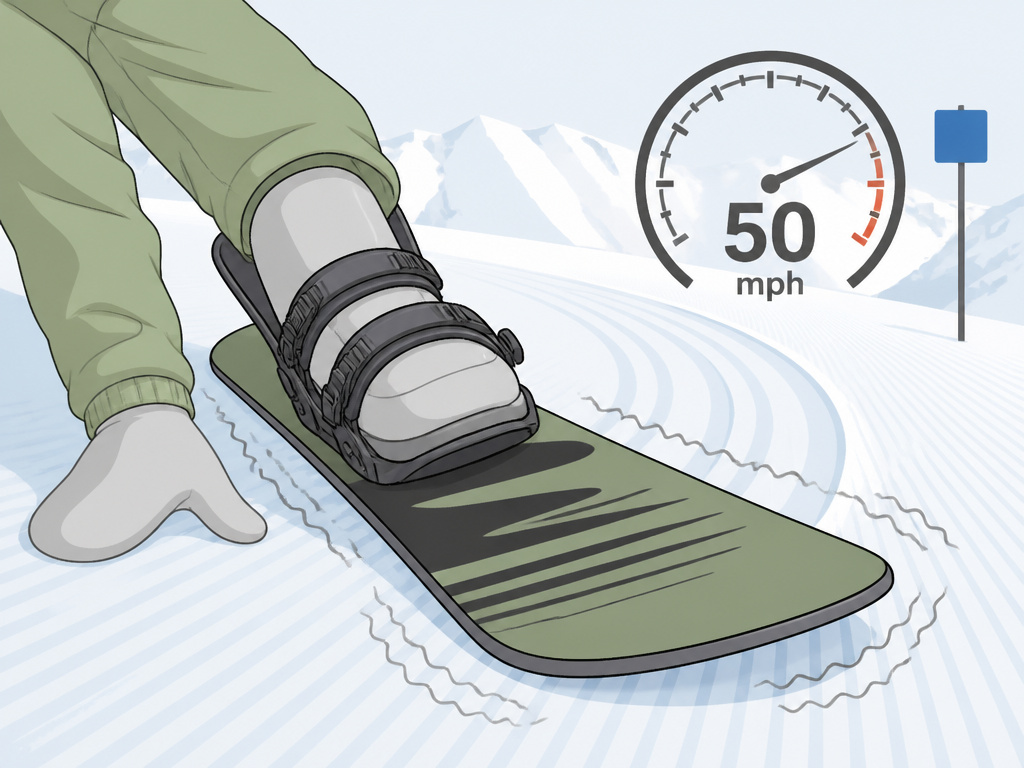
Speed & Stability: This is the great debate. The SnowboardingProfiles review is blunt: “The board’s speed definitely suffers due to its extruded base,” rating it 2.5/5. Conversely, a forum user reported “sustaining speeds over 50 mph” on a 2014 model, though he noted chatter above 60 mph. Both are true. The board can reach moderate speeds, but it requires more effort to maintain them, and the feedback through the board, a nervous chatter, becomes pronounced as you push past 50 mph. It’s stable enough for most recreational riding, but it’s not a board you bomb on.
Park & Switch: It’s an all-mountain board that can visit the park, not a park board that can ride all-mountain. But for butters, presses, or jibbing, it’s not ideal. As one Reddit user put it, “It’s not much use for butters/jibbing.”
Sizing the K2 Raygun: The Big-Foot Caveat
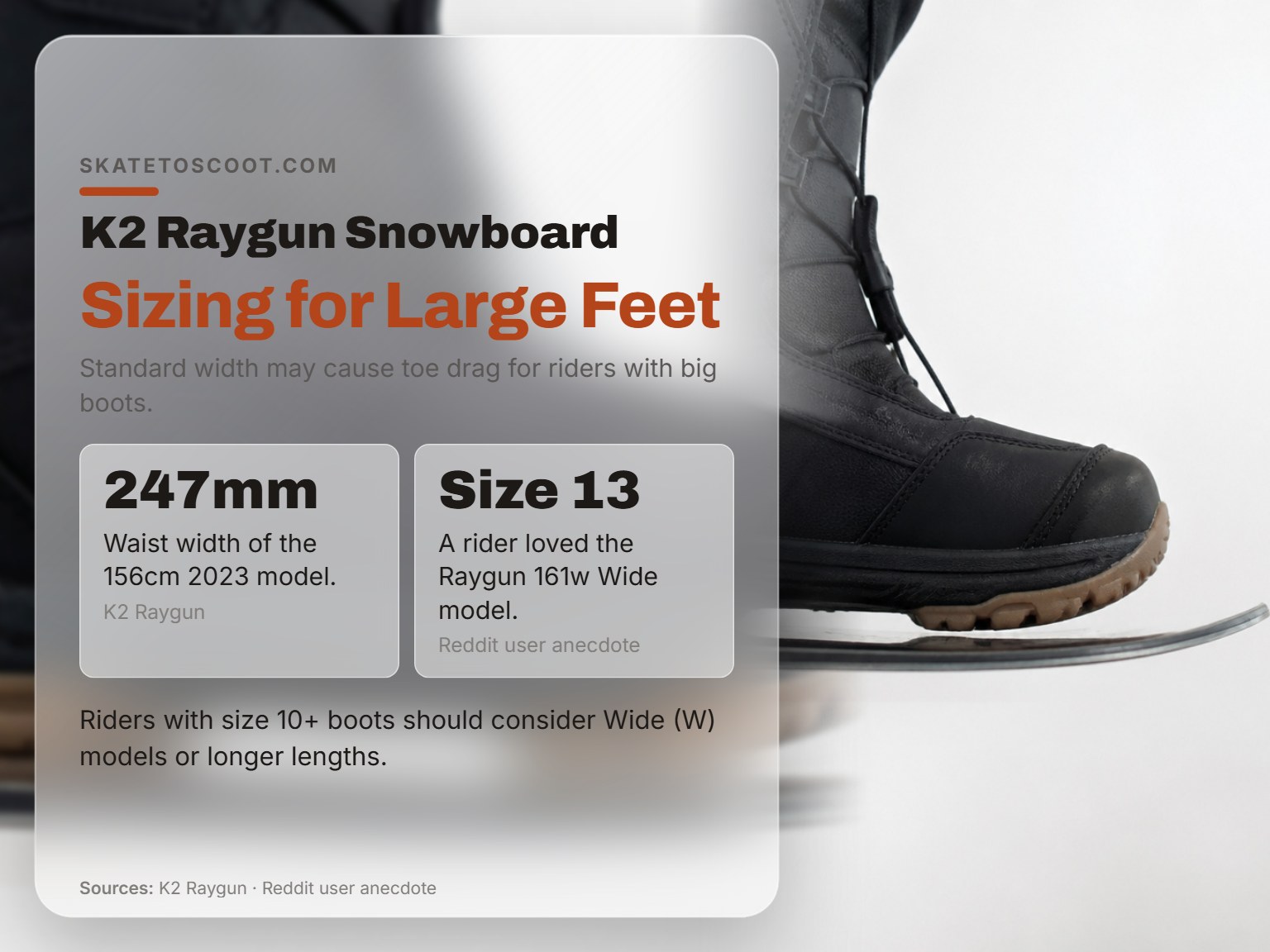
The Raygun’s directional twin shape and standard waist widths present a specific challenge for riders with larger feet. The Snowsurf review of the 2023 model cautions that “larger feet will have difficulty not toe-dragging.” This isn’t a vague warning, it’s a geometric reality.
For the 156cm 2023 model, the waist width is 247mm. Using common fitting guidelines, a rider with a US size 10 boot or below will generally be fine on the standard width, but those with larger feet should be cautious. Go above a size 10, and you’re entering toe-drag territory, especially if you run a steeper binding angle for carving.
| Boot Size (US Men’s) | Recommended Raygun Size | Notes |
|---|---|---|
| ≤ 9.5 | Standard width (156cm, 159cm, etc.) | Should have no overhang issues. |
| 10 – 10.5 | Consider Wide (W) models or size up | Borderline; depends on binding angle and riding style. |
| ≥ 11 | Definitely seek a Wide (W) model | Standard width will likely cause toe/heel drag. |
A Reddit user with size 13 feet and 185 lbs loved his K2 Raygun 161w, highlighting the necessity of the wide version for a comfortable, functional ride, especially when paired with compatible K2 Raider boots. If you’re between sizes or have larger boots, a longer board may have a slightly wider waist, but you should consult specific model specs. The better path is to seek out the Wide-specific models. If you can’t find one, this might be the deal-breaker that pushes you to a different board altogether, like the K2 WWW which was suggested as a wide, jib-friendly alternative in the same price range.
The Extruded Base: Speed Trade-Off and Long-Term Care
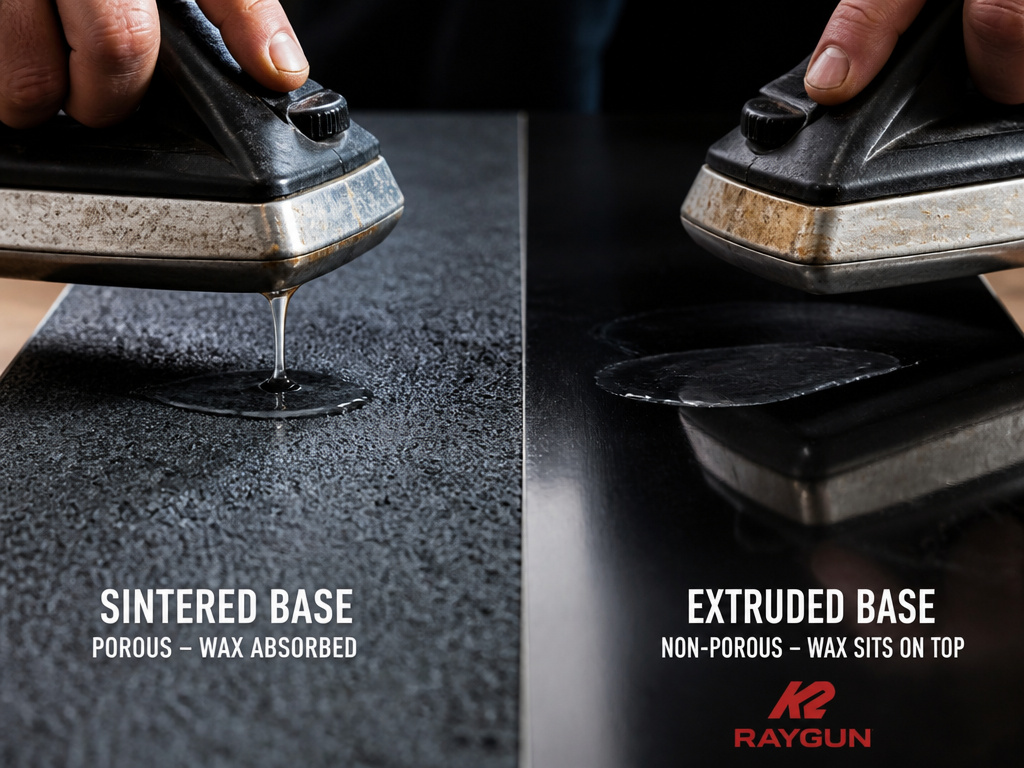
The Extruded 2000 Base demands a mindset shift. A sintered base is porous; it soaks up wax like a sponge, which then acts as a lubricant to reduce friction with the snow. An extruded base is non-porous. Wax sits on the surface. This is why sintered bases are faster, they maintain a wax layer for longer, and why extruded bases are slower.
One point often overlooked is that for most recreational riders, the speed difference only matters on cat tracks and long, flat runouts. The Raygun’s extruded base is a feature, not a flaw, for its target rider. It’s incredibly durable and virtually maintenance-free.
Common mistake: Believing you can “wax it to be fast.” A hot wax on an extruded base will clean it and provide a slight temporary speed boost as the wax cools on the surface, but it will scrape off after a run or two. You’re not changing the fundamental material.
If maximum speed is a priority for you, this is the wrong board. A Reddit user recommended the Ride Machete as a similar-shaped board with a sintered base for exactly this reason. Own the trade-off: you’re choosing durability and simplicity over ultimate performance.
K2 Raygun Alternatives and Upgrade Paths
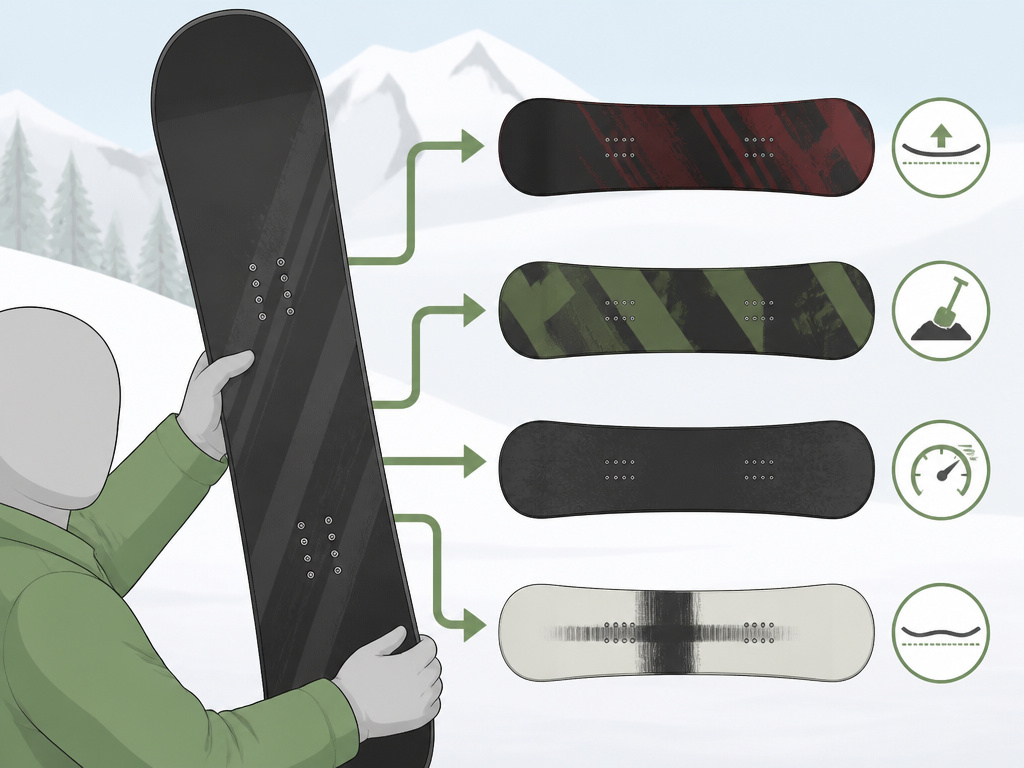
So you’ve determined the Raygun isn’t quite right, or you’re ready to move on from it. What’s next? The community and reviews point to a few clear paths.
For Progression & Proper Edge Control: If you like the Raygun’s price and vibe but want a profile that will actively teach you better technique, look at the K2 Raygun Pop. This variant features a traditional camber profile between the feet. As one Reddit user advised, “I’m always going to recommend camber (Raygun Pop) for anyone looking to actually progress their riding… It’s going to teach you proper edge control.” Another user echoed this, saying once they got a camber board, their riding improved quicker.
For a Step Up in All-Mountain Performance: The K2 Excavator is frequently mentioned as a direct, more advanced successor. It’s a volume-shifted, directional board with camber underfoot and a rocker nose. A rider recommended it, noting it’s “7/10 stiffness so it can really lay down carves” and that you can ride it 5-10 cm shorter than a typical board. It’s a modern, aggressive take on the all-mountain concept.
For a Similar Price with a Sintered Base: As mentioned, the Ride Machete was suggested as a direct comparator with a sintered base for more speed. The K2 Broadcast is another often-recommended, versatile board in the same category that many find to be a more playful and capable all-rounder.
For the Aggressive Expert: If you’re truly outgrowing the Raygun’s capabilities, you’re looking at stiffer, camber-dominant boards like the Burton Custom Camber. This represents a significant jump in performance demand and price.
Frequently Asked Questions
Is the K2 Raygun a good board for beginners?
Yes, it’s an excellent first board. The rocker-flat-rocker profile is very forgiving and reduces edge catches, the flex is medium and predictable, and the extruded base requires minimal maintenance. It provides a stable, confidence-building platform to learn the fundamentals.
What is the difference between the K2 Raygun and the K2 Raygun Pop?
The key difference is the camber profile. The standard Raygun uses a rocker-flat-rocker (or flat/rocker) design. The Raygun Pop uses a traditional camber profile between the bindings. The Pop will provide better edge hold, more pop for ollies, and a more aggressive, direct feel, making it better for riders focused on progression.
Can the K2 Raygun handle powder?
It handles powder surprisingly well for an all-mountain board. The directional twin shape with a 20mm stance setback and the rockered nose help it float. It’s not a dedicated powder board, but for the occasional deep day or soft snow conditions, most riders find it more than adequate.
How fast can the K2 Raygun go?
Owner reports conflict, which is informative. Some riders report sustaining speeds over 50 mph, while reviews note its extruded base limits top speed and causes instability (chatter) at higher speeds. Sources disagree on high-speed performance in a K2 Raygun snowboard review: a forum user reported sustaining speeds over 50 mph on a 2014 model, while SnowboardingProfiles states the board’s speed “definitely suffers due to its extruded base.”
What size K2 Raygun should I get?
Size primarily by weight, but pay close attention to your boot size. If you have a boot size US 10 or larger, you should strongly consider a Wide (W) model to avoid toe and heel drag. Refer to the manufacturer’s size chart for weight recommendations, and when in doubt, lean toward the longer end of the range for stability or the shorter end for maneuverability.
The Bottom Line
The K2 Raygun makes its trade-offs transparent once you know where to look. You get a forgiving, versatile shape and a durable, low-maintenance build for a price that’s hard to beat. In return, you accept a ceiling on speed, a limit on aggressive carving, and a warning if your feet are on the larger side.
Its real value isn’t as a forever board, but as a specific tool for a specific phase. If you’re a beginner or an intermediate who wants one reliable deck to build skills and explore every part of the mountain without overthinking maintenance or technique, it’s a standout choice. But if your local hill is a series of high-speed groomer laps, or if you’re already eyeing the advanced terrain, its extruded base and relaxed flex will feel like a handbrake.
For those who do outgrow it, the path forward is clear. The community has already mapped the upgrade to the K2 Excavator, the K2 Broadcast, or the cambered Raygun Pop. That alone tells you what the Raygun is: a solid, honest foundation. It’s the board you learn on, not the board you learn to push against.
