Niu Electric Scooter Review: Performance and Recalls
This post contains affiliate links. As an Amazon Associate, we earn from qualifying purchases.
NIU scooters are solidly built commuter machines with good ride quality, but their real-world range often falls short of claims, and a federal recall on the MQi GT EVO for sudden motor failure shows their quality control can stumble. The brand’s two-year warranty is standard, but customer service experiences are polarized, some get quick fixes, others face rigid return policies for simple parts. For most riders, the KQi3 Pro is the balanced pick, but you must know the specific charging and storage rules to protect the battery.
That gap between claimed and tested range is the practical difference between confidently commuting to work and pushing a 50-pound scooter the last mile. The manuals hide the specifics that actually determine whether your scooter lasts three seasons or three years.
What follows: a breakdown of the only recall on a NIU scooter, the verified performance numbers you won’t find in ads, a direct comparison with Segway, and the specific battery care rules that a NIU electric scooter review must highlight to prevent early failure. By the end, you’ll know exactly which model fits a real commute and the one check you must do when the box arrives.
Key Takeaways
- The NHTSA recall 22V-597 affected 38 MQi GT EVO scooters for sudden motor power loss, check your VIN if buying used.
- Real-world range tests, like those from Bennetts, show the NQi GTS achieving 30-40 miles, not its claimed 55 miles.
- Charge the battery first, then plug into power; unplug power first, then the battery to avoid sparking and board damage.
- For long-term storage, the manuals directly contradict each other: the NQi Series Manual says disconnect after one week, while the RQi User Manual says it’s safe for up to one month.
- If you need a simple part replaced under warranty, be prepared for NIU to possibly demand you ship the entire scooter.
Build Quality and Real-World Durability
The frame feels solid. You notice it the first time you lift a KQi3 Pro, the deck doesn’t flex, the stem has no play, and the welds are clean. NIU uses better aluminum than the bargain-bin brands. That’s the good news. The bad news is that solid frame is bolted to components with a mixed track record.
Owners report specific, repeatable failures. Some owners report specific, repeatable failures like worn tires or loose fenders. These aren’t catastrophic, but they’re the kind of mid-life maintenance that many first-time buyers don’t anticipate. The scooter won’t snap in half, but you will be hunting for a 10mm socket and a replacement tire sooner than you’d like.
Where this goes sideways: Assuming IP54 waterproofing means you can ride through deep puddles. The standard only protects against low-pressure water spray from any direction. Submerging the wheel axle, as the NQi manual warns, can rust the motor and kill the battery. The deck stays dry, but the critical parts underneath don’t.
The KQi Air changes the material game with a frame that’s 70% carbon fiber and 30% magnesium. Reviewers note the immediate difference in weight and stiffness. It’s a premium build for a premium price. But that premium doesn’t erase the standard warranty and support experience that comes with all NIU models.
Performance: Claimed vs. Tested Numbers
Manufacturers love top-speed and range figures. Riders need to know how it performs on a Tuesday morning with a backpack on. The gap between the two decides whether you’ll be happy or stranded.
Take the NIU NQi GTS. The spec sheet claims a 55-mile range. Bennetts BikeSocial’s real-world test got 30-40 miles. That’s a 27-45% drop. The top speed claim was 55 mph; their GPS logged 52 mph. Close enough. The important number was the charging time: up to 6 hours on a standard socket. That’s the reality you plan your day around, not the idealized range.
For the smaller kick scooters, the data is even more granular. On an 8% grade hill, their average speed dropped to 6 MPH. On a 17% grade, it failed completely. That’s the level of detail that tells you if this scooter can handle your commute.
| Model | Claimed Range | Tested Range | Top Speed (Tested) | Key Limitation |
|---|---|---|---|---|
| NQi GTS | 55 miles | 30-40 miles | 52 mph | Real-world range drop |
| KQi 100F | Not specified | 10-14 miles | 17.4 mph | Struggles on steep hills |
*Estimates based on user reports and similar motor specs.
The takeaway from any good niu electric scooter review is that their testing conditions, likely a lightweight rider on a flat track at moderate temperature, don’t match your city’s hills, your weight, and the stop-and-go traffic. You must subtract from their numbers to get yours.
The Official Recall and What It Means
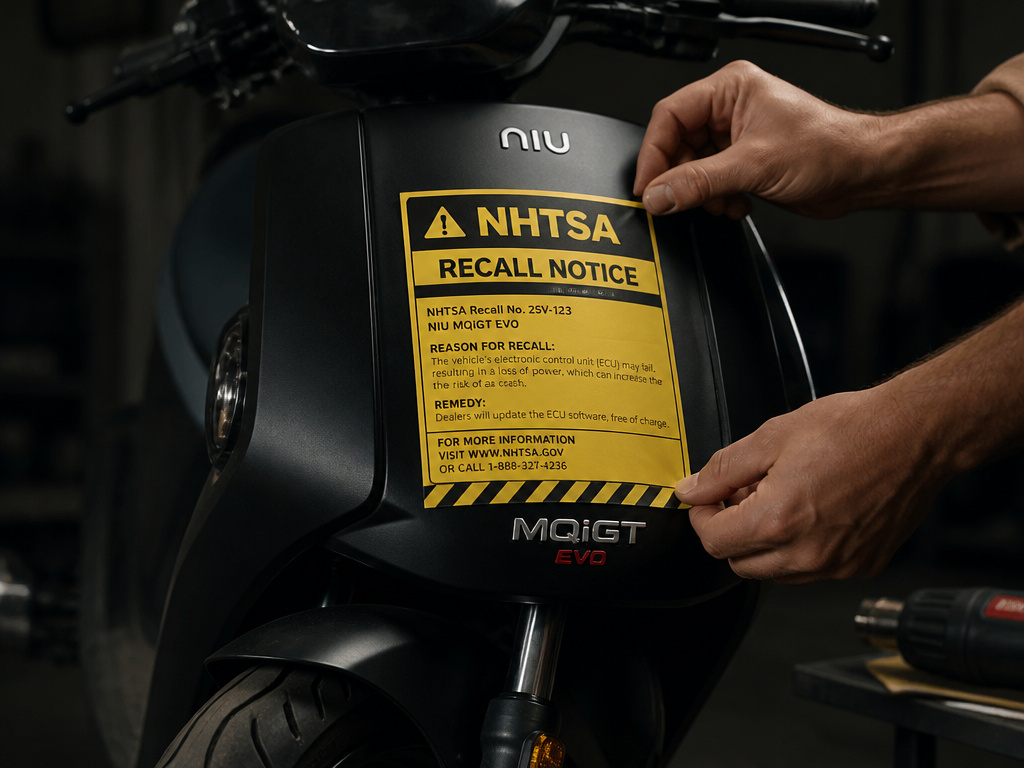
In August 2022, Genuine Scooters LLC submitted official NHTSA recall documentation for 38 NIU MQiGT EVO scooters. The defect: a loss of motor power without warning and excessive handlebar vibration. Eight complaints for motor faults and three for vibration triggered the action.
Thirty-eight units is a tiny batch, produced between January 14 and 20, 2022. If you’re not buying a used MQi GT EVO from that specific window, this recall doesn’t directly affect you. But it’s a lens into how NIU handles serious safety problems.
The chronology in the report shows the process: dealers complained, NIU investigated, and a joint decision to recall was made. They also offered a full refund.
This recall proves the system works, a defect was identified, reported, and a remedy issued. But it also highlights the kind of catastrophic failure mode (sudden power loss at speed) that every scooter buyer fears. NIU had one. They addressed it.
For a brand marketing itself on reliability, a federal safety recall is a permanent black mark. It shows that even with their experience in electric mopeds, their foray into higher-power scooters had a stinging quality control failure. When you read a niu electric scooter review, you’re looking at a company that has dealt with a worst-case scenario.
Battery Care and Warranty: Reading the Fine Print
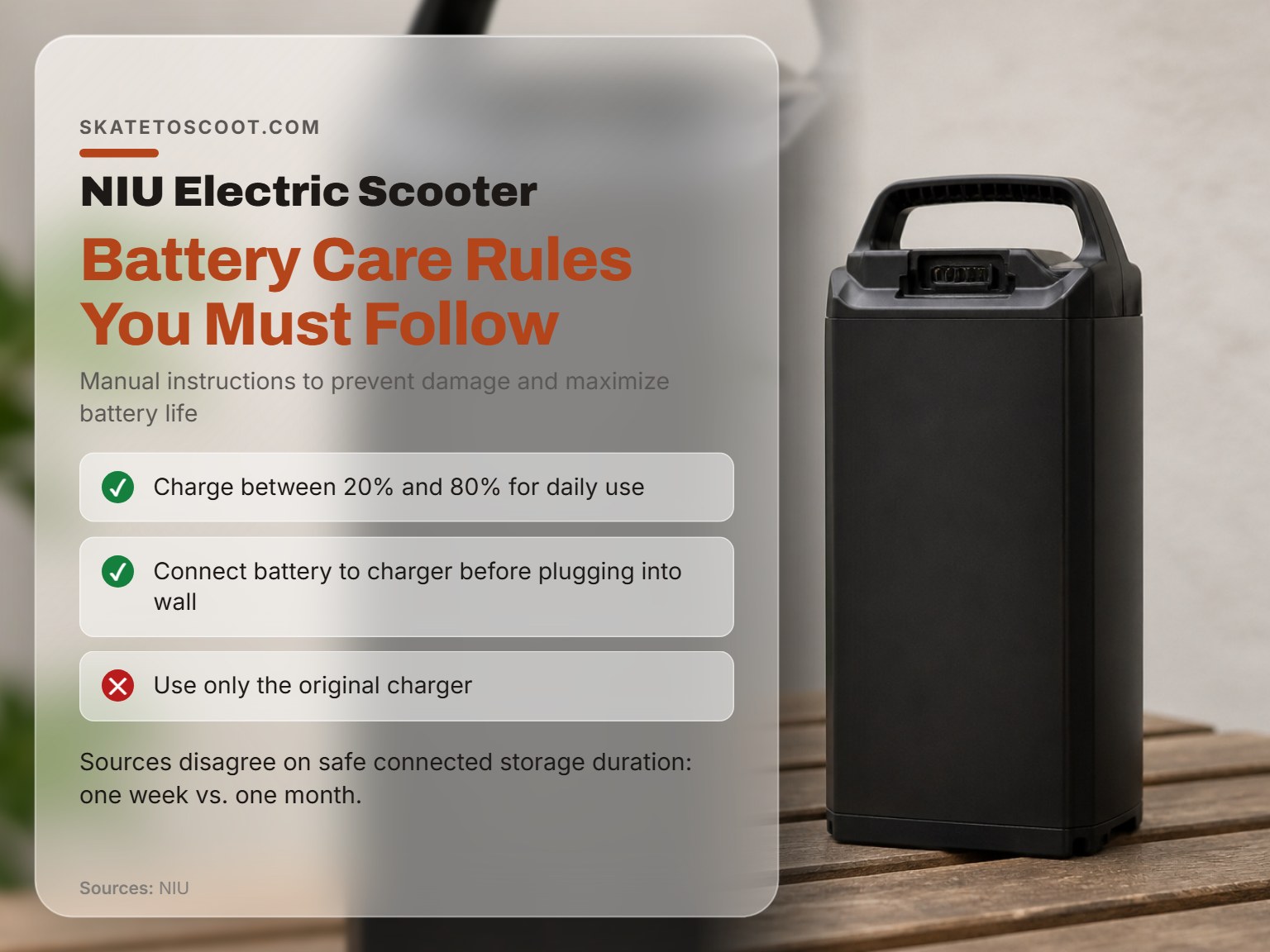
This is where you save or kill a NIU scooter. The battery is the most expensive component, and the manuals are full of strict rules that most riders gloss over.
First, charging sequence matters. The NQi manual is explicit: connect the battery to the charger first, then plug the charger into the wall. When done, disconnect from the wall first, then unplug the battery. Reversing this can cause a spark at the DC connector, potentially frying the charging port or the battery management system. It’s a simple habit that prevents a costly repair.
Second, storage is a minefield of contradictions. The NQi and MQi GT EVO manuals say to disconnect the battery from the scooter for any storage longer than one week. The RQi manual says it’s safe to leave it connected for up to one month. Which is right? NIU hasn’t clarified. The conservative take is to follow the one-week rule. A disconnected battery is less likely to be drained by phantom vehicle loads.
| Scenario | Manual Instruction | Why It Matters |
|---|---|---|
| Daily Charging | Keep battery between 20%-80% | Maximizes cycle life, prevents stress at full charge. |
| Storage (<1 Week) | Keep battery at 50% charge, store under 40°C. | Prevents capacity loss from heat or deep discharge. |
| Storage (>1 Week) | Disconnect battery, store at 10°-25°C, 30%-70% charge. | Direct Source Conflict: NQi says >1 week, RQi says >1 month. |
| Cold Weather Use | Usable capacity is 70% at -10°C, 85% at 0°C. | Your range plummets in winter; plan accordingly. |
The two-year warranty for the main body (frame, motor, controller, battery) is standard, though manuals give conflicting advice on when to disconnect the battery for storage. It starts from your purchase invoice, delivery date, or activation. But the warranty doesn’t mean convenient service. A Trustpilot review from a KQi3 Pro owner described a broken dashboard, a simple plug-and-play part. NIU’s support insisted they ship the entire 25kg scooter internationally for repair, refusing to send the small component. That’s the support gamble.
NIU vs. Segway: The Real Choice for Most Commuters
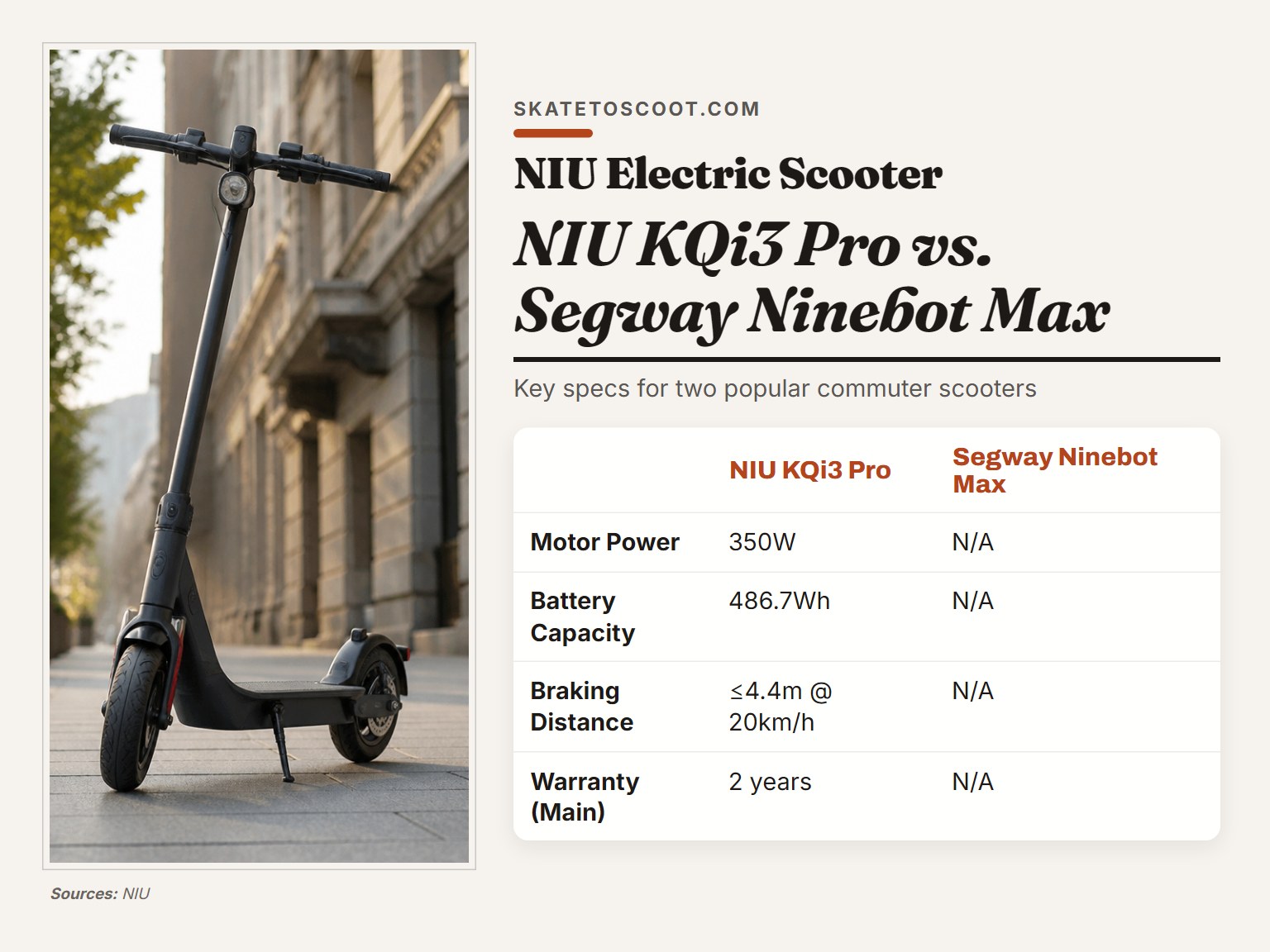
Segway’s Ninebot Max is the default commuter scooter. NIU’s KQi3 Pro is the challenger. The choice isn’t about which is “better,” but which set of compromises fits your ride.
The Ninebot Max G30P has a legendary reputation for durability and water resistance (IPX5). It’s the scooter you buy if you want minimal hassle and proven longevity. Its ecosystem of parts and mods is vast. The trade-off is a stiffer ride and a more basic design.
The KQi3 Pro fights back with a more comfortable, wider deck, better lighting, and a 350W motor. The ride quality is noticeably smoother for longer trips. However, its IP54 rating, while good, is technically less water-resistant than the Segway’s IPX5. It’s also a newer platform, so long-term reliability beyond 2-3 years is less documented.
Here’s the decision matrix:
- Choose the Segway Ninebot Max if your priority is proven, no-fuss reliability, you ride in all weather, and you value a huge aftermarket for parts and upgrades.
- Choose the NIU KQi3 Pro if you prioritize ride comfort and a more feature-rich design for a similar price, and you’re willing to be slightly more cautious in heavy rain.
For heavier riders or those with steep hills, neither is ideal; you may need to look at the best electric scooters from more powerful brands. You’d need to step up to a more powerful dual-motor scooter from another brand entirely. These are both strictly urban, single-motor commuters.
Who Is a NIU Scooter Really For?
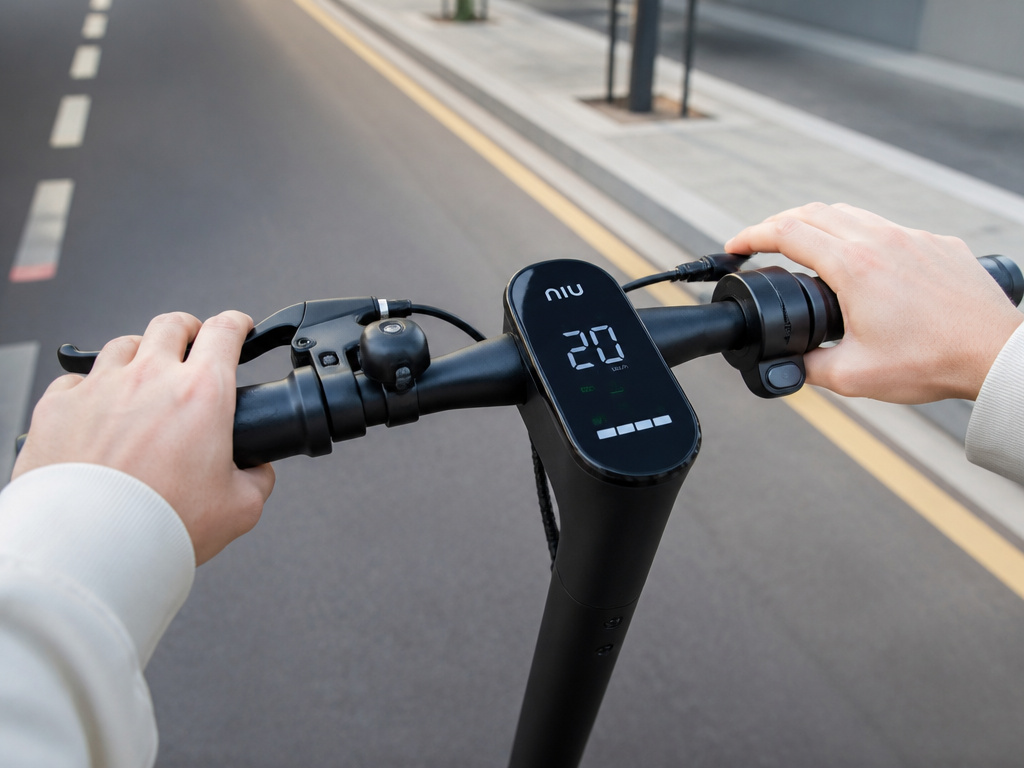
One point is clear. NIU scooters are meticulously engineered for a specific person, not for the “send it” crowd who want a rugged, all-terrain beast.
The ideal NIU rider is an urban commuter with a relatively flat, sub-10-mile route. They value a clean, quiet, and comfortable ride over raw power or off-road capability. They are the type to read the manual, maintain the correct tire pressure (which, by the way, you should check weekly), and follow the battery storage rules. They appreciate good design and are willing to pay a small premium for it over a generic Amazon scooter.
They are also a patient problem-solver. If something goes wrong under warranty, they are prepared for a customer service process that might require persistence, detailed documentation, and possibly shipping the scooter. The reward for this diligence is a well-built machine that, when treated right, should deliver years of service.
If your life involves steep hills, heavy cargo, rough roads, or a complete aversion to any maintenance, a NIU scooter will frustrate you. Look at brands with more robust suspension, dual motors, and a reputation for ruggedness instead. NIU excels at refining the core commuter experience, not expanding its boundaries.
Frequently Asked Questions
Are NIU scooters good quality?
The build quality is generally very good, especially on the KQi3 and KQi Air lines, using better materials than many competitors. However, quality control can be inconsistent, as seen in the MQi GT EVO recall and scattered user reports of misaligned brakes or failing fenders. Their customer service quality is the bigger variable, with experiences ranging from excellent to terribly rigid.
How long does a NIU scooter last?
There’s no definitive lifespan data yet, as NIU’s kick scooters have only been widely available since 2021. Based on build quality and battery care, a well-maintained NIU scooter should last 3-5 years before needing significant component replacements like the battery. Adhering to the 20%-80% charging rule and proper storage is critical to hitting the upper end of that range.
Which is better, Segway or NIU?
For proven, no-worry durability and all-weather riding, Segway’s Ninebot Max is better. For a more comfortable, feature-rich ride at a similar price, the NIU KQi3 Pro is better. It’s a trade-off between Segway’s battle-tested reliability and NIU’s slightly more refined user experience. There is no universal “better,” only a better fit for your priorities.
What should I check when my NIU scooter arrives?
Inspect the frame and stem for any cracks or deep scratches. Check that both wheels spin freely without rubbing. Test the brakes, they should engage smoothly without sticking. Power it on and ensure the dashboard lights up with no error codes. Finally, take a slow test ride in a safe area to listen for any unusual grinding, clicking, or motor noise.
The Bottom Line
A NIU scooter is a good choice, not a great one. It’s for the rider who does their homework. You must go in knowing the real-world range will be less, understanding the precise battery care rituals, and accepting that warranty service might be a battle. If you treat it as a precision tool, keeping tires inflated, storing the battery correctly, and charging in the right order, it will reward you with a smooth, reliable commute.
But if you want a scooter you can absolutely abuse, charge without thought, and expect bulletproof support, the Segway Ninebot Max still holds the crown. NIU builds a compelling alternative that shines in comfort and design, but it demands more from its owner. Your choice ultimately comes down to whether you’re a meticulous maintainer or a minimalist rider. Pick your role, then pick your scooter.
