Ookkie Skateboard Review: How It Stacks up Against Others
This post contains affiliate links. As an Amazon Associate, we earn from qualifying purchases.
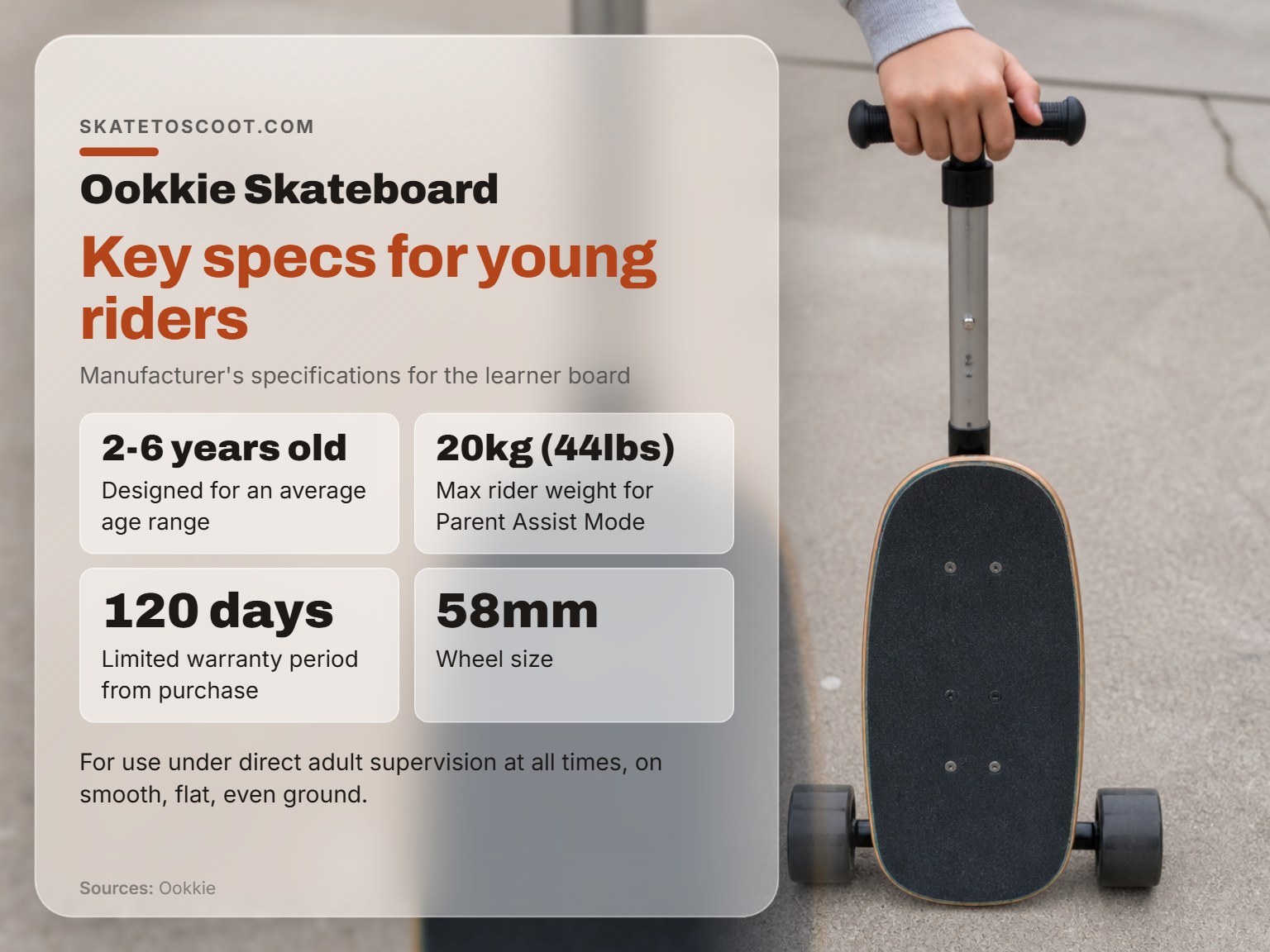
The Ookkie Skateboard is a learner board designed for kids aged 2-6, featuring removable handles and a 75cm plastic deck. Its 120-day warranty covers defects, but it comes with strict safety rules, a 20kg max weight, mandatory protective gear, and use only on smooth, flat ground. The core question is whether its handle-assisted design effectively teaches the balance crucial for real skateboarding.
The 120-day warranty period is your first clue. That’s four months from the date of purchase for defects in materials or workmanship, and it’s not transferable to a second owner. It’s a short window, and the manufacturer’s maintenance page explicitly warns that damage from leaving the board in the elements impacts warranty claims. This frames the entire ownership experience: the Ookkie isn’t a throw-it-in-the-garage piece of sports equipment. It’s a supervised, indoor-stored training tool with a finite service life, a key point in any Ookkie skateboard review.
What follows is a breakdown of the specs that matter, the safety rules you can’t ignore, and the direct conflict between glowing marketing and skeptical customer reviews. By the end, you’ll know if the Ookkie’s handle-based method fits your kid’s learning style or if you’re better off with a real, small-scale skateboard for beginners.
Key Takeaways
- The Ookkie’s 120-day limited warranty is short and packed with exclusions for environmental damage and “normal wear and tear.”
- Maximum rider weight is 20kg (44lbs) for Parent Assist Mode; exceeding this voids the warranty and risks component failure.
- Full protective gear is required per the manufacturer’s safety page, helmet, wrist guards, and pads must be worn every time.
- The board is not designed for stunts, hills, or uneven pavement; using it outside smooth, flat environments is a direct safety violation.
- Multiple customer reviews directly contradict the “premium ride” claim, calling the quality “flimsy” and comparable to a big-box store toy.
Breaking Down the Specs: What You’re Actually Buying
The product page lists the numbers. A 75cm (29.5″) deck, 18cm (7″) wide, with 58mm wheels and 3.5cm (1.3″) of ground clearance. It weighs 3.8kg (8.3lbs). The handles adjust: the child’s pole from 41-60cm (16-23.5″), the parent’s from 81-86cm (31.8-33.8″).
Those numbers tell a story. The deck is 75cm long and 18cm wide. The 58mm wheels are common for cruising, but the plastic composite deck and the integrated handle mounts change the flex and feel entirely. The weight limit is the critical spec: 20kg (44lbs) for Parent Assist Mode, 50kg (110lbs) for Child Only Mode. Go over the 20kg limit with a parent holding the handle, and you’re outside the design parameters.
The front truck is easily adjustable, to be either tightened (for a more stable ride) or loosened to allow the rider more control. This adjustment is a standard skateboard tuning step, but here it’s framed as a learning aid. The front truck is easily adjustable, to be either tightened (for a more stable ride) or loosened.
The assembly requires an adult. You insert the child’s handle pole until it clicks, a clear audio cue that it’s locked. Missing that click means the handle isn’t secure. It’s a simple process, but it shows that this isn’t a toy pulled straight from the box by a toddler. It’s a piece of sporting equipment that needs a correct setup to be safe.
The Warranty and Durability Questions
The warranty document is blunt. Ookkie offers a 120-day guarantee against defects in materials and workmanship for the original purchaser. It is not transferable. The company “will repair or replace, at our discretion, any of our goods that are defective within this timeframe.” It then lists what isn’t covered: normal wear and tear, damage from accidents or misuse, and modifications.
The maintenance page adds the critical environmental clause. “Prolonged exposure to UV or moisture may impair the performance.” It explicitly states that damage from leaving the board in the elements impacts warranty claims. The manufacturer states that prolonged exposure to UV or moisture may impair performance. This isn’t a board for leaving on the patio.
| Component | Ookkie Stated Quality | Critical Review Counterpoint |
|---|---|---|
| Deck Material | “Secret plastic formula” for strength & flexibility | Reviewer Andrew H: “quality… No better than a cheap-knock off Target or Wal-Mart skateboard” |
| Wheels & Bearings | “Quality components” for a “premium ride” | Same review: “the quality of the board and wheels are flimsy and ‘meh'” |
| Overall Durability | “Built for strength… And maximum radness” | Multiple reviews cite “cheap quality” and being “underwhelmed” |
This direct conflict is the spine of any Ookkie skateboard review. You can’t reconcile “premium” with “cheap knock-off.” One side is marketing; the other is a posted customer experience from someone claiming lifelong skateboarding knowledge. The warranty’s short duration and strict exclusions are part of the manufacturer’s terms.
Safety Rules: The Non-Negotiable Fine Print
The safety page isn’t a suggestion list. It’s a warning label written in bullet points. An adult must directly supervise at all times. The rider must wear a helmet, wrist guards, and pads. The 20kg max weight rule is repeated. The board must not be used in traffic, on hills, on uneven pavement, at night, or while the child is seated. Only one rider at a time. Periodic checks of all screws, bolts, and handles are required.
Common mistake: Letting a child over the 20kg (44lbs) limit use the board in Parent Assist Mode. The polymer handle mounts and truck assembly are rated for that specific stress. Exceed it, and the failure point becomes the parent’s grip strength versus a broken component.
The “recommended environment” is smooth, flat, even ground. That means a clean driveway, a tennis court, a smooth garage floor. Not a sidewalk with cracks, not a park path with pebbles, not a sloped driveway. The board must not be used on uneven pavement. This limitation is a major differentiator from a traditional complete skateboard, which can handle rougher surfaces with smaller, harder wheels.
The rules exist because the Ookkie is a training tool for an inherently risky activity. Skateboarding involves falls. The handles aim to mitigate that, but the manufacturer’s lawyers know they can’t eliminate it. Hence the gear mandate and the flat-ground rule, a key consideration in any Ookkie skateboard review. Skip any of these, and you’ve moved from a controlled learning session into unsupervised play with a piece of plastic sporting equipment.
The Four Stages and Learning Curve
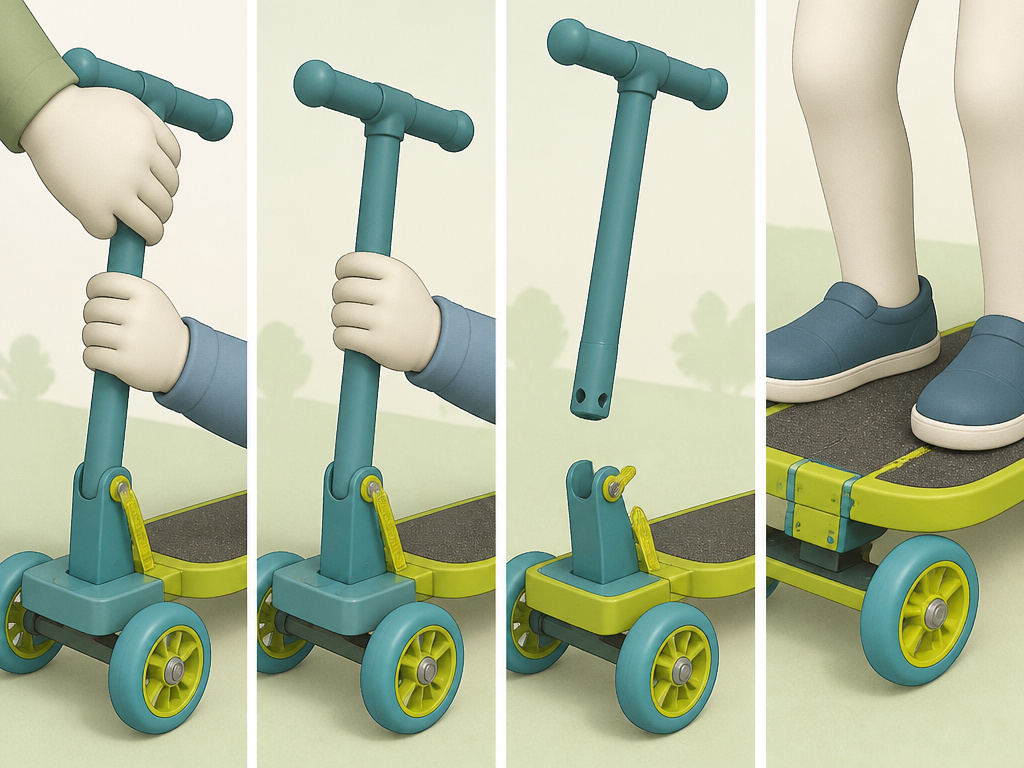
The manufacturer promotes four phases. Stage 1: Parent and child handles attached for full support. Stage 2: Parent handle removed, child uses only their handle for balance. Stage 3: Child handle removed, parent uses the handle to guide and stabilize. Stage 4: All handles removed, child rides the board solo.
The board can be used in 4 different phases/stages. Does the child learn to balance their body over the trucks, or do they learn to grip a vertical pole for stability? A Reddit comment in the research cuts to the chase: “Nonsense similar to bikes with side wheels. The entire point is they MUST learn to balance and this… Takes away this most important aspect.”
This is the fundamental debate. Proponents of traditional skateboards for teens and beginners argue balance is the first, essential skill. You learn it by standing on a board that can tilt, wobble, and roll. The Ookkie’s method inserts a rigid balance aid, which some argue teaches a dependency that must later be unlearned. The counter-argument is that it builds confidence and a familiar feeling of being on a board in a safer context.
The board is collapsible into three main parts for transport, a practical feature for families on the go. The front truck’s adjustability allows you to set the turning resistance. A tighter setting (more stable) is likely where most beginners will start. The question is whether a child graduating from Stage 4 has learned skateboarding fundamentals or just how to ride an Ookkie.
How It Stacks Up Against Real Beginner Skateboards
| Aspect | Ookkie Learner Skateboard | Traditional Beginner Complete (e.g., Braille, CCS) |
|---|---|---|
| Primary Learning Method | Handle-assisted balance, phased removal of support. | Direct balance acquisition on a freely turning board. |
| Deck Material | Proprietary plastic composite. | 7-ply Canadian maple (industry standard for strength and pop). |
| Wheel Size | 58mm (standard cruiser size). | Varies (often 52-54mm for street, larger for cruisers). |
| Key Safety Feature | Removable handles for adult assistance. | Low center of gravity, quality grip tape, appropriate sizing. |
| End Goal | Transition to riding the Ookkie without handles. | Transition to performing tricks, riding parks, or cruising. |
| Longevity | 120-day warranty, environmental sensitivity. |
A kid will fall more.
Frequently Asked Questions
What is the weight limit for the Ookkie skateboard?
The maximum rider weight is 20kg (44lbs) for Parent Assist Mode, where an adult uses the parent handle. For Child Only Mode, where the child uses only their handle, the limit is 50kg (110lbs). Exceeding the 20kg limit in Parent Assist Mode puts stress on components not designed for it and voids the warranty.
How long is the Ookkie skateboard warranty?
The Ookkie comes with a 120-day limited warranty from the date of purchase for the original buyer. It covers defects in materials and workmanship but explicitly excludes damage from normal wear and tear, accidents, misuse, modifications, or environmental exposure (sun, rain).
Can you use the Ookkie skateboard on concrete sidewalks?
The manufacturer’s safety guidelines say no. The recommended environment is “smooth, flat, even ground.” Sidewalks often have cracks, slopes, and uneven seams. Using the Ookkie on them increases the risk of catching a wheel and tipping, which is against the safety rules.
What age is the Ookkie skateboard for?
The manufacturer designs it for an average age range of 2 to 6 years old. This aligns with the 20kg weight limit for Parent Assist Mode. A child’s ability to stand unassisted and follow simple instructions is also a prerequisite per the safety warnings.
Is the Ookkie skateboard good for learning real skateboarding?
This is the core debate. The manufacturer positions it as a safe, confidence-building learner tool. Critics, including some experienced skaters, argue that learning to balance with rigid handles doesn’t translate directly to the dynamic balance needed for a real skateboard. It may build comfort and a love for rolling, but the fundamental skill of balancing on a freely turning truck must still be learned later.
The Bottom Line
The Ookkie Skateboard is a specific product for a specific scenario. It’s for a parent who wants a highly controlled, supervised introduction to skateboarding for a toddler, with safety as the absolute priority. It is a learner board with a 120-day warranty and specific maintenance requirements.
If your goal is to see if your 3-year-old enjoys the sensation of rolling on a board without the immediate risk of hard falls, and you are committed to storing it indoors and adhering to every safety rule, the Ookkie has a logic. Ookkie’s design is intended to teach balance in a safe context, while critics argue the handles don’t teach the fundamental balance needed for real skateboarding.
