Segway F SE Electric Kick Scooter Review: Where It Fits
This post contains affiliate links. As an Amazon Associate, we earn from qualifying purchases.
The Segway F SE electric kick scooter is a rebadged Segway F2, part of the F-Series family, with a 300W motor, a 275 Wh battery, and an IPX5 water resistance rating. It’s built for flat, smooth urban commutes under 10 miles and prioritizes simple reliability over high performance or comfort features like suspension.
That rating and battery size are the scooter’s entire personality. They tell you exactly what the F SE is for and, more importantly, what it is not for. This isn’t a scooter that thrives on hills, rough pavement, or long-distance hauls. Its job is to get you a few miles across town predictably and fold up quietly when you’re done. The core of any Segway F SE electric kick scooter review will confirm this focused design.
What follows is a breakdown of where that predictability holds up, where it cracks, and the handful of real decisions that separate a good buy from a frustrating one. We’ll walk through the verified specs from the Segway manuals, cross-reference them with what actual owners report after a year of use, and land on who this scooter actually fits.
Key Takeaways
- The F SE (F2) is built for flat, short urban commutes; its 300W motor struggles on sustained inclines over 10%.
- No suspension means you’ll feel every crack and pebble; this scooter demands smooth pavement for a comfortable ride.
- Long-term reliability is good, but common wear items include the rear disc brake (needs periodic adjustment) and tires (prone to flats on debris).
- For its price point, the F SE offers verified safety certifications (ANSI/CAN/UL-2272) and straightforward repairability via Segway’s official parts store.
Decoding the Segway F SE: It’s an F2 in Disguise
First, the naming clears up a lot of confusion. The Segway F SE sold at Sam’s Club is identical to the Segway F2 available elsewhere. Both are part of the broader F-Series, sitting between the entry-level F25 and the more capable F40. The core specs are locked in by Segway’s own documentation: a nominal 300W motor, a 36V battery with 275 Wh of nominal energy, and a net weight of 33.3 lbs (15.1 kg).
This matters because reviews, parts, and troubleshooting for the F2 apply directly to your F SE. You’re not buying an oddball; you’re buying a slightly discounted version of a known quantity. The value proposition is straightforward: you get Segway’s baseline build quality and a network of official support, but you give up the extra battery of the F40 or the suspension of the pricier F3 Series.
Where this goes sideways: Assuming the “SE” denotes a special edition with upgraded parts. It doesn’t. It’s a retail-channel label, not a performance tier. Expect F2-level performance.
Performance Specs: Where 300 Watts Actually Takes You
The 300W nominal motor is the workhorse of the base F-Series. According to the Segway F-Series manual, it can handle a max slope of 15% for the F30 model—which the F SE mirrors.
Here is what that means. On flat ground with a 165 lb rider, the scooter will hit its top speed. Add a backpack, a slight headwind, or a rider over 200 lbs, and you might see 16-17 mph. The 15% hill claim is a laboratory-grade maximum under ideal conditions. In practice, a “15% grade” feels like a steep residential hill. The scooter will climb it, but speed will drop significantly, often into the single-digit mph range. For a daily commute with one or two moderate hills, it’s fine. For a hilly city, it’s a constant exercise in patience.
| Performance Metric | Claimed (Segway Manual) | Real-World Expectation |
|---|---|---|
| Max Speed | 18.6 mph | 16-18 mph (varies by rider weight, wind) |
| Max Slope | 15% | Speed drops sharply on sustained inclines over 10% |
| Motor Power | 300W nominal | Adequate for flats; requires kick-assist on longer hills |
| Terrain | Obstacles < 0.4 in, gaps < 1.2 in | Strictly smooth pavement; curbs are a hard stop |
The acceleration is smooth, not jerky, which is a plus for beginners. There’s no “zero-start” feature; you need to give a gentle kick-off before the throttle engages. This is a safety design, not a flaw. It prevents accidental launches.
The 3 Real-World Range Scenarios You Need to Plan For
Here is the most critical section of any Segway F SE electric kick scooter review. The advertised “typical range” for the F30 (and thus the F SE) is based on Segway’s test with a 165 lb load, 77°F, averaging 60% of max speed on pavement. Segway’s manual defines this as a test under full power with a 165 lb load, at 77°F, averaging 60% of max speed on pavement.
Almost no one rides like that.
Owner reports split into three clear patterns, which give you a much better planning tool than the single number on the box.
Scenario 1: The Ideal Commute (Flat, Moderate Speed)
- Conditions: Mostly flat bike paths, using Sport mode but not constantly at full throttle, rider around 160-180 lbs.
- Reported Range: 12-15 miles.
- Why: This aligns closest to Segway’s test. One Reddit owner with an F2 reported getting 15 miles with 10% charge remaining under similar conditions.
Scenario 2: The Full-Throttle Run
- Conditions: Riding at top speed (18+ mph) the entire time, some stops and starts, same rider weight.
- Reported Range: 9-12 miles.
- Why: The manual’s “60% of max speed” average is key. Pinning the throttle consumes the battery dramatically faster. Another owner noted, “6 miles takes about 50% of my battery… I would only be able to get about halfway home before it goes into power saving mode.”
Scenario 3: The Loaded Rider
- Conditions: Rider over 200 lbs, carrying a backpack, maybe a slight incline on the route.
- Reported Range: 6-9 miles.
- Why: The scooter’s 265 lbs max payload is a structural limit, not a performance guarantee. More weight directly reduces range and hill-climbing ability. The motor works harder, draining the battery quicker.
The short version: If your daily round-trip is under 10 miles, the F SE will cover it with a safe margin. If it’s 12-15 miles, you’ll need to charge at your destination or ride conservatively. Anything over 15 miles on a single charge is unrealistic.
Build Quality and Durability: What Breaks First?
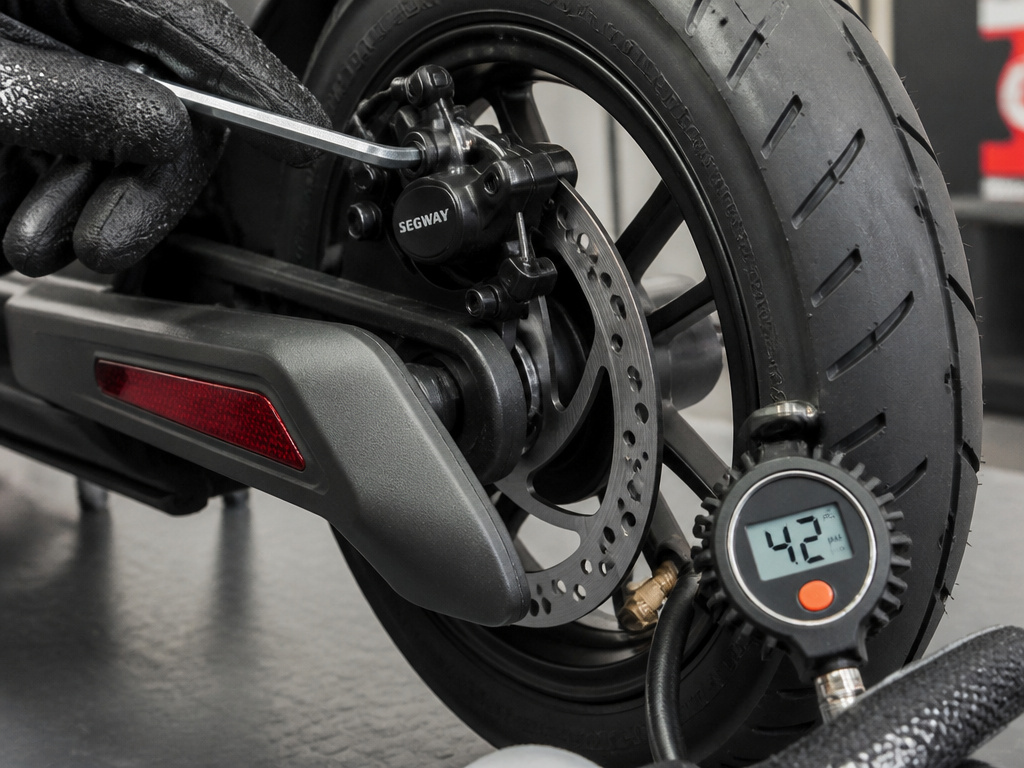
The F-Series frame is solid steel. You won’t hear rattles from the folding mechanism, and the deck has a good, grippy rubber surface. The IPX5 rating means it can handle light rain and road spray, but it’s not submersible. Don’t ride through deep puddles.
Long-term, two components see the most wear: the tires and the rear disc brake.
Tires: The pneumatic tires are a blessing and a curse. They provide the only cushion on a suspension-less scooter, offering a better ride than solid tires. However, they are prone to flats, especially if you ride over debris like glass or thorns. Keeping them inflated to the 40–45 psi specified in the manual is the best prevention. The sound of a tire going soft is a faint, rhythmic thump-thump-thump that gets faster with speed. Heed it immediately.
Rear Disc Brake: The mechanical disc brake is effective but requires occasional adjustment. A common owner complaint is the brake pad rubbing against the rotor after a few months, creating a faint metallic whirring sound and sapping range. The fix is straightforward: loosening the caliper bolts, squeezing the brake lever to center the caliper, and retightening. It’s a 5-minute job with a hex key, but it’s a job you’ll likely need to learn.
Common mistake: Ignoring the recommended tire pressure. Running tires even 10 psi low increases rolling resistance (cutting range) and makes pinch flats far more likely.
The scooter carries important safety certifications, which is a significant point in its favor. The Segway F-Series manual states the product is certified to ANSI/CAN/UL-2272 by TUV Rheinland, and the battery complies with UN/DOT 38.3 and ANSI/CAN/UL-2271. In a market flooded with uncertified batteries, this verified testing matters for fire safety.
Portability and Weight: The 33.3 lb Reality
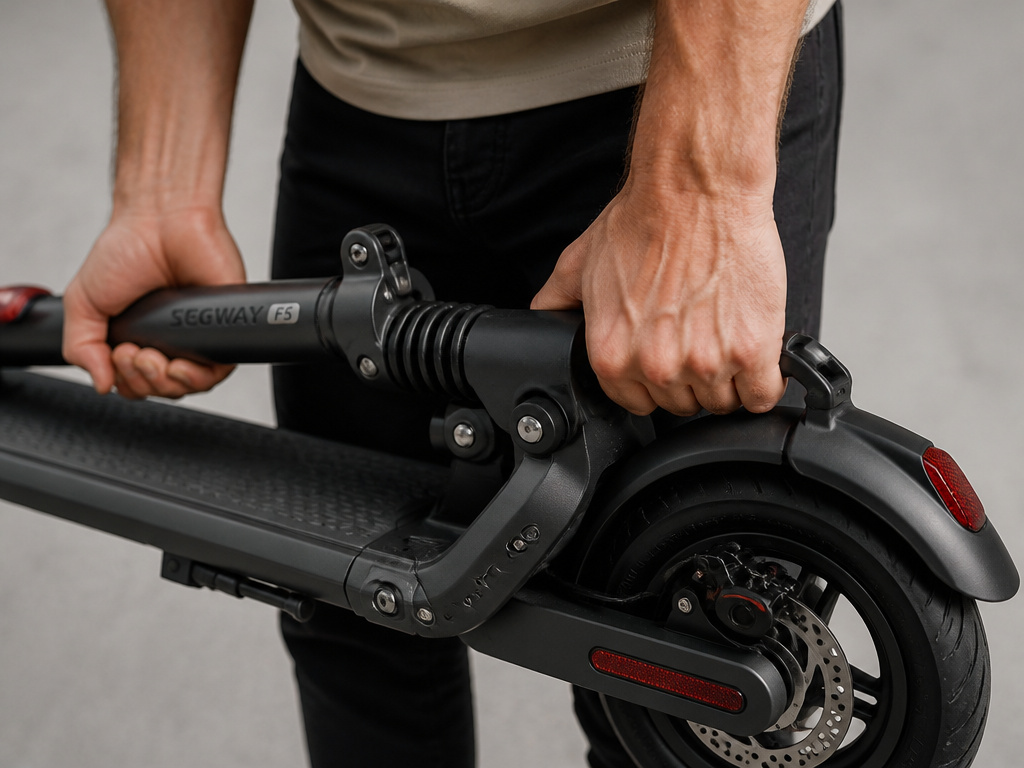
At 33.3 lbs (15.1 kg), the F SE is in the “carryable but not lightweight” category. The folding mechanism is simple and robust: pull the quick-release lever, fold the stem down, and use the safety hook to latch it to the rear fender. It works every time, but the clasp can be stiff when new.
This weight and folded size make it manageable to lift into a car trunk or carry up a few flights of stairs. Carrying it a half-mile through a train station, however, will feel heavy. If your commute involves significant multi-modal carry, the lighter F25 (32.4 lbs) or a scooter with a trolley wheel might be worth the trade-off in battery size.
The folding hook is clever. It locks the handlebar to the fender, keeping the package tidy. Just make sure it’s fully engaged; a loose fold is awkward to carry.
Segway F SE vs. Other Segway Models: Where It Fits
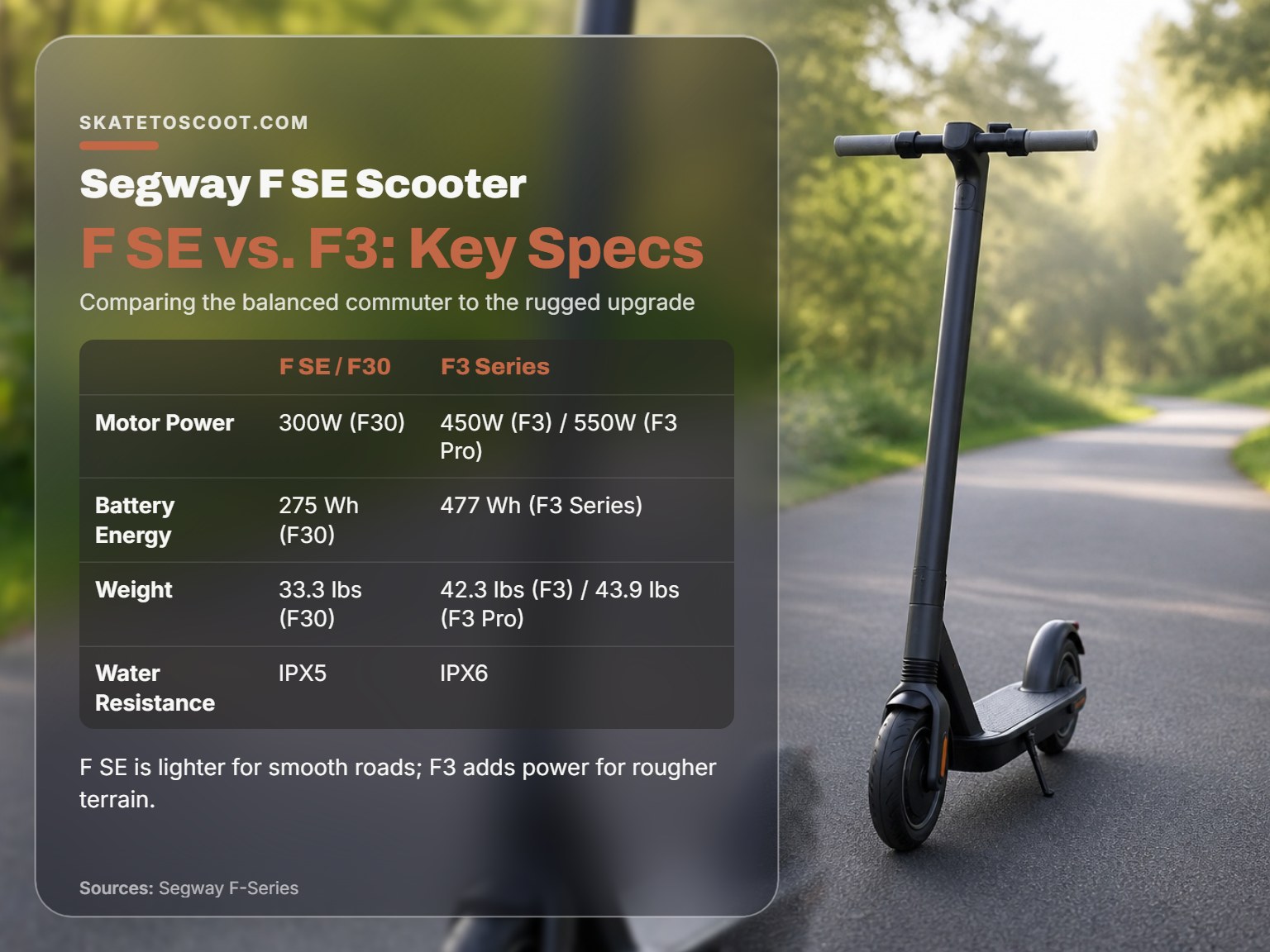
To understand the F SE’s value from a Segway F SE electric kick scooter review, you need to see its place in Segway’s own lineup. It’s the middle child.
| Model | Motor | Battery | Weight | Key Differentiator |
|---|---|---|---|---|
| F25 | 300W | 183 Wh | 32.4 lbs | Lightest, shortest range, lowest cost. |
| F SE / F2 / F30 | 300W | 275 Wh | 33.3 lbs | The balanced commuter. This review’s subject. |
| F3 Series | 450W-550W | 477 Wh | 42.3+ lbs | Front suspension, higher IPX6 rating, more robust for rougher roads. |
If your roads are rough, the F3’s front spring is worth the extra weight and cost. If you only need a last-mile solution on pristine pavement, the F SE does the job.
Compared to the legendary Ninebot Max G30P, the F SE is lighter and less expensive but gives up the Max’s legendary range, tubeless self-healing tires, and overall tank-like durability. The Max is a long-term investment; the F SE is a capable tool for a specific, shorter-range need.
Maintenance and Long-Term Ownership
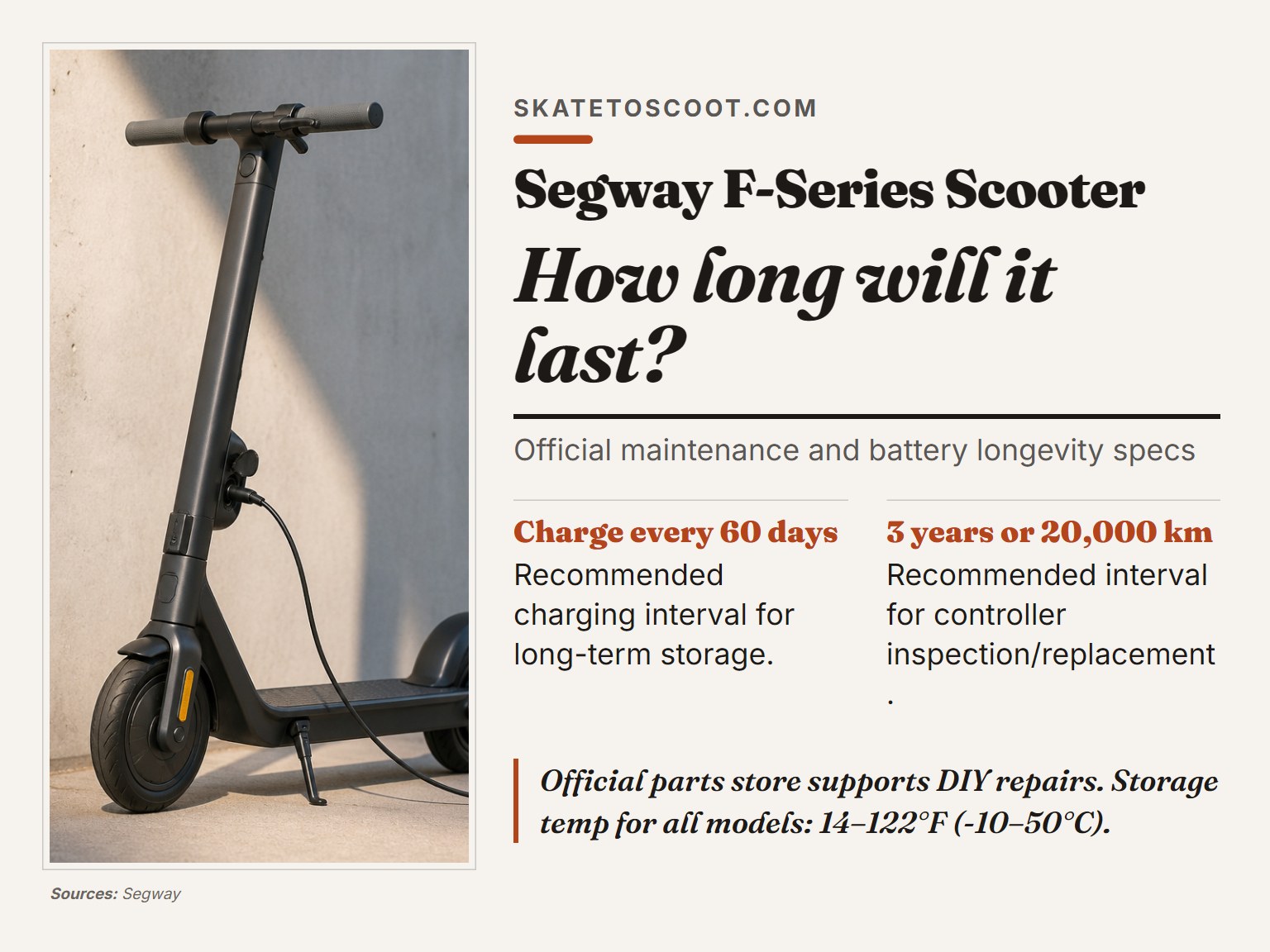
Segway’s “Important Information” sheet provides a maintenance schedule. Following it prevents most common issues.
- Every 3 months: Check the bell, throttle, app connection, and charging function.
- Every 6 months or 500 km: Check the steering for resistance or lag.
- Battery Care: For long-term storage, charge to 50% or above and charge once every 60 days. If stored below 32°F (0°C), do not charge it until it warms up above 50°F (10°C). Segway advises letting the scooter cool down before plugging it in, while some owners suggest a specific cooling interval of an hour or two.
- Longevity: The sheet states the battery should retain more than 70% capacity after 500 charge cycles. The controller may need inspection after 3 years or 20,000 km.
The official Segway parts store lists replacement parts, making DIY repairs a documented possibility. This is a major advantage over brands with no parts support.
Frequently Asked Questions
Is the Segway F SE a good scooter?
For its intended use of short, flat urban commutes, the Segway F SE is a good, reliable scooter. It offers verified safety certifications, decent build quality, and official parts support. It is not a high-performance or comfort-focused model.
What is the real range of the Segway F SE?
Plan for 10-15 miles of real-world range. You may see the advertised 18+ miles only under ideal, gentle riding conditions. Rider weight, speed, hills, and temperature all significantly reduce range.
Does the Segway F SE have suspension?
No. The F SE, like all base F-Series models, has no suspension. The ride comfort depends entirely on the 10-inch pneumatic tires and tire pressure.
Is the Segway F SE the same as the F2?
Yes. The Segway F SE sold at Sam’s Club is functionally identical to the Segway F2 sold through other retailers. They share all core specifications.
Can the Segway F SE go up hills?
It can handle moderate hills (grades around 10% or less), but speed will drop noticeably. On steeper or longer hills, the 300W motor will struggle, and you may need to kick-assist.
Before You Go
The Segway F SE’s value isn’t a mystery. It’s a competent, certified, no-frills commuter for smooth roads and short distances. Its limitations (range, hill power, lack of suspension) are clearly defined by its specs. The deal-breaker isn’t the scooter; it’s a mismatch between its capabilities and your route.
Here’s the threshold: if your daily ride involves hills, potholes, or a need for more than 12 miles between charges, step up to an F40 or an F3. If you have a flat, sub-10-mile commute on good pavement and want a dependable, serviceable tool, the F SE represents solid value, especially at a discount. Just keep the tire pressure up, listen for the brake rub, and charge it before it hits 20%. That last 20% disappears faster than the first.
