Skateboard Tricks List Easiest to Hardest
This post contains affiliate links. As an Amazon Associate, we earn from qualifying purchases.
The real skateboard tricks list from easiest to hardest isn’t a single line. It’s a branching tree where the first branch is learning to ride, the trunk is the ollie, and the limbs split by stance, rotation, and obstacle commitment. The hardest combine flips, spins, and precise truck placement, judged on a single overall score that weighs difficulty against cleanliness and flow.
Looking for a numbered list you can check off? You won’t find one here, at least not a useful one. Every skater’s path forks differently based on what feels natural first. A tre flip might click for you before a kickflip does. But the prerequisites don’t change: you need balance before pop, pop before flip, and commitment before grind. Any skateboard tricks list easiest to hardest is inherently personal.
What follows is a framework, not a checklist. We’ll pull from official glossaries, trick databases, and judging criteria to show you why a “50-50 grind” sits before a “crooked grind” on a skateboard tricks list easiest to hardest, how your stance changes the difficulty of every trick, and where most guides get the “easiest trick” debate completely wrong. By the end, you’ll have a map to build your own progression.
Key Takeaways
- Start with balance tricks that need no jump: the kickturn, tic-tac, and manual. These build board feel without the risk of a pop.
- The ollie is the essential foundation for almost every flip and grind; most skaters spend weeks to months locking it in.
- Stance changes everything: a trick in your natural “regular” stance is the baseline; doing it “switch” (opposite foot forward) is generally judged as the hardest read.
- Grinds and slides require a clean ollie onto and off of an obstacle without looking down, mastering the approach is the real gate.
- Disregard any list that calls the 360 Flip (Tre Flip) a beginner trick; major progression guides place it in the “Advanced Flips” stage for good reason.
The “Easiest Trick” Debate and Why It’s a Trap
If you Google “easiest skateboard trick,” you’ll get two conflicting answers. One side, like Boredom Wizard, points to the kickturn, tic-tac, and manual because they require no jumping. The other, like Switch Magazine, nominates the 360 Flip due to its popularity. Boredom Wizard lists the kickturn, tic-tac, and manual as the easiest tricks because they need no jumping, while Switch Magazine states the 360 Flip is considered easiest because of its popularity.
The kickturn is the easiest trick based on pure mechanics. You’re just shifting your weight to the tail to pivot the board. It’s a fundamental control skill. Calling the 360 Flip “easy,” however, is a classic case of outcome bias. Yes, the motion can feel natural once mastered, but it sits at the end of a long progression path. Onbolts categorizes it in Stage 5: Advanced Flips, noting it’s “the milestone most skaters chase for months.”
Where this goes sideways: Starting with a trick like the 360 Flip because a list labeled it “easy.” You’ll lack the pop, scoop, and commitment skills it builds on, leading to months of frustration and a higher risk of injury.
So, what’s the actual first trick? It’s not a trick at all. It’s riding. Push comfortably, kickturn, stop. As one Reddit user bluntly put it: “Do not worry about tricks. Learn to ride the skate, push it with ease, go down a curb… Get used to the board.” The first pop trick, as nearly every source agrees, is the ollie.
The Core Progression Path (Stages 1-5)
Forget random rankings. Think in stages, where each stage borrows a core skill from the last. The most coherent framework comes from Onbolts, which outlines a five-stage learning path. This isn’t just opinion; it’s a logical build-up of mechanics.
| Stage | Focus | Key Tricks | Prerequisite Skill |
|---|---|---|---|
| 1. Foundations | Balance, Pop, Board Control | Ollie, Manual, Fakie Ollie, Nollie | Riding comfortably, basic kickturns |
| 2. First Flips | Board Rotation & Flick | Pop Shove-it, Kickflip, Heelflip | Reliable, consistent ollie |
| 3. Rotations | Body & Board Spin Together | Frontside 180, Backside 180, Cab (Fakie 360) | Controlled ollie with shoulder commitment |
| 4. Grinds & Slides | Obstacle Commitment | 50-50 Grind, 5-0 Grind, Boardslide | Clean ollie onto and off of an obstacle |
| 5. Advanced Flips | Combined Flip & Spin | Varial Flips, Tre Flip (360 Flip), Hardflip | Kickflip and heelflip mechanics second nature |
Stage 1 is where you build your platform. The ollie is, as Onbolts states, “the single most important trick you will ever learn.” A clean one makes the next two years easier. This stage also introduces changing your direction: fakie (rolling backwards, normal stance) and nollie (rolling forward, popping off the nose). These aren’t just novelty stances; they double your trick vocabulary early on.
Stage 2 starts the rotation. The pop shove-it is a gentle introduction because it’s just a scoop, no flick. The kickflip and heelflip then add that front-foot flick. The prerequisite is absolute: “you need a reliable ollie first, because a flip is just an ollie with a flick added at the peak.”
Stage 3 is about spinning your body and board together. Learning 180s in both directions early prevents one-sided habits. The skill here is committing your shoulders and spotting your landing, which is foundational for every future spin trick.
Stage 4 moves you from flat ground to obstacles. The real barrier isn’t the grind itself; it’s the approach. You need a clean, controlled ollie onto a ledge or rail without staring at your feet. Start low.
Stage 5 is for synthesis. The varial flip combines a shove-it and a kickflip. The tre flip (a 360 shove-it with a kickflip) is the famous milestone. These demand the earlier mechanics be automatic.
The Stance Multiplier: Why “Switch” Isn’t Just Backwards
Most difficulty lists present tricks in a vacuum. They’ll say a “kickflip” is intermediate. But a kickflip performed in your natural stance is a world apart from a switch kickflip (opposite foot forward). In judging, stance dramatically changes the difficulty read.
JudgeMate’s analysis of competition scoring breaks down the stance difficulty hierarchy clearly:
- Regular: Natural footing. This is the baseline, no added difficulty.
- Fakie: Riding backward, feet normal. Slightly above regular.
- Nollie: Riding forward, popping off the nose. Clearly above regular.
- Switch: Opposite foot forward for everything. Generally the hardest read.
This is why learning fakie and nollie early (Stage 1) pays off when you build your own skateboard tricks list easiest to hardest. It gets you comfortable with altered balance points before you tackle the full mental hurdle of switch. A Reddit user lamented, “Learning switch early is so underrated!!! Practice or you’ll end up like me, lost when my feet are ‘backwards’.”
Skateboarding has no difficulty table, no D-score, and no multiplier. Judges assign a single overall score balancing high-difficulty anchors against cleanliness, variety, and flow.
So, a realistic “hardest” list isn’t just trick names. It’s “Hardflip” vs. “Switch Hardflip” or “Backside Noseblunt Slide.” The stance is baked into the trick’s challenge.
How Judging Context Changes “Difficulty”
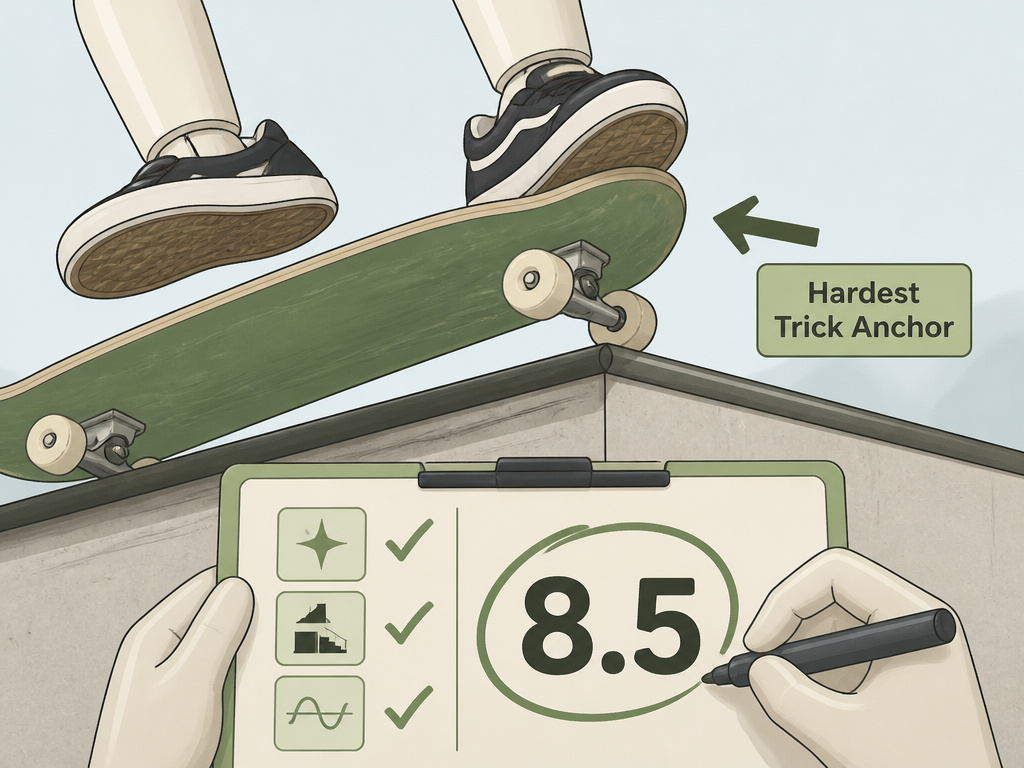
Outside of personal progression, there’s an official context for difficulty: competition. Understanding this reframes what “hard” means. In competition skating, judges don’t add up points for each trick. They watch a run and assign one number that balances the hardest tricks landed against how clean, varied, and fluid the entire run was.
The hardest, highest-impact trick anchors the difficulty score. But if the rest of the run is sloppy, the overall score drops. This means a slightly easier run landed with perfect control can beat a run with one mega-trick landed sketchily. Difficulty is relative to execution.
This judging lens is why resources like the Exploratorium skateboarding glossary are valuable. They provide clear, technical definitions, like the difference between a “5-0 grind” (on the back truck only) and a “nosegrind” (on the front truck only), which form the vocabulary of those judged performances.
Gear That Lets You Progress (Not Holds You Back)
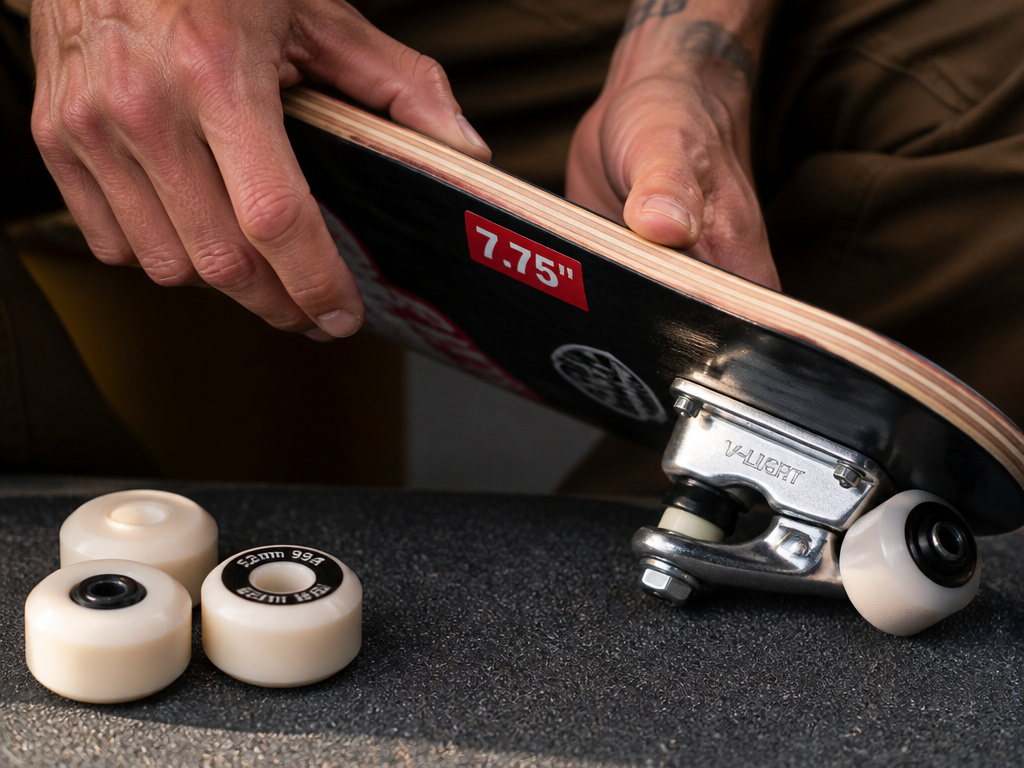
Your setup isn’t just about preference; it directly enables or hinders learning. Boredom Wizard’s advice is pragmatic: “The best skateboard for tricks is a regular ‘popsicle’ deck 7.75 to 8.25 inches wide.” Narrower decks (like a 7.75″) flip easier, which can help a beginner feel that first kickflip rotation. Wider decks (8.25″+) offer more stability for landing grinds and riding transition.
Wheels matter just as much. Boredom Wizard notes “hard, small wheels (around 52 to 54 mm) are the usual choice for street and park.” The Exploratorium glossary gives us the numbers: hard wheels have a durometer of 97 or higher, while soft wheels are about 85. Hard wheels slide and rebound predictably on concrete, essential for learning slides and precise landings. Soft wheels absorb too much and grip when you don’t want them to, making rotation tricks harder.
This is why choosing the right skateboard wheels is a foundational decision, not an afterthought. The wrong setup adds an invisible layer of friction to every new trick you attempt.
Navigating the Massive Trick Databases
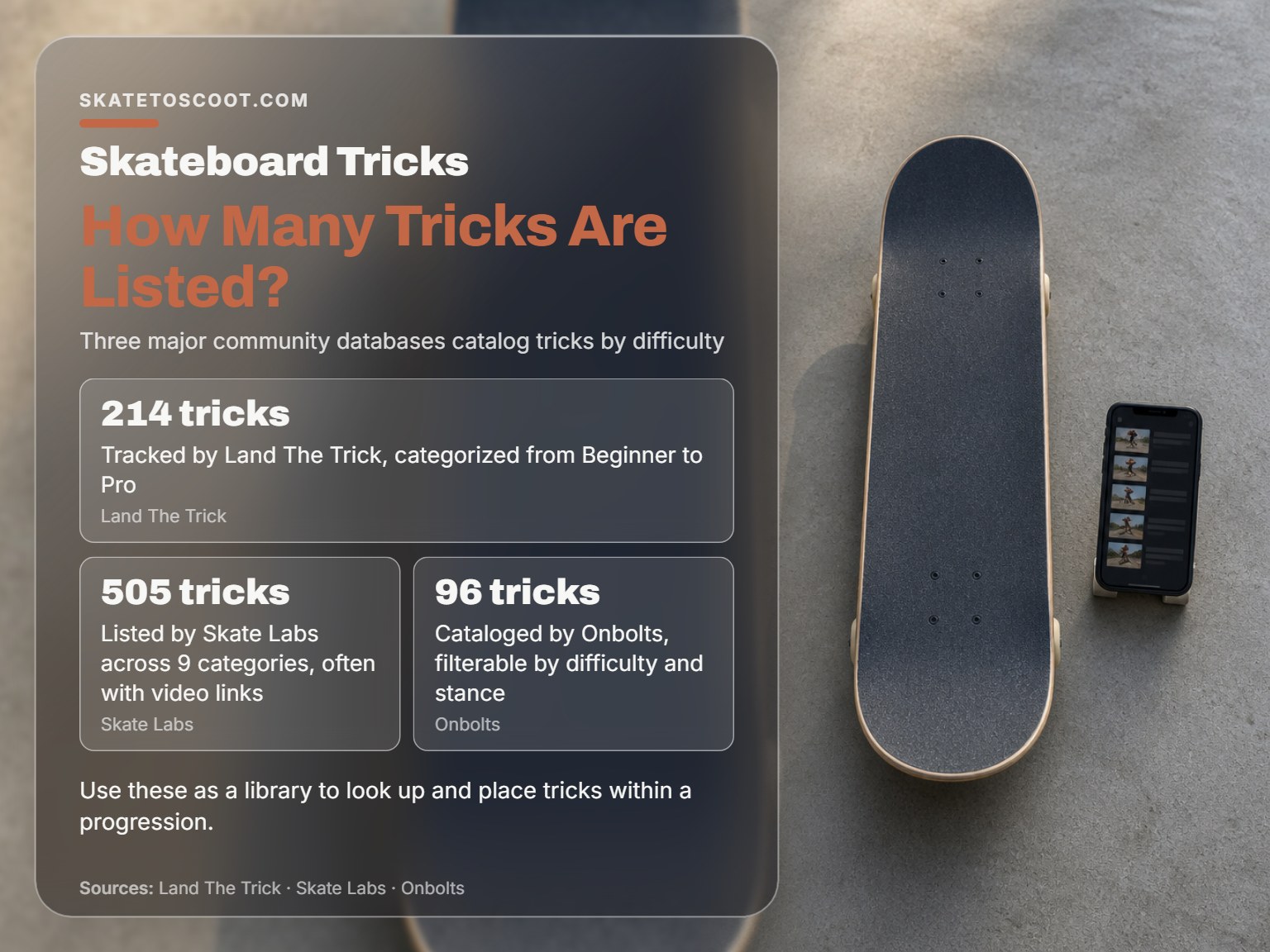
Once you have the framework, you’ll want a catalog to explore. Several large, community-driven databases exist, each with its own categorization.
- Land The Trick tracks 214 skateboard tricks, categorized from Beginner to Pro. It’s great for checking off progress.
- Skate Labs lists a massive 505 tricks across 9 categories, often linking to video lessons.
- Onbolts catalogs 96 tricks, filterable by difficulty (Beginner, Intermediate, Advanced) and, uniquely, by stance (Regular, Fakie, Nollie, Switch).
Use these as a library, not a syllabus. Look up a trick like the “crooked grind” to see it’s categorized as Advanced on Onbolts, and you’ll know it follows the 50-50 and 5-0 in the grinding family. This helps you place unfamiliar trick names within the progression tree.
Common Beginner Struggles & Solutions
The gap between knowing a trick’s name and landing it is where most get stuck. Here are specific pain points and how to bridge them.
- The Ollie Plateau: You can pop the board but it doesn’t level or stay with you. Solution: Focus on the front foot. It’s not just a jump; you must drag the side of your front foot up the grip tape to level the deck. Practice stationary on grass to kill the board’s roll-away fear.
- The Kickflip Rocket: The board spins but shoots out in front of you. Solution: Your shoulders are opening up. Keep them parallel to the board. The flick is off the side of the nose, not straight ahead.
- Fear of Grinds: You ollie toward the ledge but bail every time. Solution: Start by just ollieing onto the obstacle and landing on the bolts. Then step off. Then try stalling (landing in the grind position but not sliding). Break the trick into commits.
My personal rule, born from hard experience, is to never try more than two new tricks in a single session. Chasing a third or fourth new motion when you’re tired leads to sloppy form, frustration, and a higher risk of taking a bad fall. Drill what you’re close to landing, then play with something new.
Frequently Asked Questions
What are the 10 hardest skateboard tricks?
There’s no official list, but consensus among progression guides and community discussion points to tricks that combine multiple rotations, flips, and precise technical execution. These include tricks that combine multiple rotations, flips, and precise technical execution, often performed in switch stance. Stance always multiplies difficulty, a Switch Laser Flip is a lifetime achievement for most pros.
Is 27 too old to start skateboarding?
No, but your approach matters. Adults have less time to heal, so a methodical focus on fundamentals and safety gear is crucial. Start with the balance tricks (kickturn, manual) and invest in wrist guards and knee pads. Progress will be different than a fearless 12-year-old’s, but the enjoyment of landing a new trick is ageless. The key is consistent, short practice sessions.
What is the most difficult trick in skateboarding?
This constantly evolves as pros push boundaries. The most difficult trick constantly evolves as pros push boundaries with new combinations of rotations, flips, and technical execution. In street skating, new, never-been-done tricks often claim the title of most difficult.
Do I need to learn tricks in the exact order?
The order is a guide built on prerequisites, not a strict law. You need an ollie before a kickflip, that’s mechanical fact. However, you might find shove-its easier than 180s, or get comfortable with boardslides before 5-0 grinds. Use the stage framework to understand the required skills, then follow your own natural aptitude within that lane. Skipping fundamentals, however, always creates a plateau later.
Before You Go
Throw away the idea of a single, linear “easiest to hardest” list. Your path is a skill tree. Water the roots first: riding balance, then the ollie. The landmarks are clear, your first flip, your first 180, your first grind. The stance variations (fakie, nollie, switch) are parallel branches you can grow early or revisit later.
The ollie is the one essential skill. Everything else is a variation on its pop. So if you take one thing from this, let it be this: spend your next two sessions not chasing a trick, but chasing a higher, more controlled, more consistent ollie. That single investment pays compound interest on every trick that follows.
Now go try it. Just keep rolling.
