Vans Infuse Snowboard Boots Review: The Bottom Line
This post contains affiliate links. As an Amazon Associate, we earn from qualifying purchases.
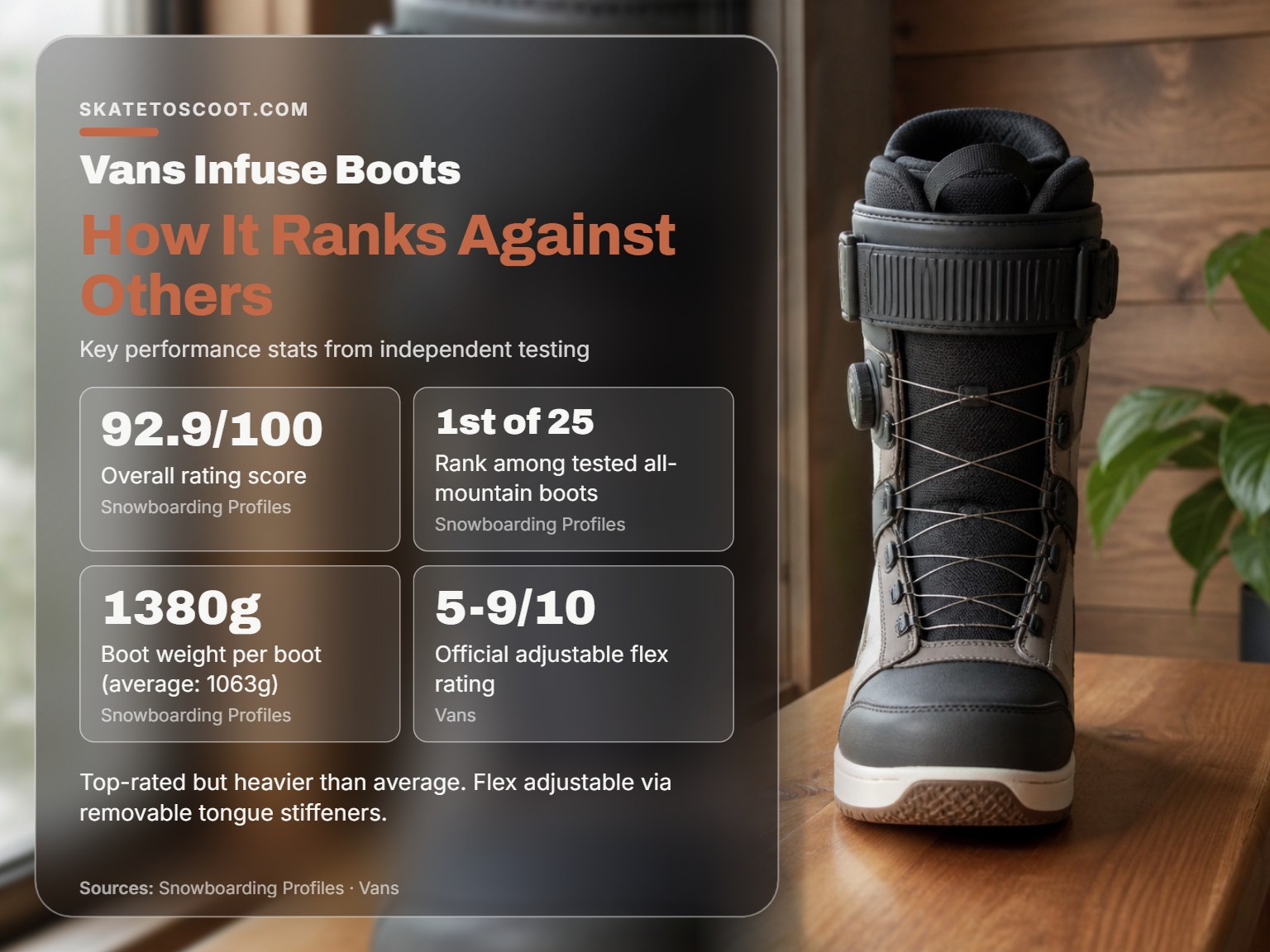
The Vans Infuse snowboard boot (model VN0A3DILBA2) is a high-end, versatile all-mountain boot that scored 92.9/100 in independent testing, ranking 1st out of 25 current model men’s all-mountain boots tested. It features a customizable flex via removable tongue stiffeners, a hybrid BOA/lace closure system, and a premium V3 liner, but its real-world flex adjustment is about 1.5-2 levels, not the advertised 4-level range, and some users report specific, painful manufacturing defects with the BOA cable guides.
That gap between the marketing claim and the on-snow measurement is where the real review starts. The boot’s official flex rating of 5-9/10 sets an expectation of massive tunability, but professional testers clock it at 7.5/10 with stiffeners in and around 5.5-6/10 with them out. That’s a crucial distinction for a rider choosing a boot based on advertised versatility, as detailed in the Vans Infuse snowboard boots review.
What follows is a breakdown of where the Infuse excels, where it stumbles, and what the actual experience looks like after 50 or 100 days on the hill, central to any Vans Infuse snowboard boots review. This review examines the flex, the controversial lacing system, the fit, and the long-term durability stories you won’t find on the product page.
Key Takeaways
- The Vans Infuse scored 92.9/100 in professional testing, ranking it first among current all-mountain boots, but its real flex range is narrower than advertised.
- Its hybrid BOA/lace system offers immense customization but has been criticized as “kind of a pain” by some reviewers, while others praise its secure fit.
- A specific, painful BOA cable guide defect has been reported by multiple users, causing sharp pressure on the ankle that sometimes requires DIY modification or warranty return.
- The boot is heavy, weighing 1380g (3lbs 1oz) per boot compared to an average of 1063g, which impacts hiking and board feel.
- Long-term owners report adding stiffeners as the boot breaks in and using shims under the footbed after 75+ days when the liner packs out, extending the boot’s life significantly.
The Official Flex Rating vs. Real-World Feel
Vans markets the Infuse with a flex rating of 5-9/10, thanks to its Vans Flex Control System, those removable plastic tongue stiffeners. The idea is you can dial the boot from a soft, playful feel to a stiff, charger-ready platform. On paper, it’s a boot that grows with you.
The on-snow measurement tells a different story. Snowboarding Profiles, after controlled testing, rated the flex at 7.5/10 with the stiffeners in and ~5.5-6/10 with them out. Their reviewer explicitly states: “that is an exaggeration of how much difference those tongue stiffeners make to flex, IMO. They don’t change the flex by 4 levels!… It’s more like 1.5 to 2 flex levels, by my feel.”
| Configuration | Vans Claim | Snowboarding Profiles Measurement | Best For |
|---|---|---|---|
| Stiffeners IN | 9/10 | 7.5/10 | All-mountain charging, carving |
| Stiffeners OUT | 5/10 | ~5.5-6/10 | Park, freestyle, surfy turns |
| Reality | 4-level range | ~1.5-2 level range | Fine-tuning, not transformation |
This isn’t a deal-breaker, but it’s a vital calibration from a Vans Infuse snowboard boots review. You’re buying a boot that sits in the medium-stiff to medium-soft range, not one that magically morphs from a park slipper into a freeride tank. The adjustability is for fine-tuning, not total reinvention.
Where this goes sideways: Choosing the Infuse expecting a 5/10 noodle for learning buttery presses. With stiffeners out, it’s still a supportive, responsive boot best matched to boards in the 5/10 to 7/10 flex range, as noted by testers. A true beginner boot this is not.
The Hybrid Lacing System: Love It or Hate It?
The Infuse uses a Hybrid Plus BOA Custom Fit System. That means you get a BOA dial over the instep, traditional laces over the lower foot, and a Powercuff strap up top. It’s a lot of hardware. The promise is a micro-adjustable, precision fit that locks your heel and ankle without pressure points.
In practice, opinions split cleanly down the middle. One professional review calls the system “kind of a pain” and “a bit of a clunker,” noting the extra steps compared to a pure BOA or pure lace setup. Other reviewers praise the ability to customize fit on the fly, cranking the BOA for the descent, loosening it for the hike, and using the laces to manage volume.
The process is straightforward but demanding. Getting the boot on requires pulling hard on the tongue’s back loop. The liner has its own lace system you tighten first. Then you thread the external laces, cinch the BOA dial, and finally secure the power strap. It’s a ritual. For some, that ritual translates to a locked-in, bombproof fit. For others, it’s just fiddly.
Common mistake: Overtightening the BOA dial to compensate for a loose liner. The BOA’s job is to clamp the instep and ankle, not to pull your heel back. If you have heel lift, tighten the liner’s laces first. Cranking the BOA alone can create a pressure point on the top of your foot.
The system’s complexity also introduces more potential failure points. Forum users have reported BOA cables getting stuck and chewed after just two weeks of riding, and plastic cable guides eroding from friction.
Fit, Sizing, and That Notorious Pressure Point
The Infuse uses Vans’ V3 Harness liner, which is their most advanced design for ankle and instep support. It’s heat-moldable and generally praised for comfort out of the box. The boot fits true-to-size for most, but the toe box is on the narrower side of average. If you have wide feet, you’ll feel it.
Now, for the elephant in the room: the BOA cable guide defect. This isn’t a universal issue, but it’s severe enough that a dedicated forum thread exists. Some users report a sharp piece of plastic or metal from the internal BOA guide protruding directly into the ankle bone. The pain is immediate and crippling.
One user posted about it after a single day of riding in January 2024. Another stated they “ended up ripping out the boa internals on one boot” after a month of agony and have since logged 50 pain-free days. This appears to be an edge case tied to specific foot and ankle bone geometry. If your ankle bones sit right against that guide, you’ll know by the end of your first run.
| Fit Characteristic | Report | Recommendation |
|---|---|---|
| Length | True to size | Order your typical snowboard boot size. |
| Width | Narrow to medium | Try on if possible; consider the wide-fit snowboard boots guide if you have a wider foot. |
| Heel Hold | Excellent with V3 Harness | Ensure the liner’s laces are snug before using the BOA. |
| Ankle Pressure | Potential defect spot | Inspect the internal BOA guide area on day one. Return immediately if you feel a sharp, localized point. |
The boot is also noticeably heavy. At 1380g per boot, it’s over 300g heavier than the average men’s boot. You feel that weight when hiking or skating. It also contributes to a “chunkier” feel underfoot, which some park riders dislike as it mutes board feel. If you’re coming from a low-profile boot like a Ride model, the difference is stark.
Performance and Ride Feel: Where It Shines
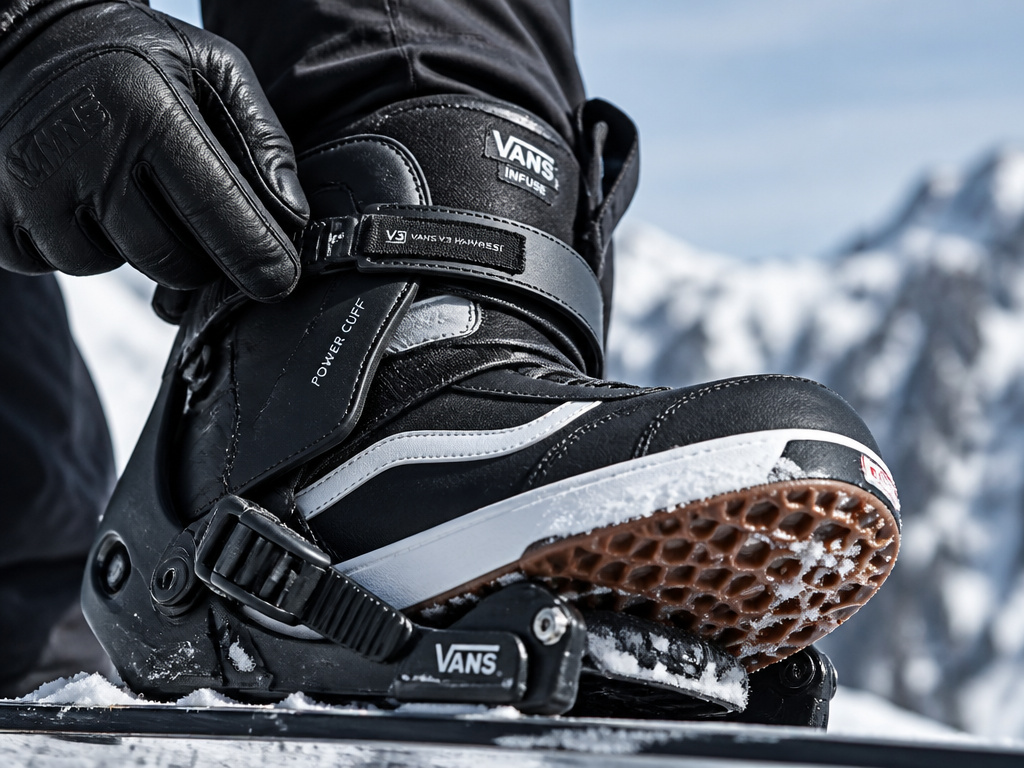
Now, here’s why this boot scored 92.9. When it fits you, and the systems work, the Infuse is a phenomenal all-mountain performer. The heel hold is exceptional, thanks to that V3 Harness. The Powercuff strap provides a responsive, connected feel from your calf to the board edge.
The V3 PopCush footbed and overall dampening soak up chatter well. The Heat Retention 360° with 200g insulation over the toes works, your feet stay warm. The waffle-outsole traction is among the best in the business for hiking and walking.
Its versatility is real. It’s been used successfully everywhere from backcountry splitboarding sessions to park laps. The key is matching its inherent stiffness to your style. With stiffeners in, it’s a capable charger. With them out, it’s a supportive freestyle boot. It won’t be the softest boot in the park, but it provides a stable platform for landing bigger jumps.
I’ve stopped recommending ultra-stiff boots as a default for aggressive riding. The Infuse’s adjustable system acknowledges that flexibility needs vary. A student of mine once developed persistent foot numbness from a boot that was too stiff for their riding style; tunable stiffness is a smart hedge against that.
Long-Term Durability and the Break-In Curve
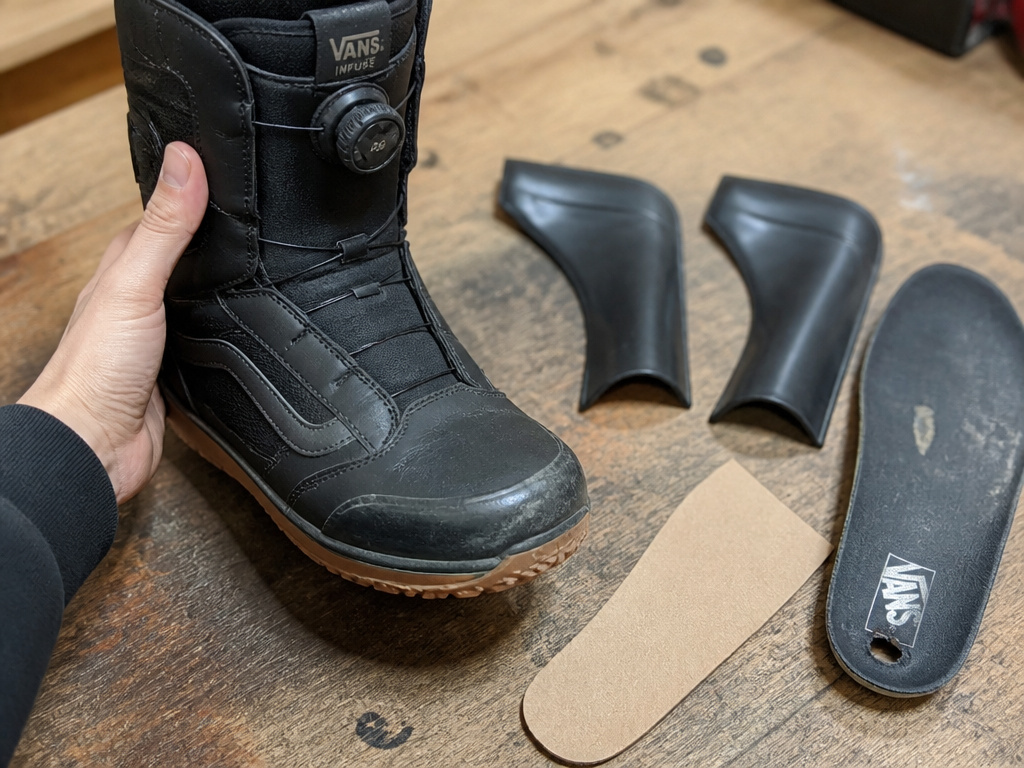
This is where forum and Reddit insights become gold. The Infuse breaks in like most boots, it gets softer. But its unique feature allows you to counteract that softening. Several long-term owners report a specific maintenance pattern:
- Start with the stiffeners out for the first 20-50 days as the boot softens naturally.
- Add one or both stiffeners back in around the 50-day mark to return some responsiveness.
- Around 75-100 days, the liner footbed may pack down. One user added a cardboard shim under the stock footbed to restore the original fit and heel hold, getting another full season out of the boots.
One Reddit user reported over 100 days with no velcro issues on the power strap. Another has 5 seasons on their pair, only replacing the footbeds. These are success stories.
The failure stories are specific: fraying power straps after minimal use, BOA failures, and the aforementioned ankle guide issue. The takeaway isn’t that the boot is poorly built across the board, it ranked first in testing, after all. It’s that quality control seems inconsistent. When you get a pair that passes quality control, it’s a tank. When you get a lemon, you’ll know quickly.
Long-term owners report using the boots for over 100 days, but be prepared for minor maintenance. Having a plan for when the liner packs out (like aftermarket insoles) extends its life dramatically.
How It Compares to the Competition
The Infuse exists in a crowded field of high-end all-mountain boots. Its differentiator is the hybrid lacing combined with adjustable flex. How does that stack up?
Against a pure BOA boot like the Burton Photon, the Infuse offers more precise zone control but is slower to get on and off. Against a stiff, traditional lace-up boot like the Union Reset Pro, the Infuse is more versatile and comfortable but less laser-focused on hard charging. Its weight and chunkiness are notable compared to sleeker park-focused boots.
Its true strength is for the rider who wants one boot to do everything reasonably well, resort, side-country, park, and values the ability to tweak the feel as the boot ages or their riding focus shifts. For a dedicated park rat, more specialized options in a guide to the best snowboard boots might be a better fit.
How are the Vans Infuse for splitboarding and backcountry?
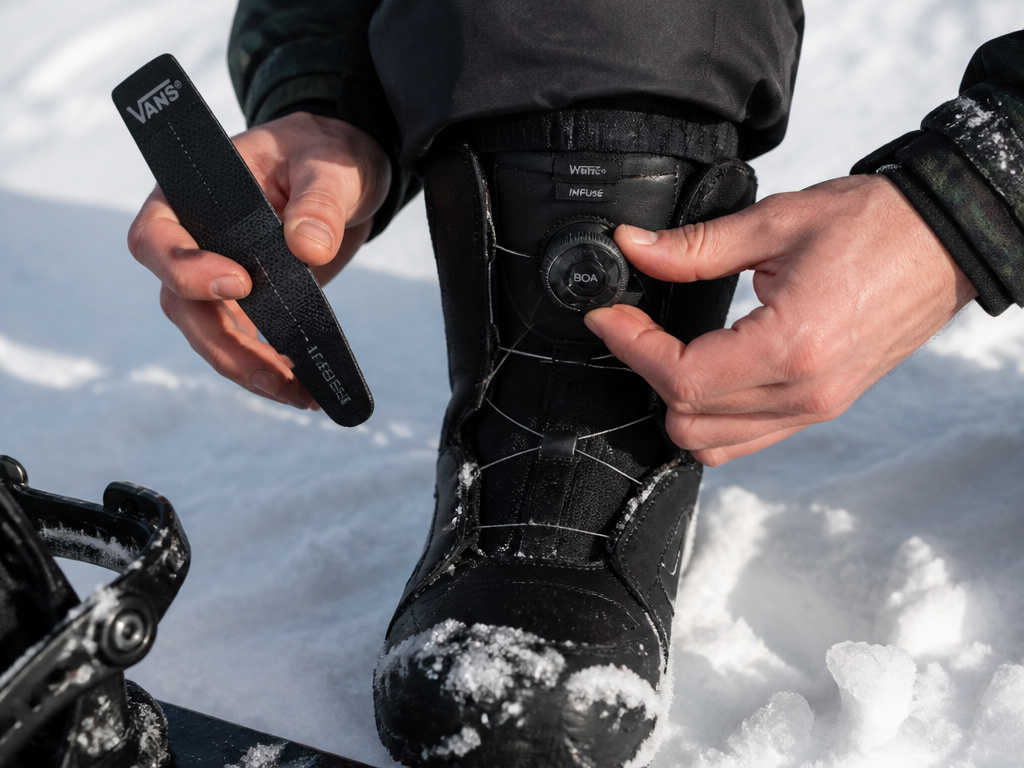
The Vans Infuse is designed for backcountry, all-mountain, and park/street use, and its features reflect that intent. The Vans Flex Control System allows you to remove the tongue stiffeners for a more forgiving flex during long skin tracks, then reinsert them for a more responsive ride on the descent. The Hybrid Plus BOA and lace system offers a secure, customizable fit that can be adjusted on the fly, which is valuable when transitioning between climbing and riding modes. However, the boot is heavier than the average men’s boot, which matters for those prioritizing ultralight backcountry setups. For riders who value adaptability and a boot that can handle both the ascent and a powerful downhill charge, the Infuse’s design targets that need directly.
Frequently Asked Questions
Are Vans snowboard boots good?
Yes, Vans makes highly regarded snowboard boots, particularly known for their comfort, traction, and board-feel. The Infuse represents their flagship performance model, ranking at the top of independent all-mountain boot tests. Like any brand, individual models and fit vary, so trying them on is crucial.
How do Vans Infuse snowboard boots fit?
The Vans Infuse fits true to size in length but is on the narrower side of average in width. The V3 Harness liner provides excellent heel hold. It’s critical to try them on, as some users experience a specific, painful pressure point from the internal BOA cable guide against the ankle bone.
What is the flex rating of the Vans Infuse snowboard boots?
Vans officially rates the flex at 5-9/10, adjustable via removable tongue stiffeners. Independent on-snow testing measured it at 7.5/10 with stiffeners in and approximately 5.5-6/10 with stiffeners out, indicating a real-world adjustable range of about 1.5 to 2 flex levels.
What are the differences between the Vans Infuse and Infuse Snowsurf boots?
The standard Infuse is the more versatile choice for most riders.
Is the Vans Infuse good for park riding?
The Vans Infuse can be used for park riding, especially with the tongue stiffeners removed, which brings the flex down to a medium range. However, some riders find its weight and chunkiness mute board feel compared to lower-profile, park-specific boots. Some users find them perfect for park without stiffeners, while others find the trade-off in weight and board feel makes more specialized boots a better choice.
The Bottom Line
The Vans Infuse is a top-tier boot with a first-place score to prove it. Its strengths, heel hold, dampening, traction, and tunable stiffness, are real. But buying it requires accepting its full profile: the weight, the lacing ritual, and the possibility of a manufacturing defect that needs quick warranty action.
If your foot shape agrees with it, and you value a single-boot quiver for resort, side-country, and occasional park use, the Infuse is a compelling, high-performance choice. Just know that its famous flex range is more about fine-tuning a great boot than magically creating two different ones. For riders who log serious days, its design even accounts for the long haul, inviting you to re-stiffen it as it breaks in. That’s a thoughtful feature in a world of disposable gear.
For the rider who wants simplicity and lightness above all, or who has a foot shape that clashes with the BOA guide placement, other excellent top-rated boots exist. But if you try on the Infuse and it clicks, you’re getting a boot that’s been tested to the top of its class.
