What Are Kicktail Longboards Good for? Is It Worth It?
This post contains affiliate links. As an Amazon Associate, we earn from qualifying purchases.
A kicktail longboard is good for three main things: urban commuting with quick turns and curb hops, performing basic freestyle tricks like ollies and manuals, and carving with added control. It trades some high-speed stability for maneuverability, making it a versatile choice for city riders who want one board for cruising and light trick play.
That’s the short version. The longer answer is that a kicktail reshapes how you interact with the street. It’s not a magic wand that makes a longboard a skateboard, but it adds a lever where there wasn’t one before. A common question is what are kicktail longboards good for.
What follows is a breakdown of where that lever actually helps, where the design falls short, and how deck length and setup turn a general category into your specific board. By the end, you’ll know exactly what a kicktail can do for your ride.
Key Takeaways
- Kicktails excel in urban environments, letting you lift the nose for quick kickturns, hop curbs, and weave through tight spaces.
- They enable basic freestyle tricks like ollies, manuals, and kickturns, but their length and weight make advanced flip tricks impractical.
- For downhill speed or distance pushing, a drop-through or pintail is often more stable; a kicktail “doesn’t add a lot” for pure downhill riding.
- Deck length is a major performance variable: shorter boards (30″-35″) are nimble for tricks, while longer boards (40″+) are often marketed as offering beginner-friendly stability for cruising, though sources disagree on the ideal beginner length.
- Prevent wheelbite by matching larger wheels (commonly over 60mm) with trucks designed for kicktails or decks featuring wheel cutouts.
The Kicktail’s Core Advantage: Urban Agility
The kicktail’s upturned rear end is a tool, not just a style. In a city setting, that tool gets used constantly. It changes the board from a passive carving platform into something you can actively manipulate.
A kicktail longboard combines the smooth, stable ride of a pintail with the maneuverability of an upturned tail. This allows for quick direction changes, curb hops, and a degree of freestyle trickery that flat-tailed boards cannot match.
You don’t need to be doing ollies to benefit. Simply navigating a sidewalk becomes different. Need to pivot 90 degrees at a crosswalk without losing momentum? A swift kickturn off the tail does it. Rolling up to a curb? A slight pop on the tail lifts the front wheels enough to roll over it, where a pintail might hang up. This is the daily utility owners on forums cite most: that little lift makes the board feel alive underfoot in a way a purely flat deck doesn’t.
The design logic is straightforward. Brands like Yocaher market their kicktails as “perfect urban or campus transportation”. It’s a direct response to the pintail’s main weakness, the lack of a kicktail for quick maneuvers.
What Tricks Can You Actually Do on a Kicktail Longboard?
This is where expectations need calibration. A kicktail longboard opens the door to freestyle, but it’s a different room than a street skateboard.
You can absolutely learn ollies, manuals, kickturns, and basic board slides. The tail gives you the force to pop the nose up. The Skateshred blog explicitly lists kicktails as “perfect for performing tricks like manuals, ollies, and kickflips.” However, the “kickflip” part is optimistic for most riders. The board’s longer wheelbase and higher weight make the flick-and-catch motion of a kickflip significantly harder than on a standard skateboard.
The real sweet spot is in control tricks. A manual (riding on the back wheels) is not only possible but a great way to practice balance and board feel. A quick ollie can get you over a crack or a low obstacle. These aren’t just for show; they’re functional skills for urban navigation. If you’re curious about expanding your tricks on a longboard, a kicktail is the necessary starting point.
Common mistake: Trying to force a kicktail longboard to behave like a street skateboard. You’ll fight the physics of the longer deck. Use it for the tricks it’s built for, power slides, pivots, and controlled pops, and you’ll have more fun, faster.
The community is clear on this. A Reddit user converting an electric skateboard noted the kicktail’s main use was “to raise the nose to a height easily grabbed” and for maneuvering when stopped. Another stated plainly that for their electric board, using the tail while riding risked wheelbite. The trick potential is there, but it’s bounded by the board’s core design.
Kicktail vs. Pintail vs. Drop-Through: Picking Your Priority
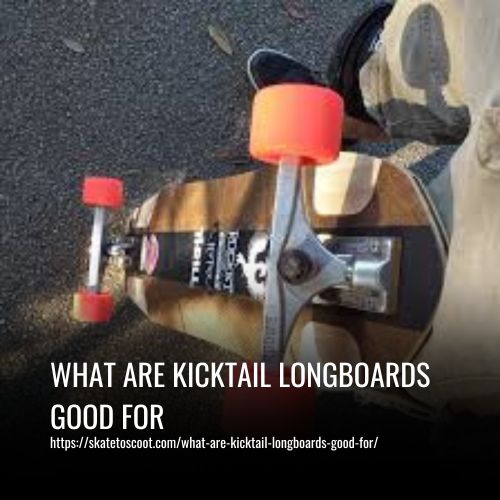
Understanding the what are kicktail longboards good for question requires knowing what it’s not as good at. This is a choice, not a universal upgrade.
| Deck Type | Best For | Trade-Off / Limitation |
|---|---|---|
| Kicktail Longboard | Urban commuting, basic tricks, carving with added control. | Less stable at very high speeds compared to drop-throughs. |
| Pintail Longboard | Smooth carving, classic cruising, a stable platform for beginners. | No kicktail for quick turns or obstacle hopping. |
| Drop-Through Longboard | Downhill stability, distance pushing, low center of gravity. | Less leverage for sharp turns, not designed for tricks. |
The kicktail vs pintail debate often centers on the tail itself. As Longboards USA frames it, both are great for cruising and carving, but the kicktail’s bent tail “give[s] you the possibility to kick it and maneuver easily and/or do tricks.” The pintail is flat and doesn’t have that.
The comparison to drop-through designs is even starker. Drop-through boards mount the trucks through the deck, lowering the ride height for superior stability. As one guide states, “drop-throughs excel at stability and pushing distance.” A kicktail is top-mounted and higher, which is “better for tricks and maneuverability.” If your primary longboard uses involve hills or covering miles, a drop-through is likely the better tool. For mixing commute with play, the kicktail wins.
How Deck Size Changes the Feel
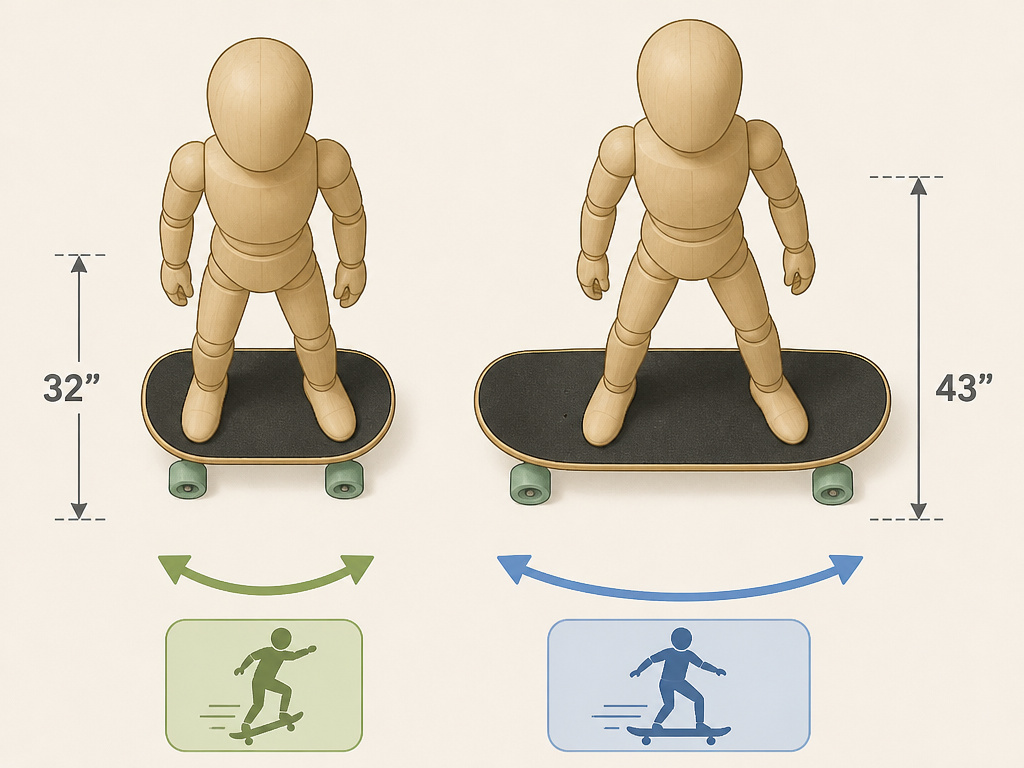
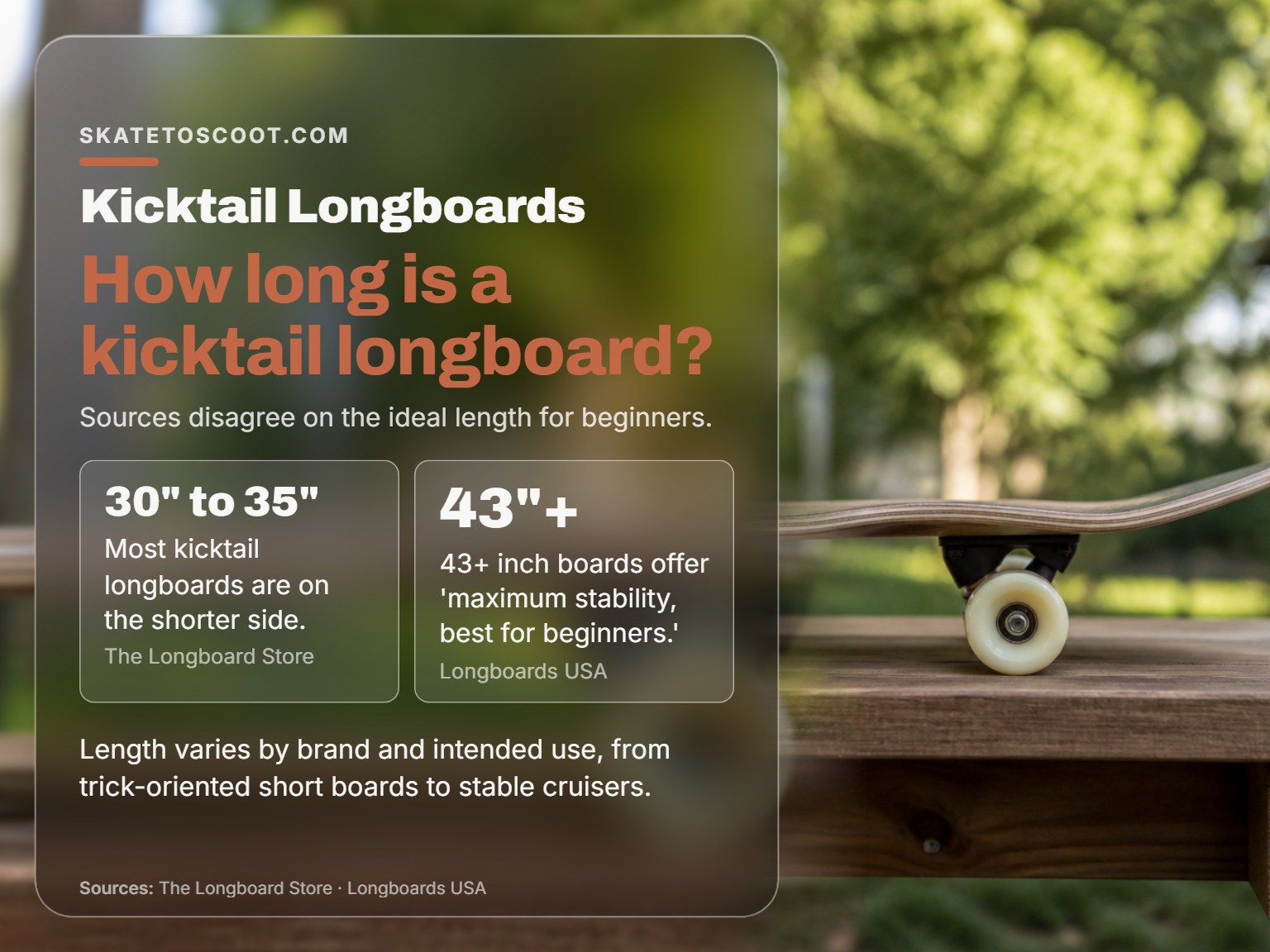
Not all kicktails are the same. A 43″ board rides nothing like a 30″ board, even with the same tail shape. This is a major point of confusion, because sources legitimately disagree on what “typical” means.
The Longboard Store blog states “most kicktail longboards are on the shorter side, between 30” to 35”.” This aligns with models like the Arbor Mission Kicktail (35″) and the Landyachtz Rally Kitty (35.00″). These are agile, carvy, and trick-ready.
On the other end, brands like Krown Skateboards market their kicktail completes at a standard 9″ width x 43″ length. Retrospec recommends their 44″ Zed model for cruising. Longboards USA suggests 43+ inch boards offer ‘maximum stability, best for beginners.’
Who’s right? Both are, for different goals.
- Short (30″-35″): Highly maneuverable, easier to pop for tricks, quicker turning radius. Better for technical street-like riding and carrying. Can feel less stable at speed for new riders.
- Long (40″+): More stable platform, smoother ride over bumps, better for cruising and commuting. The added length makes ollies and sharp kickturns more physically demanding.
The Long Island Kicktail Essential Complete Longboard (37″ model) splits the difference at 37″, with a generous 9.5″ width and a 27″ wheelbase for a stable yet responsive feel. Your height, stance, and primary use should guide your choice more than a blanket “best” length.
Optimizing Your Setup: Wheels, Trucks, and Wheelbite
A kicktail’s utility can be ruined by one thing: wheelbite. This is when the wheel contacts the deck during a sharp turn, causing a sudden stop. It’s the arch-nemesis of any top-mounted, turn-happy board.
Kicktail designs combat this in two ways. Some, like the Krown Kicktail, use wheel cutouts, physical scoops taken out of the deck, for “greater wheel bite reduction.” Others rely on a combination of wheel wells (subtle concavities) and the right truck/wheel combo.
For a kicktail meant for both cruising and tricks, a middle-ground wheel is key. The Long Island Kicktail Essential Complete Longboard (37″ model) comes with 69mm, 78A wheels.
Worth knowing before you start: If you upgrade to larger, softer wheels for comfort, you almost certainly need to add riser pads or ensure your trucks have sufficient clearance. That first sharp carve that grinds the wheel into the deck is a heart-stopper.
Your truck choice matters too. There’s no single right answer, only the right match for your riding style.
Limitations: Where a Kicktail Isn’t the Best Tool
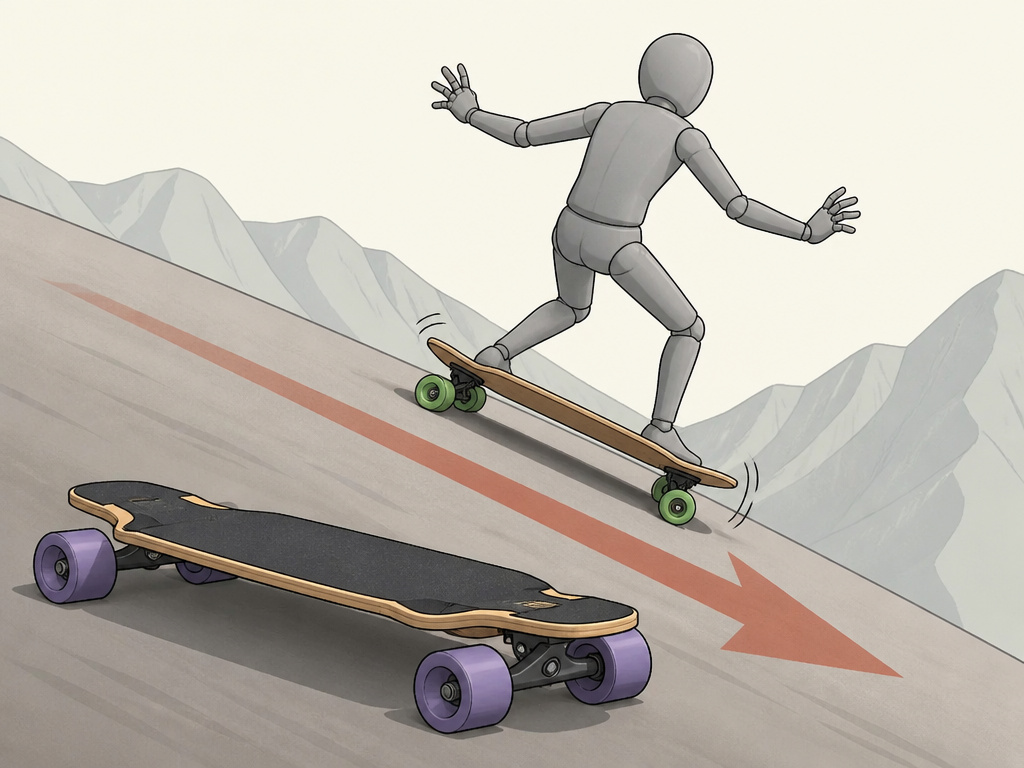
To fully answer what are kicktail longboards good for, you must know where it’s not ideal. The kicktail’s raised tail and typically top-mounted design come with compromises.
For pure downhill riding, some sources advise against kicktails. Longboards USA states a kicktail “doesn’t add a lot” for downhill riding, while Skateshred suggests pintails are better suited for downhill stability. The higher platform is less stable at high speeds than a drop-through or dedicated downhill deck.
The kicktail is a specialist in mixed-use scenarios. It’s the Swiss Army knife: good at many things, master of none. If your longboard riding styles are varied, commute today, mess around in a parking lot tomorrow, it’s perfect. If you know you only want to carve big hills or push for miles, a more specialized longboard shape might serve you better.
Frequently Asked Questions
Are kicktail longboards good for beginners?
They can be, but with a caveat. Longer kicktail boards (40 inches and up) provide a more stable platform, which is forgiving for new riders. Brands like Yocaher and Longboards USA market their 40″+ kicktails as “great for beginners.” A shorter, twitchier kicktail (like a 33″ cruiser) might be less stable for a true first-timer. For absolute beginners who want zero trick potential, a stable pintail or drop-through might be an even gentler introduction.
Can you ollie on a kicktail longboard?
Yes, you can ollie on a kicktail longboard. The upturned tail supplies the force required to pop the board. However, the longer deck and heavier build make it more physically demanding than ollieing a standard street skateboard. It’s a functional ollie for getting over cracks and onto curbs, not necessarily for high, technical tricks.
What size kicktail longboard should I get?
Match the size to your primary use. For a focus on tricks and tight maneuverability, look at shorter decks between 30-35 inches (e.g., Landyachtz Rally Kitty). For stable cruising and commuting, a longer deck between 37-44 inches (e.g., Long Island Kicktail Essential, Krown Kicktail) will be more comfortable and stable. Your own height and foot size also play a role; a longer board provides more foot real estate.
Do I need a kicktail for cruising?
No, you do not need a kicktail for cruising. Pintail and drop-through longboards are excellent for cruising. A kicktail adds utility for urban navigation (curb hops, quick turns) and trick potential. If you only plan on straightforward cruising on bike paths or boardwalks, a kicktail is an optional extra, not a necessity.
The Bottom Line
A kicktail longboard is for the rider who refuses to be pigeonholed. It’s for the commuter who sees a set of stairs as a challenge, not a detour. It’s for the carver who occasionally wants to pivot on a dime or pop the board up into their hand at a stoplight.
The data shows a split: the industry makes short, agile models and long, stable ones, each claiming to be “perfect.” They’re both right, for different people. Your choice isn’t about finding the objectively best kicktail, but the one that aligns with your most common pavement.
If you’re staring at a rack of boards, here’s the filter: plan to mostly cruise but want the option to play? Start with a longer kicktail (40″+). Want to prioritize a playful, trick-ready feel from day one? Go short (sub-37″). That single decision will do more to define your experience than any brand logo.
And remember, the kicktail is a means, not an end. It enables a style of riding. What you do with it is up to you.
