Advantages of Segway Why You Should Consider Using a Segway
This post contains affiliate links. As an Amazon Associate, we earn from qualifying purchases.
The advantages of a Segway come down to a unique combination: self-balancing stability that makes it easy to learn, a compact footprint for navigating tight spaces, zero tailpipe emissions, and a per-mile cost that undercuts cars and often public transit. Its top speed of 12.5 mph and ranges up to 22 miles (depending on model) make it ideal for short urban trips, campus commutes, or recreational tours where walking is too slow and a car is overkill.
That stability is the whole game. It’s not just a marketing point; it’s a mechanical fact documented in government research. The gyroscopic system manages something your body does automatically when you walk, constantly micro-adjusting to keep you upright. On a Segway, a computer does that work for you, which is why the learning curve is famously short. But that same system also defines its limits. These are the primary advantages of Segway why you should consider using a Segway.
What follows is a breakdown of where that advantage actually matters, the numbers from the manuals that define its use, the costs you’ll face beyond the sticker price, and a frank look at the safety record that shaped its design. This isn’t about reviving a 2000s tech hype. It’s about matching a specific tool to the trips you actually take.
Key Takeaways
- Self-balancing tech shortens the learning curve, a fact backed by a peer-reviewed study where all 23 mobility-impaired subjects mastered it after three training sessions.
- Maximum speeds are model-specific but capped around 12.5 mph for core PT and S-series models, with lower-speed keys available for beginners as noted in the Federal Highway Administration research.
- Operating cost is its strongest financial argument, charging a Segway PT battery costs pennies per full charge, eliminating fuel, parking, and most maintenance fees associated with car ownership.
- Legal access remains a patchwork; while the General Services Administration permits them in federal buildings at 3 mph, local laws vary wildly, so checking your municipal code is a mandatory first step.
- Proper battery care is essential, the manual requires a 12-hour charge every month or every 12 hours of use, and storing a unit long-term demands specific temperature controls to avoid permanent damage.
The Core Advantage: Self-Balancing Technology Explained
The gyroscopic stability system is engineering that solves the single biggest barrier to wheeled personal transport: the constant, unconscious labor of staying upright. When you stand on a Segway, an array of sensors and silicon takes over that job. Lean forward slightly, and the motors drive the wheels forward to catch you. Lean back, and they reverse. It feels intuitive because it mimics the reflex you use when you start to trip while walking.
The Segway PT uses gyroscopic sensors and a computer-controlled motor system to maintain balance. When the rider leans forward or backward, the system calculates the necessary wheel speed and torque to move the platform under the rider’s center of mass, preventing a fall. This fundamental operation is why no prior balancing skill is required.
That’s the technical snippet. The human result is that the thing you think you need to learn, balancing, is handled for you. What you’re actually learning is fine motor control: how much lean produces how much acceleration, how to steer by turning the handlebar (or, on some models, leaning your knees), and how the platform feels when it’s approaching its limit.
I’ve taught skating for a decade, where balance is the first and hardest skill. Watching someone step onto a Segway for the first time is a study in that labor being erased. Their face goes from tense anticipation to relaxed surprise in about ninety seconds. The machine holds them up. Their job shifts from not falling over to simply directing the movement.
Where this goes sideways: Assuming the self-balancing system is infallible. It’s not. The system has physical limits defined by motor torque, battery charge, and traction. The 2003 CPSC recall documents a specific failure mode: a software flaw could cause power loss when the batteries were near the end of charge. The result isn’t a graceful shutdown; it’s a sudden loss of propulsion that can lead to a forward pitch and a fall. This is why monitoring your battery gauge is a safety check, not just a range indicator.
Practical Advantages for Daily Life
For the trips it’s designed for, the advantages of Segway why you should consider using a Segway include replacing a car, a bus, or a long walk with something genuinely more efficient. Here is where it wins.
Maneuverability and Parking: Its footprint is roughly the size of a standing person. You can pivot in place, navigate through standard doorways, and store it vertically in a closet corner. Compare that to the space needed to park even a compact car or lock up a bicycle. For “last-mile” travel from a transit station or navigating a crowded campus quad, that agility is the entire point.
Cost-Effectiveness: The math is simple and brutal against car ownership. No gas. No insurance (in most jurisdictions, as it’s not a registered motor vehicle). Minimal maintenance, tire pressure checks and the occasional tire replacement. The largest ongoing cost is electricity for charging, which for a Segway PT’s 5.2Ah, 73.6V battery is minimal. For a regular commuter, the purchase price can be offset within a year or two by eliminated fuel, parking, and transit pass costs.
Eco-Friendliness and Noise: Zero direct emissions. It’s a battery-electric device. The environmental impact is tied to your local grid’s energy mix, but it’s a stark improvement over any internal combustion engine. The noise profile is also a civic benefit, it’s nearly silent, which means it doesn’t contribute to urban noise pollution. You can have a normal conversation while riding one.
Fun and Novelty: Riding one is genuinely enjoyable. The sensation of gliding smoothly without pedaling or pushing off has a thrill. This isn’t a trivial advantage; it’s the reason Segway tours remain popular in cities worldwide. The enjoyment factor increases the likelihood you’ll actually use it, turning a practical purchase into a recreational one too.
| Trip Type | Segway Advantage | Consideration |
|---|---|---|
| Urban Commute (1-5 miles) | Avoids traffic, no parking hassle, low cost. | Weather-dependent; not ideal in heavy rain/snow. |
| Campus / Large Facility | Superior to walking, more dignified than a scooter for some. | May be restricted by campus policy. |
| Tourism / Guided Tours | Covers more ground than walking, engaging for groups. | Primarily a rental/novelty use case. |
| Last-Mile from Transit | Fits on bus/train, solves the “half-mile walk” problem. | Weight (~100 lbs for a PT) can be a burden to carry. |
Health and Accessibility Benefits

The health angle is often oversold, but it exists in two specific, measurable ways that contribute to the advantages of Segway why you should consider using a Segway. First, while riding a Segway isn’t cardio, it does engage your core and leg muscles to maintain posture and steer. It’s light, sustained isometric work. Second, and more significantly, it enables mobility for people who can stand but have difficulty walking long distances due to pain, fatigue, or conditions like MS or arthritis.
A 2007 prospective study cited in the RESNA conference paper on Segway mobility found that all 23 adult subjects with mobility impairments were able to master the Segway after three training sessions. For them, the advantage is about regaining independence and reducing pain. The device acts as a mobility aid, extending their range without the bulk and stigma of a traditional wheelchair or scooter.
This use-case is formally recognized by the U.S. General Services Administration, which permits Segways as mobility aids in all federal buildings provided they are driven courteously and at or below 3 mph. That policy is a direct result of advocacy from users and organizations like DRAFT (Disability Rights Advocates for Assistive Technology).
Common mistake: Using a Segway for rehabilitation without medical guidance. While it can be a fantastic mobility tool, its use for someone recovering from an injury or with a progressive condition should be cleared by a physical therapist or doctor. The standing posture and balance demands, however managed by the machine, still place stress on joints and the core.
Safety, Regulations, and the Learning Curve
Safety is the most debated aspect. The narrative is shaped by high-profile incidents, like the 2010 fatality involving a company owner, and two major CPSC recalls in the 2000s. The data, however, helps distinguish the machine’s inherent risk from the risks of misuse.
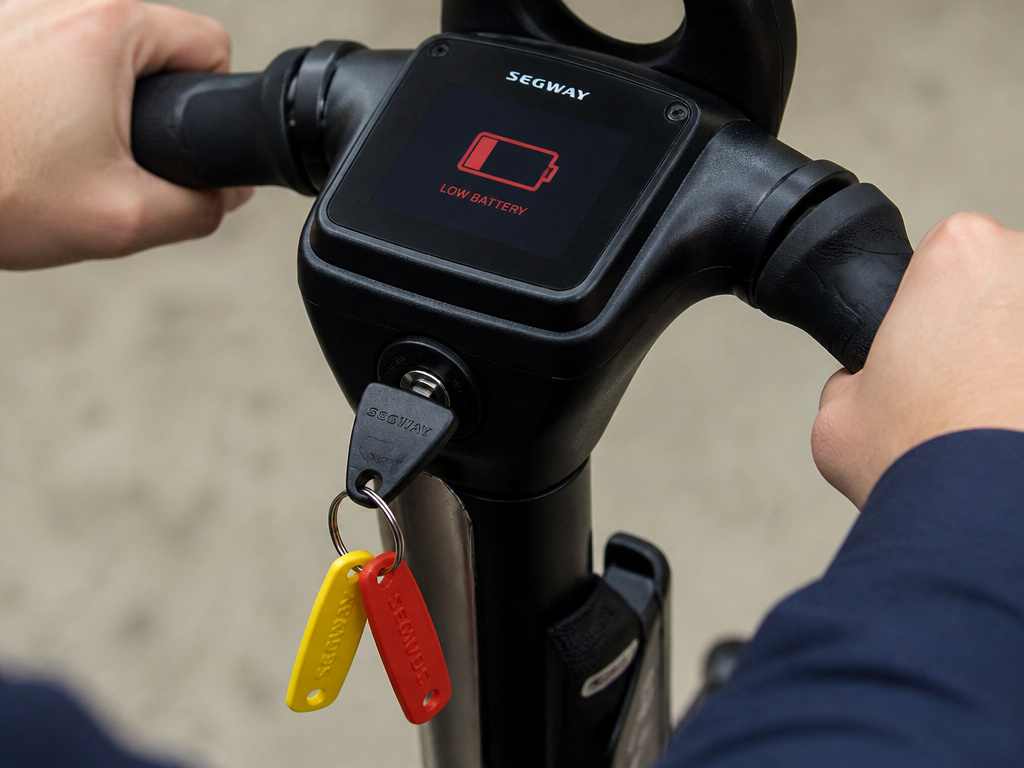
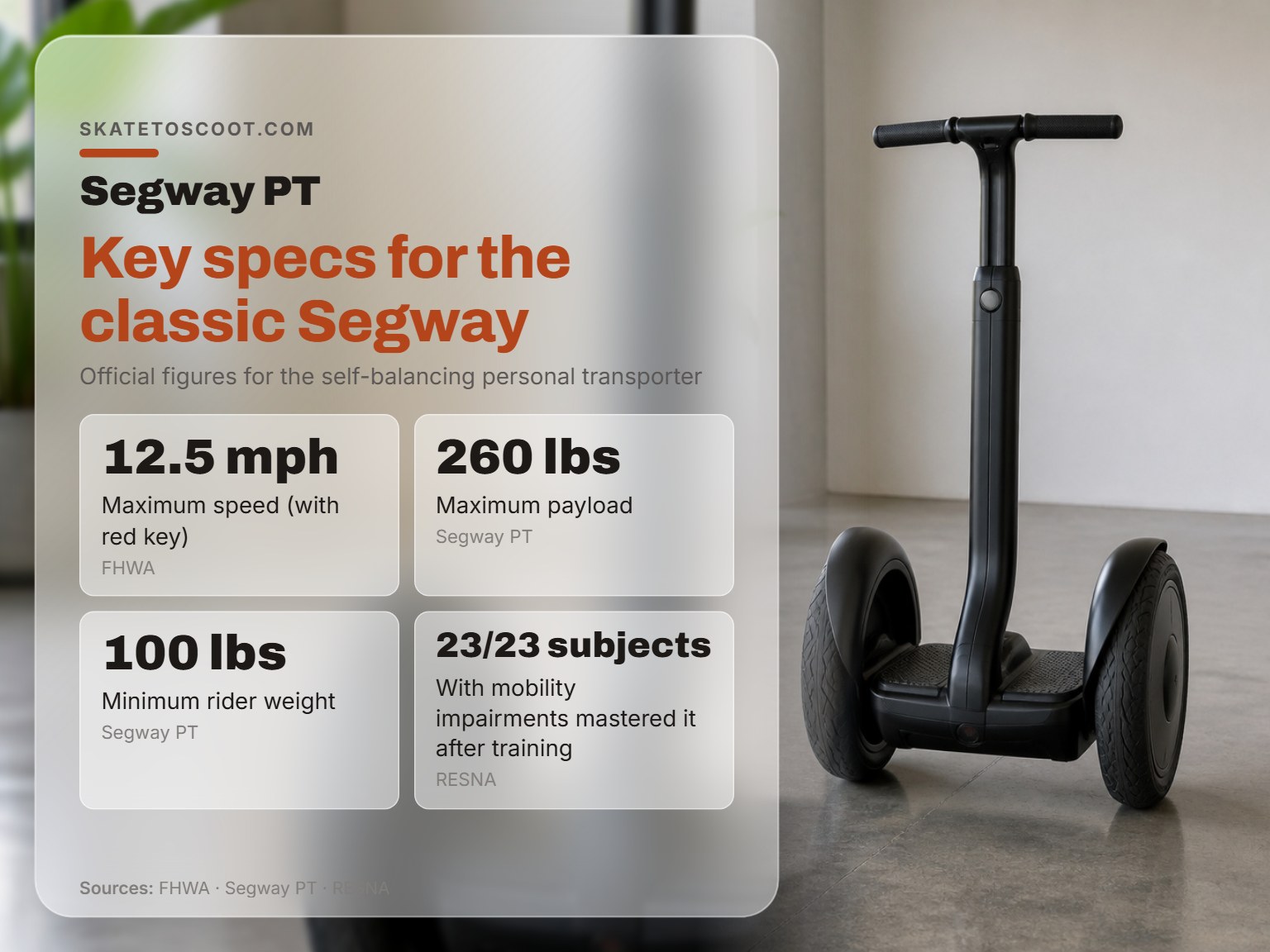
The FHWA Segway operating characteristics study provides a baseline. It notes the i-Series models use speed-limiting keys: black (6 mph), yellow (8 mph), and red (12.5 mph). A responsible first step is to start with the black key. The learning curve is short, but it’s not zero. You need to practice emergency stops, turning at speed, and dismounting safely before hitting open paths.
The two recalls are instructive case studies in risk:
- 2003 Software Recall (~6,000 units): A flaw could cause a power loss near end of battery charge, leading to falls. Three incidents, one head injury.
- 2006 Reverse Torque Recall (~23,500 units): A defect could cause unexpected reverse torque if a rider dismounted and remounted quickly while the machine was tilted back. Six injuries reported.
Both were addressed with free software upgrades. The manuals now contain stern warnings about low-battery riding and proper dismount technique. Modern Segways, like the S Plus with its IPX6 battery protection or the S Pro which is water-resistant (though not recommended for rain), are built to more rigorous standards, including compliance with ANSI/CAN/UL-2272, a safety standard for e-mobility device electrical systems.
Your local laws are the final, critical layer. Can you ride on the sidewalk? In the bike lane? On the road? It’s a patchwork. Some states classify them similarly to bicycles; others restrict them to private property. Always check your municipal code. Assuming you have the right to ride wherever you want is a fast track to a ticket or confiscation.
Segway vs. Electric Scooter vs. Hoverboard
This is the comparison most shoppers are actually making. Each has a different profile.
| Device | Key Advantage | Key Disadvantage | Best For |
|---|---|---|---|
| Segway (2-wheel, PT style) | Self-balancing stability, intuitive steering, upright posture. | Heaviest, most expensive, shortest range per dollar. | New riders, those with balance concerns, standing-only mobility. |
| Electric Kick Scooter | Lightweight, portable, foldable, highest range per dollar. | Requires kick-off start, less stable at low speeds, hands required. | Commuters who need to carry it on transit, cost-conscious buyers. |
| Hoverboard / Self-Balancing Scooter | Most compact, relatively inexpensive, playful. | Steepest learning curve, least stable, slowest, poor for uneven terrain. | Short recreational rides on perfect surfaces, teenagers. |
The Segway’s stability is its differentiator. An electric scooter demands more active balance, especially at low speeds when you’re just getting started. A hoverboard requires significant ankle strength and balance just to stay upright. The Segway removes that fundamental challenge.
The trade-off is portability and cost. An electric scooter like the Segway Ninebot Max G30P folds and can be carried. A 100 lb Segway PT does not fold. For a multi-modal commute involving a train, the scooter wins. For a dedicated commute across a corporate campus where you never need to carry it, the Segway’s comfort and ease might win.
Choosing the Right Model for Your Needs
Not all Segways are the same. The brand now encompasses everything from the original two-wheel transporters to single-wheel drift boards and electric kick scooters. Your choice depends on your primary use case.
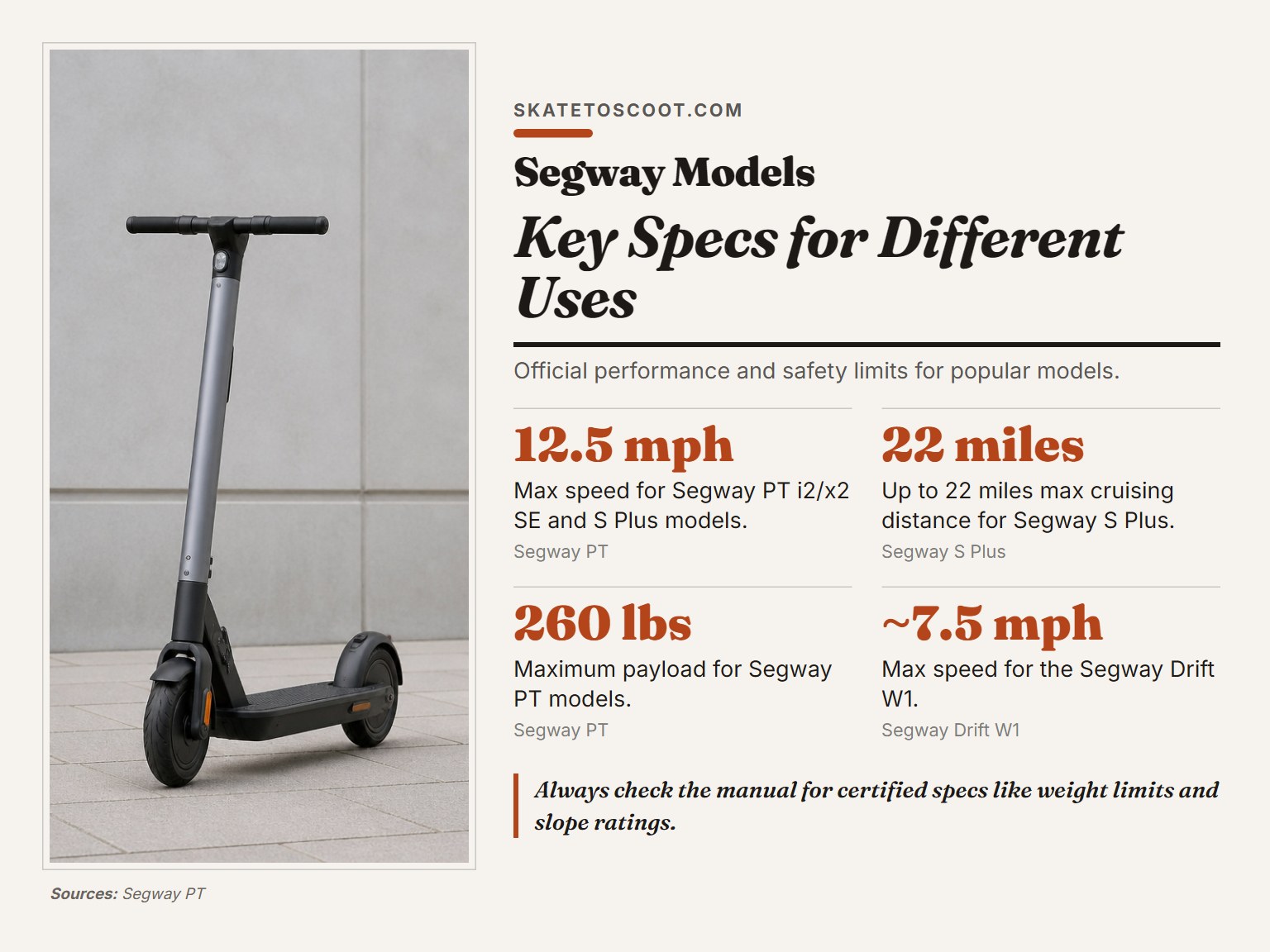
- For Urban Commuting & General Use: The Segway S Plus is a modern take. It hits a max speed of 12.5 mph and claims up to 22 miles of range. Its dual motors and air-filled tires are designed for paved urban environments. If you need an alternative model, the Segway S Pro offers a maximum range of up to 13.7 miles and supports a max weight up to 220 lbs.
- For Off-Road / Turf Use: The classic Segway PT x2 SE with its 4 psi turf tires and wider stance is the pick. It’s built for golf courses, estates, or unpaved paths. Remember its top speed is still 12.5 mph, but its torque is tuned for slopes and soft ground.
- For Recreation & Novelty: The Segway Drift W1 is a different beast, a single-wheeled, foot-steered device. Its max speed is ~7.5 mph and it has a strict 10° max slope limit. It’s fun, less expensive, and far more portable, but its manual explicitly warns against riding in the rain and recommends riders be 6+ years old with those under 16 supervised.
When researching, pay close attention to the certified specs in the manual, not just marketing copy. The maximum payload for a PT is 260 lbs, with a minimum rider weight of 100 lbs. The Drift W1 has a broader payload range of 22–220 lbs. Ignoring these limits voids warranties and risks damage.
The Ownership Reality: Costs and Care
The purchase price is the first cost. Maintenance is the second, and it’s where Segways can surprise owners. They are complex electromechanical devices.
Battery Care is Non-Negotiable: The PT manual is unequivocal: for best performance, fully charge the batteries for at least 12 hours once a month, or once every 12 hours of operation, whichever comes first. Letting the batteries fully discharge causes permanent damage. For long-term storage, you must charge them at least every 3 months. Temperature matters: do not charge below 32°F/0°C.
Tire Maintenance: The i2 SE requires 15 psi; the x2 SE requires 4 psi. Under-inflated tires increase rolling resistance, killing your range and straining motors. Over-inflated tires reduce traction and give a harsher ride. A simple digital gauge is a necessary tool.
Software & Repairs: Unlike a bicycle, you can’t fix most issues with a wrench. Diagnostics and repairs often require proprietary tools and software. Before buying, check if there’s an authorized service center within a reasonable distance. The 2003 voluntary Segway recall announcement is a reminder that software updates are part of long-term ownership safety.
The bottom-line cost advantage only materializes if you use it enough to offset its upfront price and if you follow the maintenance schedule to avoid a costly battery or motor replacement. For a daily commuter replacing bus fares or gas, the math works quickly. For a weekend toy, it probably doesn’t.
Does riding a Segway reduce stress?
The act of gliding on a Segway shifts your mental state. The machine’s gyroscopic system handles the constant work of balance, freeing your mind from that background task. This creates a uniquely fluid and effortless form of movement, allowing you to focus on your surroundings rather than the mechanics of travel. For individuals with mobility impairments, studies have shown the device can be mastered, restoring a sense of independence and freedom that directly counters frustration. It turns a commute or errand into a smooth, engaging experience, replacing the stop-and-start tension of walking in a crowd or the confinement of a vehicle with a quiet, open sense of flow.
Can a Segway handle rough terrain and weather?
Not all models are built the same. Some are designed with low-pressure tires for gentle off-road use, while others are strictly for paved surfaces. Their operational range is defined by specific temperature limits, so checking the manual for your model is essential before riding in very hot or cold conditions. Generally, these devices are water-resistant but not fully waterproof; manufacturers typically advise against riding in the rain. For storage, you must keep the unit in a dry place within its specified temperature range and follow battery care instructions, such as not charging in freezing temperatures, to ensure it’s ready when you need it.
Frequently Asked Questions
What is the main point of a Segway?
The main point is to provide stable, intuitive, zero-emission personal transportation for short trips. It eliminates the need to learn balance on a two-wheeled device, making it accessible for a wider range of people, including some with mobility challenges. It’s designed to be more efficient than walking and more agile than a car in dense urban or campus settings.
Is a Segway scooter worth it?
It’s worth it if your regular trips fall within its 12-22 mile range and you have a secure place to store and charge it. The value proposition is strongest for commuters who can replace consistent costs like fuel, parking, or transit passes. For occasional or recreational use, the high upfront cost is harder to justify compared to a cheaper electric kick scooter.
What are the disadvantages of a Segway?
Key disadvantages are its weight (making it non-portable), high purchase price, dependency on battery care and specialized service, limited range compared to e-bikes or e-scooters, and a confusing patchwork of local laws governing where you can ride. It’s also not suitable for inclement weather or off-road use unless you buy a specific off-road model.
How safe is a Segway to ride?
When ridden responsibly within its design limits, with a full battery, on appropriate terrain, at a safe speed, and while wearing a helmet, it has a robust safety record. The self-balancing system is robust. Historical risks from software flaws were addressed via recalls. The primary risks today are rider error: speeding, ignoring low-battery warnings, riding on unsuitable surfaces, or colliding with obstacles.
Can you ride a Segway on the road?
This is entirely dependent on local and state law. Some jurisdictions allow them on roads with speed limits at or below 25 or 35 mph. Others restrict them to bike lanes or sidewalks. Many prohibit them from roads entirely. You must research the laws in your specific city, county, and state before riding on any public roadway.
How long does a Segway battery last?
Battery lifespan is measured in charge cycles. With proper care (avoiding full discharges, charging within the correct temperature range), the lithium-ion batteries in a Segway PT can last for many cycles. Performance will gradually degrade over time, reducing the maximum range per charge.
The Bottom Line
A Segway is a specific solution for a specific set of problems: short trips where walking is too slow, where carrying a bulky vehicle isn’t required, and where the user prioritizes ease of use over ultimate portability or range.
Its advantages are real and documented, the self-balancing tech works, the per-mile cost is low, and its footprint is minimal. But those advantages only materialize if your lifestyle matches its design. Before you consider one, map your regular trips. If most are under 5 miles on paved, reasonably flat terrain, and you have a secure indoor storage spot, it’s a compelling option.
The Segway’s story is often framed as a failure of hype. That’s the wrong lens. Look at it as a specialist tool that found its niches, tourism, campus security, assisted mobility, and for a certain type of urban commuter. Within those niches, its advantages are why it’s still here, two decades later.
