Arbor Axis 37 Longboard Review: Carver, Commuter, Cruiser
This post contains affiliate links. As an Amazon Associate, we earn from qualifying purchases.
The Arbor Axis 37 is a versatile, snowboard-inspired drop-through longboard built on a 7-ply Canadian Maple deck. It comes as a complete with Paris Reverse Kingpin 50° 180mm trucks, 69mm 78A Arbor Easyrider wheels, and either ABEC 5 or ABEC 7 bearings depending on the retailer. Its primary strength is all-around cruising and carving, though owners report the proprietary Recycled Glass Re-Grit grip wears down faster than traditional tape.
That description covers the basics, but it misses the decisions a buyer actually faces. The difference between a review and a useful one, like a thorough arbor axis 37 longboard review, is in the specifics that change your ride: the 0.125-inch width gap between the Flagship and Photo models, the bearing spec that changes depending on where you look, and the one component owners consistently swap out first.
What follows is a breakdown of the specs, the real ride feel, and the upgrades that turn this capable stock board into a personal favorite. We’ll walk through the deck, trucks, wheels, and bearings, then tackle the common questions about sizing and long-term wear.
Key Takeaways
- The Axis 37 is built on a 37.00-inch deck of 7-ply Canadian Maple, with a mild concave and drop-through mounting for a low, stable ride.
- Check your retailer for bearing specs: the official Arbor site lists ABEC 7 bearings, while Amazon and Tactics list ABEC 5.
- The proprietary Recycled Glass Re-Grit on the Flagship model sheds glass particles over time; many owners add traditional grip tape over it.
- For a more carvy, responsive feel, the first and cheapest upgrade is a set of softer barrel bushings.
- If you’re between the 37-inch and 40-inch Axis, choose the 40-inch for more foot space if you have larger feet or prefer extra stability.
The Deck: Snowboard DNA Meets Maple
Look at the profile of the Axis 37. You see a symmetrical shape with pronounced sidecuts, a direct lift from Arbor’s snowboard heritage. This isn’t just for looks. Those curves, combined with the drop-through mounting, lower the ride height by about an inch. The result is a board that feels planted and easier to push for distance, but also quick to lean from rail to rail when you want to carve.
The deck is 7-ply Canadian Maple. That’s the industry standard for a reason—it’s durable, has a predictable flex pattern, and offers a good balance of stiffness and slight give. The Flagship variant adds a Palisander wood topsheet and bottom sheet, which is mostly an aesthetic upgrade. The Photo variant uses a graphic topsheet. Both share the same core construction.
The Axis has a symmetrical snowboard inspired shape that offers quick rail-to-rail performance, with drop-through mounting for a more ergonomic push and power through turns and slides. Arbor Collective, 2013 Product Profiles
The wheel cutouts are generous. They’re there to prevent wheel bite—when the wheel contacts the deck during a sharp turn—which is a common issue with drop-throughs. The generous wheel cutouts are designed to prevent wheel bite with the stock 69mm wheels. This design freedom means you can run slightly larger wheels if you want, a common upgrade path we’ll get to later.
Where the deck gets interesting, and where owners have strong opinions, is the top surface.
The Griptape Dilemma: Recycled Glass Re-Grit
The Flagship model uses Arbor’s Recycled Glass Re-Grit. Instead of traditional adhesive sandpaper grip tape, a layer of crushed glass is fused to the wood’s top coat. The idea is a unique look and a durable, integrated grip. The reality, according to multiple owner reports, is more complicated.
One verified buyer on Tactics put it bluntly: “If you touch the deck on this board you will be reminded not to touch it ever again as it sheds glass constantly.” Another review on the Vandem shop notes you may need to update the griptape after a amount of riding. The grip itself wears down, and the loose glass particles can be a nuisance.
Common mistake: Assuming the integrated glass grip is maintenance-free. It wears and sheds, and applying traditional grip tape over it is the standard owner fix.
This isn’t a deal-breaker, but it’s a planning point. Some owners report the Recycled Glass Re-Grit wears down or sheds, leading them to apply traditional grip tape over it. The Photo model uses standard die-cut griptape, which avoids this issue entirely but lacks the Flagship’s clear-wood aesthetic.
Trucks, Wheels, and Bearings: The Stock Setup
A complete board lives or dies by its components. Arbor doesn’t cut corners here. The Axis 37 comes with Paris Reverse Kingpin (RKP) 50° 180mm trucks. Paris trucks are a benchmark in the longboard world for good reason. They offer a smooth, predictable turn with a finish. The Vandem shop description calls out their “turny geometry, decent bushings and a finish.”
The stock bushings are fine for getting started. But if you want the board to carve “like a dream,” as one Reddit user suggests, swapping to softer barrel bushings is a cheap and immediate upgrade. Orangatang Knuckles or Venom Barrels in a softer duro will change the feel for about twenty bucks.
The wheels are Arbor’s own Easyrider Series “Outlook” wheels. They’re 69mm in diameter with a 78A durometer. This is a classic cruising spec. The 78A softness absorbs vibrations from rough pavement, making for a smooth, quiet ride. The wheels are 69mm in diameter with a 78A durometer, a common specification for cruising.
| Component | Specification | Effect on Ride |
|---|---|---|
| Trucks | Paris RKP 50° 180mm | Smooth, predictable turning. A quality standard. |
| Wheels | Arbor Easyrider “Outlook” 69mm 78A | Smooths rough pavement, good grip for carving. |
| Contact Patch | 44mm, 0mm offset | Provides stable, predictable grip during leans and slides. |
| Urethane | Venice Formula with Momentum Core | Arbor’s bio-urethane formula designed for roll speed and rebound. |
The bearings are where you need to pay attention to your source. There’s a clear discrepancy. ### The ABEC 5 vs. ABEC 7 Bearing Confusion Sources disagree on the bearing rating: the official Arbor Collective site lists ABEC 7 bearings with spacers, while retailer pages from Amazon and Tactics list ABEC 5 bearings with spacers.
| Source | Claimed Bearing Spec |
|---|---|
| Arbor Collective (Official Product Page) | ABEC 7 Bearings with Spacers |
| Amazon Product Listing | ABEC 5 Bearings with Spacers |
| Tactics Retailer Page | ABEC 5 Bearings with Spacers |
Which is correct? It’s likely that Arbor’s own site reflects the intended spec, while some retailers’ listings haven’t been updated or reflect a different production batch. Sources list different bearing ratings (ABEC 5 or ABEC 7) depending on the retailer, a key detail you’ll find in any arbor axis 37 longboard review. But if you’re buying based on a specific component claim, this is a detail to note.
Ride Feel and Performance: Carver, Commuter, Cruiser
Arbor calls the Axis “perhaps the most versatile board in the lineup.” That’s marketing, but it’s not wrong. The low ride height from the drop-through makes it effortless to push. The low ride height from the drop-through mounting makes pushing easier, a point highlighted in every arbor axis 37 longboard review. The deck has a symmetrical, snowboard-inspired shape.
The board has a mild flex. One Reddit owner described it as “pretty mild” and “very sturdy.” The deck is made from 7-ply Canadian Maple, which provides a predictable flex pattern. The deck has a mild concave and drop-through mounting for a stable ride.
For carving, the combination of the snowboard sidecuts, Paris trucks, and soft wheels works. The board wants to lean into turns. It’s not a twitchy, high-speed downhill racer, and it’s not meant to be. Arbor describes the Axis as versatile, equipped to excel as a carver, commuter, cruiser, freerider, and entry level downhill board. Drop-through mounting provides a lower ride height and a more ergonomic push.
Where this goes sideways: Taking it on steep, technical hills right out of the box. The soft 78A wheels grip well but can deform under high-speed slides, and the stock bushings may feel too restrictive for quick, aggressive turns at high speed.
Axis 37 vs. Axis 40: The 3-Inch Decision
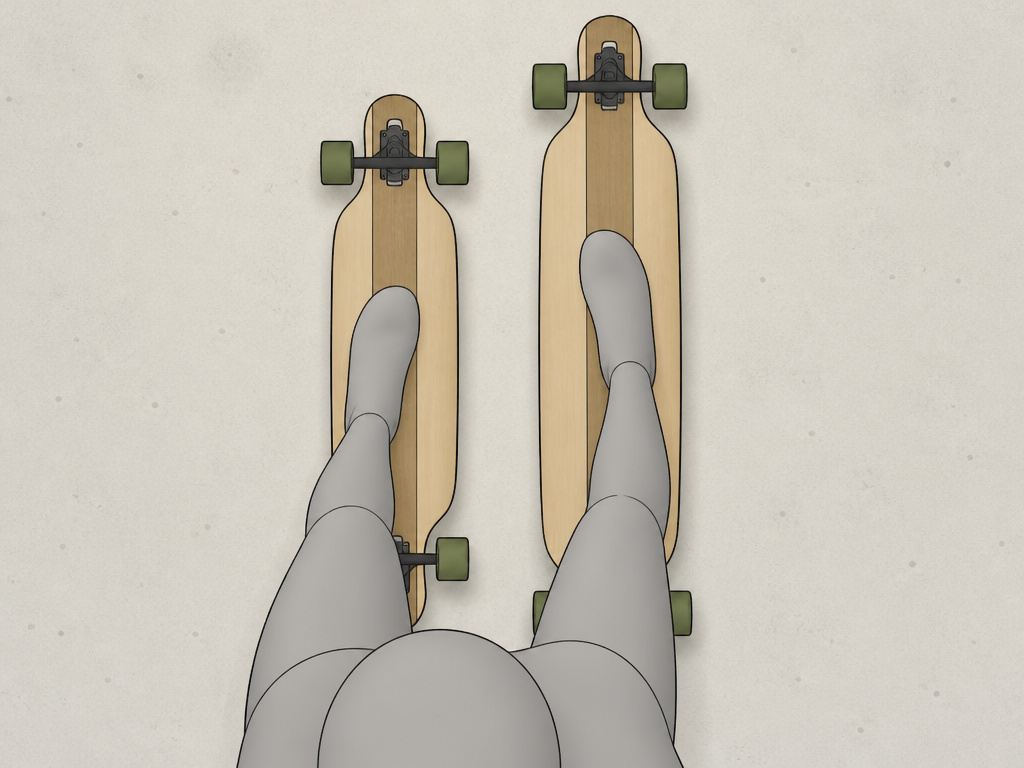
The most common comparison isn’t to another brand; it’s to its bigger sibling, the Axis 40. The 40-inch version shares the same deck shape and components but offers a longer wheelbase and more deck space. (Note: The fact sheet does not provide specs for the Axis 40.)
The choice here boils down to your size and riding style. If you’re taller, have larger feet, or simply want a more stable, less nimble platform, the 40-inch is the call. One Reddit user who bought the 37-inch said, “I just got a 37 and wish I went 40 for a little more room to shift around.”
The 37-inch is more maneuverable. The 37-inch version is more maneuverable and compact than the 40-inch. For a smaller rider or someone prioritizing agility over maximum stability, the 37-inch is perfect.
Common Upgrades and Long-Term Ownership
No stock board is perfect for everyone. The Axis 37 is a fantastic starting point, but the community has identified a few key upgrade paths.
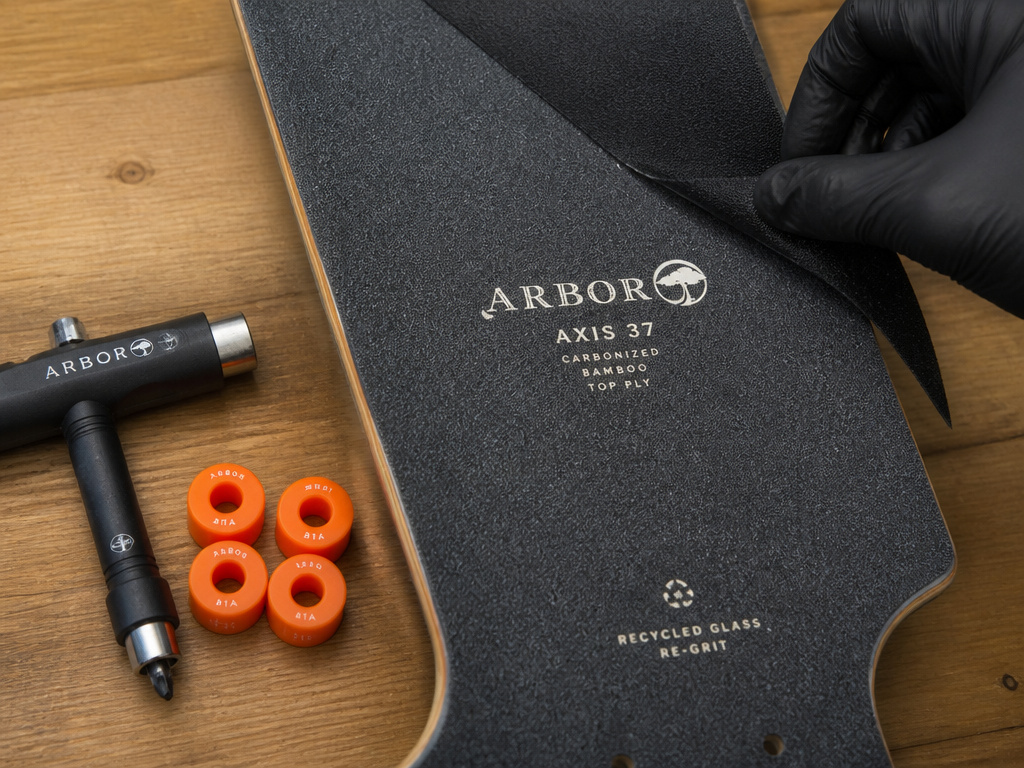
1. Softer Bushings: This is upgrade number one. The stock bushings are geared towards stability. Switching to softer bushings is a common upgrade recommended by owners to make the board carve more easily. It’s a fifteen-dollar fix with the biggest immediate payoff.
2. Wheel Upgrades: The 69mm 78A wheels are great all-rounders. But if you ride over very rough pavement or want more grip for hill bombing, larger wheels are a common swap. One Reddit user running an Axis 40 reported using 85mm Caguama wheels without risers and experienced no wheel bite during normal carving. Another wished for 75mm wheels. Some owners upgrade to larger wheels for different riding characteristics.
3. Griptape Maintenance: As discussed, the Recycled Glass Re-Grit on the Flagship may require attention. The solution isn’t to remove it—that would ruin the wood finish. Instead, owners apply traditional grip tape over the top. Some, as noted on Reddit, also choose to “cut your grip tape off in and or around the drop-throughs” to make future maintenance like cleaning bearings easier.
4. Bearings: While the stock bearings are fine, many riders eventually upgrade to a premium set like Bones Reds or Bronson G3s for faster roll speed and easier cleaning. While the stock bearings are fine, many riders eventually upgrade to a premium set.
How the Axis 37 compares to other Arbor boards
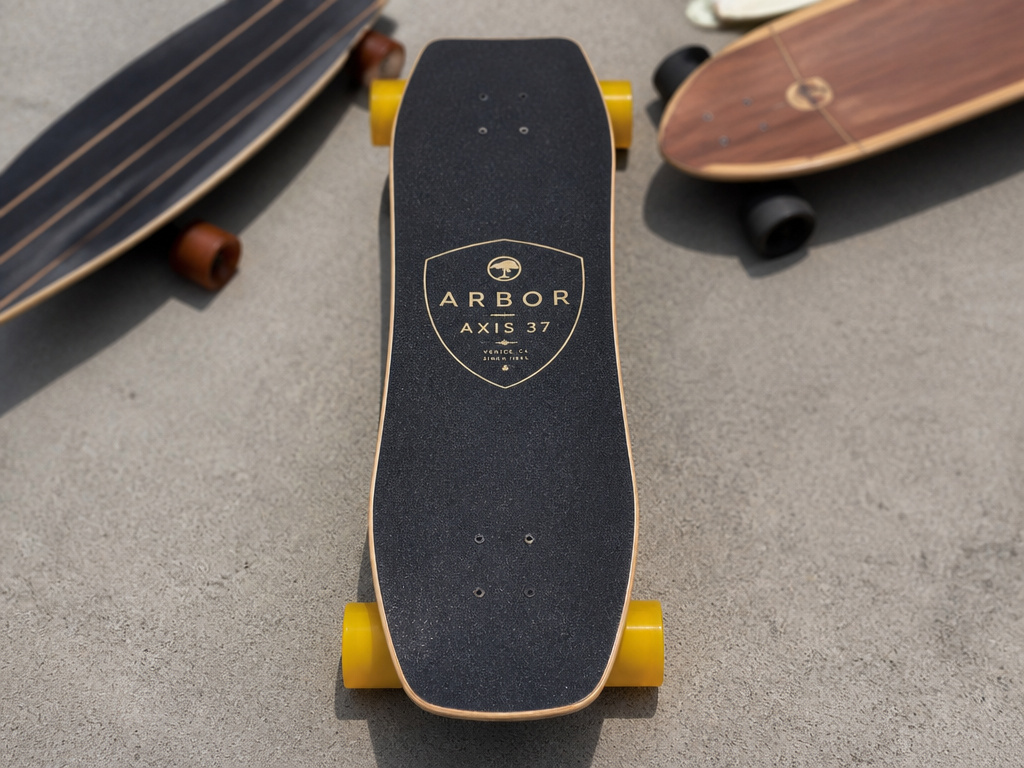
The Axis is designed as Arbor’s most versatile drop-through board, suited for carving, commuting, and even entry-level downhill. This sets it apart from more specialized models. The Axis is designed as Arbor’s most versatile drop-through board, suited for carving, commuting, and even entry-level downhill. The Axis features a symmetrical, snowboard-inspired shape with sharp sidecuts for quick rail-to-rail transitions, whereas other models may favor directional shapes for a different feel. If you’re looking for a single board to handle a wide variety of riding styles, the Axis is the pick.
Frequently Asked Questions
Are Arbor longboards good quality?
Yes. Arbor is a long-standing brand with roots dating back to 1995. Their completes, like the Axis, use quality name-brand components such as Paris trucks rather than generic no-name parts. Their decks are made from 7-ply Canadian Maple in the USA, and they have a strong focus on eco-friendly board construction.
Is the Arbor Axis 37 good for beginners?
It’s an excellent beginner board. The drop-through design lowers the deck for easy pushing and stability. The soft, large wheels handle rough pavement well, and the overall package is forgiving. Just remember to pair it with the proper safety gear.
What is the weight limit for the Arbor Axis 37?
Arbor does not publish an official weight limit for the Axis 37. The 7-ply maple construction is standard and robust, suitable for most adult riders. Arbor does not publish an official weight limit for the Axis 37. The 7-ply maple construction is standard and robust, suitable for most adult riders.
Can you do downhill on an Arbor Axis 37?
It can handle mellow downhill with the right setup and rider skill. In its stock form, it’s more of a cruiser/carver. For serious downhill, riders often modify their setup for increased stability and control. It’s an “entry level downhill” board at best.
How does the Axis 37 compare to other drop-through longboards?
The Axis 37 sits in the mid-to-upper tier of complete drop-throughs. Its use of Paris trucks sets it apart from cheaper completes that use generic trucks. The Axis 37 uses quality name-brand components such as Paris trucks and has a snowboard-inspired shape and eco-material focus.
The Bottom Line
The Arbor Axis 37 is a thoughtfully designed, well-built complete longboard that delivers exactly what it promises: a smooth, stable, and enjoyable ride for cruising and carving. Its strengths are its quality components right out of the box and its versatile, forgiving nature.
Its weaknesses are specific and fixable: the glass grip’s durability and the stock bushing’s restrictiveness for eager carvers. Knowing these points ahead of time allows you to budget for grip tape and bushings, common upgrades recommended by owners.
If you’re looking at longboards for commuting and value a board that looks as good as it rides, the Axis 37 is a top contender. Just be sure to compare it to other top longboards in your search, and use our longboard buying guide to weigh all your options. For the rider who wants a single, do-it-all board that won’t need immediate part replacements, this one gets you very close straight from the shop.
