Arbor Skateboards Review: Are They Worth the Price?
This post contains affiliate links. As an Amazon Associate, we earn from qualifying purchases.
Arbor skateboards are a legitimate, pro-backed brand offering high-quality, factory-assembled completes that are excellent for cruising and solid for street skating, but their warranty has critical exclusions for water damage and physical modifications that every buyer needs to know.
That “Certified Arbor Complete” label is the key. It’s not just a marketing sticker, it’s a promise that the trucks, wheels, and bearings have been matched to the deck’s geometry by Arbor’s team. The catch is in the fine print: leave that board out in the rain once, and you’ve likely voided the warranty on warping. This is a crucial point in any arbor skateboards review.
What follows is a breakdown of the specs that matter, the real-world performance from parks to pavement, and the exact models that fit a beginner’s first board versus an intermediate’s trick progression, all essential for a thorough arbor skateboards review. By the end, you’ll know if an Arbor board is the right tool for your kind of skating, or if your money is better spent elsewhere.
Key Takeaways
- A Certified Arbor Complete guarantees the components (trucks, wheels, bearings) are Arbor-approved and matched to the deck’s shape for balanced performance, so look for the symbol.
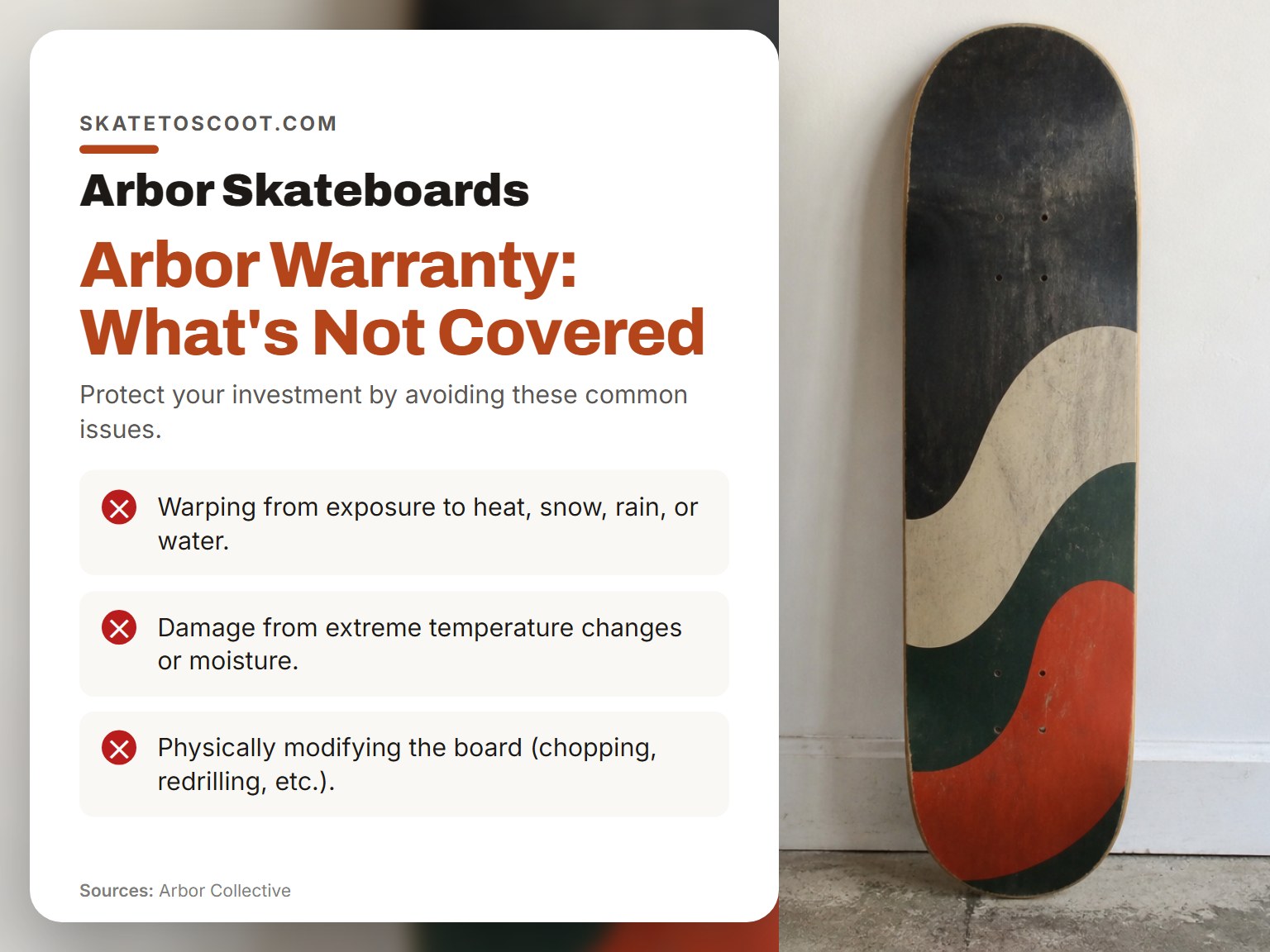
- The brand’s warranty does not cover warping from rain, snow, or heat, nor damage from water or extreme temperature changes, which are common real-world hazards.
- For pure cruising and commuting, models like the Pilsner with 61mm, 78a wheels are top-tier, but their soft wheels make slide tricks impossible.
- Their street shapes (Kitten, Puppy, Wizard, Reaper) use 92a wheels and ABEC 7 bearings, making them viable for park and street skating, though some riders immediately swap the stock bushings.
- Compared to a budget build-your-own setup, Arbor completes offer pro-level component quality and convenience, but you pay for that curation and the brand’s sustainability focus.
What Does a ‘Certified Arbor Complete’ Actually Mean?
You see the phrase on every product page. It sounds official. Here’s what it actually commits the brand to, and where that commitment stops.
A Certified Arbor Complete is a fully assembled skateboard built with select, high-end components that complement the performance and geometry of each deck shape. The package considers truck angle and size, wheel diameter and shape, bushing rebound, and wheel well placement.
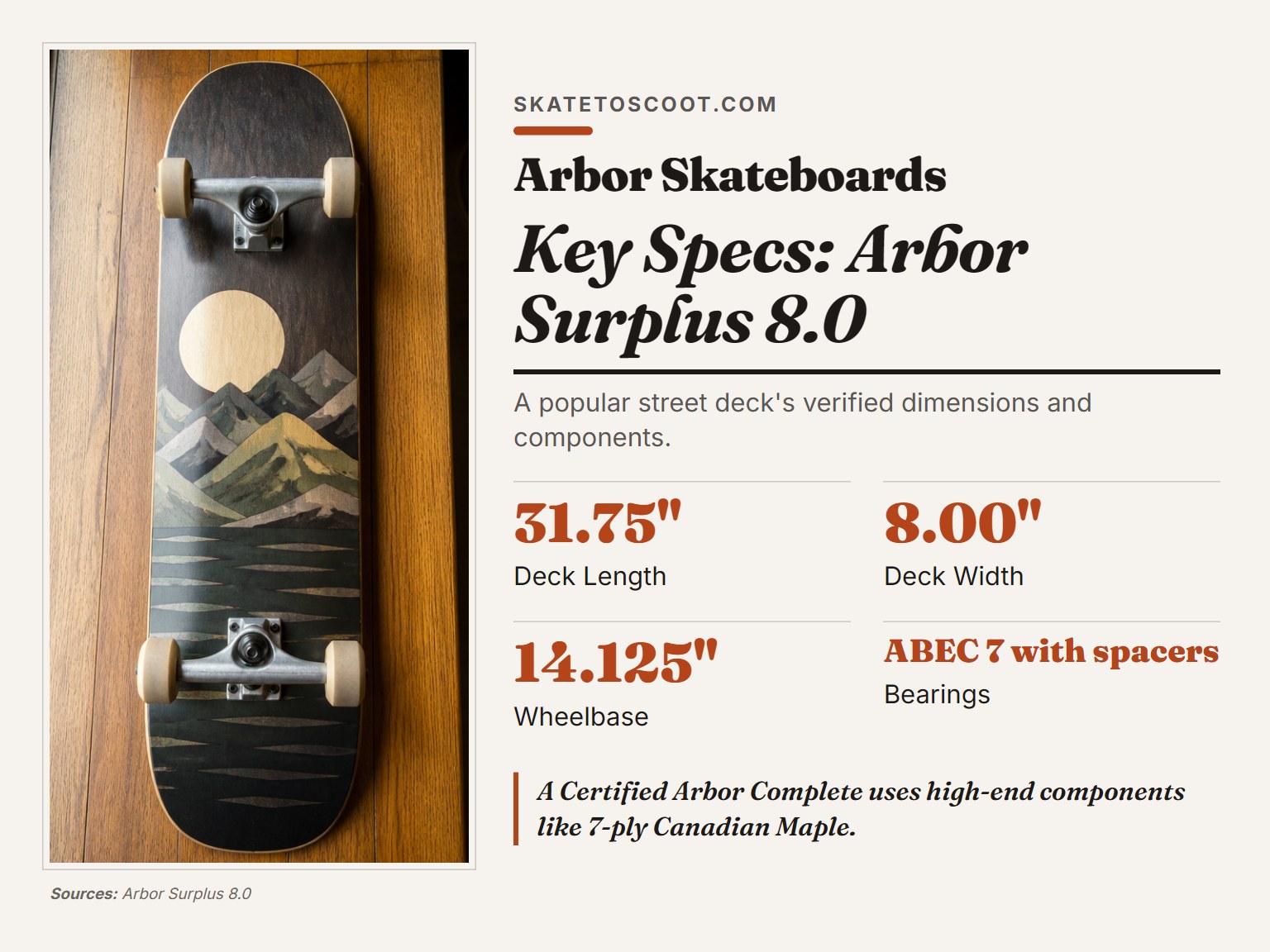
That’s from Arbor’s own product descriptions. In practice, it means you aren’t getting a random assortment of parts. The Arbor 5.25″ Surplus Trucks on a Surplus 8.0 are picked because their width and geometry fit that specific 8-inch deck. The Arbor Revert Series 54mm, 92A wheels on that same board have a 22.0mm contact patch chosen for a balance of grip and slide on street terrain.
It’s a curated experience. The alternative is buying a deck, then picking trucks, wheels, and bearings separately, a great way to dial in a perfect setup, but a confusing gauntlet for a newcomer. The Certified Complete is Arbor saying, “We’ve done that homework for you.”
Where this goes sideways: That warranty. According to Arbor’s official policy, the guarantee is voided by “warping as a result of exposure to heat, snow, rain, or immersion in water” and “damage from extreme temperature changes, water, or moisture.” It also doesn’t cover “physically modifying your skateboard (chopping, redrilling, etc.).”
Skateboards live outside. They get left on damp grass. They ride through puddles. Want to redrill your truck holes for a different wheelbase? That’s a common customization. Arbor’s warranty treats these real-world events as abuse. It’s a significant limitation that shifts the long-term durability risk to you, the owner.
Breaking Down a Real Arbor Complete: The Surplus 8.0 vs. The Reaper 8.5
We’ll move from theory to concrete specs. Comparing two popular street models shows how Arbor tweaks components for different ride feels.
| Component | Arbor Surplus 8.0 | Arbor Reaper 8.5 |
|---|---|---|
| Deck | 31.75″ L x 8.00″ W, 14.125″ WB, 7-ply Canadian Maple | 32.125″ L x 8.5″ W, 14.5″ WB, 7-ply Canadian Maple |
| Trucks | Arbor 5.25″ Surplus Trucks | Arbor 5.5″ Revert Trucks |
| Wheels | Arbor Revert Series 54mm, 92A, 22.0mm contact patch | Arbor Revert Series 52mm, 92A, 16.0mm contact patch |
| Bearings | ABEC 7 with spacers | ABEC 7 with spacers |
The Surplus 8.0 is the classic street size. The Arbor 5.25″ Surplus Trucks and Arbor Revert Series 54mm, 92A wheels with a 22.0mm contact patch give it a stable, grippy feel for technical street skating. The Reaper 8.5 has a wider deck and Arbor 5.5″ Revert Trucks. Its Arbor Revert Series 52mm, 92A wheels have a 16.0mm contact patch.
Both use ABEC 7 bearings with spacers. The ABEC rating is about tolerances, not necessarily speed, but the included spacers are a pro touch, they keep the bearings aligned under lateral pressure, preventing the wheels from wobbling and extending bearing life. This is a detail budget completes consistently skip.
The common thread is 7-ply Canadian Maple decks. You aren’t getting an experimental or cost-cut material here.
The Arbor Pilsner: A Hybrid That Tests Well
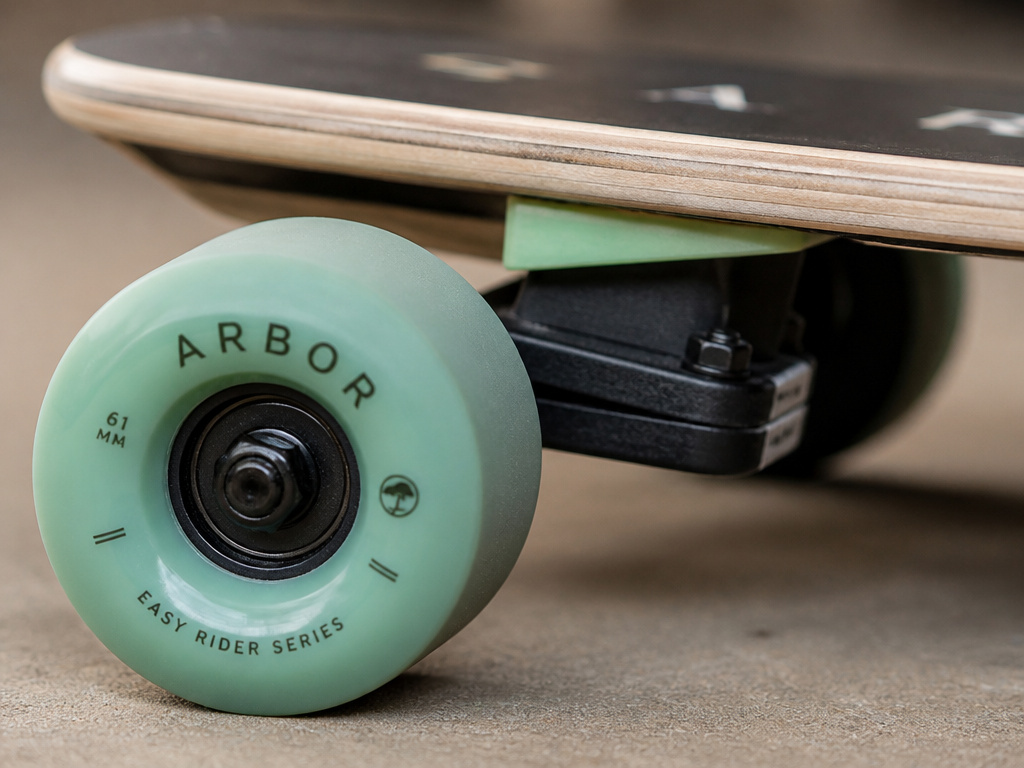
Not everyone wants a pure street machine. For the rider who prioritizes getting around town comfortably but still wants to hit a park occasionally, Arbor offers hybrids like the Pilsner Cruiser.
Third-party testing from TechGearLab measured the Pilsner at a 28.75″ deck length and 8.25″ width, paired with 61mm, 78a hardness wheels. Those are cruiser specs through and through. The testers noted its “wide squared-off tail” was great for stalls and that the “bearings hold speed exceptionally well,” requiring little pumping on transitions.
The part nobody mentions: The Pilsner’s riser pads and big wheels give it a taller ride height. If you’re used to a low, street setup, it feels tippy for the first few sessions. You adjust, but it’s a real sensory shift.
The same review states the “soft wheels make any sort of slide trick impossible,” and the deck has “only a slight concave on the nose,” making nose tricks harder.
This is a perfect example of the Certified Complete philosophy. The Pilsner has riser pads and big wheels giving an elevated ride. It’s a cohesive package designed for a specific type of riding.
Who Are Arbor Skateboards Actually For? (Beginners vs. Intermediates)
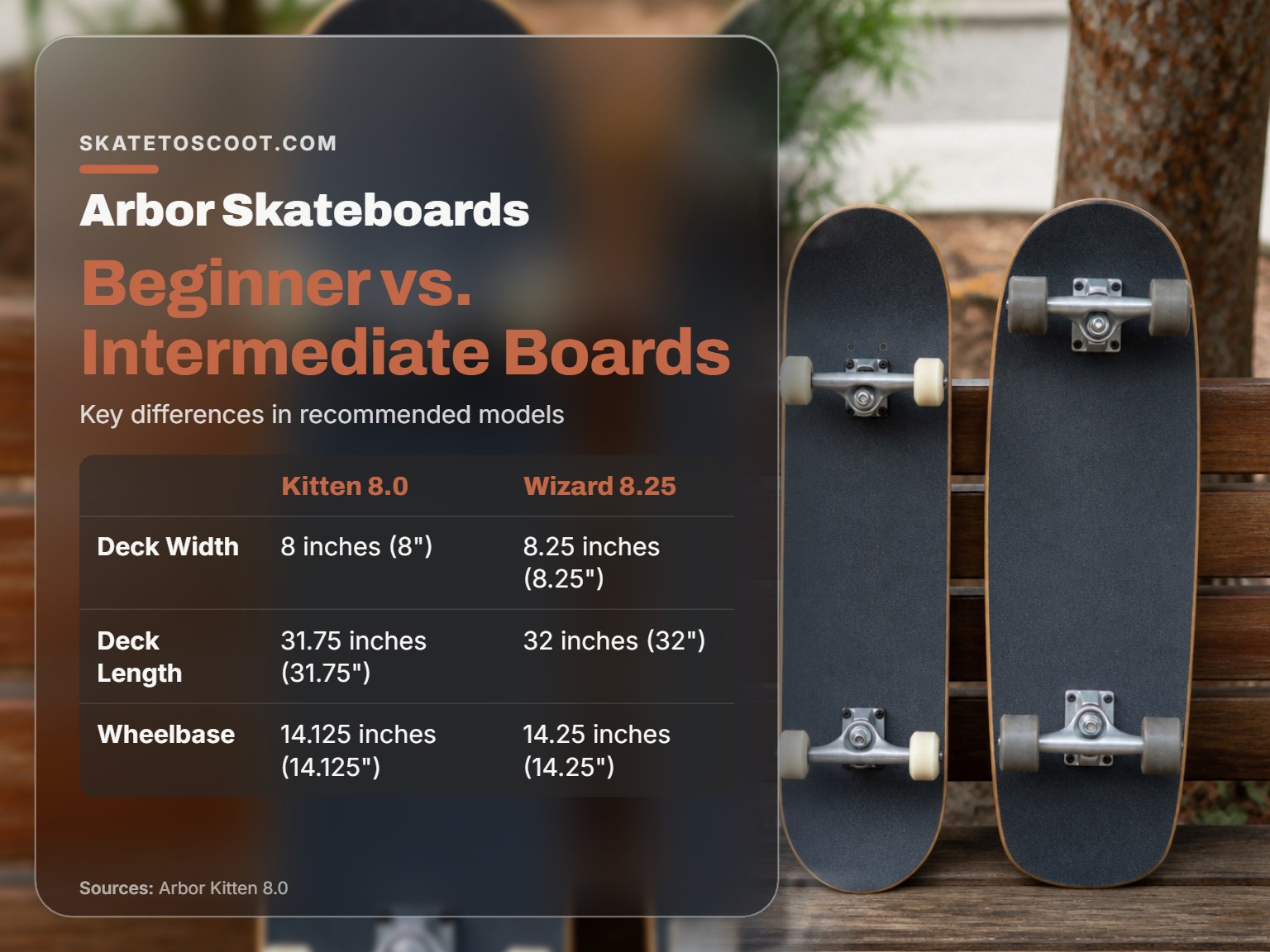
The brand makes boards for everyone, but that doesn’t mean every board is for every person, a key distinction in any arbor skateboards review. Your skill level and goals dictate which model makes sense.
For Beginners:
- The Recommendation: The Arbor Kitten 8.0 (31.75″ L x 8″ W) or Puppy 8.25 (32″ L x 8.25″ W). These are mid-sized boards with 92a wheels.
- The Caveat: Some beginners find the stock bushings in Arbor’s Ace trucks too soft and “squishy,” as noted in a Reddit user’s experience. A 195lb rider mentioned swapping them for Bones Hard bushings immediately for better control. This is a $10 fix, but it’s a common first upgrade.
- The Alternative: If you are 100% certain you only want to cruise and never touch a skatepark, the Pilsner is a fantastic, albeit more specialized, beginner board.
For Intermediate Skaters:
You have your ollies and kickflips on lock. You’re starting to grind ledges, hit bigger transitions, or want a board tailored for a specific style.
- The Recommendation: The Arbor Wizard 8.25 or Reaper 8.5. The Wizard and Reaper have wider decks.
- The Reality Check: At this level, you might be particular about your setup. You might want harder or softer wheels, different trucks, or a specific concave. The value of a complete diminishes here. You could buy a blank deck and your preferred components for a similar price. The Arbor complete saves you the assembly hassle and guarantees component compatibility, but it’s less customizable out of the box.
The Daisy Mini 7.5 is a mini-cruiser with a 28.5″ length, 7.5″ width, and 12.25″ wheelbase.
How Arbor Stacks Up Against Other Brands
It’s not a vacuum. Shoppers compare Arbor to Landyachtz for cruisers and to brands like Santa Cruz or even building a custom setup for street decks.
Arbor vs. Landyachtz (for Cruisers):
This is the most common head-to-head. Both are premium brands known for quality completes.
Arbor vs. A Custom Budget Build:
This is the value question. For around the same price as an Arbor complete, you could buy a blank deck, independent trucks, and branded wheels and bearings.
- Arbor’s Edge: Convenience, curated performance, and pro-level components (ABEC 7 with spacers, quality maple) right away. You’re also supporting a brand with a sustainability ethos.
- Budget Build’s Edge: Total customization. You choose every part. A budget build allows total customization but requires knowledge and time to assemble.
Arbor vs. Sector 9:
For longboards and cruisers, Sector 9 is a direct competitor with a similar heritage. If you’re looking at a drop-through cruiser, compare Arbor’s Axis 37 to Sector 9’s similar models.
For a true budget-conscious option, brands like Retrospec offer functional completes at a lower price point, but they typically use generic components, softer maple, and lower-grade bearings to hit that cost.
The Verdict: Are Arbor Completes “Worth It”?
So, do they suck? Absolutely not. Arbor skateboards are well-made boards.
The “worth it” calculus depends on your profile:
- For a beginner who wants a quality, no-fuss start: Yes, they are an excellent choice. A board like the Kitten 8.0 is a complete for beginners.
- For an intermediate seeking a specific performance feel: Maybe. The completes are competent, but you might chafe at the lack of customization. Consider buying just an Arbor deck and building your own setup.
- For a dedicated cruiser: A strong yes. The Pilsner is a top-tier cruiser for commuting.
Before you buy any complete, not just Arbor’s, check our guide to the best complete skateboards to see how they fit into the broader market. And if you’re curious about how their longboard-specific models perform, our deep dive on the Arbor Axis 37 covers that terrain in detail.
One final, essential rule: respect the warranty’s limits. Store your board indoors. Dry it off if it gets wet.
Frequently Asked Questions
Are Arbor skateboards good quality?
Yes, based on the component specs, Arbor skateboards are good quality. They use standard 7-ply Canadian Maple decks, brand-matched trucks and wheels, and include ABEC 7 bearings with spacers,
Is Arbor a good brand for beginners?
Arbor is a very good brand for beginners. Their Certified Completes take the guesswork out of a first purchase, ensuring the board is properly assembled with compatible parts. Models like the Kitten 8.0 or Puppy 8.25 offer stable, forgiving platforms to learn on. Just be aware some beginners may want to upgrade the stock bushings for a firmer feel.
Where are Arbor skateboards made?
Arbor Collective is a California-based company. While their official manufacturing locations aren’t explicitly listed on their consumer site, the brand emphasizes sustainable practices and materials. Their decks are typically pressed from Canadian Maple, a global industry standard.
What is the most reliable skateboard brand?
“Reliable” often means durable components and consistent quality. Brands like Arbor, Santa Cruz, Landyachtz, and Powell-Peralta have long-standing reputations for reliability because they use proven materials (like 7-ply maple) and quality hardware. Reliability also depends on using the board for its intended purpose; a cruiser board ridden on smooth pavement will last longer than a street board constantly slammed down stairs.
Can you do tricks on an Arbor skateboard?
You can absolutely do tricks on many Arbor skateboards. Their street shapes (Surplus, Reaper, Wizard) are designed for street and park skating. However, their cruiser models like the Pilsner have soft, large wheels and a taller ride that make flip tricks and slides very difficult. Choose a model based on your primary activity.
The Bottom Line
Arbor doesn’t make bad boards. They make specific boards for specific riders, wrapped in a convenient, quality-controlled package. The value is in that curation and the guaranteed component harmony. Just go in with your eyes open: you’re buying a tool optimized for a certain job, and the warranty won’t save you from rain or your own modifications. Pick the model that matches your actual skating, not just the coolest graphic, and you’ll get a board that holds up.
