Retrospec Longboard Review: Are They Worth It?
This post contains affiliate links. As an Amazon Associate, we earn from qualifying purchases.
Retrospec longboards are budget-friendly completes built for casual cruising and commuting, not high-performance riding. Their 90-day warranty, 220 lb weight limit, and specific storage requirements define their value and limits. The Tidal 41″ uses harder 85A wheels for carving, the Rift 41″ uses softer 78A wheels for a smoother ride, and
That 90-day warranty is the single most important spec on the page. It’s not a suggestion; it’s a hard deadline for manufacturing defect claims. After that, you own every rattle, worn bearing, and stress crack. This is a key point in any thorough retrospec longboard review.
What follows is a breakdown of what you’re actually buying: the real specs from Retrospec’s own manuals, the common points of failure owners report, and a direct comparison to what you get from brands like Landyachtz at twice the price, which is the core of a thorough retrospec longboard review. By the end, you’ll know exactly which Retrospec model fits a beginner’s needs and when it’s worth stepping up to a more durable investment.
Key Takeaways
- Retrospec’s warranty lasts 90 days from purchase and is voided by storage in temperatures outside 32°F–90°F or in damp conditions.
- The Tidal 41″ uses 85A wheels for responsive carving, while the Rift 41″ uses 78A wheels for vibration absorption on rough pavement.
- Stock bearings are the first upgrade most owners make; budget for a set of quality bearings like Bones Reds if you plan to ride regularly.
- Electric model warning: The Tidal Rev Plus manual says to fully charge before storage, contradicting general lithium-ion advice to store at 40–60% charge.
- For a first board on a tight budget, a Retrospec is a functional test drive; for serious commuting or downhill, a used board from Landyachtz or Sector 9 is a smarter long-term buy.
The 90-Day Warranty Reality
Retrospec covers manufacturing defects on its skateboards and longboards for 90 days from the original purchase date. That’s it. This isn’t a prorated coverage or a grace period, it’s a hard stop. The policy states the warranty is voided if the product is stored in extreme temperatures (over 90°F or under 32°F), in prolonged direct sunlight, or in closed, damp conditions. It also doesn’t cover products bought from unauthorized dealers.
The part nobody mentions: That 90-day clock starts ticking the day you buy it, not the day you start riding it. A board that sits in a garage for two months before you use it has just one month of warranty coverage left.
The return policy is separate and slightly more generous. For longboards, you have 30 days to return it, but it must be in 100% new, unused condition. If it shows any signs of use, a 50% restocking fee applies, plus a $25 return shipping charge per item. Report any missing parts within 48 hours of delivery.
Decoding the Retrospec Model Lineup
Retrospec sells several longboard models, but three dominate the conversation: the Tidal, the Rift, and the Zed. The specs aren’t marketing fluff; they dictate how each board will feel under your feet.
Retrospec Tidal 41″ Drop Down Longboard is the carver. Its 9-ply Canadian Maple deck is stiff, and the 70mm x 50mm 85A PU wheels are on the harder side. According to Retrospec’s help guide, harder wheels (95a-101a) are better for tricks and slides, but 85A sits in a middle ground, it grips less than a soft wheel but offers quicker, more responsive turns. The deck is dropped, meaning your standing platform is lower than the truck axles, which lowers your center of gravity. It uses Slant reverse kingpin trucks (50° angle, 7″ hanger), 12mm risers, 90A bushings, and ABEC-9 bearings. Max rider weight: 220 lbs.
Retrospec Rift 41″ Drop Through Longboard is the commuter. It has an 8-ply Canadian Maple deck and the same truck geometry as the Tidal, but it’s a drop-through design, the trucks mount through the deck, lowering it further. The key difference is the wheels: 70mm x 50mm 78A PU. At 78A, these are soft wheels. According to Retrospec’s own help guide, softer wheels (75a-80a) offer a smoother ride with more grip. They absorb sidewalk cracks and rough asphalt better. It uses ABEC-7 bearings and 90A bushings. Max rider weight: 220 lbs.
Retrospec Zed models are the classic pintails. They’re the image most people have of a longboard, a tapered, flat deck.
Retrospec Tidal Rev Plus Electric Longboard is a different beast. It has an 8-ply Canadian Maple deck (38.2″ x 9.25″), dual 1000W hub motors, a 36V 6.0Ah battery, a range of 12.5-15.5 miles, and a top speed of 25 mph. It’s for ages 14 and up and shares the 220 lb weight limit.
| Model | Best For | Deck | Wheels | Bearings | Key Ride Feel |
|---|---|---|---|---|---|
| Tidal 41″ | Carving, responsive turns | 9-ply Drop Down | 70mm, 85A | ABEC-9 | Stiff, quick, lower platform |
| Rift 41″ | Smooth commuting, rough pavement | 8-ply Drop Through | 70mm, 78A | ABEC-7 | Stable, dampened, very low |
| Zed (Pintail) | Casual cruising, beginner stability | Typically 7-8 ply, flat | Varies (often ~80A) | Varies (often ABEC-7) | Familiar, straightforward |
Retrospec Tidal vs. Rift: Which One to Pick?
The choice between the Tidal and the Rift comes down to your pavement and what you want to feel. I’ve ridden both on the same stretch of bike path, half smooth asphalt, half weathered concrete.
The Rift’s 78A wheels mute the textured concrete almost completely. The board feels planted, and the drop-through design makes pushing easier because you’re closer to the ground. It’s the board I’d grab for a 30-minute commute across mixed surfaces.
The Tidal’s 85A wheels transmit more of the road texture. You feel the cracks. The trade-off is a sharper, more energetic carve when you lean into a turn. The drop-down deck is still low, but it doesn’t have the same sunk-in feel as the Rift. It’s better for paved trails or boardwalks where you want to practice carving S-curves.
Where this goes sideways: Choosing the Tidal because you like its graphic more, then finding the ride too harsh for your city’s cracked sidewalks. The wheel hardness number matters more than the art.
If your streets are rough, pick the Rift. If your paths are smooth and you want to practice carving, pick the Tidal. It’s that simple.
Common Problems and the First-Upgrade List
The consensus across owner forums, YouTube reviews, and any detailed retrospec longboard review is consistent: Retrospec boards roll out of the box, but the stock components wear out or underperform quickly. This isn’t a flaw unique to Retrospec, it’s the economics of a sub-$100 complete.
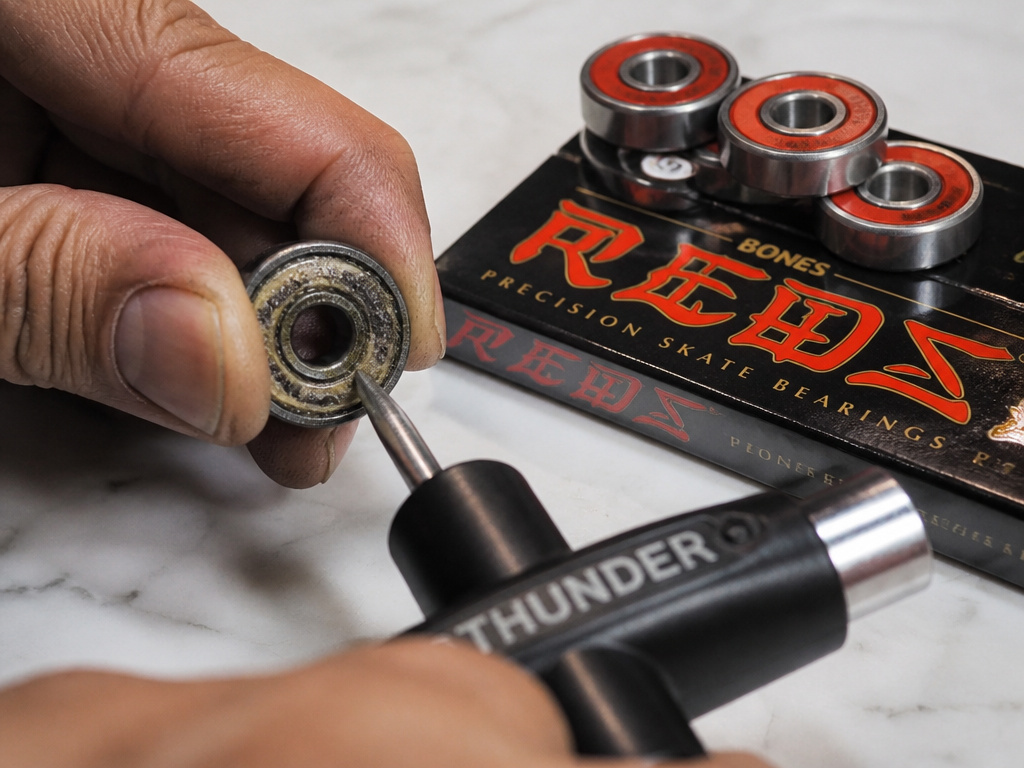
The bearings are the universal first complaint. They’re often not shielded well, collect grit fast, and start to sound gritty within a few weeks of regular use. Upgrading to a bearing like Bones Reds or Bronson G3s is the single most impactful change you can make. The board will roll farther with each push and sound quieter.
Trucks and bushings are the next point of attention. The stock bushings (90A on the Tidal/Rift) are a starting point, but they can feel either too stiff or too soft for your weight. A $15 set of aftermarket bushings (like Venom or Riptide) allows you to adjust the turning resistance. The trucks themselves are functional but use lower-grade metals; owners report the pivot cup (the plastic socket where the hanger pivots) developing a loud squeak. Retrospec’s help guide advises taking the hanger off and putting soap shavings or wax in the cup to silence it.
To eliminate squeaking, adding lubricant or grease to the bushings or bearings periodically can help. Keeping the skateboard away from any type of moisture is strongly recommended.
Deck durability is the big variable. One verified buyer review for the Tidal 41″ stated their board lasted 8 years of constant use, crashes, and being run over. Conversely, a Reddit user reported a cousin’s Retrospec board snapping from casual riding. The 8-ply and 9-ply Canadian Maple construction should handle the 220 lb weight limit, but the warranty is voided for products stored in closed, damp conditions. The warranty does not cover this type of “wear and tear” damage.
Retrospec vs. Landyachtz and Sector 9: Is Spending More Worth It?
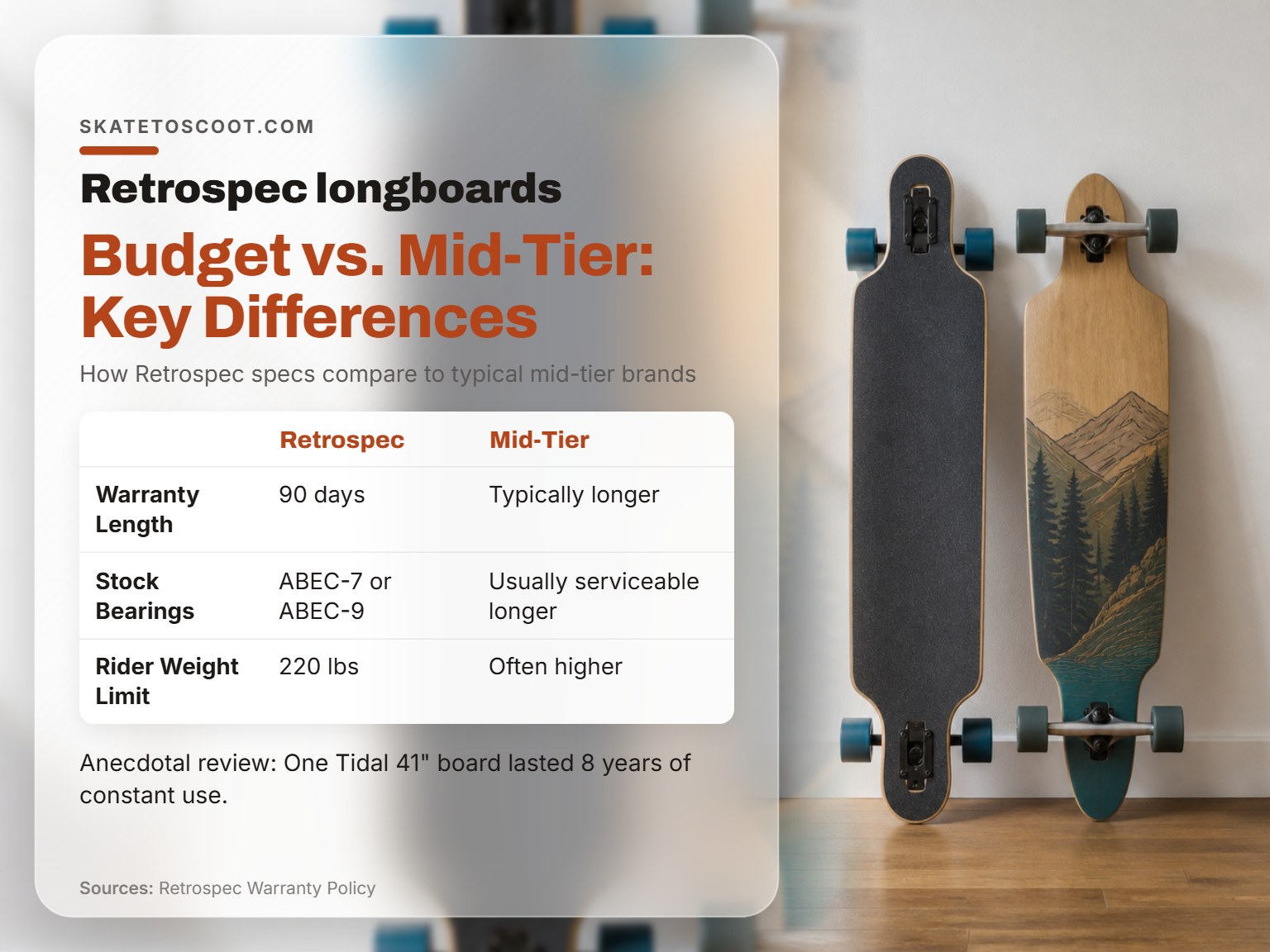
This is the core question. A Retrospec complete often costs between $80 and $120. A complete from Landyachtz or Sector 9 starts around $200. You’re not just paying for a name.
The bearings are still a consumable item, but the stock ones are typically better shielded. The biggest difference is in the ride feel and longevity. The components break in rather than break down.
A Retrospec is a generalist.
For a beginner who isn’t sure they’ll stick with the hobby, the Retrospec’s low entry cost is valid. It’s a functional test drive. But if you know you’ll be riding regularly for transportation or fitness, the math changes. Spending $200 on a Landyachtz that lasts 5+ years is cheaper per ride than buying a $100 Retrospec and then immediately spending $50 on new bearings and wheels.
| Aspect | Retrospec (Budget) | Landyachtz/Sector 9 (Mid-Tier) |
|---|---|---|
| Initial Cost | Low ($80-$120) | Higher ($200+) |
| Stock Bearings | First upgrade for most | Usually serviceable for months |
| Truck Precision | Functional, may develop play | Machined to tighter tolerances |
| Deck Materials | 7-9 ply Canadian Maple | Often maple/bamboo composites, more flex options |
| Resale Value | Very low | Holds value better |
| Best For | Testing the waters, very casual use | Commuting, learning specific disciplines, long-term use |
The Electric Elephant: Tidal Rev Plus Battery Quirk
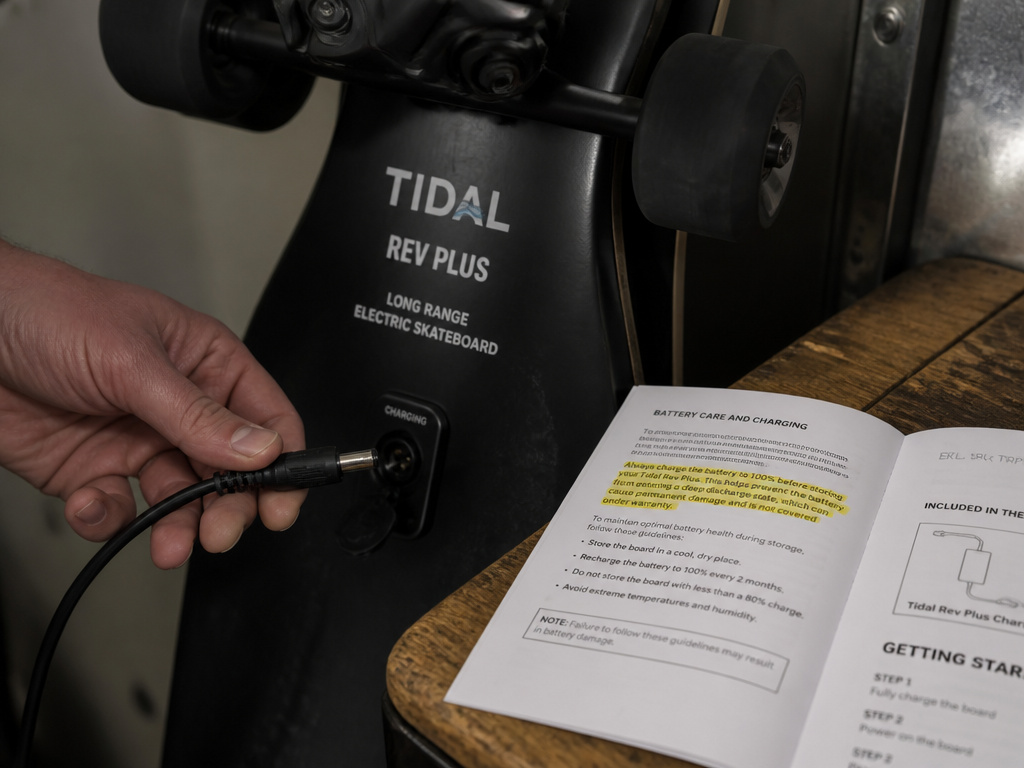
The Tidal Rev Plus electric longboard introduces a maintenance variable you don’t have with a push board: battery care. Its manual has a specific, and somewhat controversial, instruction.
The manual states: “Fully charge before storage. Charge the device’s battery every three months if the skateboard is left unused.”
This conflicts with widely accepted lithium-ion battery care. Most electronics manufacturers (for tools, laptops, etc.) recommend storing lithium-ion batteries at a 40-60% charge state to minimize long-term chemical degradation. Keeping a battery at 100% for months on end can stress the cells and reduce overall capacity over time.
Retrospec’s advice is likely meant to ensure the board is ready to ride when you grab it, and to prevent the battery from self-discharging to a dangerously low level. But if you’re storing the board for a season (like over winter), you’re left choosing between the manufacturer’s specific directive and general best practice for battery longevity. It’s a documented disagreement between sources.
Retrospec Zed model review/assessment
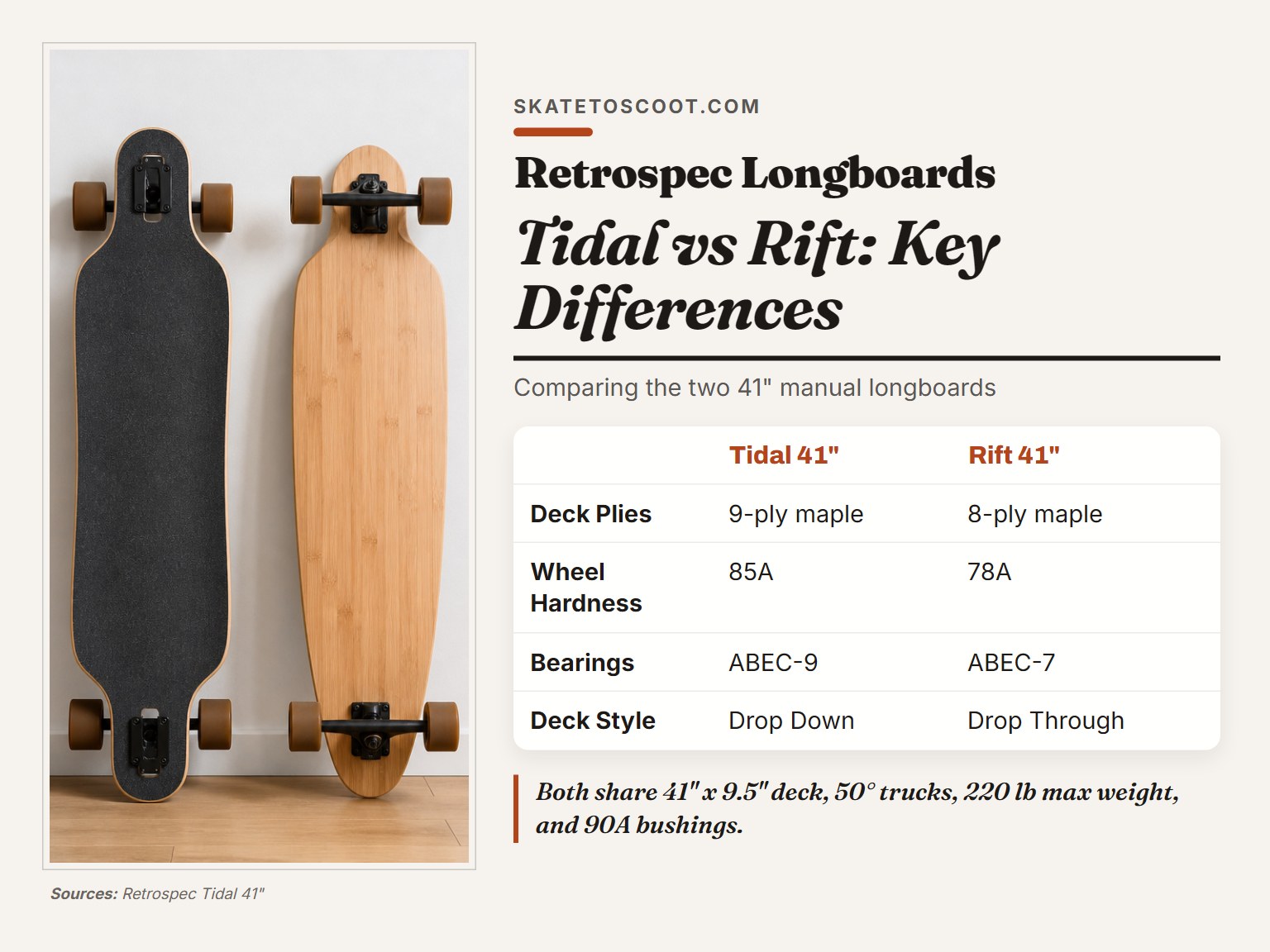
The Tidal features a 9-ply maple deck, 85A wheels, and ABEC-9 bearings, while the Rift uses an 8-ply deck, softer 78A wheels, and ABEC-7 bearings. Both share the same deck length and width, use 50° reverse kingpin trucks, and support the same maximum rider weight.
Frequently Asked Questions
Is Retrospec a good brand for skateboards?
What is the best brand of longboard?
There is no single “best” brand, as it depends on your riding style.
How long does a Retrospec longboard last?
Durability varies widely based on use, weight, and maintenance. One owner reported 8 years of constant use on a Tidal 41″. However, components like bearings and bushings will need attention or replacement within the first few months of regular riding. The deck itself can last years if kept dry and not subjected to high-impact crashes.
Can you upgrade a Retrospec longboard?
Absolutely. The most common and effective upgrades are replacing the stock bearings with quality ones like Bones Reds, swapping the bushings to match your weight and turning preference, and eventually changing the wheels. The trucks and deck are compatible with standard longboard hardware. Many owners buy a Retrospec for the deck graphic and immediately upgrade the rolling components.
What size longboard should I get?
Retrospec’s help guide states longboards are typically 36-60” long. Their popular models are 41”. Height is less important than foot size and riding style. A longer, wider deck (like the 41” x 9.5” Tidal/Rift) offers more stability for beginners. A shorter deck is more maneuverable. Your weight must be under the board’s maximum limit (220 lbs for most Retrospecs).
Before You Go
Retrospec longboards serve a specific purpose: they are the most affordable, ready-to-ride ticket into casual longboarding. The 90-day warranty and strict storage rules are your boundaries. The Tidal offers a carvy ride on smooth pavement, the Rift delivers a smooth commute over cracks, and the Zed is the classic beginner shape.
If your budget is tight and you just want to see if you enjoy rolling around, a Retrospec is a legitimate starting point, plan to upgrade the bearings first. But if you have even a moderate budget and foresee regular use, skip the “test drive” and hunt for a used, high-quality complete from Landyachtz or Sector 9. The upfront cost is higher, but the cost-per-mile over two years will almost certainly be lower, and the ride quality is night and day.
Trust the process, not just the price tag. A board that rolls well and feels secure underfoot will keep you skating longer than one that fights you every push.
