Are Electric Skateboards Illegal? How to Check Local Laws
This post contains affiliate links. As an Amazon Associate, we earn from qualifying purchases.
Electric skateboards exist in a legal gray area defined by conflicting state laws, local ordinances, and sporadic enforcement. In places like Michigan, they are legal with a 25 mph speed limit and 2,500-watt power cap, while Virginia limits them to 20 mph. However, cities can override state permission, and in locations like New York City or special districts, they are flatly prohibited, with fines reaching thousands of dollars.
The gap between a state’s permission and a city’s ban is where most riders get into trouble when trying to answer the are electric skateboards illegal question. It’s not enough to know your state law; you have to check the municipal code for the town you’re riding in, because local councils have the explicit power to ban them on sidewalks, in business districts, or near waterfronts. That patchwork turns a simple question into a multi-layer research project.
What follows is a breakdown of the exact legal definitions from state statutes, the specific areas where use is prohibited, the real-world enforcement stories from riders, and a step-by-step method for checking your own local laws before you roll out.
Key Takeaways
- State law is just the starting point. Local ordinances can and do override state-level legality, creating a confusing patchwork where a device legal at the state level is banned in the city you live in.
- Speed and power thresholds define legality. Michigan allows 25 mph and 2,500 watts; According to web research, California defines a legal “electrically motorized board” at 20 mph and under 1,000 watts. Exceeding these specs in those states makes your board illegal by definition.
- Enforcement is unpredictable but severe. While many riders report no issues, documented cases exist of riders facing $2,000 fines, license points, and even a ban on obtaining a driver’s license for operating an unregistered “vehicle.”
- Sidewalk riding has strict conditions. If allowed at all, you must yield to all pedestrians, give an audible signal before passing, and in some places like France, slow to walking speed (~6 km/h).
- Historic and special districts are often no-go zones. Laws in Michigan explicitly prohibit operation in places like Mackinac Island State Park and special charter cities, regardless of state rules.
The 25 MPH vs. 20 MPH Legal Speed Divide
The first thing to understand is that an electric skateboard isn’t a single, universally defined thing in the eyes of the law. Its legality hinges on whether it fits a specific state’s definition, and those definitions clash. For example, Michigan defines a legal board with a 25 mph, 2,500-watt cap, while other jurisdictions, like California according to web research, have stricter limits of 20 mph and under 1,000 watts.
Michigan law, under MCL 257.13f, provides a clear blueprint. It defines an electric skateboard as a device no more than 60 inches long and 18 inches wide, with a power system under 2,500 watts and a maximum speed of 25 mph. If your board meets those specs, it’s legal in Michigan—at the state level. The Michigan vehicle definition law is unusually precise for this category.
Technical Snippet: Under Michigan Compiled Law 257.13f, an electric skateboard is legally defined as a wheeled device designed to transport one person, with a floorboard no more than 60 inches long and 18 inches wide. Its electric propulsion system must not exceed 2,500 watts in power, and it must have a maximum speed on paved level ground of not more than 25 miles per hour.
Now cross the country to California. The California Vehicle Code 313.5 defines an “electrically motorized board” with similar size limits but stricter performance caps: an average power of less than 1,000 watts and a top speed of 20 mph. A board that’s legal in Michigan could easily be illegal in other jurisdictions with stricter power limits, such as California’s reported 1,000-watt cap.
This is a practical difference between buying a board that fits the law and buying one that doesn’t. High-performance boards that exceed a jurisdiction’s defined speed or power limits may be classified as unregistered motor vehicles.
| State | Max Speed | Max Power | Governing Statute |
|---|---|---|---|
| Michigan | 25 mph | 2,500 watts | MCL 257.13f |
| California | 20 mph | <1,000 watts | VEH 313.5 |
| Virginia | 20 mph | Not specified | Code § 46.2-908.1 |
Where this goes sideways: You buy a board online rated for 28 mph and 1,500 watts. In Michigan, you’re fine on both speed and power. In jurisdictions with stricter limits like California, you could be illegal on both counts. The onus is on you to know your state’s definition before you click “buy.”
Where You Can (and Absolutely Cannot) Ride
Suppose your board fits your state’s definition. Your next hurdle is location. State law often grants local governments sweeping authority to restrict where you can ride, and they use it. This is the patchwork reality that makes a simple “yes it’s legal” answer to are electric skateboards illegal impossible.
Michigan’s law, MCL 257.660, is a masterclass in conditional permissions. It says local governments may regulate operation on sidewalks, highways, streets, or crosswalks, and may prohibit it in specific areas like waterfront pedestrian zones. It then lists specific areas where they definitely can prohibit it: areas adjacent to a waterfront, on a trail, in a downtown business district, or on a street with streetcar tracks. It goes further, explicitly banning operation in “special charter cities” and state parks under the Mackinac Island State Park Commission.
Think about that. Your board is state-legal. You decide to cruise the scenic trails of Mackinac Island. You are now breaking the law, full stop. The same principle applies in Virginia, where the Virginia sidewalk use regulations allow any county, city, or town to ban motorized skateboards on designated sidewalks or crosswalks.
Common mistake: Assuming state permission means you can ride anywhere in the state. Local ordinances routinely carve out downtowns, parks, waterfront paths, and historic districts. Not seeing a “No Electric Skateboards” sign does not mean it’s allowed.
The rules of the road, when you are allowed on them, are equally specific. You must ride as near to the right as practicable. You cannot ride more than two abreast. You cannot pass between lanes of traffic. On a sidewalk, you must yield to every pedestrian and give an audible signal before passing. In many jurisdictions, these are the legal code you’re bound to follow, similar to the rules for skateboard on sidewalk use generally.
How Enforcement Actually Works (The Reddit Reality)
The law on paper and the law in practice are two different things. For this, you have to listen to the riders. Scrolling through community reports reveals a spectrum of enforcement, from total indifference to life-altering penalties.
In many U.S. Suburbs, the attitude is permissive. Riders in forums talk about passing police officers at moderate speeds and receiving nothing more than a glance. The common refrain is “don’t be a dick, and you’ll be fine.”
But the other end of the spectrum is severe. A rider in New York City reported being fined 2,000€ and receiving a 2-year ban on obtaining a driver’s license for riding an electric skateboard. The result wasn’t a warning. They were treated as if operating an unregistered, non-street-legal car. The penalty: a $2,000 fine, two points on a driver’s license they didn’t yet have, a two-year ban on obtaining a license, and a note on their criminal record for “driving a car without a license.”
I’ve seen this common mistake a hundred times. Riders assume enforcement will match the minor, toy-like nature of the device. Traffic courts and police sometimes see it as a motor vehicle violation, which carries a completely different scale of penalty.
According to user reports from online forums, thresholds vary in Europe: a UK source states anything exceeding 15.5 mph is illegal; a user reports France limits boards to 25 km/h and sidewalk speed to 6 km/h if authorized; another reports Poland allows 20 kph on bike lanes and pedestrian speed on sidewalks.
The lesson here is to make you weigh the risk. Knowing the difference is what keeps you rolling.
A Step-by-Step Guide to Checking Your Local Laws
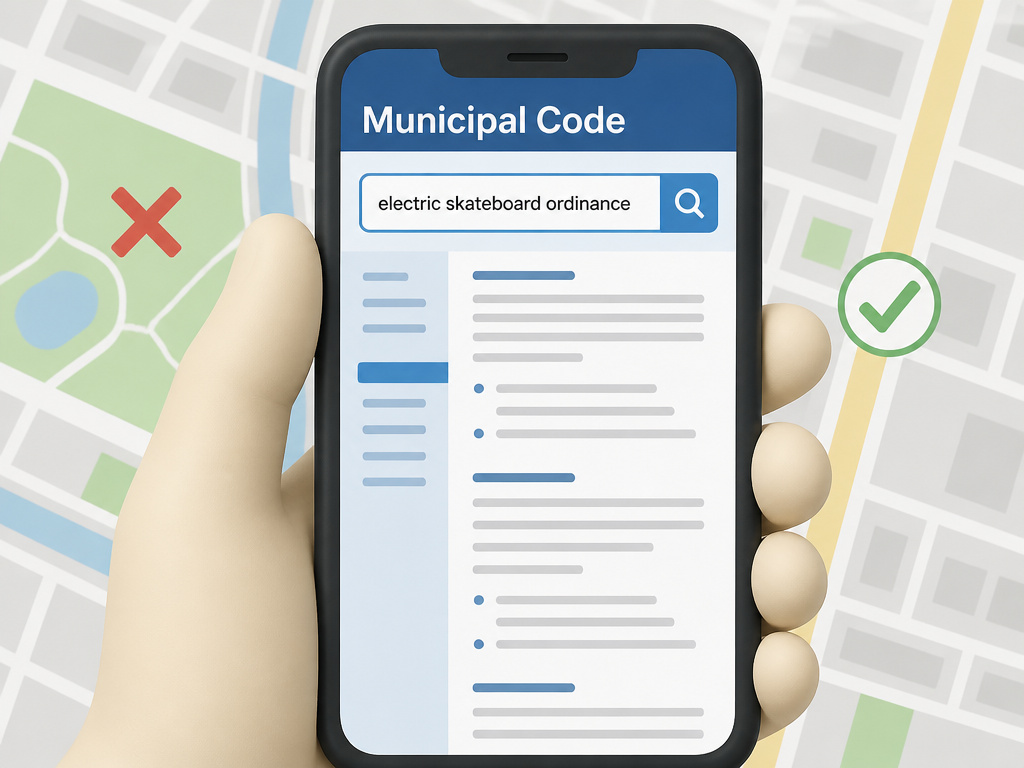
You can’t rely on a national or even state-level answer. Your due diligence has to be hyper-local. Here is a practical, step-by-step method to find out if you can ride your board where you live.
- Find Your State’s Definition. Search for “[Your State] vehicle code electric skateboard” or “motorized skateboard law.” Look for the exact statute, such as Virginia’s motorized skateboard law, which specifies a maximum speed of 20 mph. Note the speed, power, and dimensional limits. Does your board exceed them? If yes, it’s likely illegal at the state level.
- Search Your City or County Municipal Code. Go to your local government’s website. Find the “Municipal Code” or “Ordinances” section. Use the search function for terms like “skateboard,” “motorized vehicle,” “personal transportation device,” or “EPAMD.” This is where you’ll find local bans on where to ride or sidewalk use.
- Identify Specific Prohibited Zones. Look for ordinances related to parks, historic districts, business improvement districts, and waterfronts. These are favorite locations for local bans. Don’t assume—read the code.
- Call the Non-Emergency Police Line. This is the most direct method. Call your local police department’s non-emergency number. Ask: “I’m trying to understand the local rules for riding an electric skateboard. Can you tell me if there are any city ordinances restricting where they can be used, or if they’re prohibited altogether?” Get the answer in plain English.
- Check College Campus or Private Property Rules. If you plan to ride on a university campus or in a large private complex (like a business park), check their specific regulations. These are not covered by city or state law and can be even more restrictive.
This process might seem tedious, but it’s the only way to move from guessing to knowing. It’s the difference between a fun commute and a court date.
Electric Skateboards vs. E-Scooters & Bikes in the Law
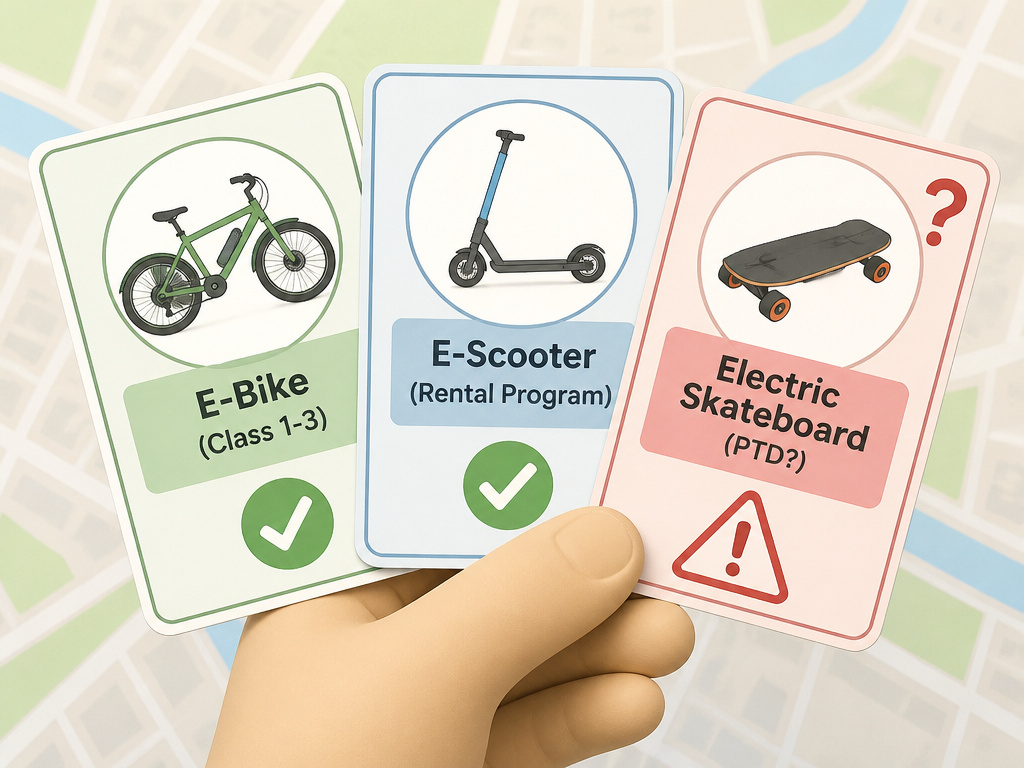
You’ll often see electric skateboards lumped in with e-scooters and e-bikes in casual conversation, but the law frequently treats them differently. This confusion can lead to false assumptions.
E-bikes have a relatively clear, three-class system (1, 2, and 3) that has been adopted by many states, granting them clear access to bike lanes and paths. E-scooters, while also subject to local rules, are often part of sanctioned rental programs that implicitly legitimize their use in certain zones.
Electric skateboards rarely have such a clear classification. They often fall into catch-all categories like “Personal Transportation Device” (PTD) or “Motorized Skateboard,” which come with their own unique restrictions. For example, a rule that allows “e-bikes” on a bike path does not automatically extend to electric skateboards. You must look for explicit permission.
Furthermore, equipment rules differ. Many states have lighting requirements for bicycles and e-scooters used at night. It’s wise to assume these apply to electric skateboards as well—a front white light and a rear red reflector or light are minimums for visibility and safety, not to mention avoiding “equipment” citations.
Understanding this distinction helps you navigate infrastructure. Just because there’s a longboard on the road or an electric scooter on the road doesn’t mean your electric skateboard has the same legal right to be there. Always verify the specific device mentioned in the law or path regulation.
Frequently Asked Questions
Are electric skateboards legal in the US?
There is no federal law governing electric skateboards, so there is no single “US” answer. Their legality is determined state-by-state and often city-by-city. States like Michigan and California have legal frameworks for them, but local governments within those states can prohibit their use. Always check your specific state definition and local ordinances.
Do I need a license or insurance for an electric skateboard?
Generally, no driver’s license is required for devices that meet state definitions like Michigan’s 25 mph cap.
Can you get a DUI on an electric skateboard?
Yes, absolutely. An electric skateboard can be considered a motorized vehicle for DUI laws in many states. If you are under the influence of alcohol or drugs while operating one, you can be charged with driving under the influence, with the same severe penalties as if you were in a car, including license suspension, fines, and jail time.
What are the penalties for riding an illegal electric skateboard?
Penalties vary wildly. They can range from a verbal warning and confiscation of the board to substantial fines. In a documented New York City case, a rider faced a 2,000€ fine and a two-year ban on obtaining a driver’s license. In Virginia, violating sidewalk ordinances carries a civil penalty of up to $50. The severity often depends on local enforcement attitudes and how the violation is classified (e.g., a pedestrian infraction vs. A motor vehicle violation).
Before You Go
The core issue is that you’re trying to fit a new type of mobility into a legal system built for cars and bicycles. The system hasn’t caught up, and you’re the one navigating the gap.
The most important thing you can do is shift your thinking. Don’t ask, “Are electric skateboards illegal?” Ask, “Is my electric skateboard, with its specific specs, legal to operate right here, right now under the combined state and local rules that apply to this exact street?” That’s the level of specificity the law demands.
If your state has a permissive law like Michigan’s, celebrate cautiously. Your next stop is your city’s website and a call to the non-emergency line to see where that permission is stripped away. If you’re in a place like New York City or a state with a restrictive definition like California, assume you are guilty until you prove yourself innocent through research. The burden is on you, not the police, to know the rules. That’s the unavoidable reality of riding right now. Your best defense is a well-informed, cautious approach that respects both the letter of the law and the shared space you’re riding in.
