Camp Seven Redwood Snowboard Review: Performance Breakdown
This post contains affiliate links. As an Amazon Associate, we earn from qualifying purchases.
The Camp Seven Redwood RCRX is a budget-friendly, all-mountain snowboard built around a forgiving RCRX profile and a durable DD2 with Edgelock core. It’s a solid package deal for beginners and intermediates, offering reliable edge hold and versatility, though its extruded base and softer flex limit high-speed performance.
That last sentence is the short answer. The long one starts with where this board actually comes from and what you’re really getting for your money.
You’re looking at a board-and-binding package that costs less than many premium boards alone, a key point in any camp seven redwood snowboard review. That raises questions about construction, durability, and brand reputation. The specs tell one story, rocker-camber-rocker, steel edges, a three-year warranty. But the real story is how those pieces come together on snow, who they’re for, and where the compromises live. This review examines the construction, the ride feel, and where the Redwood fits in a crowded field of entry-level all-mountain boards.
Key Takeaways
- The RCRX profile blends rocker tip/tail for catch-resistance with camber underfoot for edge grip, making it a forgiving yet capable choice for learners.
- Its DD2 with Edgelock core and Rockwell 48 steel edges provide surprising durability and hold for the price, but expect a softer, more forgiving flex overall.
- As a complete package with MTN bindings for $329.95, it represents significant value, but the extruded base requires more frequent waxing and won’t match sintered speed.
- It’s a legitimate tool for progression, not a toy, but understand it’s a budget-oriented product from the Wiredsport house brand ecosystem.
- For beginners and casual intermediates who prioritize value and all-mountain versatility over top-tier materials, the Redwood package is a defensible choice.
Camp Seven Redwood RCRX Specs & Construction
Look past the graphic. The story is in the layers.
The Redwood is built around an RCRX (Rocker-Camber-Rocker) profile. Camp Seven positions this as having “strategically placed rocker zones in the tip and tail to prevent those pesky edge catches,” with an “elongated camber section under foot” for responsiveness. That’s marketing, but the geometry is real. You get the easy initiation and forgiveness of rocker at your contact points, with camber’s power and bite right where your feet drive the board.
The RCRX profile uses rocker at the tip and tail to reduce catch points and improve float in soft snow, while the camber section between the feet provides a defined pressure point for controlled carving and pop.
The core is where the Redwood punches above its weight class on paper. It uses a DD2 with Edgelock core. According to the manufacturer, this is dual-density poplar with high-density stringers running down the center and along each edge. The theory is sound: a softer, more forgiving poplar body with stiff, responsive stringers reinforcing the riding area and edges. This aims to give you a board that’s torsionally stiff enough to hold a carve without being a punishing plank.
The laminates are biaxial over triaxial fiberglass. This is a common, cost-effective layup that provides a predictable, all-around flex. You won’t get the explosive rebound of more advanced, targeted laminates, but you also avoid the dead spots or unpredictable hinge points that can plague cheaper boards.
The edges are fully wrapped Rockwell 48 steel edges. The Rockwell 48 rating indicates a harder, more durable steel alloy that should resist deformation longer than softer edges. The base is extruded. This is the trade-off. Extruded bases are slower out of the factory and require more frequent waxing to maintain glide, but they are easier for a novice to repair with a simple P-Tex candle.
| Specification | Camp Seven Redwood RCRX |
|---|---|
| Available Sizes | 149 cm, 153 cm, 156 cm, 158 cm Wide, 160 cm |
| Profile | RCRX (Rocker-Camber-Rocker) |
| Core | DD2 with Edgelock (Poplar with high-density stringers) |
| Laminates | Biaxial over triaxial fiberglass |
| Edges | Fully wrapped Rockwell 48 steel |
| Base | Extruded |
| Warranty | 3 years against manufacturer defects |
Who Makes It? The Camp Seven & Wiredsport Story
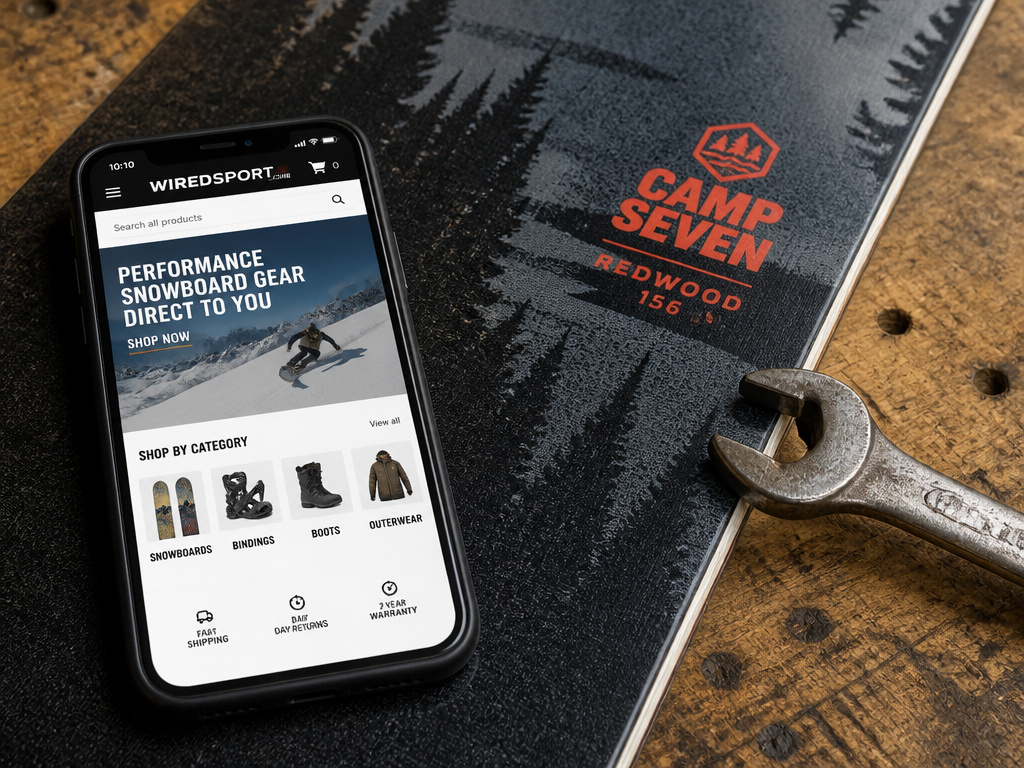
This is the elephant in the room. You won’t find a standalone Camp Seven brand website.
Camp Seven and System are house brands sold primarily through Wiredsport.com. Forum deep-dives from a few years back, like a 2020 Reddit thread often centered on a camp seven redwood snowboard review, show riders trying to trace the manufacturing origins. The consensus that emerged was that these are budget brands produced in large-scale Asian factories, similar to many other value-oriented snowboards and skis. Wiredsport acts as the designer, specifier, and retailer.
Does that make it bad? Not inherently. It makes it a direct-to-consumer value proposition. You’re not paying for Burton’s team of pro riders, Salomon’s R&D campus, or Jones’ marketing campaigns. You’re paying for the materials, the factory time, and the retailer’s margin. The three-year warranty offered on the Redwood and MTN binding package is a signal that Wiredsport stands behind the product’s durability for a reasonable period.
Think of it like a store-brand tool. It might not have the prestige of a Snap-on, but if it’s built to the DD2 core, steel edges, and fiberglass layup spec and backed by a three-year warranty, it can absolutely do the job. The Redwood’s listed specs, the DD2 core, the steel edges, the fiberglass layup, suggest it’s built to a functional recipe, not just a pretty graphic slapped on a blank.
How Does It Ride? Performance Breakdown
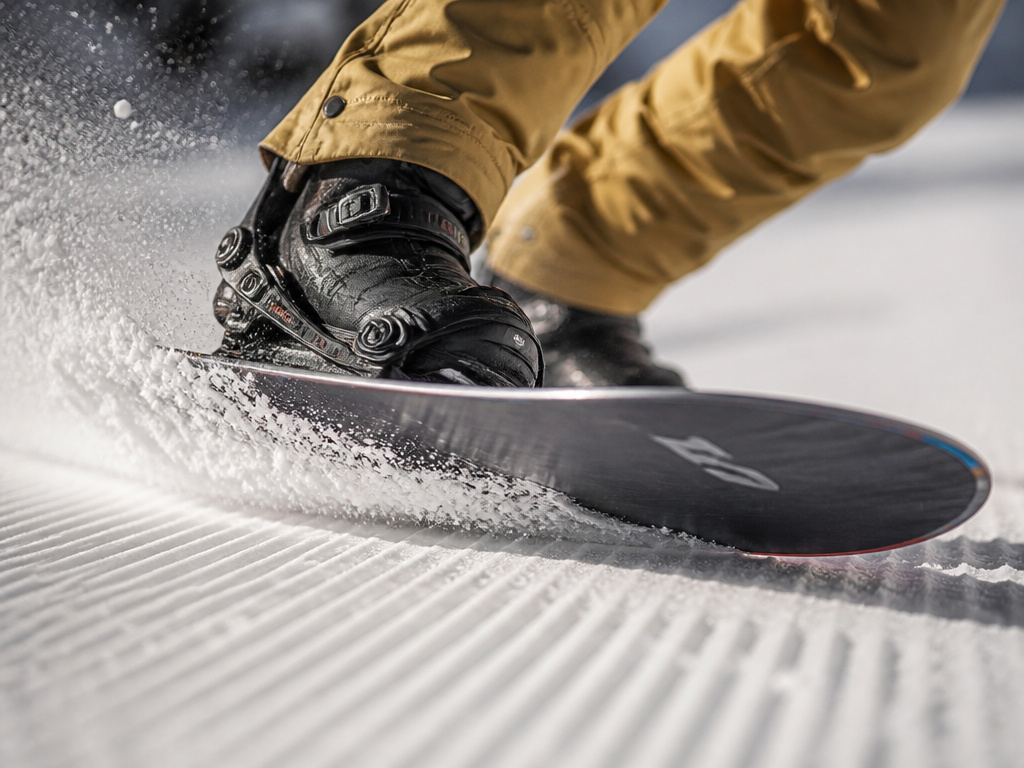
We should be realistic about performance expectations. You’re not getting a damp, high-speed charger or a park-ready noodle. You’re getting a balanced, middle-of-the-road all-mountain board.
On groomers, the RCRX profile is the star. The camber underfoot engages predictably. You lean on your edge, and the board responds with a clean, arcing turn. It’s not lightning-quick from edge to edge, but it’s stable and communicative. The rockered tips mean you can be a little lazy with your weight distribution without instantly catching an edge. For a beginner linking turns or an intermediate working on carving, it’s a confidence-inspiring platform.
In mixed conditions and ice, the Edgelock core and steel edges do their job. The board holds a credible edge on hardpack. You won’t get the laser-lock of a full camber board with a aggressive sidecut, but it won’t wash out beneath you either (for pure performance, see the best camber snowboards). The feedback through your boots is clear: when you’re on the edge, you feel planted; when you start to skid, you know immediately.
Where this goes sideways is expecting high-performance carving or aggressive freeriding (see our guide to the best all-mountain freeride boards for those). The softer overall flex and standard sidecut mean it won’t inspire confidence at very high speeds or in steep, technical terrain. It’s a board for the front side of the mountain, not the backcountry.
For park riding, it’s serviceable but not specialized. The twin shape is fine for learning switch and hitting small to medium jumps. The softer flex makes presses and butters manageable. But the extruded base is slow, and the board lacks the pop and precise flex pattern of a dedicated park board.
Common mistake: Pairing this board with ultra-soft beginner bindings. The Redwood needs a binding with some responsiveness to leverage the camber section. A mid-flex binding like the MTN it comes with, or a Burton Freestyle, is a better match than a pure noodle.
The Package Deal: MTN Bindings & Value
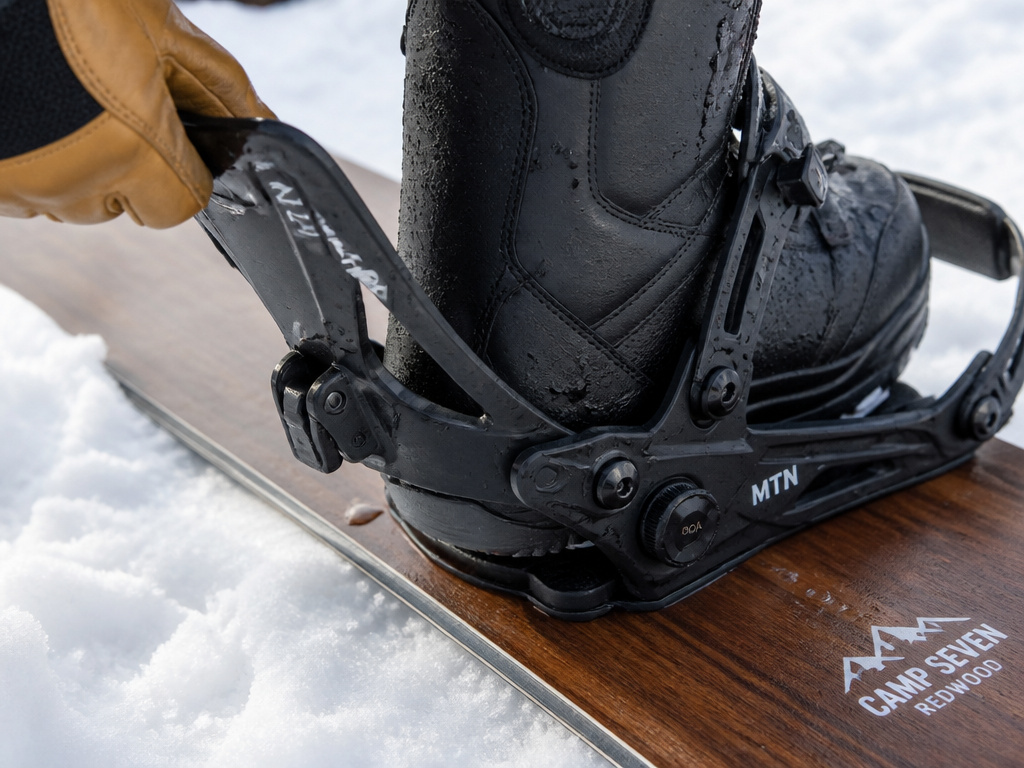
The most common way to buy the Redwood is as a package with MTN rear-entry bindings for $329.95. The board alone lists for $249.95. This is the core value proposition.
The System MTN bindings are rear-entry step-ins. They have high-density dampening pads in the heel and toe ramp, 3D PU molded ankle straps, an EVA padded highback, and a toolless forward lean adjust. The baseplate is a fully compatible multidisc that fits 4-hole and Burton Channel EST boards.
For a beginner or casual rider, these bindings eliminate the sitting-down-and-strapping-in dance. That’s a genuine quality-of-life improvement. The dampening pads and EVA padding add comfort. Are they as precise or durable as a $250 pair of high-end strap bindings? No. But for the package price, they are a coherent match for the Redwood’s forgiving, all-mountain character.
This package directly competes with other entry-level bundles from brands like Rossignol, K2, and Ride in broader best snowboards comparisons. The Redwood’s specs, on paper, often look slightly better, the DD2 core and Rockwell 48 edges are talking points you don’t always see at this price in a typical camp seven redwood snowboard review. The trade-off is the unknown brand cachet and the direct-to-consumer sales model.
Sizing the Redwood: Which Length Is Right?
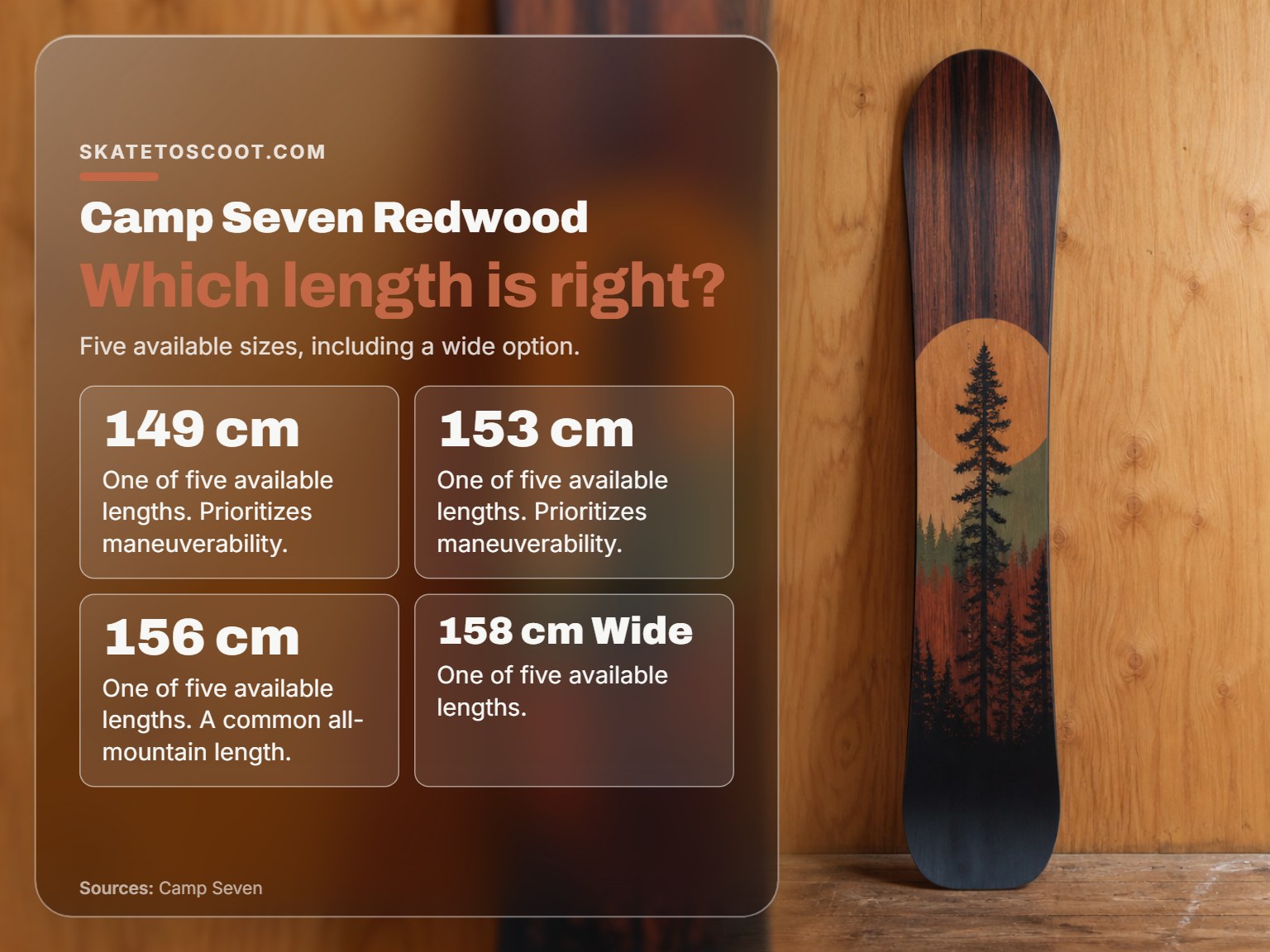
Picking the right size is more important than any spec.
The Redwood comes in five lengths: 149 cm, 153 cm, 156 cm, 158 cm Wide, and 160 cm. The 158 cm Wide is the key option for riders with larger boots (typically US 11+). A wide board prevents toe and heel drag, which is a common frustration for bigger riders on standard boards.
Here’s a simplified guide: – 149cm-153cm: Best for riders prioritizing maneuverability. – 156cm: A common all-mountain length. – 158cm Wide: The wide option for riders with larger boots. – 160cm: For riders seeking more stability at speed.
Stand the board upright. The top of the board should land between your chin and nose. That’s the old-school method that still works.
Camp Seven Redwood vs. The Competition
Where does the Redwood sit among other budget-friendly all-mountain boards? The following comparison uses two common reference points.
| Board | Camp Seven Redwood RCRX | Burton Instigator | Rossignol District |
|---|---|---|---|
| Profile | RCRX (Rocker-Camber-Rocker) | Flat Top (Rocker-Flat-Rocker) | All-Turn Rocker (Rocker dominant) |
| Core | DD2 with Edgelock (Poplar + stringers) | FSC-Certified Poplar | Poplar Woodcore |
| Best For | Beginner to Intermediate, All-Mountain | First-Time Beginners, Park & Play | Beginners, Surfy Feel, Learning Turns |
| Key Strength | Balanced blend of edge hold & forgiveness | Maximum catch-free forgiveness | Easy, loose, turn initiation |
| Consider If | You want a board that can grow with you as you learn to carve. | You are terrified of catching edges and want the easiest ride possible. | You prioritize a soft, playful, surfy feeling over precision. |
The Burton Instigator uses a Flat Top profile. The Rossignol District uses an All-Turn Rocker profile. The Redwood, with its defined camber section, asks a bit more from the rider but offers better carving performance and edge hold as a reward. It’s a board for someone who plans to progress beyond the absolute basics.
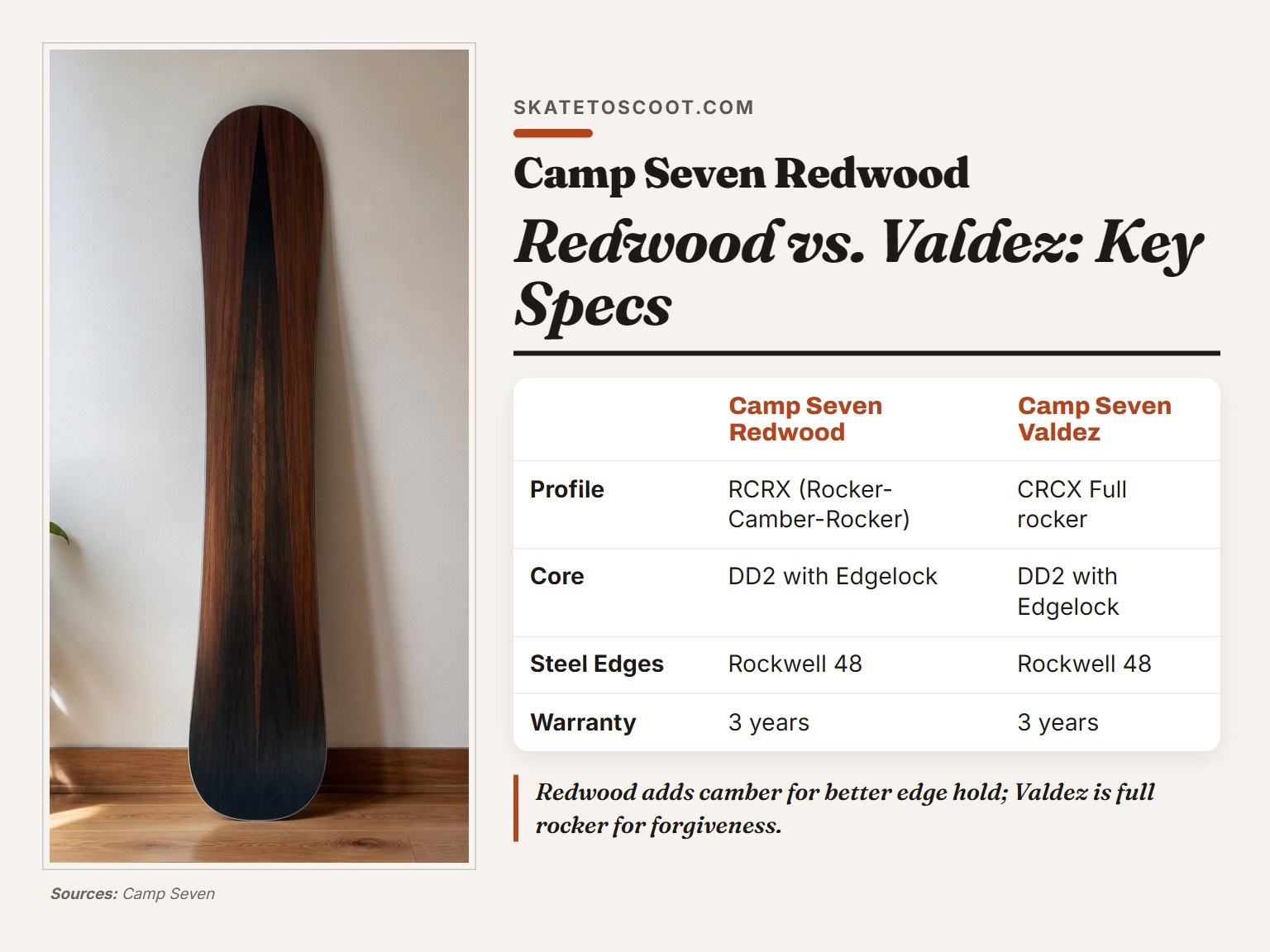
Against other Camp Seven models, like the Camp Seven Valdez (a CRCX full rocker board), the Redwood uses an RCRX profile; see our Camp 7 snowboard review for more on the lineup.
Who Should Buy the Camp Seven Redwood?
This isn’t a board for everyone. It’s a tool for a specific job.
Buy the Camp Seven Redwood RCRX package if:
- You are a first-time buyer or a casual rider who wants a complete, functional setup without a major investment.
- You are an intermediate looking for a forgiving but capable board to explore the whole mountain.
- Value is your primary driver, and you prioritize solid construction specs over brand name.
- You have larger feet (US 11+) and need the 158 cm Wide option.
Skip the Redwood if:
- You are an advanced or expert rider seeking high-performance, stability at speed, or aggressive carving.
- You are a dedicated park rat wanting a soft, poppy, park-specific board.
- You are chasing powder most days and want a dedicated directional powder board.
- You absolutely require the resale value or brand recognition of a major manufacturer.
For the right rider, it’s a legitimate path onto the mountain. You get a board that works, bindings that are convenient, and a three-year warranty for peace of mind. You trade off some material refinement, base speed, and brand prestige. That’s the deal.
How does the Redwood compare to other Camp Seven boards?
The Redwood’s closest relative in the Camp Seven lineup is likely the Valdez. Both share the same DD2 with Edgelock core construction and fully-wrapped Rockwell 48 steel edges, promising similar durability. The critical difference is in the profile. The Redwood uses an RCRX (Rocker-Camber-Rocker) profile, while the Valdez features a CRCX Full rocker. This means the Redwood has a camber section underfoot for snap and edge hold, making it more oriented for all-mountain carving. The Valdez’s full rocker will feel looser, more surfy, and better suited for powder and playful riding, sacrificing some of the Redwood’s precision on hardpack.
Frequently Asked Questions
Is Camp Seven a good snowboard brand?
Camp Seven is a value-oriented house brand sold by Wiredsport. Their boards, like the Redwood, are built to published specifications (DD2 core, steel edges) that are competitive for the price. They are legitimate tools for learning and casual riding, backed by a warranty, but they don’t carry the R&D heritage or pro-level validation of major brands like Burton, Jones, or Lib Tech.
What is the average lifespan of a snowboard?
With proper care, a snowboard can last for several seasons for a casual rider. Lifespan depends heavily on usage (park riding is harder on a board than groomers), maintenance (regular edge sharpening, base waxing), and storage conditions. The Camp Seven Redwood’s three-year warranty suggests the manufacturer expects it to hold up to typical use for at least that long.
What are good cheap snowboard brands?
Good budget-friendly brands often include house brands like Camp Seven and System (via Wiredsport), as well as entry-level lines from major manufacturers like Burton (Instigator, Process), K2 (Standard, Raygun), Ride (Zero, Agenda), and Rossignol (District, Circuit). The key is to compare specific models and their construction, not just the brand name.
Can the Redwood handle ice?
The Redwood’s RCRX profile and Rockwell 48 steel edges provide decent edge hold on hardpack and icy patches. It’s more capable than a pure rocker board in these conditions. However, it is not a dedicated “ice board” like some aggressive camber models with magnetraction or similar edge tech. For occasional east-coast style hardpack, it’s sufficient; for consistently icy conditions, you’d want a more specialized tool.
Are the MTN bindings good for beginners?
Yes, the System MTN rear-entry bindings are excellent for beginners. The rear-entry design makes getting in and out easy without sitting down. The high-density dampening and EVA padding provide comfort and reduce leg fatigue. They offer enough response for a learner to feel the board while being forgiving. As you progress into more aggressive carving or park riding, you might eventually want more precise strap bindings.
The Bottom Line
The Camp Seven Redwood RCRX is a coherent, value-driven package. It takes a proven all-mountain recipe, a blended rocker-camber profile, a reinforced wood core, steel edges, and executes it at a budget price point.
You feel the value in the predictable turn initiation and the credible edge hold. You feel the cost-saving in the slower extruded base and the overall softer flex pattern. It’s a board that acknowledges its place: it’s not trying to be a top-tier charger. It’s trying to be a reliable, versatile partner for someone who’s still building their skills and doesn’t want to over-invest.
If your goal is to get on the snow with a complete setup that won’t hold you back as you learn to carve and explore blues and easy blacks, the Redwood package delivers. Just know that when you start pushing into expert terrain or demanding high-performance carving, you’ll be reaching for the limits of its design. For under $350 complete, that’s a fair trade.
