Can I Bring Electric Skateboard on the Plane?
This post contains affiliate links. As an Amazon Associate, we earn from qualifying purchases.
You can often bring an electric skateboard on a plane if its lithium-ion battery is at or under 100 watt-hours (Wh), but some airlines, like Jetstar Japan (GK), ban them regardless of battery size. The airline has the final say and can refuse any device.
The 160Wh ceiling is the line the FAA and IATA draw for what’s considered a manageable fire risk in an aircraft cabin. Most board-type self-balancing scooters hover right under it at about 158.4 Wh, while many unicycle-style boards blow past it. The rule is absolute, but your path to compliance depends entirely on one number stamped on your battery. A common question is, “Can I bring electric skateboard on the plane?”
What follows: a breakdown of the three watt-hour tiers, exactly how to find your board’s rating, a step-by-step packing guide, and the real-world airline policies that override everything else.
Key Takeaways
- The FAA and IATA prohibit any lithium-ion battery over 160Wh from air travel in both carry-on and checked baggage, while some airlines and authorities forbid devices in the 101-160Wh range entirely.
- Batteries under 100Wh are generally permitted by many regulations, but you must still check your specific airline’s policy before flying, as some, like Jetstar Japan (GK), impose blanket bans.
- For batteries between 101-160Wh, you must obtain written approval from your airline before your flight—this is not a guarantee.
- Always carry the board in your carry-on luggage if the battery is installed; IATA recommends this to keep potential incidents where crew can respond.
- Jetstar Japan (GK) flights ban all electric skateboards and scooters regardless of battery size, a critical exception to the watt-hour rules.
The 100Wh, 160Wh, and 160Wh+ Tiers Explained
The regulations concern the energy packed into the board’s lithium-ion battery, measured in watt-hours (Wh). This creates three distinct legal categories with very different outcomes at the check-in counter.
Under 100Wh: This is the green zone. The FAA and IATA consider these batteries low-risk enough for carriage without special approval. Your airline might still have size or weight restrictions for carry-on items, but the battery itself isn’t the blocker. Many smaller, travel-focused electric skateboards aim for this range.
101-160Wh: This is the grey zone—technically possible but practically difficult. The FAA states airline approval is required for any battery over 100Wh. In reality, many airlines are hesitant to grant it. Some aviation authorities and airlines note that devices in this range face blanket bans from many carriers due to unverifiable quality control and the difficulty for ground staff to verify compliance. Getting a “yes” requires proactive effort.
Over 160Wh: This is the red zone. A battery exceeding 160Wh is prohibited as carry-on or checked baggage under U.S. And international regulations. The FAA specifically states most unicycle scooters and Segway-type devices exceed this limit. If your board’s battery is above 160Wh, your only options are to ship it via ground transport as dangerous goods or leave it behind.
The part nobody mentions: The 101-160Wh “approval” tier is where most heartbreak happens. Regulations say it’s possible, but airline risk departments often say no. Assume it’s forbidden unless you get a written confirmation.
How to Find Your Board’s Watt-Hour (Wh) Rating
You can’t guess this. You can’t estimate. The number must be verifiable, either printed on the battery or calculated from its specs. IATA guidance requires all lithium-ion batteries to have the Wh rating marked on the outside of the battery case. Start there.
If the Wh number isn’t printed, you’ll need to do the math. The formula is straightforward: Volts (V) x Amp-hours (Ah) = Watt-hours (Wh). You’ll find the voltage (V) and capacity in amp-hours (Ah) or milliamp-hours (mAh) on the battery label or in the user manual. If you see mAh, divide by 1000 to get Ah.
| Spec on Label | Example Value | Conversion | Calculation | Result |
|---|---|---|---|---|
| Voltage (V) | 36V | N/A | 36V x 4.4Ah | 158.4 Wh |
| Capacity (Ah) | 4.4 Ah | N/A | ||
| Capacity (mAh) | 4400 mAh | ÷ 1000 = 4.4 Ah | 36V x 4.4Ah | 158.4 Wh |
Common Pitfall: Don’t confuse motor wattage (e.g., a 400W motor) with battery watt-hours. They’re unrelated. The motor power tells you nothing about the battery’s energy capacity, which is what regulators care about.
If you cannot find or calculate this number, you cannot prove your board is compliant. Ground staff are instructed to refuse carriage if they cannot verify the watt-hour rating. That simple missing label is why many boards get turned away.
Airline Approval for 101-160Wh Batteries: The Reality

The FAA says approval is required. Your airline’s website might say approval is possible. What does that process actually look like? It’s opaque and time-sensitive.
Jetstar’s policy is one of the clearest: for batteries between 101-160Wh, you must request prior approval via email to [email protected] at least five business days before your flight. This is the template you should expect. You’ll need to provide your battery’s specifications, proof of its Wh rating, and your flight details. Approval is not automatic.
Where this goes sideways: Some airlines explicitly ban electric skateboards altogether, citing the difficulty of verifying battery safety. Some aviation guidance supports this, stating that many airlines will not allow them even within the 101-160Wh range. Your “approval” may be a flat denial.
The takeaway is brutal but simple: if your battery is over 100Wh, consider it likely forbidden unless you have a printed email from your airline’s dangerous goods office stating otherwise. Do not rely on a phone agent’s verbal okay.
Carry-On vs. Checked Baggage: Where to Put Your Board
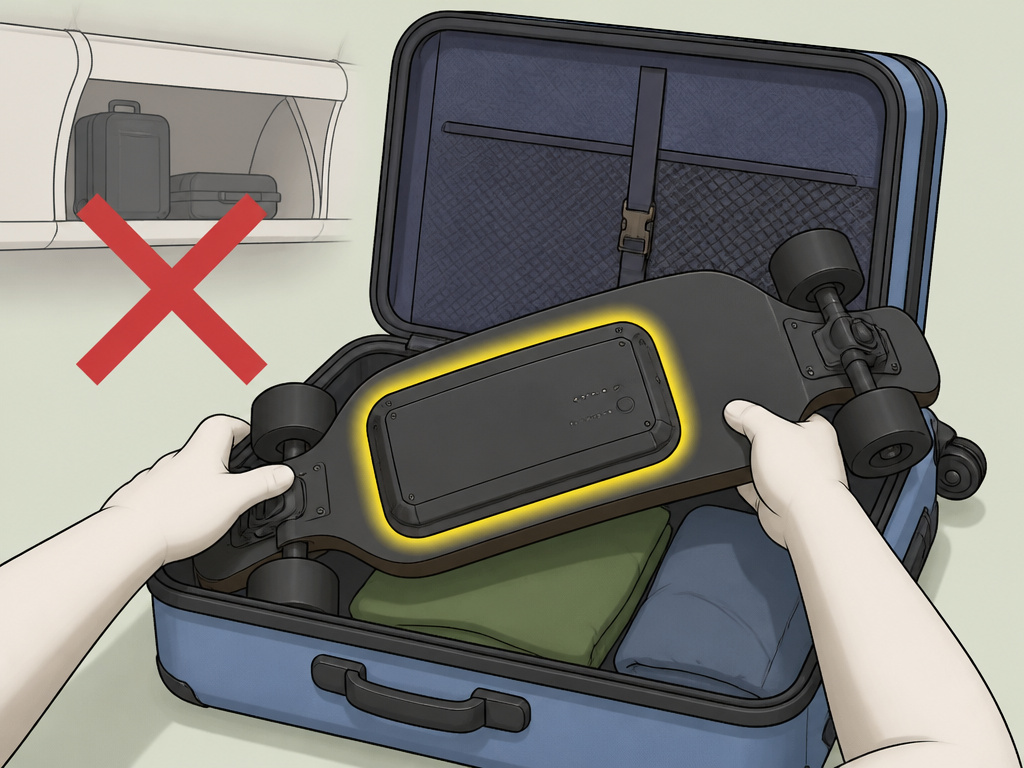
The rule is counterintuitive but critical: if the battery is installed in the device, the entire board should be in your carry-on luggage. IATA explicitly recommends operators restrict these devices to carry-on baggage. The logic is fire safety—a thermal event in the cabin can be addressed immediately by the crew, whereas one in the cargo hold cannot.
If you must check the board, the battery must be removed and carried in your carry-on. A board without a battery is typically treated as sporting equipment, but it will still be subject to oversize baggage fees and your airline’s weight limit—Jetstar, for example, sets a maximum of 32kg per item.
Worth knowing before you start: Some airports simply do not allow skateboards or scooters through security at all, as Jetstar notes. Even if the rules say you can carry it on, local airport policy can override that. Call ahead.
The Packing Checklist (Beyond Just a Bag)
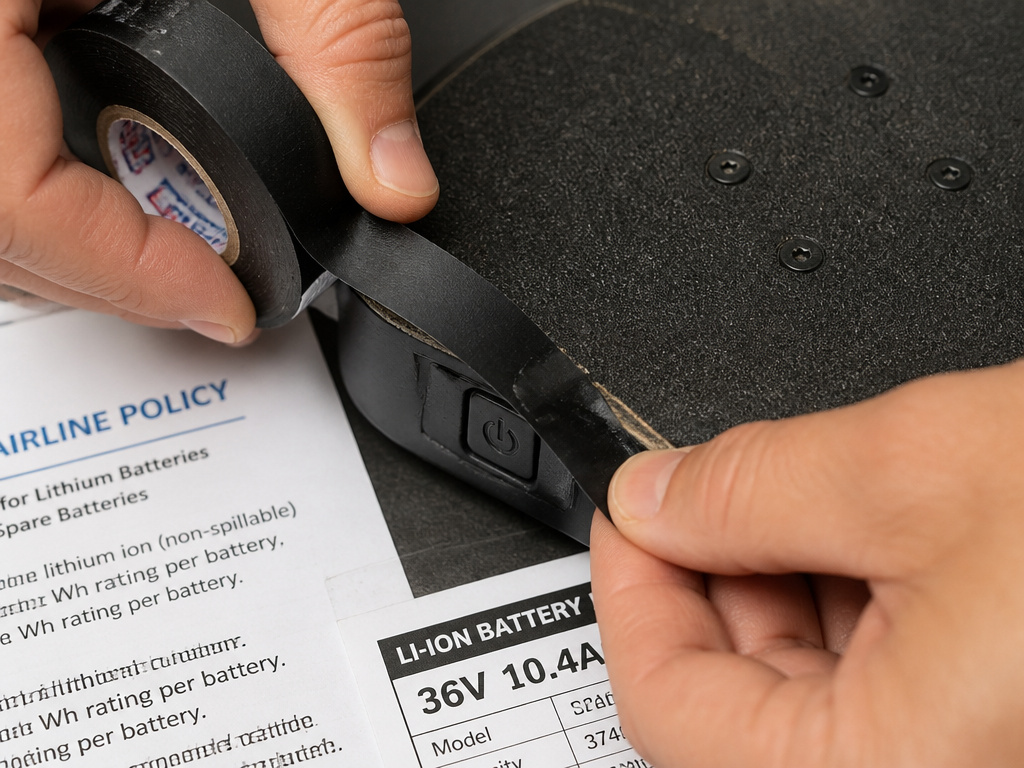
Compliance isn’t just about watt-hours. You must also prepare the battery to prevent short circuits and accidental activation during transit. This is where a simple checklist prevents a last-minute denial.
- Power Down & Protect the Switch: Turn the board completely off. Then, tape over the power button. IATA guidance accepts the original manufacturer’s packaging or taping over the on/off switch as suitable protection against accidental activation.
- Isolate the Terminals: If the battery is removed, the exposed metal terminals are a short-circuit risk. The New Zealand Civil Aviation Authority specifies each spare battery must be protected in retail packaging, an individual bag, a protective pouch, or with tape placed over exposed terminals. Use non-conductive electrical tape.
- Pack for Impact: Use a board-specific bag or a well-padded case. Remove any fragile components like remote controls and pack them separately. The goal is to give the baggage system no reason to consider your gear “damaged,” as the FAA prohibits carrying any damaged or recalled battery.
- Bring Your Documentation: Have a printed copy of your battery’s spec sheet, your airline approval email (if required), and the relevant regulations page from the FAA or IATA website. This turns a debate into a verification.
Specific Airline Policies You Must Check
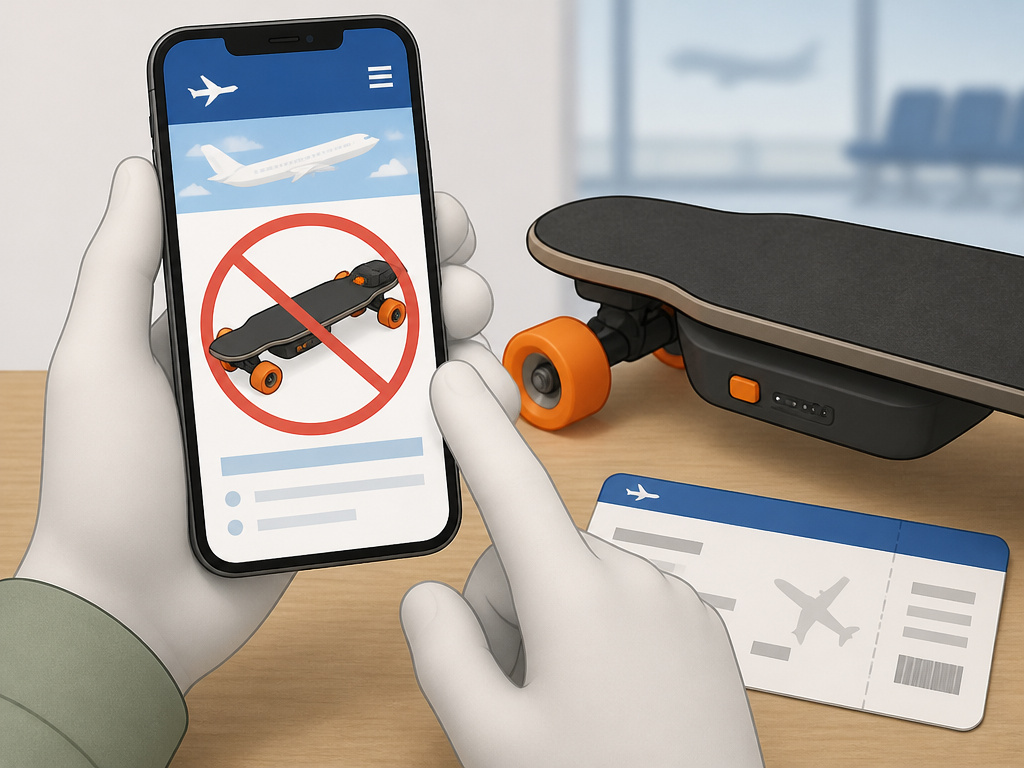
The watt-hour rules are the framework, but each airline builds its own house on it. Failing to check your specific carrier’s policy is the most common mistake.
- Jetstar Japan (GK): This is the starkest example. Their policy states: “Jetstar Japan (GK) flights do not allow electric skateboards or electric scooters regardless of battery type.” It’s a blanket ban. The general watt-hour table does not apply here.
- LATAM Airlines: Their website clearly lists electric skateboards as prohibited items for travel.
- French bee: Similarly bans passenger carriage of electric skateboards, directing passengers to special freight services.
- Many U.S. carriers generally follow the FAA tiers but may add their own restrictions. Their policies can change, so a recent check is essential.
The PHMSA safety alert underscores the risks associated with these devices, and many airlines have implemented bans. Your first step before any trip is a direct search on your airline’s website for “electric skateboard” or “hoverboard” policy.
What If Your Battery Is Too Large?
If your battery exceeds 160Wh, or your airline denies your 101-160Wh approval request, you have two realistic options. Neither is convenient.
Ship the Battery Separately: You can remove the battery and ship it to your destination via ground transport (e.g., FedEx Ground) as a dangerous good. This requires proper UN-certified packaging and labeling, which is a specialized service. The board itself, now inert, can be checked as baggage. This method, used for cargo shipment of dangerous goods, can be adapted for personal travel.
Rent or Buy at Your Destination: For shorter trips, investigate rental services at your destination or consider purchasing a compliant, sub-100Wh “travel board” dedicated to flying. The cost might compare favorably to shipping fees and the sheer hassle.
Attempting to sneak a non-compliant battery onto a plane risks more than confiscation. Violating hazardous materials regulations can result in penalties and you could be denied boarding.
Differences for international vs. Domestic flights
The core watt-hour rules from the FAA and IATA provide a global baseline for the can i bring electric skateboard on the plane issue, but your destination country’s civil aviation authority adds another layer. For a domestic flight within the U.S., you’re primarily dealing with FAA regulations. For international travel, you must also comply with the rules of your destination country. Always check the specific regulations of both your departure and arrival countries, as the stricter rule will apply.
Specific airline examples (Delta, United, American, Ryanair, etc.)
While major U.S. Carriers like Delta, United, and American generally follow FAA guidelines, their specific approval processes can differ. The critical step is to check your airline’s dangerous goods policy directly. Be aware of blanket bans on certain routes; Jetstar Japan, for example, does not allow electric skateboards or scooters at all, regardless of battery size. Never assume a policy is universal.
Differences between electric and non-electric skateboard policies
The fundamental difference is the lithium-ion battery. A standard skateboard is treated as standard sports equipment, subject only to your airline’s size and weight limits for checked baggage. An electric skateboard, however, is governed by hazardous materials regulations for its battery. The device itself must be protected from accidental activation, often by taping the power switch, and the battery must be protected from damage and short circuits. The battery’s watt-hour rating then dictates everything: whether it can fly, if it needs airline approval, and if it must stay in your carry-on bag.
Frequently Asked Questions
Can I bring my electric skateboard on a plane as a carry-on?
You can often carry on an electric skateboard if its battery is at or under 160Wh and you have any required airline approval, but some airlines forbid devices in the 101-160Wh range regardless. The board must fit your airline’s carry-on size and weight limits. IATA recommends keeping these devices in carry-on baggage so any potential battery issue can be managed in the cabin.
What happens if my electric skateboard battery is over 160Wh?
Battery over 160Wh is forbidden in both carry-on and checked baggage under FAA and IATA rules. You cannot bring it on a passenger aircraft. Your only options are to ship the battery separately via approved ground transport as dangerous goods or not bring it.
Do I need to remove the battery from my electric skateboard to fly?
If the battery is under 100Wh and installed in the board, you can typically keep it installed and carry the whole board on. For batteries between 101-160Wh, follow your airline’s specific approval instructions, which may require it to be carried separately. For checked baggage, the battery must always be removed and carried in your carry-on.
How do I get airline approval for a 100-160Wh battery?
Contact your airline’s dangerous goods or special assistance department via email or phone well in advance—Jetstar requires at least five business days. Be prepared to provide your battery’s watt-hour rating, model information, and flight details. Approval is at the airline’s discretion and is not guaranteed.
Before You Go
The system is designed for the worst-case scenario in a sealed aluminum tube at 35,000 feet. Your mission is to prove your gear doesn’t add to that risk.
Start with the label on your battery. If it doesn’t say “≤100Wh,” clear your schedule for a call to your airline. If it says anything near 158Wh, know that you’re skating on the absolute edge of the law and one skeptical gate agent is all that stands between you and a very different travel day. For boards over 160Wh, save yourself the airport drama and ship it ground. The rule is simple, its enforcement is not, and your preparation is the only variable you control.
