Can You Bring a Skateboard on a Plane? Step-by-Step
This post contains affiliate links. As an Amazon Associate, we earn from qualifying purchases.
Yes, you can bring a regular, non-motorized skateboard on a plane as a carry-on or checked item, according to TSA rules. The FAA provides a conditional framework for portable recreational vehicles powered by lithium-ion batteries based on watt-hour rating, but airlines like Delta Air Lines prohibit all powered skateboards regardless of battery size. However, your airline’s policy is the final word, and carriers like Delta ban all powered boards.
That “final word” clause is where most of the confusion and last-minute gate drama happens. The TSA governs security checkpoints, but the airline you fly with sets the rules for what gets on the aircraft. A common question is, can you bring a skateboard on a plane? A security agent might wave your board through, only for a gate agent to refuse it based on a carrier-specific ban you never checked.
What follows is a breakdown of the two rulebooks you need to navigate for the can you bring a skateboard on a plane question: the TSA’s checkpoint policy, the FAA’s hazardous materials framework for batteries, and the specific, often stricter, policies of major airlines. By the last section, you’ll have a concrete pre-flight checklist to avoid surprises.
Key Takeaways
- The TSA allows skateboards in carry-on or checked bags, but always check your airline’s policy first, it overrides the TSA’s green light.
- For electric boards, the FAA uses battery watt-hours (Wh) as the key: under 100 Wh is usually fine, 101-160 Wh needs airline approval, and over 160 Wh is banned.
- Delta Air Lines and Jetstar Japan prohibit all electric skateboards/hoverboards, regardless of battery size, while the FAA provides a conditional framework based on watt-hours.
- Pack to protect your board and others: remove loose parts, use a dedicated bag or straps, and always stow it wheels-up in the overhead bin to prevent rolling and damage.
- At the gate, confidence and preparation win: have your airline’s policy printed or saved, and be ready to politely present your case if questioned.
The TSA’s Skateboard Rule (And Where It Ends)
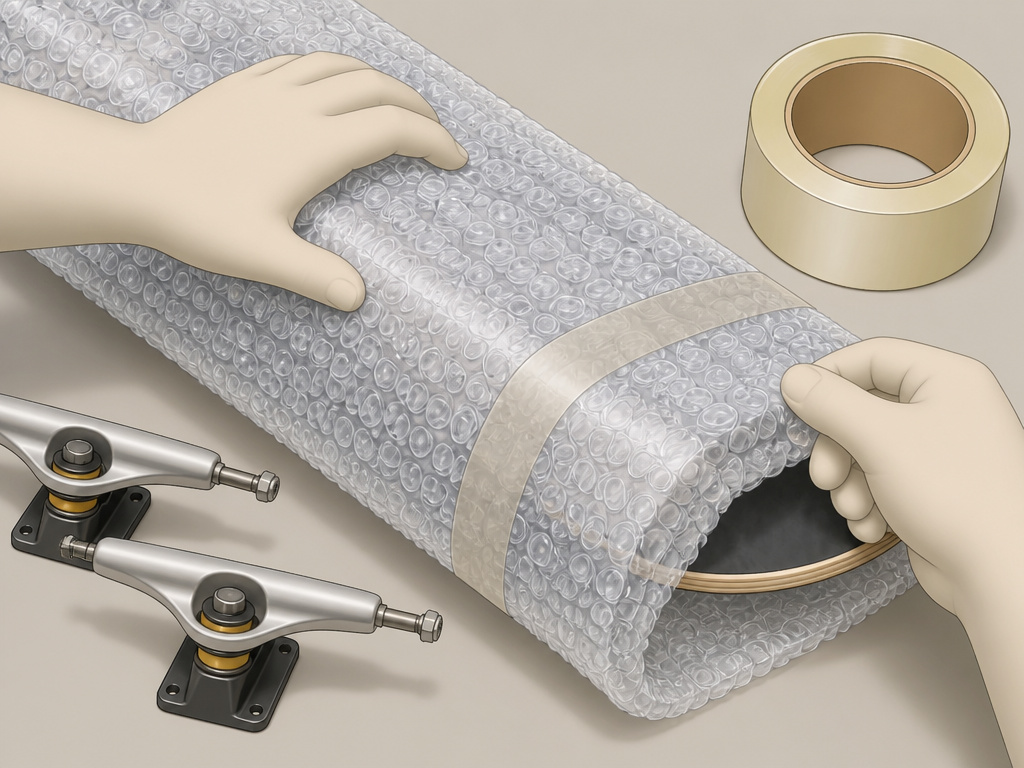
The Transportation Security Administration’s stance is straightforward. Their “What Can I Bring?” page lists skateboards with a simple “Yes” for carry-on. No special instructions, no caveats about size. From a security perspective, a skateboard is just another piece of sporting equipment.
Skateboards are allowed in carry-on bags. Please check with your airline for any size or weight restrictions.
That second sentence isn’t a suggestion, it’s the entire game. The TSA’s job is to ensure what passes through the checkpoint is safe for the flight. They don’t manage the aircraft’s baggage holds or overhead bins. Your airline does. I’ve watched skaters celebrate clearing security, only to get stopped at the gate because their board exceeded the airline’s carry-on dimensions or violated a specific sporting equipment policy. The security line is just the first hurdle.
Where this goes sideways: Assuming the TSA’s “yes” means your airline automatically agrees. I’ve seen this assumption cost travelers a checked bag fee at best, and a forced surrender of their board at worst. Always check your airline’s website before you pack.
This split authority means you need to understand two different rulebooks. For a regular skateboard, the TSA rule is permissive. For anything with a battery, you immediately enter the jurisdiction of the Federal Aviation Administration and your airline’s hazardous materials department.
Electric Skateboards: The FAA’s Watt-Hour Framework
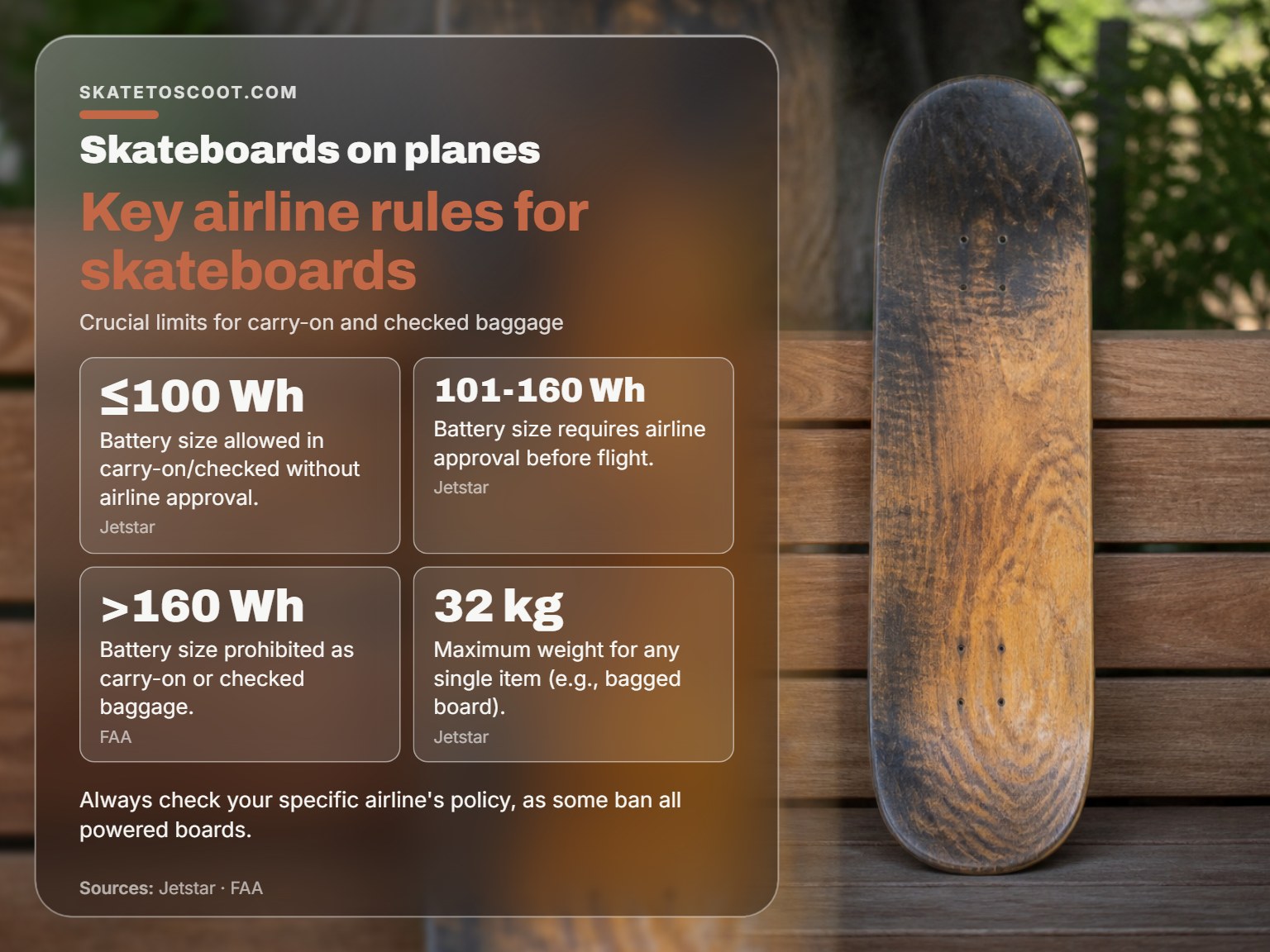
This is where the answer shifts from “usually yes” to “it depends on a calculation.” The FAA regulates lithium-ion batteries on aircraft due to fire risk. Their policy for “Portable Recreational Vehicles”, which includes hoverboards, electric skateboards, and self-balancing scooters, uses watt-hours (Wh) as the deciding metric.
The FAA’s PackSafe hazardous materials guide breaks it into three tiers:
| Battery Watt-Hours (Wh) | FAA Rule | Typical Examples |
|---|---|---|
| ≤ 100 Wh | Generally permitted in carry-on or checked baggage. | Many smaller electric skateboards, some scooters. |
| 101 – 160 Wh | Airline approval is required before travel. | Most board-type self-balancing scooters (~158.4 Wh). |
| > 160 Wh | Prohibited as carry-on or checked baggage on passenger aircraft. | Most unicycle scooters, Segway-type devices. |
The watt-hour rating is often printed on the battery itself. If it’s not, you can calculate it: Wh = Volts (V) x Amp-hours (Ah). If the label shows milliamp-hours (mAh), divide by 1000 to get Ah first. The FAA notes that “most board-type self-balancing scooters have a Wh rating of about 158.4 Wh (36 volts x 4.4 Amp hours).” That puts them squarely in the “airline approval required” zone.
The part nobody mentions: The FAA rule assumes you can determine the Wh rating. But airlines like Delta explicitly cite the inconsistency of manufacturer labeling as a reason for their blanket ban. If your battery isn’t clearly marked, the airline may ask for proof. Without it, they can, and will, refuse the device.
Airline Policies: The Final, Often Stricter, Word
Here’s the real-world catch: airlines can, and do, impose rules stricter than the FAA’s baseline. Some follow the watt-hour framework. Others issue total bans. Your success hinges on knowing which carrier you’re flying and reading their specific sporting goods or hazardous materials page.
| Airline | Regular Skateboard | Electric Skateboard / Hoverboard |
|---|---|---|
| Delta Air Lines | Generally allowed as carry-on/checked if size fits. | Prohibited entirely. Delta states it “will not accept the transport of balance gliders, hoverboards, powered skateboards… Which use lithium or lithium-ion batteries.” |
| Spirit Airlines | Allowed as carry-on or personal item if stowed wheels-up. | Prohibited entirely. Spirit’s policy is a blanket ban “due to Hazardous Materials restrictions.” |
| Jetstar | Allowed as checked baggage; some airports ban from security. | Conditional. For most flights, follows the FAA watt-hour framework (≤100 Wh allowed, 101-160 Wh with pre-approval, >160 Wh banned). Jetstar Japan (GK) flights ban all electric boards. |
| General U.S. Carrier | Typically allowed, but subject to carry-on size/weight limits. | Typically follows FAA watt-hour framework, but prior approval is mandatory for 101-160 Wh batteries. Always contact the airline’s dangerous goods office. |
Delta’s stance is the clearest example of the disconnect. Their prohibition isn’t based on the battery’s size, but on the inconsistent labeling from manufacturers. They’ve decided the risk of an undocumented, potentially oversized battery isn’t worth it. So while the FAA’s policy might permit your 158.4 Wh board with approval, Delta’s policy does not. Ever.
For international travel, remember agencies like Canada’s CATSA set security rules at foreign airports. Jetstar’s warning that “some airports do not allow skateboards and scooters (including electronic variations) to be taken through security” highlights this extra layer. Your airline might say yes, but the airport security in your departure country might say no.
Packing and Carrying Your Board: A Tactical Guide
Your goal at the airport is to be the least problematic passenger when you compare a can you bring a skateboard on a plane scenario. Proper packing turns your board from a bulky, wheeled oddity into a manageable piece of luggage. It also protects your gear and everyone else’s.
Step 1: Choose Your Stow Method
You have three main options, each with pros and cons.
- Fully Assembled & Strapped: Use backpack straps or a dedicated skateboard carry bag. This is the fastest method and works if your airline allows it. The downside: it’s bulky and the grip tape can snag other bags.
- Trucks Removed, Deck Strapped: This is the method I prefer for longer flights. Remove the trucks and wheels, pack them in your checked or carry-on bag, and strap the deck to your backpack. It slims the profile dramatically and eliminates the risk of wheels rolling.
- Fully Disassembled in a Bag: The most secure, but also the most work. Everything goes into a padded skateboard travel bag or a sturdy duffel. This is best for expensive setups or if you’re checking the board.
Step 2: Secure and Protect
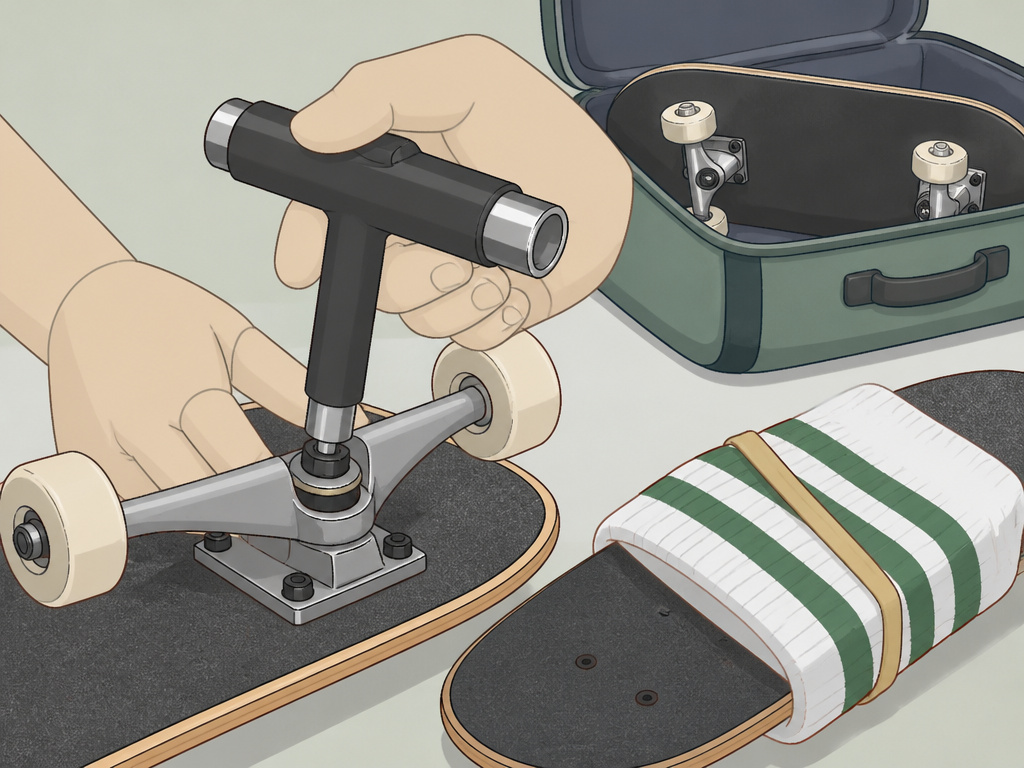
- Remove loose hardware: Tighten all bolts before you pack. If you’re disassembling, put nuts and bolts in a small ziplock bag taped to the deck.
- Address the grip tape: Cover the grip tape with a sock or a strip of cloth secured with rubber bands. This prevents it from grinding against your bag’s lining or other items.
- Wheels-up is the rule: Whether in the overhead bin or a checked bag, always place the board with the wheels facing up or inwards. A rolling board in a bin during turbulence is a hazard.
Step 3: Navigate the Airport
- At Security: Send the board through the X-ray separately if it’s not attached to your bag. Be prepared to carry it through the metal detector or body scanner if asked. Security usually doesn’t care, but they may want to swab it for explosives.
- At the Gate: This is the moment of truth. Have your airline’s printed policy handy. If you’re nervous, approach the agent early, show them your neatly packed board, and ask politely: “My carry-on meets the size rules, and I have my skateboard strapped here. Is that okay for this flight?” Proactive, polite communication disarms most conflicts before they start.
Your Pre-Flight Checklist (The 5-Step Process)
Don’t leave this to chance at the airport. Follow this sequence in the days before your flight.
- Verify Airline Policy: Go beyond a Google search. Find the “sporting equipment,” “prohibited items,” or “dangerous goods” page on your airline’s official website. Look for the words “skateboard” and “lithium battery” on your airline’s official website.
- Calculate Watt-Hours (If Electric): Locate the battery’s V and Ah ratings. Calculate Wh (V x Ah). If it’s between 101-160 Wh, you must obtain airline approval before travel. Jetstar recommends submitting a dangerous goods approval request at least 5 business days before departure.
- Choose and Test Your Packing Method: A week before, pack your board how you plan to travel with it. Does it fit your bag? Is it stable? Make adjustments now, not at 4 AM before your flight.
- Print Your Evidence: Have documentation ready, such as the TSA skateboard page, your airline’s policy, and any approval for a battery. One goes in your carry-on, one in your checked bag (if you have one).
- Plan for the Worst: Know what you’ll do if the board is refused at the gate. Are you willing to pay a checked bag fee? Is there a nearby shipping service? Having a fallback plan reduces panic.
This checklist isn’t paranoid, it’s practiced. It turns a chaotic, emotion-driven argument with a gate agent into a calm presentation of facts. You’re not “trying to bring a skateboard”; you’re following the documented procedure for transporting sporting equipment.
What do other travelers say about bringing skateboards on planes?
Experienced travelers emphasize that the single most important step is to contact your specific airline well before your flight. Policies vary wildly, especially for powered boards. Many flyers report that standard skateboards in a carry-on bag or padded backpack rarely cause issues at TSA checkpoints, but gate agents or check-in staff may enforce airline-specific size rules. For electric models, the consensus is to prepare for extra scrutiny; have your battery’s watt-hour rating clearly documented, ensure the device is powered off and protected from accidental activation, and be ready for the possibility that you may be denied boarding entirely if the airline has a blanket ban.
Frequently Asked Questions
Can I take my skateboard through TSA?
Yes. The TSA explicitly allows skateboards in carry-on bags. You’ll send it through the X-ray machine like any other item. They may perform additional screening, like swabbing it for residue, but it is not prohibited.
Does it cost extra to bring a skateboard on a plane?
It can. If your skateboard fits within your airline’s standard carry-on size and weight limits, it should not incur an extra fee. However, if it’s oversized or must be checked, you may have to pay a standard checked bag fee or an oversized baggage fee. Some airlines classify it as sporting equipment, which may incur a fee.
Can you bring a skateboard in an airport?
You can carry a skateboard through an airport terminal, but you typically cannot ride it. Riding a skateboard inside an airport is almost universally prohibited for safety reasons. You must carry it or have it secured to your bag.
Can you bring a skateboard as carry-on luggage?
Yes, this is the most common method. The TSA allows it, and most airlines will permit it as long as it fits in the overhead bin or under the seat. The key is ensuring it doesn’t exceed your airline’s carry-on dimensions.
What about international flights with a skateboard?
The rules fragment. The TSA only governs U.S. Airport security. For your departure from a foreign country, you must comply with that nation’s security agency (e.g., CATSA in Canada). Their rules may differ. Always check the website of the security authority for your departure airport, in addition to your airline’s policy.
Before You Go
One rule cuts through the complexity: your airline’s policy beats everything else. The TSA’s “yes” and the FAA’s watt-hour chart are just opening bids. Delta’s ban, Spirit’s ban, and Jetstar Japan’s ban are the final, binding rules if you fly with them.
If you’re buying a board specifically for travel, lean towards a compact cruiser or a board designed to be broken down quickly. The minor convenience of a full-sized board isn’t worth the potential gate-side argument.
Finally, pack patience with your toolkit. Gate agents aren’t being difficult; they’re enforcing policies written by people who’ve never tried to strap a skateboard to a backpack. Show them you’ve done the homework, have your board under control, and you’ll clear that final hurdle more often than not. Your fundamentals, research and preparation, are your foundation here, just like on the pavement.
