CCM Ice Skates Review: Jetspeed vs Tacks for Your Style
This post contains affiliate links. As an Amazon Associate, we earn from qualifying purchases.
CCM ice skates are built across three performance families: Jetspeed for agility and quickness, Tacks for power and stability, and a Recreational line for casual skating. The right model depends on your skating style, foot shape, and budget, with a standard 90-day warranty covering manufacturing defects for most retail purchases.
That 90-day warranty has a critical footnote most buyers miss. It explicitly excludes all team sales, professional, college, university, and junior leagues. If you’re buying through a team, your skates have zero factory warranty from day one. This is a key point in any CCM ice skates review.
What follows is a breakdown of where CCM skates actually excel, where their sizing trips people up, and how to match a model to your game. This section explains the one-piece boot tech, the quick-change blade systems, and the real-world fit advice that contradicts the manufacturer’s chart.
Key Takeaways
- CCM’s standard warranty covers skates for 90 days from the date of retail sale, but team purchases are excluded.
- For agility and speed, choose the Jetspeed line; for power and stability, look at the Tacks line.
- A user review recommends sizing down one to two full sizes from your street shoe for CCM skates, noting Jetspeed models run slightly narrow, which may contradict the manufacturer’s implied sizing guide.
- Higher-tier models feature one-piece composite boots and quick-change blade systems, while entry-level skates use simpler constructions.
- The TotalDri Pro liner and heat-moldable foams in models like the FT6 provide a customized, moisture-wicking fit.
CCM’s Skate Families: Jetspeed, Tacks, and Recreational
CCM organizes its skate lineup into three families, each engineered for a distinct skating style. This isn’t just marketing, the structural differences change how you move on the ice.
The Jetspeed line is built for agility and acceleration. Think of a forward who needs to change direction instantly. The boots are designed to be lightweight and responsive, with features like the one-piece Liteframe 360 EVO quarter package (found on the FT2) to maximize energy transfer from your leg to the blade. Stiffness ratings climb with the tier; the 2025 Jetspeed FT8 has a 195 flex for explosive, high-power skating.
The Tacks line is the opposite. It’s for the powerful, straight-line skater who relies on stability and deep knee bends. The construction prioritizes a locked-in heel and ankle support for driving into strides. If your game is about winning battles in the corners and holding the blue line, this is your family.
Finally, the Recreational line (including models like the CCM Next) is for casual skaters and absolute beginners. The tech is simplified, think 3D-injected composite boots and basic padding, with a focus on out-of-the-box comfort for pond hockey or weekend sessions.
Common mistake: Choosing a skate line because your favorite pro wears it. Your skating mechanics and foot shape matter more than any endorsement. A power skater in Jetspeeds will fight the boot; an agile skater in Tacks will feel anchored.
How to Choose Between CCM Lines for Your Play Style
Your position or playing style points you toward a line, but your foot shape and skill level decide the specific model.
For forwards and players who rely on quick cuts, the Jetspeed family is the default. The anatomical fit is generally more tapered, promoting a forward-leaning stance. If you have a narrower foot, this line will feel more natural. The Jetspeed FT6 Pro takes this to the extreme with its one-piece composite boot and heat-moldable memory foam throughout the interior.
Defensemen and power-focused skaters should start with Tacks. The fit profile is often roomier in the forefoot and offers more vertical volume, accommodating a wider foot. The stiffness is tuned for stability during hard stops and physical play. It’s the difference between a sports car and a truck, both are fast, but one is built for cornering, the other for raw push.
Here’s a quick guide to match your profile:
| Skating Style / Position | Recommended CCM Line | Key Reason | Best For Foot Type |
|---|---|---|---|
| Agile Forward / Quick Cuts | Jetspeed | Lightweight, responsive boot for rapid direction changes | Narrow to medium |
| Power Forward / Defense | Tacks | Stable, supportive boot for powerful strides and stability | Medium to wide |
| Beginner / Casual Skater | Recreational (CCM Next) | Focus on comfort and easy break-in | Varies |
| Two-Way Player / All-Around | Jetspeed (FT800 series) or Tacks (mid-tier) | Balanced performance; choose based on fit preference | Depends on model fit |
Your skill level decides the tier within that line. A novice skater does not need the 195 flex of a top-end Jetspeed FT8. That much stiffness requires strong ankle muscles and proper technique to flex the boot effectively. A stiff skate that you can’t bend is a liability, it transfers impact directly to your joints and slows your learning curve. A mid-tier model like the Jetspeed FT870 (with a 140 flex) offers a better balance of support and forgiveness for developing players. For a broader look at options across brands, beyond the scope of a single CCM ice skates review, see our guide on the best hockey skates.
Fit, Sizing, and the Critical Break-In Process
Sizing is the single biggest point of failure. The official CCM sizing chart is a starting point, but real-world user experience consistently contradicts it.
A review of the Jetspeed FT6 explicitly states: “Per usual with ice skates, size down one or two full sizes from your street shoe. The Jetspeeds run slightly narrow.” This is the non-commodity insight most retail pages skip. A user review advises that your skate size is not your shoe size, a common theme in a CCM ice skates review, recommending sizing down, which may contradict the manufacturer’s implied sizing guide. The boot must hold your heel firmly without any lift, with your toes just brushing the cap when you’re in a slight knee-bend stance. If you have wide feet, the standard Jetspeed fit may not work at all, pushing you toward a Wide fit option or the Tacks line. Our resource on skates for wide feet dives deeper into this challenge.
The break-in process is where durability problems often start. New skates should feel snug but not painfully tight. The myth is that you need to “bake” every pair. Heat-molding, available on models like the FT6 with its heat-moldable memory foam, accelerates the process by softening the internal foams to match your ankle bones and instep. However, baking a skate that is already the wrong size will not fix it, it just sets the mistakes in place.
- Wear them indoors first. Walk around on a clean, soft surface for 30-60 minutes to start the natural molding.
- Focus on lace pressure. Over-tightening the top eyelets to compensate for heel lift creates lace bite and cuts off circulation. The ankle should be secure, but your foot should not go numb.
- Expect a few sessions. A proper break-in takes 3-5 hours of ice time. The boot will soften where it needs to and stay stiff where it must.
Where this goes sideways: Skipping the gradual break-in because the skates “feel okay” in the shop. On the ice, pressure points you didn’t feel while standing still will blister after 20 minutes. Once the liner is packed out from skating, you can’t reverse it.
On-Ice Performance: Stiffness, Weight, and Blade Systems
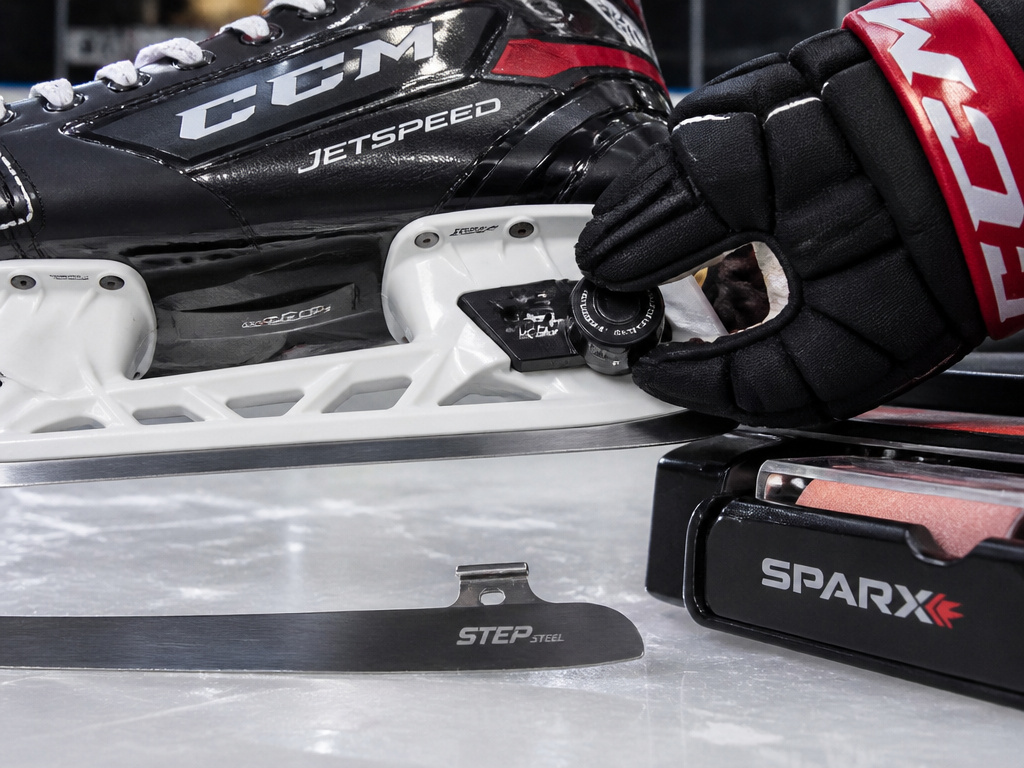
Once the fit is dialed, the skate’s construction dictates your performance. The evolution here is toward one-piece boots and tool-less blade changes.
A one-piece composite boot, like on the Jetspeed FT880 or FT8, eliminates seams and glue points between the quarter and the toe cap. This creates a more direct energy transfer. You get more push from each stride because less force is absorbed by a flexible joint in the boot. The trade-off is that these boots are less forgiving of fit errors, they mold to you, not the other way around.
Weight matters for endurance. Lighter skates reduce leg fatigue over a long shift or a full game, letting you maintain speed into the third period. This is a key advantage of the Jetspeed line over the traditionally heavier Tacks.
The blade system is your direct connection to the ice. Higher-tier models now feature quick-release systems. The Jetspeed FT2 introduced a quick-change blade system with a lock dial mechanism. The Jetspeed FT870 uses a quick-release SpeedBlade XS holder. This allows you to swap steel between periods or switch to a dedicated pair of STEP steel runners for a deeper hollow without any tools. For maintaining that perfect edge, a reliable skate sharpener is a necessary investment.
What is CCM’s Warranty and Return Policy?
This is the most important and misunderstood section. CCM’s coverage is specific, short, and full of exclusions.
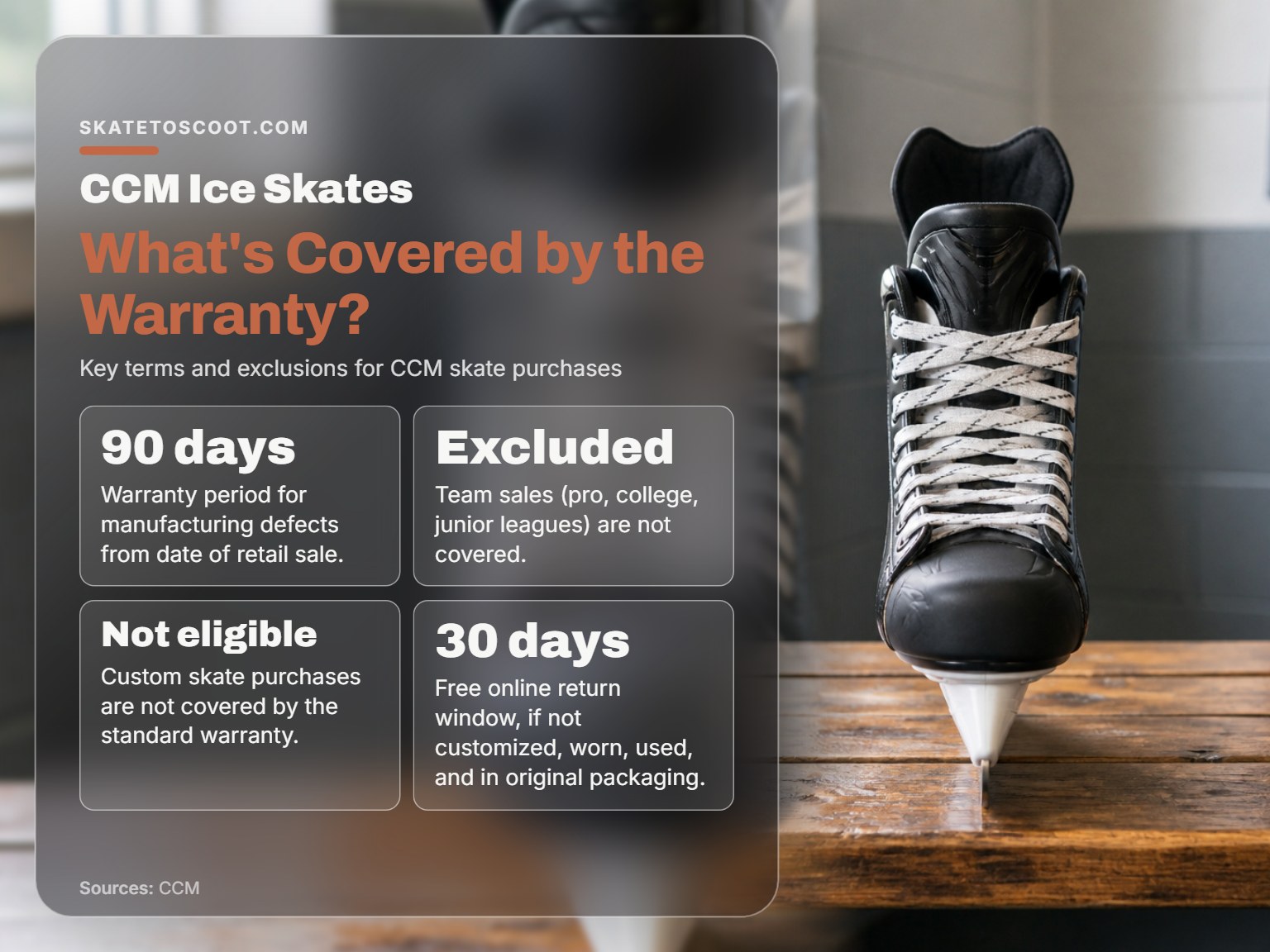
The baseline: Skates are warranted against manufacturing defects and workmanship for a period of ninety (90) days from the date of sale to the consumer. This is clearly stated on CCM’s warranty page. However, this warranty excludes team sales (professional, college, university, and junior leagues) and custom skate purchases.
Now, the critical exclusions. The same warranty document states: “Professional, NHL, CHL, ECHL, USHL, AHL, university, college and all other team sales are excluded from this warranty.” If you are buying skates as part of a team order, common for many competitive players, you have no manufacturer warranty. Your recourse is through the retailer or team.
Furthermore, custom skate purchases are not eligible under the standard warranty program. And CCM’s free returns for online purchases only apply within 30 days, provided the product is not customized, worn, used, and is in its original packaging.
Worth knowing before you start: The 90-day clock starts at the date of retail sale, not when you first use them. Keep your receipt. A defect that appears in month four is your responsibility, barring a retailer’s separate policy.
CCM vs. Bauer: Which Brand is Right For You?
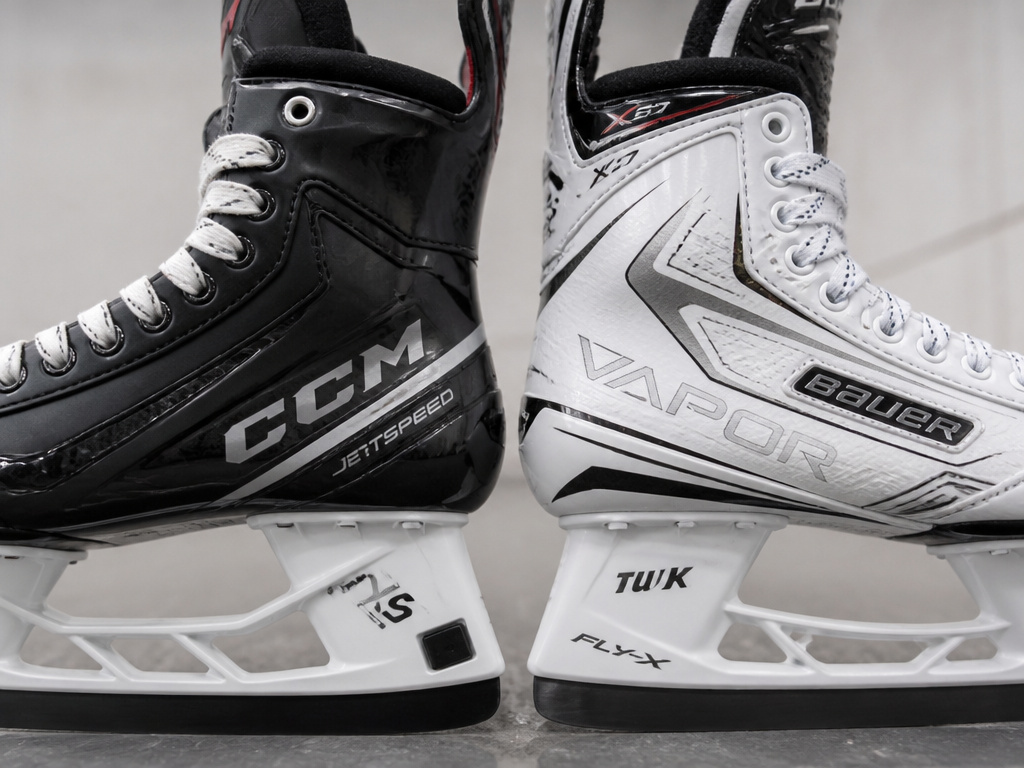
The eternal debate. CCM and Bauer dominate the market, and the choice often comes down to fit philosophy and feature preference.
Bauer’s fit system (Vapor for agility, Supreme for power, Nexus for volume) is highly refined and consistently applied across price points. CCM’s fit, particularly in the Jetspeed line, is known to be more anatomical and tapered. Many skaters find Bauer offers more width options within a single model line.
Technologically, both brands have converged on one-piece boots and quick-change blade holders. Bauer’s Edge holder system is directly comparable to CCM’s SpeedBlade XS. The difference often lies in the feel: Bauer’s Vapor line is often described as “snug and responsive,” while CCM’s Jetspeed is “anatomical and quick.” It’s a nuance you must feel on your foot. Reading a review of Bauer skates can help you compare the specifics.
For most new skaters, the brand decision is secondary to finding the correct fit within your budget. An intermediate skater upgrading from entry-level gear should try on both a mid-tier Jetspeed FT800-series skate and a comparable Bauer Vapor model. The one that disappears on your foot is the right one.
Long-Term Durability and Common Issues
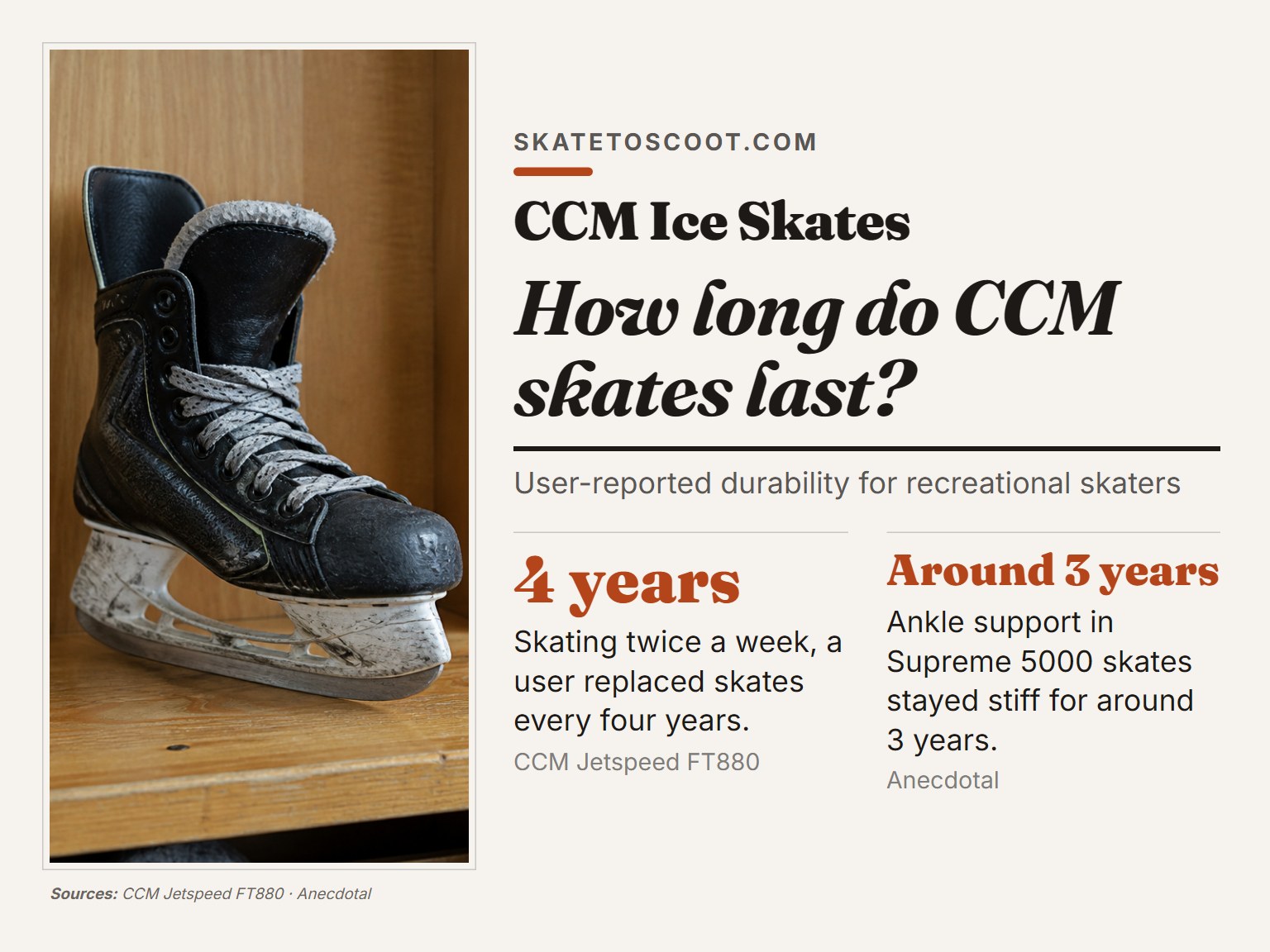
How long should a pair of CCM skates last? It depends on your level, ice time, and care.
A recreational skater playing once a week might get four years from a mid-tier pair. A Reddit user noted their older Supreme 5000 skates stayed stiff for around 3 years with regular use. Higher-end models with TotalDri Pro liners and replaceable steel blades are designed to mitigate these issues.
The flexible tendon guard on the Jetspeed FT6 is a design response to the latter, allowing more stride flexion without sacrificing protection.
- Dry your skates after every use. Pull the liners out if possible to let air circulate. Moisture breaks down the materials from the inside.
- Rotate your steel. If you have a quick-change system, having a second set of runners extends the life of both by spreading out sharpening wear.
- Store them in a breathable bag. A damp skate bag is a mold factory. A good skate bag is a worthwhile accessory.
Frequently Asked Questions
Are CCM skates better than Bauer?
Neither brand is universally better. CCM skates, particularly the Jetspeed line, are often preferred for their anatomical, narrow fit and quick-feeling boot. Bauer’s fit system is more modular, offering more width options. The “better” skate is the one that fits your foot shape and skating style correctly after a proper fitting.
What is the difference between CCM Jetspeed and Tacks?
Jetspeed is designed for agility, quickness, and a forward-leaning stance; it typically has a narrower, more tapered fit. Tacks is built for power, stability, and deep knee bends; it usually has a roomier fit, especially in the forefoot. Choose Jetspeed if you’re a forward who makes quick cuts, Tacks if you’re a defenseman or power forward who drives through strides.
How long do CCM skates last?
Durability is greatly extended by proper care: drying skates thoroughly after use, avoiding walking on concrete in them, and storing them at room temperature.
Do CCM skates run true to size?
A user review states they do not, recommending you size down one to two full sizes and noting the Jetspeed line runs slightly narrow, which may contradict the manufacturer’s implied sizing guide. Always try skates on with the socks you’ll wear for hockey and ensure a professional fitting for the best results.
What does the 90-day CCM warranty cover?
CCM’s 90-day warranty covers defects in materials and workmanship under normal use. This includes issues like premature stitching failure, holder cracking, or composite delaminating. It does not cover damage from accidents, abuse, alterations, or normal wear and tear. Crucially, it does not cover skates purchased through team sales for professional, college, university, or junior leagues.
The Bottom Line
If you’re buying your first serious pair of hockey skates, let fit be your absolute guide. Ignore the top-tier model hype and find the boot that holds your heel without pressure points. For most developing players, a mid-range model like the Jetspeed FT870 or a comparable Tacks option provides the best balance of performance, durability, and cost.
Remember the warranty fine print. That 90-day coverage is a retail consumer protection, not an industry-standard guarantee. If you’re part of a team order, you’re on your own from the start.
Finally, invest time in the break-in. A great skate that’s rushed onto the ice becomes a painful skate you’ll want to replace. Start slow, let the materials adapt, and the performance will follow. For those ready to move beyond basics, our review of intermediate skates can guide your next step up.
