CI G Skate Review: The Gudauskas Collaboration Explained
This post contains affiliate links. As an Amazon Associate, we earn from qualifying purchases.
The Channel Islands G Skate surfboard is a 2+1 fin hybrid shortboard designed for speed and a skatey feel, born from a collaboration between Britt Merrick and the Gudauskas brothers. Its key design move is a 5-inch shorter rail line than a typical CI shortboard, and the sizing rule is to ride it 3 to 6 inches shorter than your CI Pro model.
That rail cut is the mechanical heart of the board. It pulls the outline in, which shifts the sweet spot for your back foot and changes how the board initiates a turn. The result isn’t just a shorter board; it’s a different timing on your bottom turn. This nuance is precisely what the CI G Skate review highlighted.
What follows is a breakdown of that design, the specs that matter, the two constructions you can choose from, and the one common sizing mistake that flattens the board’s performance before you even paddle out.
Key Takeaways
- Ride the G Skate 3 to 6 inches shorter than your standard CI Pro shortboard, keeping the same thickness — sizing it to your normal length kills its skatey feel.
- The board is designed for a 2+1 fin setup (twin plus trailer); CI recommends their Merrick/Gudauskas set or Futures Fins AMT, but a standard thruster also works for a different, more controlled feel.
- Its wave range sits between the Bobby Quad and Rocket Wide, handling the low-end power of the former and the better-wave performance of the latter.
- Choose PU construction for a livelier, more traditional flex pattern, or Spine-Tek for increased durability and a slightly stiffer, more consistent response, especially in choppy conditions.
- Avoid the “ultra-light” glassing option unless you are a pro-level surfer; standard or reinforced glassing dramatically extends the board’s life with only a minimal feel difference for most surfers.
The G Skate’s Key Design Change
The whole board starts with a single number: five inches. Channel Islands took their typical shortboard rail line and shortened it by five inches for the G Skate. This isn’t a minor tweak; it’s a fundamental recalibration of where the board wants to pivot.
That shorter rail line pulls the widest point slightly forward and tightens the tail curve. When you’re riding, your back foot lands in a different spot relative to the fins. The board doesn’t just feel shorter; it feels quicker to initiate a turn, with less rail in the water needing to be engaged. It’s the design equivalent of moving the steering wheel closer to the driver. The input is more immediate, a principle of responsive control also discussed in our Chicago roller skate review.
The G Skate’s defining feature is a rail line shortened by 5 inches compared to a standard Channel Islands shortboard. This pulls the outline in, moving the board’s pivot point and creating a faster, more skateboard-like initiation for turns.
This change directly serves the board’s stated goal: a skatey, fast feel. A longer rail line wants to draw a longer, more drawn-out arc. The G Skate’s rail wants to snap off the top and change direction quickly, which is why it excels in average waves where you’re generating speed off the lip rather than relying on a steep, pitching wall.
Who Is The G Skate For? (And Who Should Look Elsewhere)
The G Skate is marketed as a board for surfers who ride thrusters but want to try something different, a point clarified in any thorough ci g skate review. Let’s be real about that. It’s not a beginner’s board. It’s not a true groveler for tiny waves. It’s a performance hybrid for someone who already understands how to generate speed on a standard shortboard and wants a different tool for the same conditions, much like choosing specialized gear from our guide to the best street skates.
The ideal G Skate surfer has a CI Pro or similar performance shortboard in their quiver. They surf beach breaks or points that are often in the waist-high to head-high range. They’re comfortable driving off the bottom and want a board that releases off the top with less effort. The collaboration with the Gudauskas brothers (known for their explosive, skate-inspired style) tells you exactly the intent: progressive surfing in average-good waves.
Who should look elsewhere? If your local spot is consistently tiny and gutless, a dedicated groveler like the CI Bobby Quad will be a better fit. If you’re regularly surfing powerful, overhead waves and want maximum control, a more refined step-up shape is the call. The G Skate can handle overhead waves, but its wider outline and skatey nature become a liability when the wave is doing all the work for you. For pure high-performance surfing in excellent waves, you’d grab your standard thruster.
Sizing and Volume: The One Rule Everyone Gets Wrong
Channel Islands gives a clear, specific rule: “Ride this board 3” to 6” shorter and the same thickness as your CI Pro.” This is not a suggestion. It’s the recipe.
The most common mistake is ignoring the “shorter” part. A surfer used to a 6’0″ shortboard looks at the G Skate’s stubby outline and thinks, “I’ll just get a 6’0″ to have more foam under my chest.” That’s how you end up with a board that feels slow, unresponsive, and flat. You’ve just added length back into a design that was specifically shortened to change the turning radius. You’re fighting the design.
People rarely mention that the volume number is misleading. Because you’re going shorter, the volume will naturally be less than your standard board. Chasing your normal volume by adding thickness misses the point. The G Skate is meant to be ridden more aggressively. You need to be comfortable with a slightly smaller platform that demands more precise footwork and faster pumping.
For reference, a 5’6″ G Skate model has a width of 19 1/4 inches, a thickness of 2 7/16 inches, and a volume of 29.1 liters. Compare that to your usual shortboard dimensions. If your 6’0″ standard shortboard is 19 1/4″ wide and 2 3/8″ thick, the 5’6″ G Skate is the correct step down.
| Your CI Pro Size | Recommended G Skate Size | Key Adjustment |
|---|---|---|
| 6’0″ | 5’6″ – 5’9″ | Go shorter, not thicker. |
| 5’10” | 5’4″ – 5’7″ | Trust the shorter outline. |
| 6’2″ | 5’8″ – 5’11” | Volume will be lower; focus on the turn radius. |
Fin Recommendations and Setup
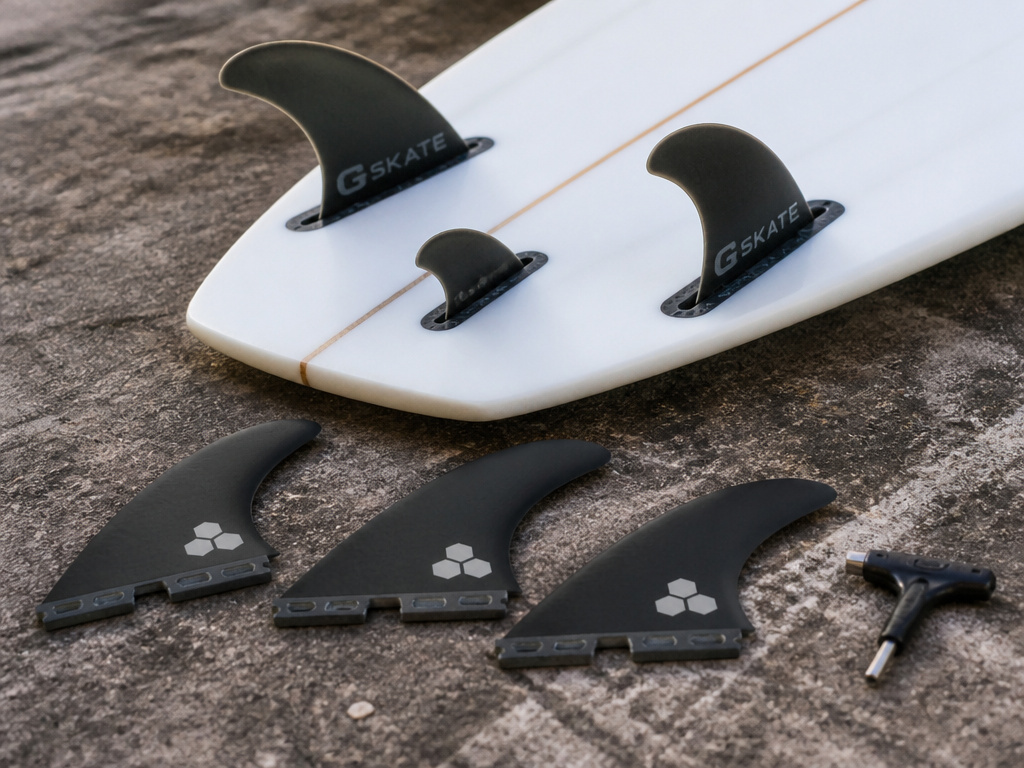
The G Skate is designed around a 2+1 fin setup: twin side fins with a smaller trailer fin in the center box. This configuration is the secret to its loose, skatey feel. The twin fins up front provide speed and release, while the center trailer fin adds a touch of pivot and control that pure twin fins lack.
Channel Islands specifically recommends two fin sets for this board: the Merrick / Gudauskas 2 + 1 fin set (a collaboration matching the board) and Futures Fins AMT. Both are designed to complement the board’s wider tail and flatter rocker, feeding it speed and allowing quick directional changes.
Where this goes sideways: Assuming you must run it as a 2+1. The manufacturer’s own product page states, “their favorite thruster set will work well in this design.” Throwing a standard thruster in (like an FCS II Performer or Reactor) completely changes the feel. It trades off some of the loose, skatey freedom for more drive, control, and familiarity. It’s a great option if you’re transitioning from a standard shortboard and find the 2+1 feeling too slippery for your first few sessions.
The 2+1 setup is where the board comes alive. You’ll feel the difference on your first bottom turn. The board wants to slide and project rather than grip and rail. But if that feels too foreign, the thruster option is a built-in training wheel that still works exceptionally well. It’s a rare design that genuinely supports two distinct fin personalities.
Wave Range and Performance Characteristics
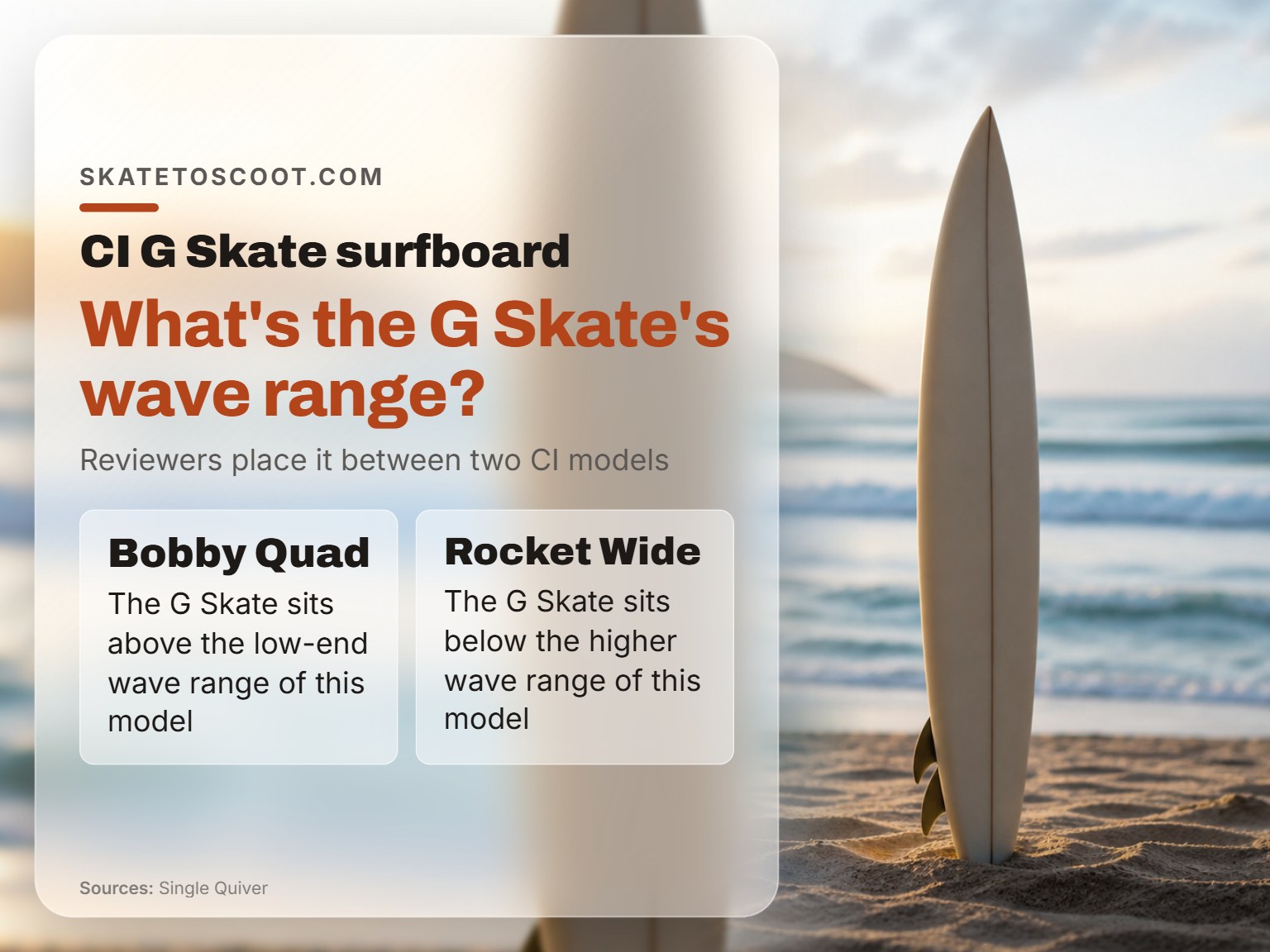
Reviewers place the G Skate’s wave range, as noted in a typical ci g skate review, between the low-end capability of the CI Bobby Quad and the higher-performance range of the CI Rocket Wide. That’s a useful bracket. It means the G Skate isn’t a deep-water groveler, but it also isn’t a pure good-wave board.
In weaker waves, its speed generation comes from its design. You pump it differently than a groveler. It’s less up-and-down, more projecting and using the lip. It wants to be surfed vertically, with quick snaps off the top and tight, hooked turns in the pocket.
Its limitations appear at both extremes. In very weak surf, it lacks the design features of a true groveler.
| Condition | G Skate Performance | Better Alternative |
|---|---|---|
| Weak, knee-high surf | Struggles to plane; requires constant pumping. | CI Bobby Quad, Lost Puddle Jumper |
| Waist-high to head-high, average shape | Excellent. Generates speed, loose, skatey turns. | The G Skate’s sweet spot. |
| Powerful, overhead+ barrels or walls | Can feel too wide and loose; hard to control at high speed. | CI Pro, Rocket Wide, or a dedicated step-up. |
Construction: PU vs. Spine-Tek
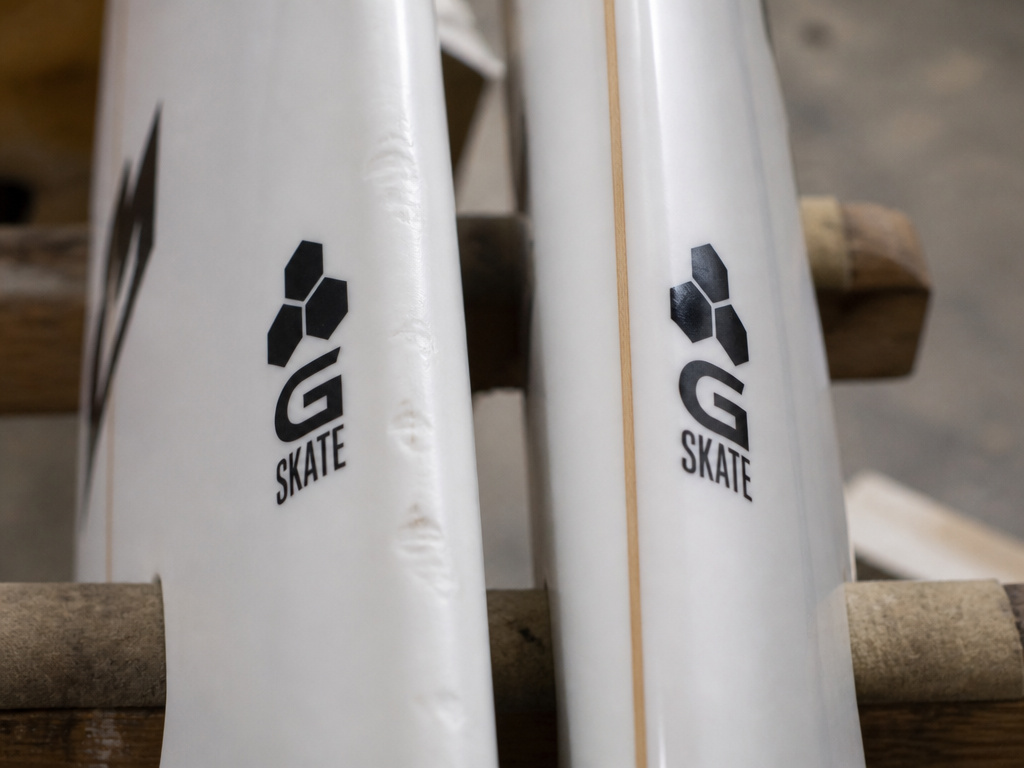
Channel Islands offers the G Skate in both traditional Polyurethane (PU) and their proprietary Spine-Tek construction. This isn’t just a marketing choice; it’s a decision that affects the board’s flex, durability, and ultimately, how it feels under your feet.
PU (Polyurethane) is the classic surfboard material. It offers a livelier, more organic flex pattern. When you press on the rail, the board bends and rebounds in a way many surfers describe as “responsive” or “alive.” The trade-off is that PU is more susceptible to pressure dings and overall damage from impacts. For a board like the G Skate, which encourages aggressive surfing, a PU version will feel more dynamic but may show wear faster.
Spine-Tek is Channel Islands’ epoxy-based construction with a wooden stringer system. It is significantly more durable. You can whack the lip harder, travel with it more carelessly, and generally expect it to last longer with fewer pressure dings. The feel is different: stiffer and more consistent. Some surfers call this a “dead” feel compared to PU, but that’s an exaggeration. It’s more accurate to say it’s more stable and predictable, especially in choppy conditions where a lively PU board can feel chattery.
Common mistake: Choosing ultra-light glassing on either construction for everyday use. The slight weight savings isn’t worth the reduced lifespan for most surfers. Standard or even reinforced glassing is the wise long-term investment.
For the G Skate, your choice depends on your local waves and how you treat your gear, a key consideration in any ci g skate review. If you surf mostly clean waves and prize that traditional, lively feel, go PU. If you surf a lot of choppy beach break or want a board that can withstand travel and repeated abuse, Spine-Tek’s durability is worth the slight change in flex character.
Transitioning From a Standard Thruster
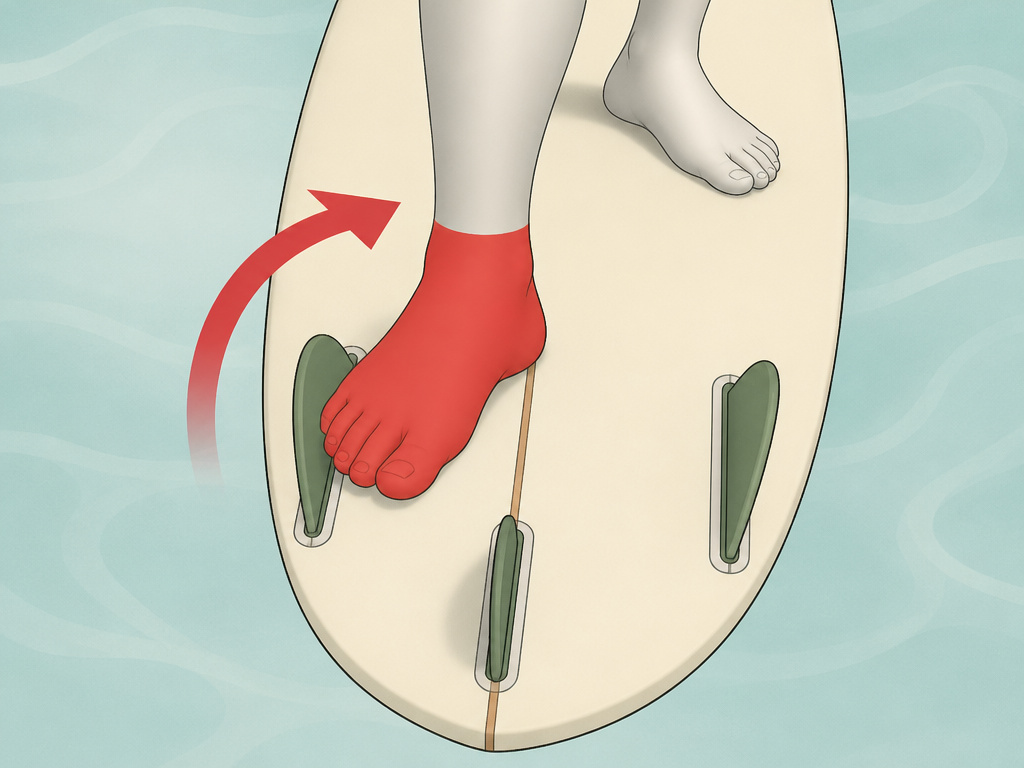
If your only reference point is a standard thruster shortboard, the G Skate will feel different for your first few sessions. The adjustment isn’t huge, but it’s specific. Trust the process.
First, your foot placement will be off. On a thruster, you’re used to driving off your back foot with the center fin providing pivotal resistance. On the G Skate (in 2+1 mode), you need to place your back foot a touch further forward, over the twin fins. The drive comes from a more forward stance, and the release off the top happens faster because there’s less fin dragging in the water behind you.
Second, your pumping rhythm changes. Instead of a deep, rail-to-rail pump to generate speed in a weak section, you’ll use a quicker, more projecting pump that uses the board’s flat rocker and width.
Finally, your turns will feel more “auto-rotated.” The board wants to complete the turn once you initiate it. This is where the skatey feel is most apparent. It can feel uncontrollable at first, like the board is sliding out. That’s the twin fins doing their job. Lean into it, trust the trailer fin to keep you from spinning out, and you’ll find you can snap around faster than you thought possible.
Frequently Asked Questions
What size G Skate should I get if I ride a 5’10” shortboard?
Follow the Channel Islands rule: go 3 to 6 inches shorter. For a 5’10” daily driver, look at a G Skate between 5’4″ and 5’7″. Your exact choice depends on your weight and how aggressive you want the board to feel. A 5’4″ will be ultra-responsive and skatey; a 5’7″ will offer a bit more stability and paddle power while still honoring the design intent.
Can you ride the G Skate as a thruster?
Yes. The manufacturer explicitly states a standard thruster set will work well. Installing a standard thruster (three fins of equal size) will make the board feel more familiar, adding drive and control while reducing the ultra-loose, skatey feel of the 2+1 setup. It’s an excellent way to ease into the board’s design.
Is the G Skate good for small waves?
It’s good for average small waves, but not the smallest, weakest conditions. Its sweet spot is waist-high to head-high. For truly gutless, knee-high surf, a board with more specialized groveler features (like the CI Bobby Quad) will be a better performer. The G Skate needs a little curve and push in the wave to really come alive.
How does the G Skate compare to the CI Rocket Wide?
The G Skate’s wave range sits between the low-end wave range of the CI Bobby Quad and the higher wave range of the CI Rocket Wide. The Rocket Wide is a performance shortboard first, designed for better waves. The G Skate, with its shorter rail line and 2+1 focus, is more of a hybrid suited for average conditions where you want a fun, progressive feel.
What’s the difference between PU and Spine-Tek for this board?
PU offers a livelier, more traditional flex pattern but is less durable. Spine-Tek is significantly more durable and provides a stiffer, more consistent response, which can be an advantage in choppy conditions. Spine-Tek is significantly more durable and provides a stiffer, more consistent response.
Before You Go
The G Skate isn’t a magic board, but it’s a brilliantly specific one. It solves the “average wave performance shortboard” problem by borrowing from skate and twin-fin design. Its success hinges entirely on following the sizing rule — go shorter, not thicker.
If you’re stuck between constructions, let your local waves decide. And if the 2+1 setup feels too foreign on day one, slap a thruster in it. The adjustment period is shorter than you think, and the payoff is a board that makes a 3-foot day feel like a video game.
One final, grounded piece of advice from someone who has seen a lot of boards come and go: skip the ultra-light glassing. A standard glass job on a G Skate will still feel fast and responsive, and it’ll be in your quiver years longer.
