Evercross Hoverboard Review: CPSC Warning and Battery Test
This post contains affiliate links. As an Amazon Associate, we earn from qualifying purchases.
An Evercross hoverboard review must start with a critical safety warning: the U.S. Consumer Product Safety Commission (CPSC) warns consumers to immediately stop using the EVERCROSS EV5 model due to a fire hazard, while the EVERCROSS EV2 and other models remain on the market with standard performance claims of 9.32 mph top speeds and 1-2 hour run times.
That official warning from March 2024 changes the entire conversation. It’s not about whether the EV5 is a good buy; it’s about following a CPSC safety directive. For other Evercross models, the review becomes a balance of advertised specs against widespread concerns about battery life and long-term durability noted by owners and international safety agencies.
What follows is a breakdown of the hard data: the CPSC’s findings, the manufacturer’s claimed performance from the official manuals, and the gaps between promise and real-world experience that every potential buyer needs to weigh.
Key Takeaways
- The CPSC has issued a stop-use order for the EVERCROSS EV5 hoverboard due to a fire hazard; you must remove and dispose of its battery following local hazardous waste procedures.
- Advertised run times are “up to 1-2 hours” per the EV2 manual, but owner reports contradict this, with some batteries dying in as little as 15 minutes.
- A 2018 Dutch safety agency (NVWA) test found 28 of 29 hoverboards had faulty battery protection circuits, highlighting an industry-wide safety issue buyers must consider.
- The EVERCROSS EV2 is the current flagship model, with a 220 lb weight capacity, Bluetooth app, and IPX4 water resistance, but lacks independent safety certifications.
- For any hoverboard, charge only when you are present and awake, and disconnect it immediately after charging to mitigate fire risks.
The Official CPSC Warning on the EVERCROSS EV5
This isn’t a recall. It’s a public safety warning with legal force. In March 2024, the U.S. Consumer Product Safety Commission (CPSC) took the rare step of issuing a direct alert because the manufacturer, Jinhua Smart Electric Technology Co. Ltd., refused to recall the product.
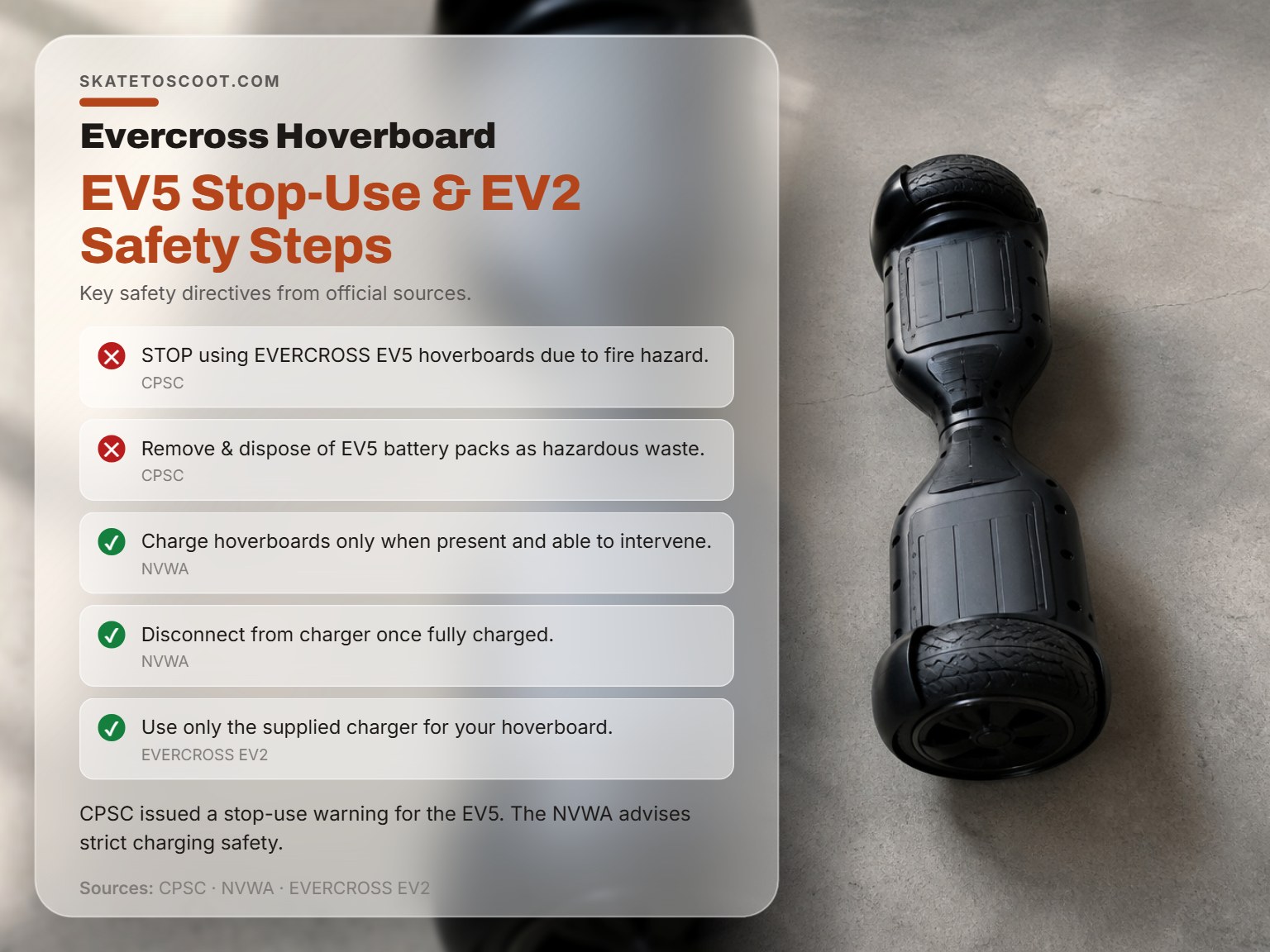
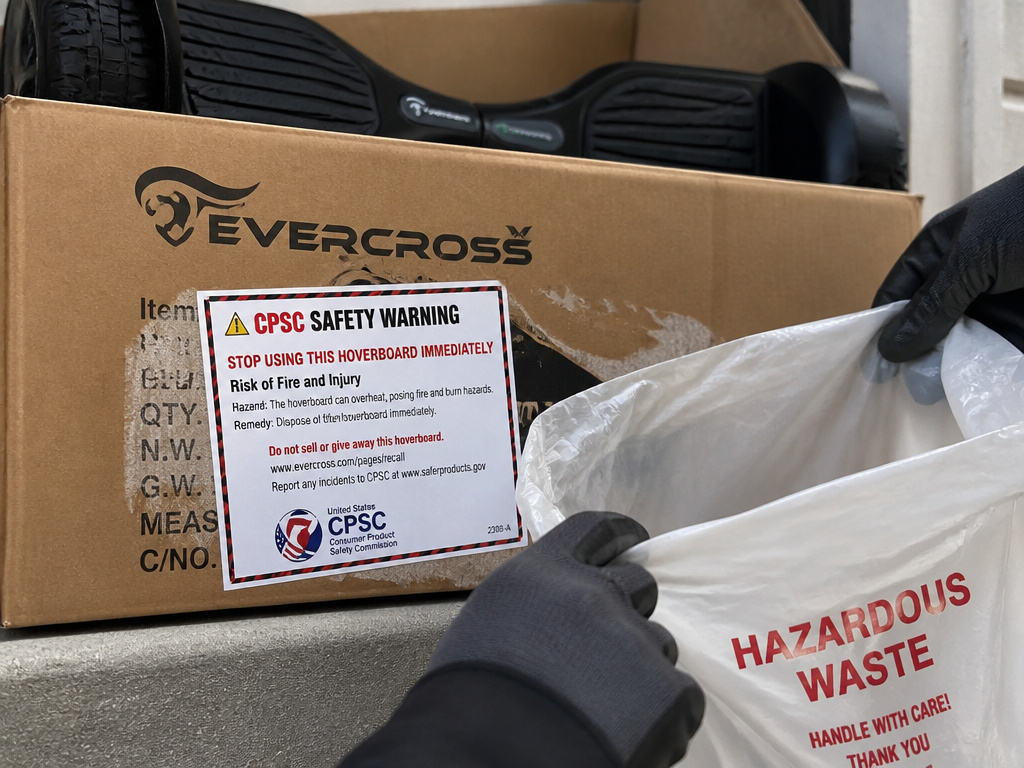
The warning is specific: stop using the EVERCROSS EV5 hoverboard immediately. The CPSC states it “pose[s] a risk of fire to consumers,” citing one reported fire in New York City in May 2023 that caused substantial property damage. The agency urges owners to remove the battery packs and dispose of them as hazardous waste.
CPSC hoverboard fire hazard warning: The Consumer Product Safety Commission warns consumers to immediately stop using EVERCROSS EV5 hoverboards because they pose a risk of fire. CPSC has received one report of a fire, resulting in substantial property damage to a residential building in New York City in May 2023.
The reality is this. If you own an EV5—sold online for between $180 and $300 from July 2021 onward, in black, blue, or pink—the standard review metrics of speed and battery life are irrelevant. The only metric that matters is risk. The company’s stance, as noted in the CPSC release, is that it “has not agreed to recall these hoverboards or offer a remedy.” That puts the entire onus of safety on you, the owner.
This creates a stark divide in any evercross hoverboard review. For the EV5, the review is over. For other Evercross models like the EV2, the question shifts to whether the underlying safety and quality concerns are isolated to one model or indicative of the brand’s approach.
Performance and Specs: What the Manuals Promise
For models still on the market, like the EVERCROSS EV2, the manufacturer makes specific performance claims. The official operation manual lists a net weight of 28.22 lbs, a load capacity of 44-220 lbs, and a maximum speed of 9.32 mph (15 km/h). The battery is a 24V, 4.0 Ah Lithium-ion pack.
The most critical spec is run time. The manual states “up to 1-2 hours of continuous ride time.” That “up to” is doing a lot of work. It’s a best-case scenario, assuming ideal conditions, a lighter rider, and smooth pavement. The hoverboard carries an IPX4 rating, meaning it’s protected against water splashes from any direction, which is adequate for damp pavement but not for puddles or rain.
| Specification | EVERCROSS EV2 (Manual Claim) | Real-World Owner Report |
|---|---|---|
| Max Speed | 9.32 mph (15 km/h) | Generally accurate on flat ground. |
| Max Load | 220 lbs (100 kg) | Holds at max weight, but performance drops. |
| Run Time | Up to 1-2 hours | Contradicted by reports of 15-30 minute life. |
| Water Resistance | IPX4 (splash-proof) | Suitable for dry or slightly damp conditions only. |
| App Connectivity | Bluetooth speaker & smartphone control | Functional, but app can be buggy. |
The EV2 is also marketed as an app-enabled hoverboard. You can download the EVERCROSS app via a QR code or app store to control features like LED lights, track mileage, and adjust riding modes. It’s a selling point common among modern best hoverboard models, but it doesn’t impact core safety or mechanical reliability.
Battery Life and Charging: The Biggest Gap Between Claim and Reality
Marketing materials never mention that the battery is the hoverboard’s heart and its most frequent point of failure. The EV2 manual’s “up to 1-2 hours” claim is a perfect example of a spec that needs scrutiny.
Owner reviews tell a different story. One Walmart review from January 2023 stated the battery “goes dead within 15 minutes.” When the customer complained, a manufacturer representative reportedly said this was “normal.” That’s a massive discrepancy. A battery that delivers 15 minutes against a claim of up to 2 hours is a significant shortfall. It turns a functional toy into a frustration.
This isn’t just about one bad unit. It points to quality control in the battery cells or the battery management system (BMS). A functional BMS prevents overcharging, balances cells, and monitors temperature. Its failure is what leads to the fire hazards flagged by safety agencies.
Where this goes sideways: Charging a hoverboard overnight or while away from home. The Dutch NVWA advises charging only when you are present and can intervene, and to disconnect the board immediately once charged. A faulty BMS won’t stop charging when full, leading to overheating.
For any hoverboard, but especially for brands with spotty track records, your charging habits are your first line of defense. Use only the supplied charger, charge on a non-flammable surface, and never leave it plugged in unattended for extended periods. This is the most practical hoverboard safety tip you can follow.
Build Quality, Safety, and Industry Context
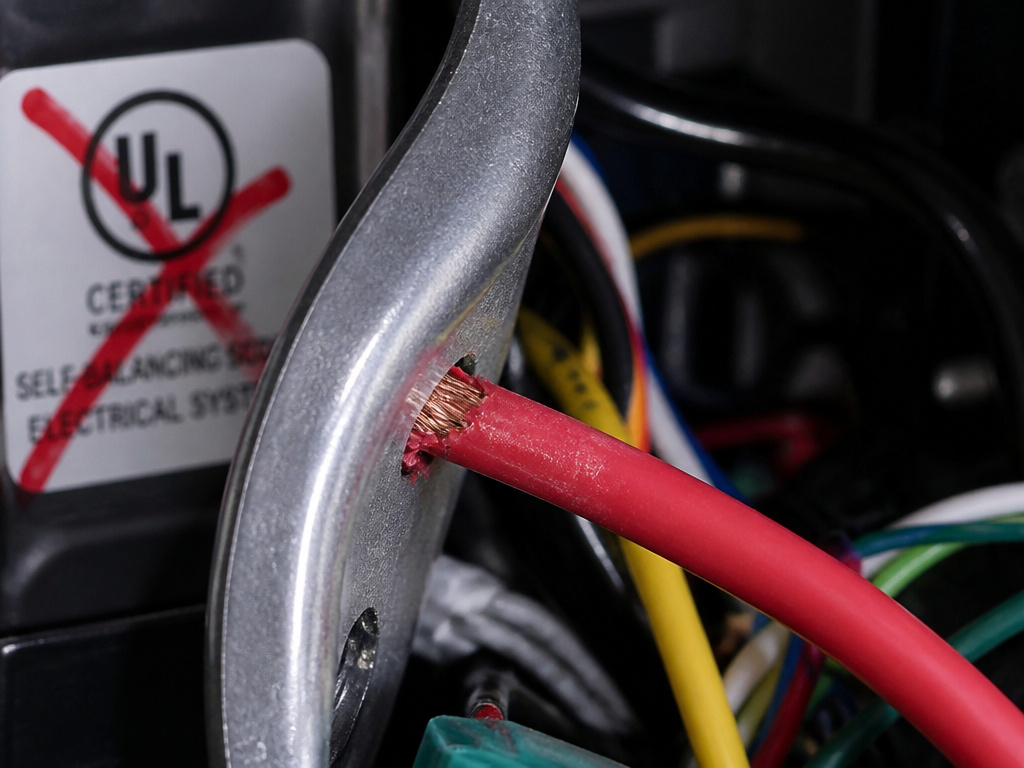
When you lift a hoverboard, you get a feel for its build. The EV2 has a net weight of 28.22 lbs, but weight doesn’t equal safety certification. Evercross hoverboards lack marks from independent testing labs like UL (Underwriters Laboratories), which specifically certifies electrical systems for fire and shock risk.
This context is crucial. In 2018, the Dutch Food and Consumer Product Safety Authority (NVWA) tested 29 hoverboard models purchased from foreign websites. The results were damning:
- All 29 failed to comply with essential safety requirements.
- 28 of 29 had a battery protection circuit that did not meet safety requirements.
- 27 of 29 had wiring paths not free of sharp edges, risking short circuits.
- 27 of 29 did not have a sufficiently fire-resistant casing.
The NVWA advised consumers to stop using all 29 tested models. While the Evercross EV5 wasn’t named in that 2018 study, the findings paint a picture of an industry segment where safety is often an afterthought, especially for models sold through online marketplaces.
For the EV2, the manual includes standard warnings: don’t ride on icy surfaces, avoid violent impacts, store in a dry place, and don’t over-tighten seat attachment straps. These are good, but they’re procedural guards against user error, not replacements for engineered safety systems like a certified BMS or fire-resistant battery compartment.
App, Connectivity, and Accessories
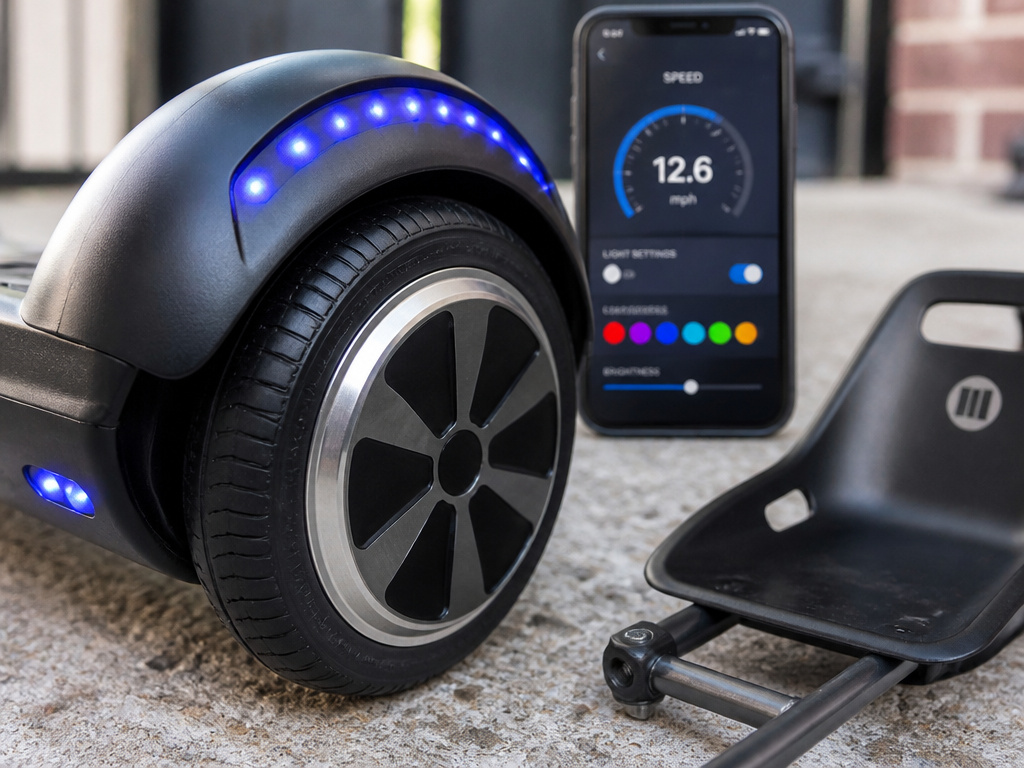
The smartphone app and Bluetooth speaker are value-adds. Customizing the ride with the app is enjoyable for riders who like technology. A seat attachment can convert it into a rudimentary scooter, which can be great for younger riders or those wanting more stability.
But these features are secondary. A cool app doesn’t fix a bad battery. A seat attachment doesn’t improve water resistance. When evaluating hoverboards for adults or off-road hoverboards, the core metrics are power, range, durability, and verified safety. Accessories are the icing, not the cake.
Long-Term Reliability and the Bottom Line
The long-term data on Evercross hoverboards is thin. This is the hidden cost of a budget brand. The initial price of $180-$300 is attractive, but potential long-term reliability concerns should be considered.
So, is an Evercross hoverboard a good buy? The answer is a conditional no for the EV5 (due to the stop-use order) and a very cautious maybe for the EV2, with heavy caveats.
If you proceed with an EV2:
- Treat the battery life claim as a maximum, not a guarantee. Plan for potentially less than the advertised run time.
- Follow strict charging protocol. Be present, use the charger that came with the hoverboard, disconnect after full charge.
- Manage your expectations. It’s an entry-level board for light, casual use on smooth surfaces.
- Consider the warranty. Understand what it covers (often just manufacturing defects, not battery wear).
- Compare actively. Look at the total cost of ownership, including potential battery replacement, against more established brands.
For many riders, especially those wanting more range or riding on varied terrain, the better value might lie in a comparison with electric scooters, which often offer superior battery systems, better suspension, and more predictable real-world range for a similar hoverboard cost.
How do Evercross hoverboards handle different terrains?
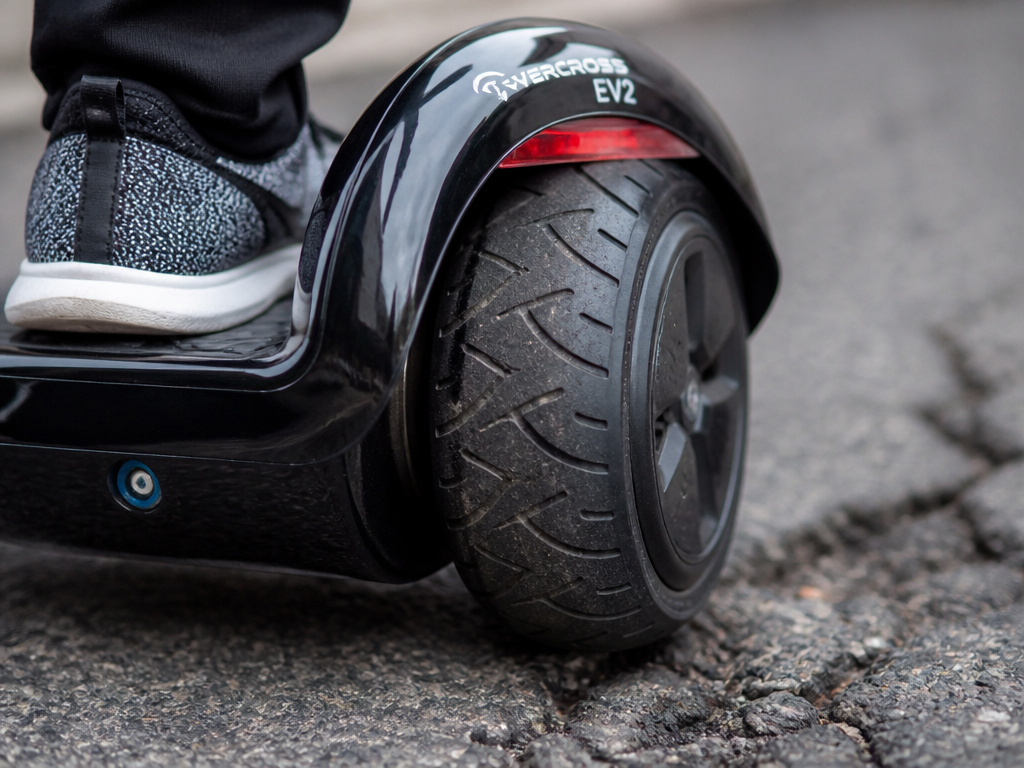
The official manual for the EV2 model advises riders to avoid icy or slippery surfaces for safety. While specific tire dimensions for all-terrain use aren’t provided in the available facts, the guidance suggests these boards are designed for typical paved or smooth surfaces. For any hoverboard, checking the manufacturer’s specifications for wheel type and any stated IP rating for water resistance is a practical step before riding on uneven ground. General riding safety always depends on matching the board’s design to the conditions.
What is the shipping process for an Evercross hoverboard?
The fact sheet notes that Evercross EV5 hoverboards were sold online from July 2021 onward, with prices ranging between $180 and $300. They were available through major online retailers. However, the CPSC has issued a stark warning to immediately stop using the EV5 model due to a fire hazard, which fundamentally changes any consideration of purchasing or receiving one. If a board is already in transit or delivered, the priority is to follow the safety directive to cease use and handle the battery as hazardous waste, not to unbox and ride it.
Can you add a seat attachment to an Evercross hoverboard?
The manual for the Evercross EV2 model includes instructions for assembling a seat attachment, specifically warning not to over-tighten the straps during the process. This confirms that at least some Evercross models are designed to be compatible with such accessories. For safe use, it is critical to follow all manufacturer assembly guidelines precisely. Potential buyers should verify the specific model’s compatibility before purchasing any attachment, as designs and connection points can vary between hoverboard versions and brands.
Frequently Asked Questions
Is the Evercross EV5 hoverboard safe?
No. The U.S. Consumer Product Safety Commission has warned consumers to immediately stop using the EVERCROSS EV5 hoverboard due to a fire hazard. The CPSC urges owners to remove the battery pack and dispose of it following local hazardous waste procedures, while the manufacturer’s manual for other models implies normal use and charging.
What is the real battery life of an Evercross hoverboard?
The EVERCROSS EV2 manual claims “up to 1-2 hours.” Real-world owner reports frequently cite much shorter run times, often between 15 and 45 minutes, depending on rider weight, terrain, and battery health. The advertised time is a best-case scenario.
Does Evercross have a good warranty?
Battery failure is a frequent point of contention, so read the warranty terms carefully before purchasing.
Are hoverboards from Amazon safe?
Not necessarily. Safety depends on the specific brand and model, not the retailer. The CPSC warning for the Evercross EV5 specifically mentions it was sold on Amazon.com. Always check for independent safety certifications (like UL 2272) and recent government safety alerts before buying any hoverboard online.
Can adults ride Evercross hoverboards?
Yes. The EVERCROSS EV2 has a stated load capacity of 220 lbs (100 kg), which accommodates most adults. However, performance—including speed, torque, and battery life—will be reduced for a rider at or near the maximum weight limit compared to a lighter rider.
The Bottom Line
An Evercross hoverboard review can’t just tally features against a price. You have to start with the government warning on the EV5 and then read the EV2’s specs with the knowledge that a major European study found nearly every hoverboard it tested was fundamentally unsafe.
Your buying decision depends on safety and realistic performance, not Bluetooth speakers or color options. Charge smartly, respect the battery’s limits, and understand that the low upfront cost might come with higher long-term frustration. For casual, supervised riding on perfect pavement, the EV2 might suffice if you go in with eyes wide open. For anything more, the risks and performance gaps suggest looking at brands with transparent safety certifications and a longer track record.
