Gotrax Flex Electric Scooter Review: The Bottom Line
This post contains affiliate links. As an Amazon Associate, we earn from qualifying purchases.
The Gotrax Flex electric scooter is a seated commuter model with a 350W or 500W motor, a 15.5–20 mph top speed, and a 16–25 mile range, depending on the variant. Its cushioned seat, rear storage basket, and suspension target casual rides and light errands on flat terrain, but its non-removable battery and mixed owner feedback on durability and hill climbing are key considerations.
Most reviews just list the specs and call it a day. They miss what happens after 60 miles, what a 190-pound rider feels on a 5% grade, and which part fails first when the warranty runs out.
What follows is the kind of breakdown you’d expect from a rigorous Gotrax Flex electric scooter review, covering the two motor options, the real-world range you’ll actually get, the common points of failure owners report, and whether the seated design is a comfort upgrade or a compromise.
Key Takeaways
- The 350W motor struggles on inclines for riders over ~190 lbs; the 500W Flex Ultra/Campus Pro is the better choice for hills or heavier riders.
- Expect real-world range to be 10–15 miles on the 350W model, not the advertised 16–25 miles, especially if you use the basket or encounter hills.
- The non-removable battery complicates cold-weather storage, as the entire scooter must be brought indoors to prevent damage.
- A two-year ownership review found the battery degraded to roughly half its original runtime after an estimated 60–80 miles of use.
- Common issues include an intermittent brake sensor that requires a power cycle and, in one documented case, a faulty throttle spring that led to a crash.
The Gotrax Flex Performance Breakdown: Speed, Range, and Hill Climbing
You have two core choices: a 350W base model or a 500W upgraded version. The advertised top speed is 15.5 mph for the 350W and 20 mph for the 500W.
Those numbers assume a 165-pound rider on perfectly flat ground with a full battery and no headwind. Reality subtracts.
The Gotrax Flex electric scooter is offered in two primary power configurations. The base model uses a 350W rear-wheel motor paired with a 36V 7.8Ah battery, yielding a manufacturer-rated top speed of 15.5 mph and a range of up to 16 miles. The upgraded Flex Ultra or Flex Campus Pro model uses a 500W motor with a 48V 10Ah battery, rated for 20 mph and up to 25 miles per charge.
A 190-pound rider on the 350W model found it inadequate for “slight hills.” Another user at 220 pounds said it was fine on their flat coastal town but would upgrade to 500W for any hills. The motor has enough torque to move you, but not enough to maintain speed or acceleration on an incline. You’ll hear the motor strain, a high-pitched whine, and feel the scooter slow down.
The 500W model changes that equation. An owner weighing 210 lbs reported “plenty of torque” to haul them up a moderate grade. It can hit 22 mph on a straightaway and maintain 15 mph on that same grade. That extra 150 watts isn’t just for speed; it’s for preserving range when the terrain isn’t a parking lot.
Your real-world range depends almost entirely on hills, weight, and how you use the throttle. A rider on the 350W model expecting 16 miles will likely see 10–12. The 500W model’s 25-mile claim is a best-case scenario; anecdotal reports suggest a realistic range closer to 20 miles.
Build Quality, Ride Comfort, and Design Quirks
The Flex arrives 90% assembled. You attach the handlebars, charge it, and you’re ready to go. The frame feels solid, and the 14-inch air-filled tires absorb small cracks.
The seat is the main attraction. It’s a simple, cushioned pad on a post. For a 10-minute ride to the store, it’s comfortable. For a 25-minute commute, you’ll want to stand up halfway. It’s not designed for switching between sitting and standing mid-ride, the seat is fixed, and the standing deck is small.
Then there’s the basket. It’s a genuine utility feature, rated for 50 lbs. The dimensions of the included basket are 280230170mm for the Flex model. It’s great for a grocery bag or a backpack. But it mounts over the rear wheel, which changes the scooter’s balance. Load it up, and you’ll feel the handling get a little more ponderous, especially at low speeds.
| Feature | Flex / Flex Campus (350W) | Flex Ultra / Campus Pro (500W) |
|---|---|---|
| Motor | 350W Rear | 500W Rear |
| Top Speed | 15.5 mph (25 kph) | 20 mph (32 kph) |
| Advertised Range | 16 mi (25 km) | 25 mi (40 km) |
| Battery | 36V 7.8Ah (US) / 36V 8.0Ah (CA) | 48V 10Ah (US) / 48V 9.6Ah (CA) |
| Max Weight | 220 lbs (US) / Not Specified (CA) | 264 lbs (US/CA) |
| Key Differentiator | Budget price, flat terrain only | Necessary for hills or riders over 200 lbs |
The handlebar controls are simple: a thumb throttle, a key ignition (turn once for power, twice for the headlight), and brake levers. The bright LED headlight is adequate for being seen, not for illuminating a dark path. The whole package is heavy, and only the handlebar stem folds. This isn’t a scooter you’ll casually carry up a flight of stairs.
Real Owner Experiences: The Good, The Bad, and The Broken
Forums and long-term reviews paint a more nuanced picture than the spec sheet. The brand’s reputation is polarized.
On the positive side, a two-year ownership test is revealing. The reviewer used the Flex hard, hauling trailers, crashing it, and storing it outdoors. After an estimated 60–80 miles, the motor still ran, the tires had plenty of tread with no dry rot, and the original charger still worked. The main issues were a battery that had degraded to about half its original runtime and an intermittent brake sensor that required an occasional restart.
Other owners praise it for short, flat trips. “Good for 10 km trips, quick charge, smooth acceleration, reliable brakes,” said one. Another called it “really strong, fast, and reliable” for a cheap scooter. These are often the voices of users with light demands and ideal conditions.
Where this goes sideways: A faulty throttle spring. In one verified purchase review, the spring “clicked and snapped into the handle,” causing the rider to be run over by the scooter. This is a catastrophic, safety-critical failure.
The negative experiences cluster around customer support and premature failures. “One week after use and the throttle is broken,” reported a Reddit user, who then faced a protracted struggle to get a return label. Another thread is simply titled “Do not buy from Gotrax,” citing ghosting from support. These stories are frequent enough that the community routinely warns new buyers.
There’s also disagreement on longevity. One user had a Gotrax scooter from 2018 that survived heavy abuse until 2022. Others report scooters held together with “tape, glue and prayers” within months. The build quality might be inconsistent, or the scooter’s tolerance for less-than-perfect treatment might be a lottery.
Common Problems and Troubleshooting Guide
The Flex isn’t maintenance-free. Knowing the common failure points saves you a headache.
The most discussed issue is battery degradation. The two-year review is the best data point: roughly 50% capacity loss after 60–80 miles and two years of storage, not constant use. This is a lithium-ion battery aging, a process accelerated by leaving it fully charged or fully depleted for long periods. The non-removable design means you can’t easily bring the battery inside in winter, which the manual warns against storing the scooter in extreme cold.
Brake sensor errors are the next most common gripe. The symptom is the scooter refusing to move, even with a full battery. The fix is often a full power cycle, turning it off and on again. This points to a loose connection or a finicky sensor in the brake lever.
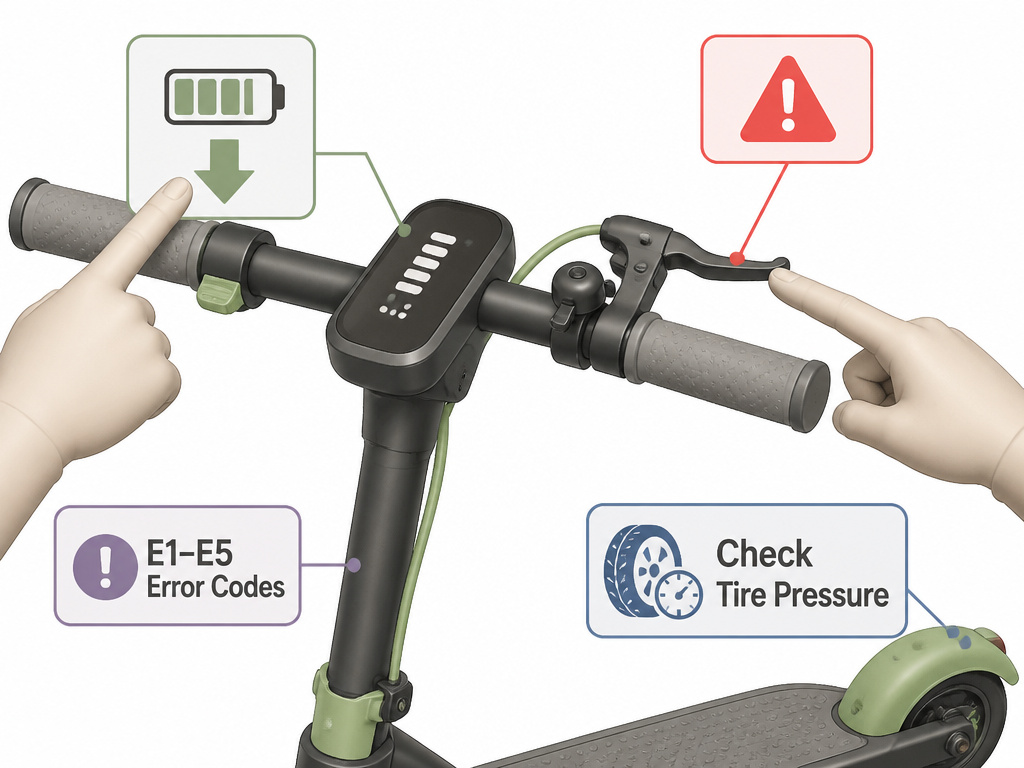
Gotrax publishes a list of error codes for its scooters. If your display shows E1 through E5, stop riding.
- E1 (Communication Failure), E4 (Motor Failure), E5 (Controller/Body End Failure): These indicate internal electrical issues. Contact support.
- E2 (Brake Lever Failure), E3 (Handlebar Failure): These could be a stuck button or a disconnected cable. Check the physical components before assuming the worst.
For general performance loss, check tire pressure first. The manual recommends checking and maintaining proper tire pressure. Soft tires create more rolling resistance, which murders your range and makes the motor work harder.
Gotrax Flex vs. Other Options and Who It’s For
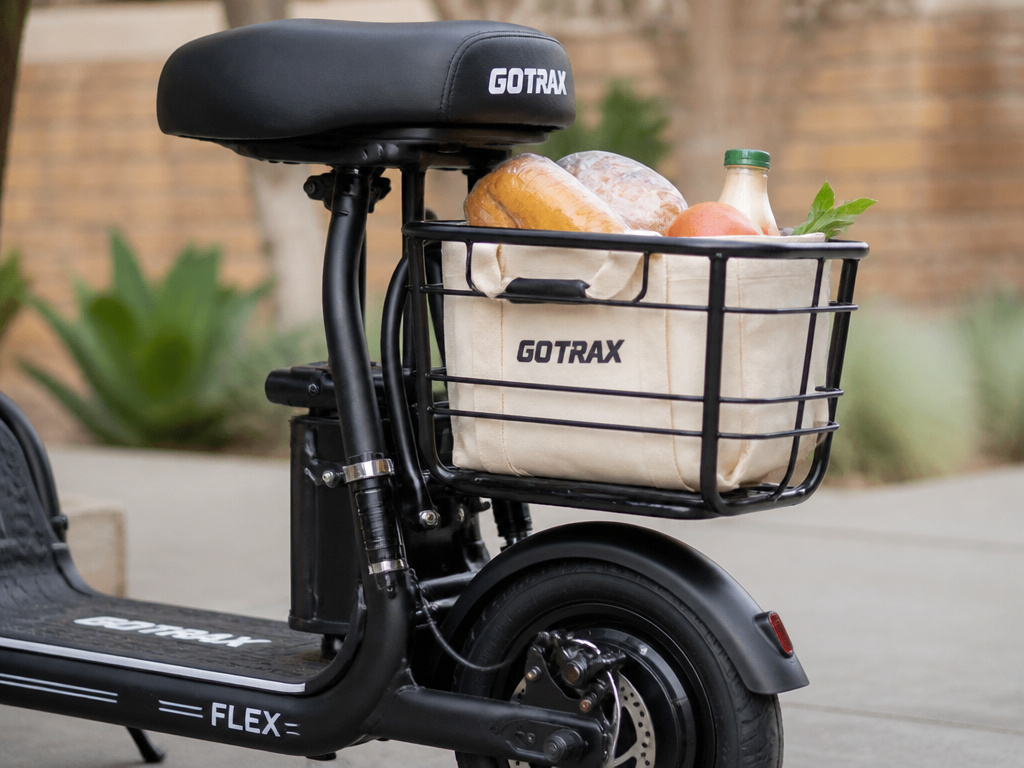
The Flex sits in a odd category. It’s not a agile, stand-up commuter scooter like the Gotrax GXL V2. It’s also not an e-bike. It’s a hybrid meant for relaxed, short trips where you value the seat and basket.
Skip the Flex if: Your commute has any significant hills, you weigh over 200 lbs, or you need to carry it regularly. The 350W model will disappoint, and the scooter’s weight makes it a chore to lift.
Consider the 500W Flex Ultra/Campus Pro if: Your terrain is mostly flat with occasional mild slopes, you want the utility of the basket for errands, and you prioritize a seated ride over portability. It’s a specific solution for a specific need.
For everyone else, look at the broader Gotrax scooter lineup. A traditional stand-up scooter will be lighter, faster, and easier to store. An e-bike might offer more comfort and range for a similar price. The Flex’s value is entirely in its integrated seat and basket, if you don’t need those, other Gotrax models offer better performance per dollar.
How does the Gotrax Flex compare to other scooters?
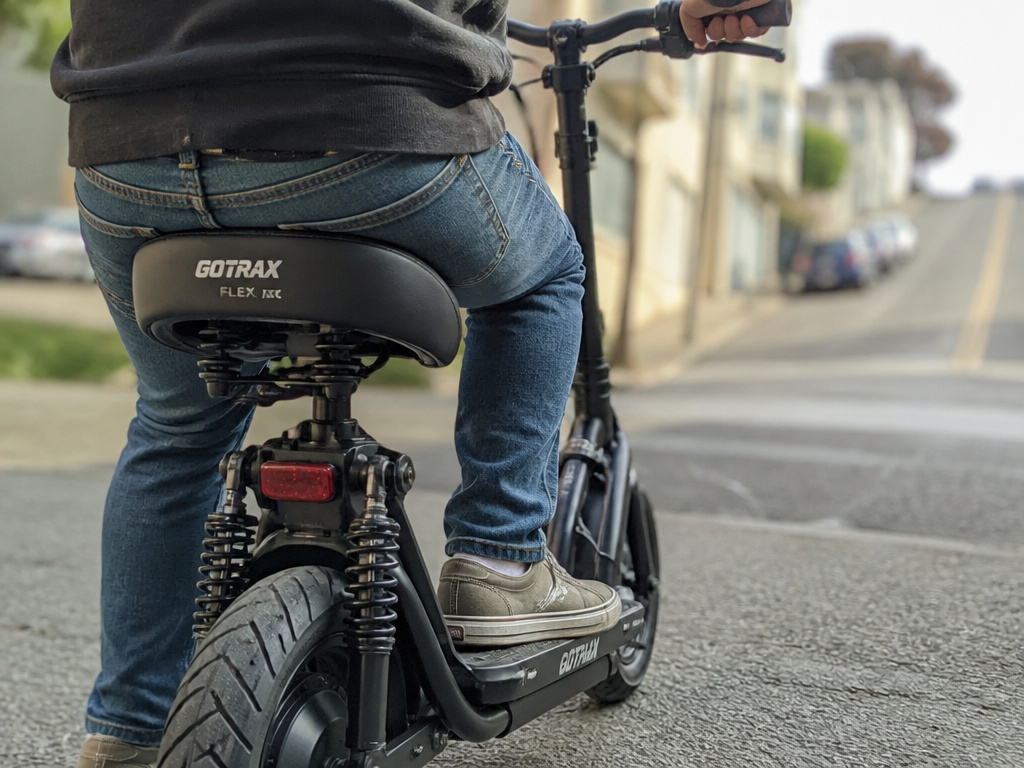
The Flex’s main differentiator is its integrated cushioned seat, a feature many budget competitors lack. Its larger 14-inch air-filled tires and rear suspension are designed for a more stable ride over bumps compared to models with smaller, solid tires. Where the Flex may fall short for some riders is hill performance; user reports indicate the 350W motor can struggle on inclines, especially for heavier riders, while some competitors offer more powerful motors at similar price points. Its unique seated-only design also means you can’t easily switch to a standing position, which is a trade-off for the comfort it provides.
Frequently Asked Questions
Are Gotrax scooters any good?
The answer is heavily dependent on model and expectation. Budget models like the Flex are “good” for light, flat-terrain use and short trips, with numerous reports of minor issues like brake sensors. Higher-end Gotrax models have different performance profiles. Long-term durability is mixed, with some units failing early and others lasting years.
How long will a Gotrax scooter last?
There is no single answer. A two-year review of the Flex showed significant battery degradation but overall survival. Anecdotes range from a scooter lasting 3-4 years with abuse to throttles breaking within a week. Proper maintenance (tire pressure, clean storage, avoiding water) and buying the appropriate motor power for your weight and terrain are the biggest factors.
Which is better, the Gotrax Flex 350W or 500W?
The 500W model (sold as Flex Ultra or Flex Campus Pro) is objectively better for most adults. The 350W motor struggles on inclines and with riders over 190 lbs, making its advertised range unrealistic in many real-world conditions. The 500W version provides adequate torque for moderate hills and preserves range under load, justifying its higher cost.
Can you sit and stand on the Gotrax Flex?
No. According to Gotrax’s own product guide, the Flex series is “not designed to be used both sitting and standing.” The seat is fixed, and the standing deck is not intended for prolonged use. If you want that flexibility, Gotrax directs you to their Fusion model with a detachable seat.
Is the Gotrax Flex foldable?
Only the handlebar stem folds down. The main frame does not fold, which limits its portability. If space is a major concern, you should review the steps in our guide on folding a Gotrax scooter to understand the limitations compared to fully folding models.
The Bottom Line
The Gotrax Flex is a tool for a specific job. That job is short, flat trips where you carry a small load and really want to sit down. While some riders find the 350W model adequate for flat terrain, others report it struggles on inclines, especially for riders over ~190 lbs.
Its flaws are well-documented: battery degradation, finicky sensors, and a polarizing customer service reputation. Its advantages are equally clear: the convenience of the basket, the comfort of the seat for short durations, and a price point that’s hard to match for a seated scooter.
Before you buy, be brutally honest about your terrain and weight. If your route has any hill you’d call a “slope,” get the 500W. If you’re over 200 lbs, the 500W is mandatory. For everyone else on pancake-flat land, the 350W might suffice, but know you’re buying the very baseline of performance. Manage those expectations, and the Flex can work. Expect it to be something it’s not, and you’ll join the chorus of frustrated owners.
