How Much Does Spin Scooter Cost?: The Real Numbers
This post contains affiliate links. As an Amazon Associate, we earn from qualifying purchases.
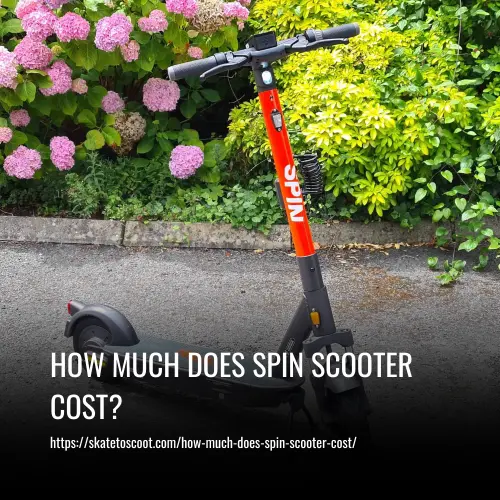
A Spin scooter costs $1 to start a ride plus a per-minute rate that varies by city, typically between $0.20 and $0.42. Standard rides are pay-per-use, but discounts exist through Spin Access for low-income users, city-specific programs like St. Pete Resident Rate, and university partnerships that offer automatic price cuts.
The real answer is a matrix of start fees, per-minute charges, and location-specific discounts. A 10-minute ride could cost you $4.20 in St. Petersburg, $3.50 in Greeley, or as little as $2.00 if you qualify for certain subsidies. The cost depends entirely on where you are, what you qualify for, and how you choose to pay, which is why people often ask, ‘How much does Spin scooter cost?’
What follows: a breakdown of the standard pay-per-minute model, a comparison of every major discount program (Spin Access, resident rates, university deals), a cost-benefit analysis of monthly passes, and the hidden fees that turn a $3 ride into a $13 charge. By the end, you’ll know exactly what your next Spin ride will cost and how to pay the least for it.
Key Takeaways
- Standard pricing is $1 to start a ride plus a per-minute rate that varies from $0.20 to $0.42 depending on your city.
- The Spin Access program provides discounted fares for low-income users and, in some cities, a text-based (SMS) rental system for those without a smartphone or credit card.
- City and university partnerships can slash costs: St. Petersburg residents pay $0.34/min, and UNC Greeley students/staff get an automatic 50% discount via email.
- Monthly or multi-day start passes (like the $2.99 monthly pass) waive the $1 fee and only make financial sense if you take multiple short trips per month.
- Always end your ride properly in a designated zone; parking violations can trigger fines from $10 to $25 and lead to account suspension.
The Standard Pay-Per-Use Model
Forget flat rates. Spin’s default model is simple but location-dependent: a $1 start fee plus a per-minute charge for every second the scooter is moving. This is the cost structure you’ll encounter if you just download the app and go.
The per-minute rate is where your city matters. In St. Petersburg, Florida, the standard rate is $0.42 per minute. Over in Greeley, Colorado, for their pilot program, it’s $0.35 per minute. Anecdotal reports from university campuses like UCF suggest rates can dip to around $0.20 per minute, though these often have additional taxes and partner service fees tacked on. The rate from Spin’s 2019 launch in Columbus was $0.29 per minute.
A 10-minute standard ride in St. Petersburg costs $1 + (10 x $0.42) = $5.20. The same ride in Greeley costs $4.50, and on a campus with a $0.20 rate, it would be $3.00 before fees.
This variance isn’t random. It reflects local operating agreements, city permit fees, and competitive landscapes. The takeaway is universal: your cost is time-sensitive. A leisurely 15-minute cruise costs significantly more than a focused 5-minute commute.
Before you start: The timer starts the moment you start the ride and only stops when you successfully end the ride in the app. A common mistake is walking the scooter a short distance to a proper parking spot while the meter is still running, those two minutes of walking cost you.
Spin Access and City-Specific Discounts
If the standard rate seems steep, a web of discount programs exists. The most significant is Spin Access, designed for low-income riders. Qualification requires submitting documents proving your status, but the benefits are substantial. In St. Petersburg, Spin Access provides income-eligible residents with up to 3 free 30-minute rides per day. Proposed rates for Spin Access vary by location; for example, a Seattle application proposed rates as low as $0.02 per minute, while St. Petersburg offers up to 3 free 30-minute rides per day.
The mechanics of Spin Access also solve access problems. Approved users without a smartphone can use a text-based (SMS) system to start scooters by texting a code to a dedicated number. In certain cities like Baltimore, Fort Collins, and Portland, you can even purchase ride credit in person with cash, a $10 minimum, at a local Spin office.
Beyond income-based aid, geographic and institutional discounts are common. The St. Pete Resident Rate shaves the per-minute cost to $0.34 for locals. In Greeley, an automatic 50% discount applies to all UNC students, faculty, staff, and City of Greeley employees simply by signing up with a verified university or city email domain.
| Discount Program | Who Qualifies | Pricing Benefit | Key City Example |
|---|---|---|---|
| Spin Access | Low-income residents | Free rides or deeply reduced per-minute rates | St. Petersburg: 3 free 30-min rides/day |
| Resident Rate | Local residents | Reduced per-minute fee | St. Petersburg: $0.34/min (vs. $0.42) |
| University/Org. Discount | Verified email domain holders | Automatic percentage discount | Greeley: 50% off for UNC & City staff |
| Adaptive Program | Riders with mobility needs | No-cost adaptive device rental | UC Davis: Seated scooter, 3-wheel scooter |
The adaptive program, like the one at UC Davis, is a different kind of discount. It offers seated scooters, three-wheeled scooters, and electric wheelchair attachments at no cost, though they require a 24-hour advance request for delivery, a critical logistical detail most standard riders never encounter.
Passes vs. Pay-Per-Use: When Does a Pass Pay Off?
Seeing the per-minute ticker adds up, you might wonder about passes. Spin offers several, but they’re not automatic money-savers. You need to run your own numbers.
The most common is the start pass. In some locations, like Fayetteville, a monthly start pass costs $2.99 and waives the $1 start fee on every ride for a month. You still pay the full per-minute rate. This pass only makes sense if you take frequent, very short trips. If your typical ride is 5 minutes at $0.35/min, the pass saves you $1 per ride. You’d need at least three such rides in a month to break even.
Then there are bundled minute passes. The pass saves over $12, but only if you actually use all 60 minutes. If you only use 20 minutes, you’ve prepaid $9.99 for $8 worth of riding.
In some locations, like Fayetteville, a College Pass costs $39.99 for 200 minutes usable within 30 days. It brings your effective per-minute cost down, but you must be a heavy user to consume it.
Where this goes sideways: Buying a minute-bundle pass and then not using the full allocation. You lock in a lower per-minute rate but waste money if your usage falls short. Track your weekly ride time for a month before committing.
Here’s a quick decision table:
| Your Usage Pattern | Best Payment Option | Why |
|---|---|---|
| Occasional, short rides (<10 min) | Standard Pay-Per-Use | No upfront cost; you only pay for what you use. |
| Frequent, very short rides (multiple <5-min trips/week) | Monthly Unlock Pass ($2.99) | Saving the $1 unlock fee on multiple trips adds up quickly. |
| Predictable, moderate usage (~1 hour per week) | 60-Minute Pass ($9.99) | Locks in a lower per-minute rate and eliminates unlock fees. |
| Heavy daily user (e.g., campus commuter) | College Pass or Spin Access | Maximizes discount; College Pass offers the lowest per-minute cost for high volume. |
Mechanically speaking, the break-even point for the monthly start pass is about three 5-minute rides.
The Hidden Costs and Penalties
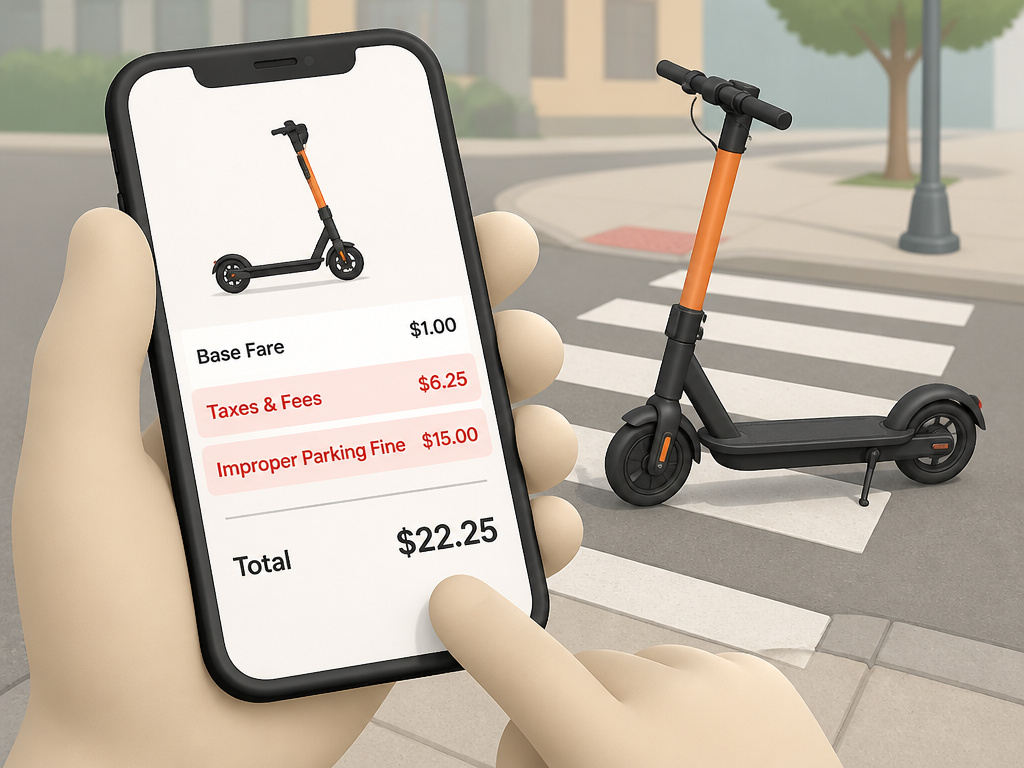
The advertised $1 + $0.XX/min is just the start when figuring out how much does Spin scooter cost. Several other factors can inflate your final charge, and they’re the number one source of user frustration on forums.
First, taxes and partner service fees. Reddit users in Fayetteville and at UCF specifically note their final cost includes these additions. The per-minute rate can increase after taxes and fees are added. The app’s price preview usually shows this, but it’s easy to miss.
Second, improper parking fines. Cities and Spin enforce strict parking rules to keep sidewalks clear. In Greeley, the penalty structure is a three-strike system:
-
Strike 1: A warning for violations like sidewalk riding or blocking a crosswalk.
-
Strike 3: Account suspension. You can reactivate it by retaking Spin’s safety quiz and scoring 100%.
Devices should not be parked within 10 feet of a crosswalk or curb ramp and never on private property without a dedicated area. The app will often require a photo of your parked scooter; skipping this step is a guaranteed way to incur a fee or warning.
Third, out-of-service-area charges. If you ride outside the designated geo-fenced operating zone, the scooter may slow to a halt or stop working, but the timer might not stop immediately. You are responsible for returning it to a valid area to end the ride.
Common mistake: Ending a ride but not getting the “Ride Ended” confirmation in the app. If the timer is still counting, you’re still being charged. Always wait for the final receipt screen.
In some cities, like Seattle, the maximum rental time for a Spin scooter is 24 hours. While designed for lost scooters, if you somehow manage to keep a scooter active for a full day, you’ll be charged for 1,440 minutes at the per-minute rate, a bill in the hundreds of dollars.
Adaptive Devices and Special Programs
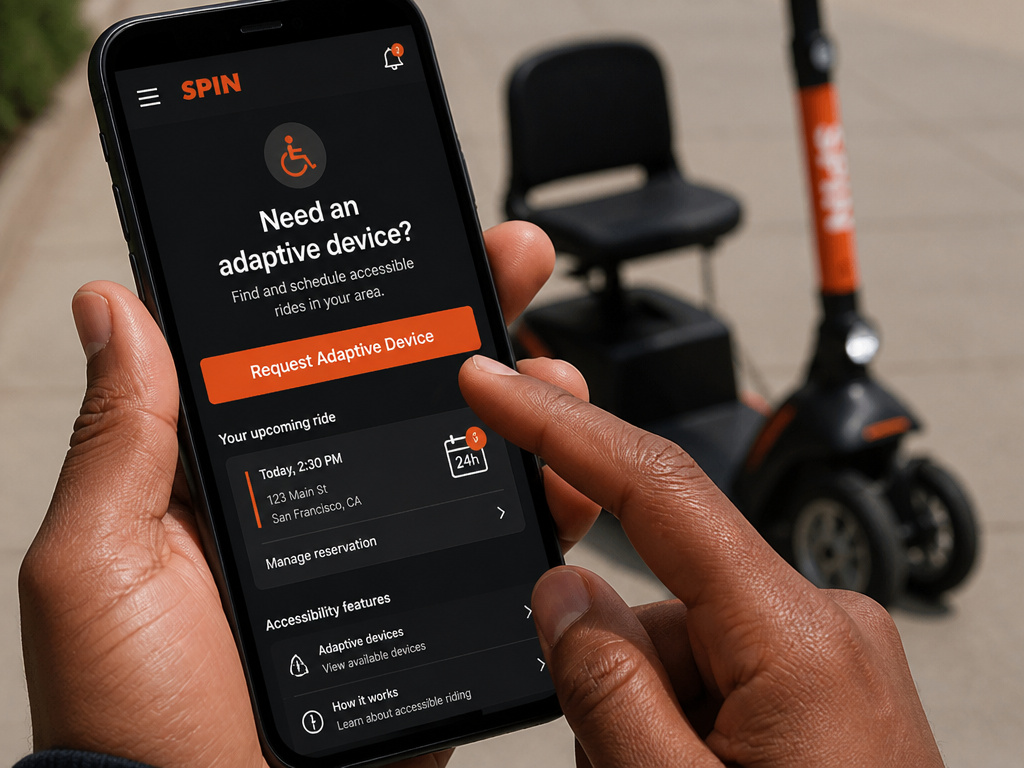
For riders with mobility challenges, Spin’s cost structure changes entirely through partnerships like the one with UC Davis Transportation Services. Their program offers adaptive devices, a seated scooter, a three-wheeled scooter, and an electric wheelchair attachment, at no cost.
The catch is logistical. These devices are not scattered around the city like standard scooters. They require a request 24 hours in advance for delivery to a specific location. This is a planned mobility aid, and the cost savings are profound, transforming a potential $15 daily scooter rental into a free service.
Available adaptive devices vary; for example, Spin’s no-cost program at UC Davis includes a seated scooter, a three-wheeled scooter, and an electric wheelchair attachment, while other partnerships may offer different models like the Drive Medical Spitfire Scout 3. If you need an adaptive device, your first step is to check Spin’s official website or contact the local program (like a university transportation office) rather than assuming the standard app inventory includes them.
How Spin’s Cost Compares
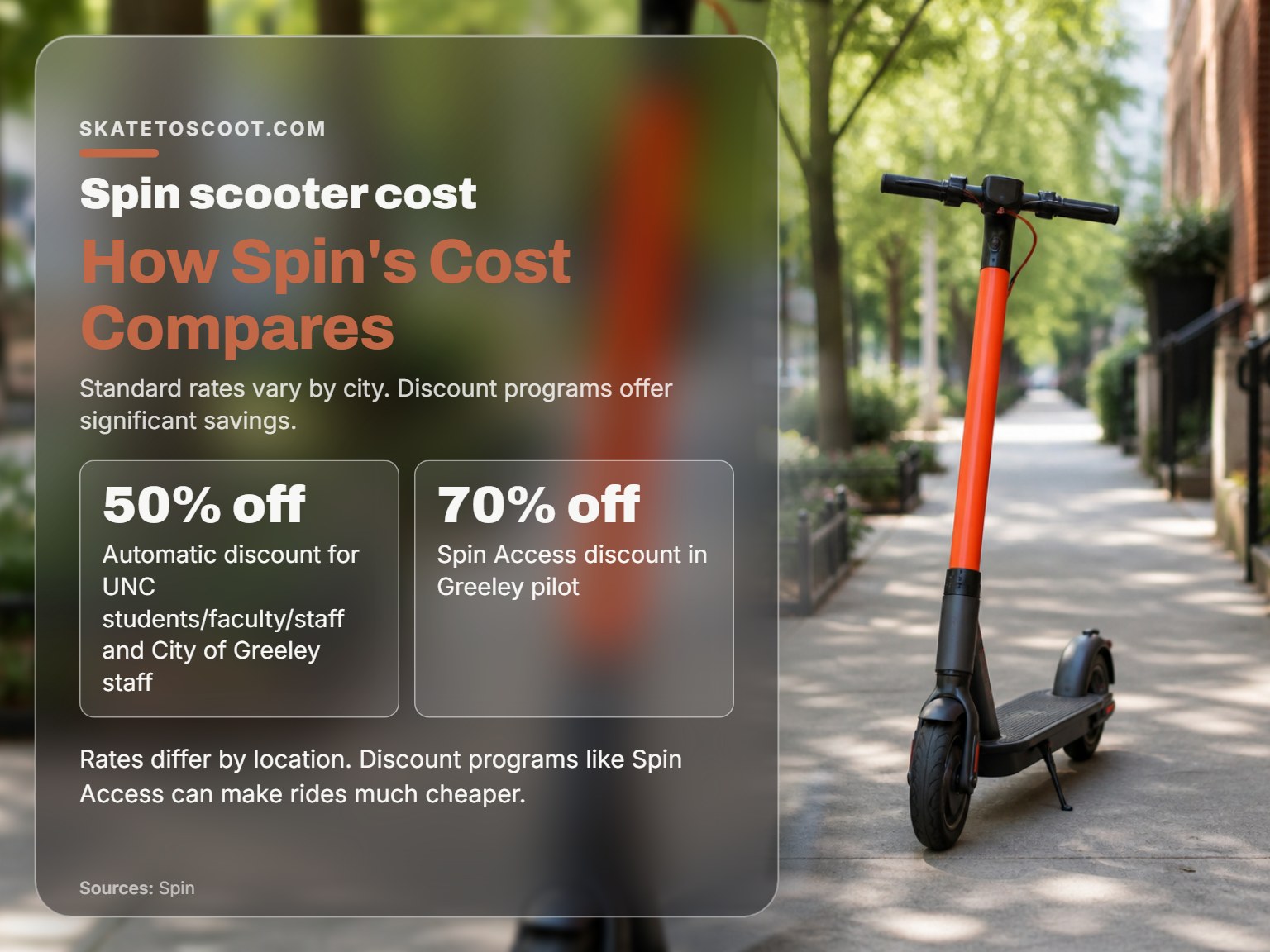
Is Spin cheaper than its competitors? It depends. When Lime and Bird dominated markets, their per-minute rates were often identical to Spin’s. Today, in many cities, they’ve converged to similar pricing, usually within a few cents of each other.
The real differentiator isn’t the base rate; it’s the discount programs. Spin’s Spin Access and its university partnership model (like the automatic 50% off in Greeley) are more structured and publicly documented than many competitor offers. If you qualify for these, Spin can be significantly cheaper.
For the average rider without discounts, the costs are virtually interchangeable. Your choice should then hinge on vehicle availability, app reliability, and which company’s scooters are best maintained in your area. A cheaper ride is worthless if the scooter has a flat tire or a dead battery.
If you’re considering frequent use, the cost-benefit analysis shifts. Compare the long-term rental costs of Spin to the outright cost of a scooter. As Reddit users at UCF discussed, buying your own electric scooter could be more economical than frequent rentals for daily riders.
Spin Prices in Different Cities and Universities
Spin’s pricing changes depending on your location. The standard pay-per-minute rate varies from city to city, and some areas have special local discounts. For example, residents of a particular city might get a lower per-minute rate, and university students or staff may receive an automatic discount verified through their school email. Some city or university pilot programs also offer unique passes. Spin Access also provides discounted fares for income-eligible residents, with the specific discount model differing by location. Always check the Spin app when you arrive in a new city to see the exact rates and any local promotions that apply to you.
How Spin Compares to Lime, Uber, and Other Services
Comparing Spin to other scooter services like Lime or Uber requires checking your local market, as all companies adjust their prices by city. The main difference often comes down to the specific per-minute rate and start fee in your area, as these can vary even between operators in the same city. Spin sometimes offers unique local programs, like discounted resident rates, university deals, or its Spin Access program for low-income riders, which may not be mirrored by competitors. To get the best price, download the apps for available services in your location and compare the start fees, per-minute rates, and any active pass options side-by-side before your ride.
Frequently Asked Questions
How much is a 15-minute Spin scooter ride?
A 15-minute ride costs the $1 start fee plus 15 times the local per-minute rate. In St. Petersburg at the standard $0.42/min, that’s $7.30. In Greeley at $0.35/min, it’s $6.25. With the St. Pete Resident Rate ($0.34/min), it’s $6.10. Always check your app for the exact rate before you start a ride.
What is Spin Access and how do I get it?
Spin Access is a program offering discounted fares and alternative access methods for low-income individuals. You apply through the Spin app or website, providing documentation of your income status. If approved, you receive discounted rates. In some cases, you can also use an SMS text system to rent without a smartphone and purchase ride credit with cash at Spin offices in select cities.
Are there student discounts for Spin scooters?
Yes, but they are usually tied to specific university partnerships, not a universal student ID. For example, UNC Greeley students, faculty, and staff receive an automatic 50% discount by signing up with their university email. Other campuses may have similar deals; check with your student transportation services or the Spin app under promotional offers.
Can I rent a Spin scooter without a smartphone or credit card?
Yes, through Spin Access. Qualified users without a smartphone can use the SMS text system to start and lock scooters. In cities like Baltimore, Fort Collins, and Portland, you can also visit a Spin office and purchase ride credit with cash (minimum $10) to use with the SMS system.
What happens if I don’t park the Spin scooter correctly?
Improper parking can trigger a graduated penalty system. First, you’ll receive a warning. A repeated violation may lead to a fine (e.g., $25 in Greeley). Continued offenses can result in account suspension. To reactivate a suspended account, you typically need to retake Spin’s in-app safety quiz and score 100%.
The Bottom Line
Spin scooter pricing is a choose-your-own-adventure of base rates, geographic discounts, and qualification-based programs. The standard model is simple, but the savvy rider looks past it.
If your rides are infrequent, just pay as you go. If you’re a student or staff at a partner institution, your verified email is your ticket to automatic savings. For those with limited income, Spin Access is a fundamentally different access model that includes cash payments and phone-free rentals.
The one rule that changes the math: if you ride more than 25 minutes a week on average, start looking at the 60-minute or College passes. Otherwise, you’re leaving money on the table. And always, always end your ride with the app’s confirmation. That’s the line between a $4 trip and a $25 lesson.
