How Much Does It Cost to Rent an Electric Scooter?
This post contains affiliate links. As an Amazon Associate, we earn from qualifying purchases.
Renting an electric scooter usually costs a small start fee plus a per-minute rate while you ride. A standard ride might be $1 to start and $0.32 to $0.39 per minute, making a 20-minute trip cost between $7.40 and $8.80. However, flat hourly rates, regional currencies, and substantial discount programs for students or low-income riders can dramatically change that math.
The unlock-plus-per-minute model is standard, but other options exist. A flat $10 hourly rate exists, such as with Levy Electric. A ride with JorGo in Ukraine costs in UAH, not USD. And a qualifying rider at Oregon State University might get their first 30 minutes free every day through Veo Access. The final price on your screen depends on which of these variables your specific ride hits, so a common first question is how much does it cost to rent an electric scooter.
What follows: a breakdown of the standard pricing formula, a direct comparison of what major brands actually charge, and the specific discount programs that can cut your cost by more than half. We’ll also cover the less-obvious fees that inflate a bill and the real-world math for a tourist versus a daily commuter.
Key Takeaways
- The common model is an $1 start fee plus a per-minute rate, but rates vary by company and location; always check your local operator’s app for exact numbers.
- Low-income and student discount programs like Veo Access, Spin Access, and Lime Access can reduce costs by 50% or more, often requiring proof of assistance program enrollment.
- Flat-rate pricing, like Levy Electric’s $10/hour model, becomes cheaper than per-minute rentals for trips longer than 20-25 minutes.
- Hidden costs like pause fees, out-of-area fines, and improper parking charges can quickly double a short ride’s expected price.
- Your final cost is decided by three things: the local operator’s rates, the length of your trip, and whether you qualify for any institutional or need-based discounts.
The Standard Pricing Model (Unlock Fee + Per-Minute Rate)
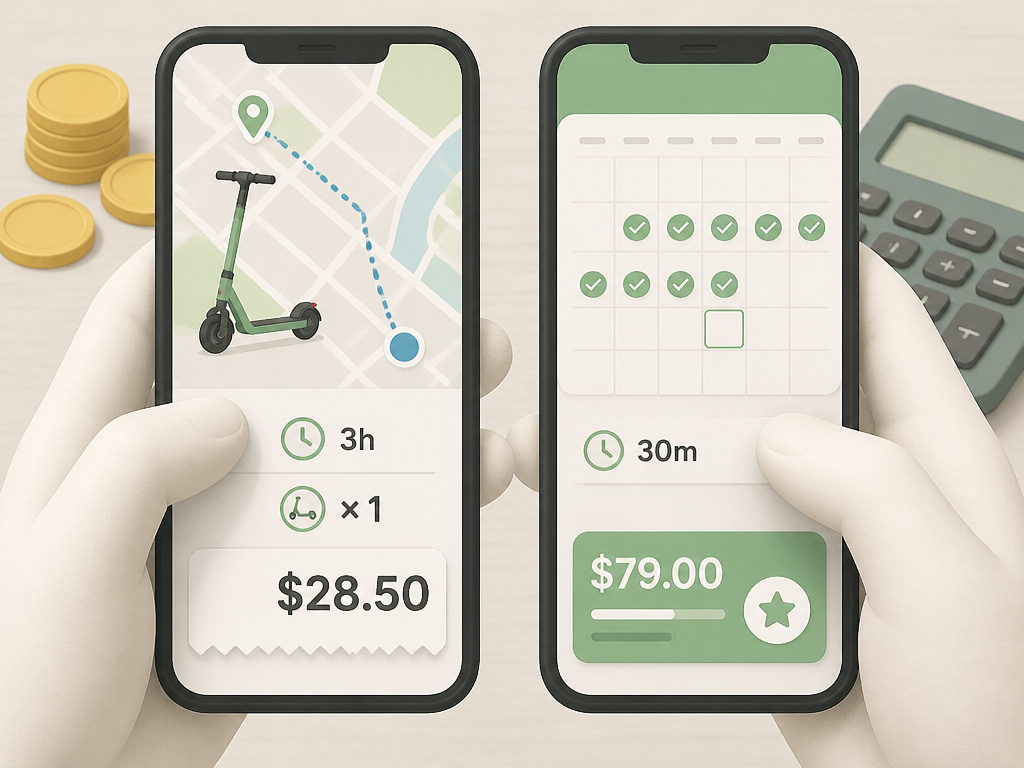
When you compare a how much does it cost to rent an electric scooter query across apps, open any major scooter rental app in a U.S. City and you’ll likely see some version of this formula. It’s designed for short, point-to-point trips.
The base cost has two parts. First, a fixed start fee, usually $1, is charged the moment your ride begins. This covers the overhead of the transaction and the scooter’s digital lock. Second, a per-minute rate kicks in for the duration of your trip. This rate varies by company and location.
A standard 20-minute ride with Veo in Asbury Park, New Jersey, costs $1 + (20 minutes × $0.39) = $8.80. The same 20-minute ride with Spin at UC Davis costs $1 + (20 × $0.32) = $7.40.
These numbers aren’t universal. The City of Asbury Park’s official page lists Veo’s rate at $1 start and $0.39 per minute. At UC Davis, their announcement notes Spin charges $1 start and $0.32 per minute. An older Lime permit application in Oakland listed $1 start and $0.29 per minute. The difference of a dime per minute adds up fast on a longer cruise.
The “per-minute” part is key. The meter runs until you manually end the trip in the app and park correctly. Forget to end the ride, and you’ll be charged for every minute it sits idle. This model, central to the how much does it cost to rent an electric scooter calculation, assumes you’re moving, not pausing for a long lunch.
Why this structure? It aligns the company’s revenue with scooter usage. They earn more when the scooter is in motion and serving another rider, incentivizing short trips and quick turnover. It also makes pricing predictable for the user—you see the rates before you scan.
A Side-by-Side Brand Comparison
You can’t compare apples to oranges. Here’s how the major players stack up on their documented, publicly listed pricing. This table pulls from official municipal, university, and company sources.
| Brand / Location | Unlock Fee | Per-Minute Rate | Notes / Source |
|---|---|---|---|
| Veo (Asbury Park, NJ) | $1 | $0.39 | City of Asbury Park official website. |
| Spin (UC Davis, CA) | $1 | $0.32 | UC Davis university announcement. |
| Lime (Oakland, CA – 2019) | $1 | $0.29 | SFMTA permit application document. |
| Veo (Oregon State Univ.) | $1 | $0.39 | OSU Today article. |
| JorGo (Ukraine) | 10 UAH | 4 UAH | Operator website (jorgo.com.ua). |
| Levy Electric (NY, USA) | $10 / hour (flat rate) | N/A | Operator website (levyelectric.com). |
The table shows the core spread. In the U.S., the per-minute rate clusters between $0.29 and $0.39. But look at the last two rows: regional and model outliers exist.
JorGo in Ukraine uses its local currency (UAH) and a different fee structure, including a 5-minute free booking period before charging 1 UAH per minute to hold a scooter. Levy Electric breaks the per-minute model entirely with a simple $10 hourly flat rate. This is a crucial fork in the road.
Flat rate vs. Per-minute: The flat rate is simpler but only cheaper beyond a certain trip length. If a per-minute ride costs $1 + $0.39/min, it reaches $10 at about 23 minutes. A 30-minute Levy rental costs $10. That same 30-minute per-minute rental would cost about $12.70. For a longer joyride or a deliberate tour, the flat rate wins.
Cost-Saving Strategies and Discount Programs
The sticker price is for infrequent or tourist riders. If you plan to use these regularly, or if your income is limited, you have paths to serious savings. These aren’t secret promo codes—they are structured programs, often mandated by cities as part of the operator’s permit.
Universities and cities frequently negotiate discounted “Access” programs. The details vary wildly, which is why a generic web search fails.
- Veo Access at Oregon State University: Qualifying riders (like Pell Grant recipients) get one free 30-minute ride per day. After that, the per-minute rate drops to $0.20 for the rest of the day.
- Spin Access at UC Davis: Eligible low-income or financial-aid recipients pay a reduced $0.50 start fee and $0.10 per minute.
- Lime Access (Oakland, 2019): The old model was a $5 annual fee for unlimited 30-minute rides.
Where this goes sideways: Assuming all “discount” programs work the same. A Veo Access free ride resets daily, Spin Access slashes both the unlock and per-minute fee, and an old Lime Access was a yearly subscription. You must find the specifics for your city and operator.
Enrollment usually requires verifying your status within the app, often by providing proof of enrollment in a state or federal assistance program.
The tactical takeaway? Before you rent, open the app and look for “Access,” “Discounted Rides,” or “Community Pricing” in the menu. If you’re a student, check your university’s transportation page. The savings aren’t hidden, but they aren’t advertised on the main ride screen either.
Real-World Cost Scenarios: Tourist vs. Commuter
Abstract rates are one thing. What does this actually cost for the two most common use cases? We’ll calculate with real examples from our sources.
The Weekend Tourist
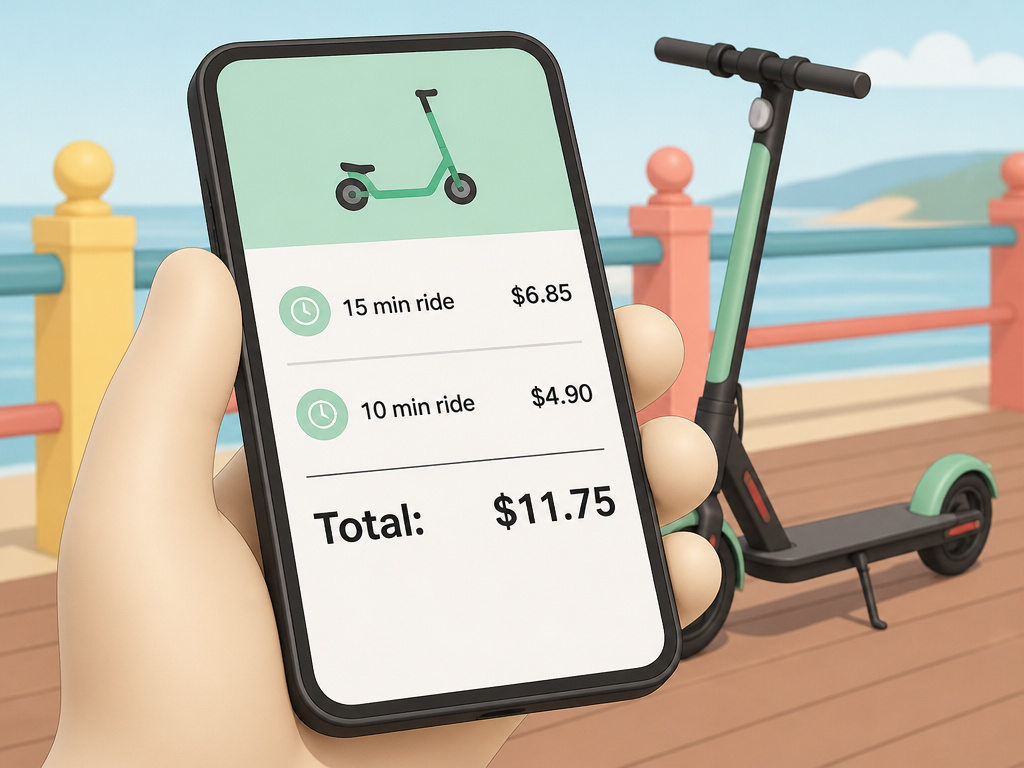
You’re in Asbury Park for the day. You take two separate scooter trips: a 15-minute ride from your hotel to the boardwalk, and later a 10-minute ride to a restaurant.
- Trip 1: $1 + (15 × $0.39) = $6.85
- Trip 2: $1 + (10 × $0.39) = $4.90
- Total Daily Cost: $11.75
That’s for two short hops. If you did that for three days, you’re looking at over $35. A tourist might be better off with Levy’s $10/hour flat rate if they plan a longer, continuous exploration.
The Daily Commuter
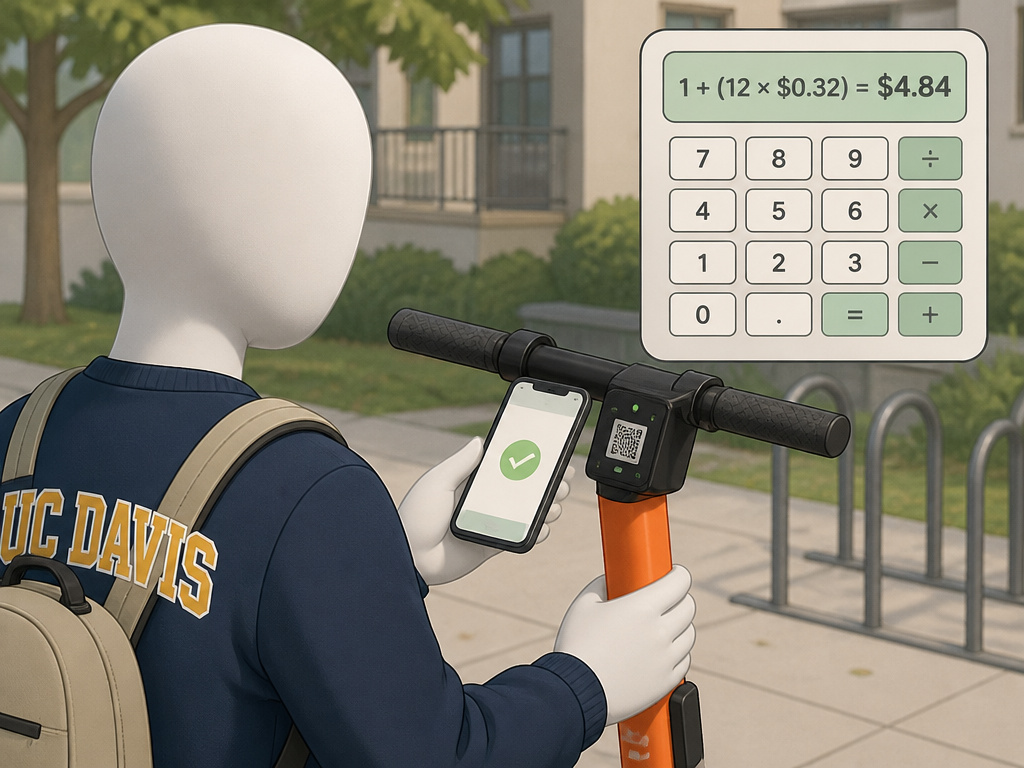
A student at UC Davis uses a Spin scooter to get from their off-campus apartment to class—a 12-minute ride each way, five days a week.
- Standard Rate (per trip): $1 + (12 × $0.32) = $4.84
- Daily Round-trip: $4.84 × 2 = $9.68
- Weekly Cost (5 days): $9.68 × 5 = $48.40
That’s nearly $200 a month. This commuter is the perfect candidate for Spin Access. With the discounted rate ($0.50 start fee + $0.10/min), their per-trip cost drops to $0.50 + (12 × $0.10) = $1.70. The daily round-trip becomes $3.40, and the weekly cost plummets to $17.00. The program cuts their cost by about 65%.
These scenarios ignore potential pass options.
Hidden Fees and Cost Inflators
The quoted per-minute rate is the best-case scenario. Several common behaviors can tack on substantial extra charges, turning a $6 ride into a $12 surprise. These are laid out in the service agreement but easy to miss when you start the ride.
- Pause Fees: Need to stop at a shop but don’t want to end your ride and risk losing the scooter? Most apps have a “pause” function. It often comes with a reduced but still active fee. JorGo in Ukraine charges 2 UAH per minute during a pause.
- Improper Parking Fines: Almost every system uses geofenced “virtual docks” or designated parking areas. Ending a trip outside these zones usually isn’t allowed. If you force it, you may incur a fine. Buckinghamshire Council’s trial with Voi states riders must follow parking rules, and repeat offenders can be fined or blocked.
- Out-of-Boundary Penalties: Riding outside the approved service area is a big one. Scooters often have geofencing that slows them to a stop if you leave the zone. JorGo imposes a fine of 100 UAH for entering a prohibited area.
- Low-Battery or Damage Fees: If you end a ride with a critically low battery or cause damage, you might be charged a fee or repair cost. While not always a listed “fee,” it’s a potential financial liability.
- Multiple Rider Fines: Almost every municipality and terms of service stipulates one rider per scooter. Getting caught riding tandem can lead to a fine from the operator and a ticket from local police.
The most insidious is the continued charge for improper parking. Your ride doesn’t end, so the per-minute rate just keeps ticking. You could walk away thinking you’ve parked, only to find your 8-minute ride became a 45-minute drain on your wallet. Always, always get the app’s confirmation that the trip has ended.
Legal and Safety Requirements That Affect Cost
Your wallet isn’t the only thing at risk. Ignoring local laws can lead to fines that dwarf any scooter rental fee. These rules also exist for your physical safety—a hospital bill is the ultimate hidden cost.
First, where you can ride. This is mandatory and city-specific. Asbury Park’s rules are clear: sidewalk riding is prohibited. You must ride in the street or bike lane. Buckinghamshire’s trial with Voi also prohibits pavement riding. Getting caught can mean a fine from local authorities on top of the rental cost.
Second, rider qualifications. Most systems require you to be 18 or older. Some, like the Voi trial in the UK, require riders to hold at least a provisional driving licence. You’ll need to scan your license in the app to verify this before your first ride. Lying about your age or credentials could void insurance and leave you fully liable in an accident.
Third, equipment. While not always a legal requirement, helmet use is “strongly encouraged” almost everywhere. Buying a helmet is an upfront cost, but it’s a one-time investment against a traumatic brain injury.
These aren’t scare tactics. They are the documented conditions of use from city and operator websites. Violating them transfers risk directly to you, turning a cheap ride into a very expensive mistake.
Where can I rent an electric scooter?
Electric scooter rentals are not available everywhere. Their availability depends on local government permits and company operations. You’ll typically find them in specific cities, university campuses, or designated trial areas. For example, one provider operates a trial in Buckinghamshire, UK, that runs until May 2028, while another has a program with over 50 parking locations in Asbury Park. Always check a provider’s official app or website to see if they list your city or campus as an active service area before planning your trip.
What kinds of scooters can I rent?
Most rental fleets consist of standard standing electric scooters. These are designed for a single rider and have a platform you stand on during your ride. Some services may offer seated scooters, which are sometimes categorized as mobility options, but the standard offering is the standing model. Rental agreements typically specify that only one person is allowed per scooter. When you locate a scooter through an app, you can often see a picture of the model to confirm its type before you start the ride.
Frequently Asked Questions
What is the cheapest electric scooter to rent?
The cheapest option is usually the one you qualify for through a discount program like Spin Access or Veo Access, which can drop rates to $0.10-$0.20 per minute. For standard pay-as-you-go riders, the lowest per-minute rate in our sourced data is Lime’s historic $0.29 per minute in Oakland. Always check your local operator’s app for current promotions.
How much is a 20 minute Lime ride?
Based on Lime’s 2019 permit application in Oakland, a 20-minute Lime ride would cost $1 start fee + (20 minutes × $0.29) = $6.80. However, rates are location-specific and may have changed, so verify in your local Lime app before riding.
How do electric scooter rentals work?
You download the operator’s app (e.g., Spin, Veo, Lime), create an account, and add a payment method. You use the app’s map to locate a nearby scooter, scan its QR code to start the ride (which begins the charge), ride to your destination, and then manually end the trip in the app after parking in a designated area. The full process for renting an electric scooter involves a few more specific steps for safety and proper parking.
Is it better to rent or buy a mobility scooter?
This depends entirely on frequency of use. For occasional, short-term needs (like a vacation or recovering from surgery), renting is more economical. For daily, long-term mobility aid, purchasing a scooter is far cheaper over time. Rental costs of $10-$50 per day quickly surpass the one-time cost of a personal mobility scooter.
Before You Go
The final number on your receipt is the product of a simple equation, but the variables are local. Your cost isn’t just “about $1 and 30 cents a minute.” It’s the specific rate your city negotiated with Veo or Spin. It’s whether you’re a student at a university with a discount code. It’s your decision to pause the ride or park properly.
If you take one thing, let it be this: always open the app and check the rates before you scan. The price for a 15-minute ride in Asbury Park ($6.85) is different than in Davis ($5.80), and both are different if you qualify for an Access program. Look for that “Access” or “Discounts” tab. That single click is the difference between paying the tourist price and the local price.
And remember the rules. That $8 ride becomes a $150 ticket if you cruise on the sidewalk where it’s banned. The legal requirements for riding, from licenses to sidewalk rules, are part of the real cost. Rent with your eyes open, park it where it belongs, and the math will work in your favor.
