When Was the Scooter Invented? A Historical Timeline
This post contains affiliate links. As an Amazon Associate, we earn from qualifying purchases.
The scooter wasn’t invented once. The kick scooter traces to 1817, but the first recorded motor scooter is the 1902 French ‘Auto-Fauteuil’. The mass-produced motor scooter as we know it began with the 1916 Autoped. The modern seated scooter era was defined by the Vespa, patented on April 23, 1946.
That answer to the question “when was the scooter invented” covers three distinct inventions across 130 years. The story isn’t a single eureka moment but a series of reinventions, each solving a different mobility problem with the technology of its day.
What follows is a clear timeline: the draisine in 1817, the first motor scooter in 1902, the commercial Autoped in 1916, the post-war Vespa in 1946, and the modern folding scooter in the 1990s. By the end, you’ll know exactly which invention answers which part of the question “when was the scooter invented?”
Key Takeaways
- The kick scooter’s precursor, the draisine, was invented in 1817 by Karl von Drais.
- The earliest recorded motor scooter is the 1902 French Auto-Fauteuil with a 433cc engine.
- The first mass-produced motor scooter was the 1916 Autoped, featuring a front-mounted 150cc engine.
- The modern seated scooter era began with the Vespa, patented April 23, 1946, which sold over 18 million units.
- Distinguish between kick, motorized, and electric scooters, each has a separate invention date and purpose.
The Draisine (1817): The Kick Scooter’s Ancestor
The story starts with a problem unrelated to engines: the price of oats. In 1817, after crop failures made horse feed expensive, Baron Karl von Drais invented a “running machine” to provide a cheap transport alternative. This wooden, two-wheeled contraption, later named the draisine, is the direct mechanical ancestor of both the bicycle and the kick scooter.
You pushed it along with your feet on the ground. It was cumbersome, with wooden wheels that made for a lurching ride. But it proved a simple, human-powered concept could work on two wheels in a line. The Swiss National Museum blog notes this 1817 invention as the clear starting point for wheeled personal transport that led to scooters. It wasn’t a scooter yet, but it was the foundational idea, a platform on wheels you stand on.
The 1902 Auto-Fauteuil: The First Recorded Motor Scooter?
If we’re talking about a motorized scooter, the timeline jumps forward 85 years. According to a peer-reviewed study in the Japanese Society for the Science of Design Bulletin, the earliest recorded motor scooter is the 1902 French ‘Auto-Fauteuil’.
The 1902 ‘Auto-Fauteuil’ used a 433cc 4-stroke I.O.E. Engine, as documented in the JSSD Bulletin. This places a motor on a scooter-like frame decades before the popular post-war models.
This was more of a motorized armchair on wheels than the sleek Vespa image in your head. But it fits the definition: a small, step-through frame with an engine. It’s a crucial data point because it shows motorized scooter prototypes existed in the early 1900s, a fact most simplified histories skip. They disappeared for over twenty years between the World Wars, as the study notes, which is why the 1946 Vespa feels like a sudden invention.
The 1916 Autoped: The First Mass-Produced Contender
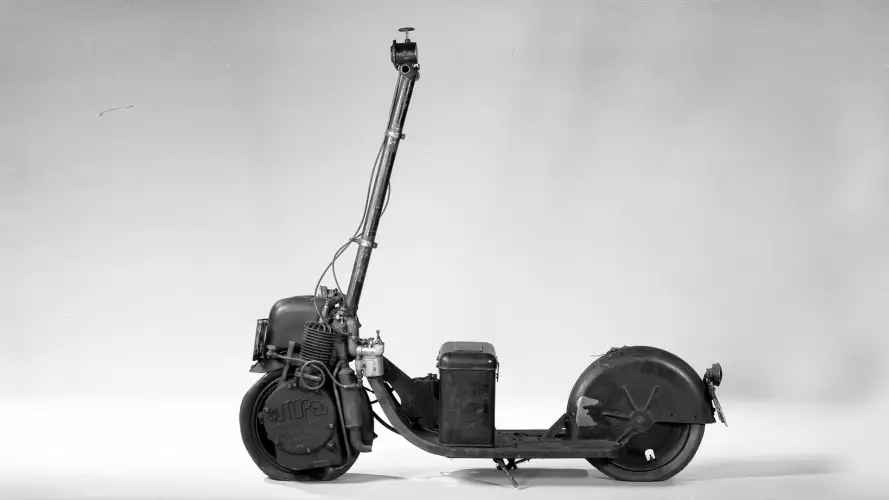
The Autoped is where the motor scooter starts to look familiar. Produced commercially by 1916, it’s often cited as the first mass-produced motor scooter. The JSSD Bulletin records it had a 150cc 4-stroke engine mounted on the front wheel and a governed top speed of 16 km/h (about 10 mph).
You stood on a platform, gripped a central column with controls, and twisted the handlebar to go. It was used by postal workers and even suffragettes. Its commercial production and recognizably scooter form make it a strong candidate for the “first” in the public imagination. Wikipedia’s “Scooter (motorcycle)” entry represents a common viewpoint, stating motor scooters have been made since at least 1914 and citing the 1915 Motoped as a believed first, while the JSSD Bulletin points to the 1902 Auto-Fauteuil as the earliest recorded motor scooter. This highlights a source disagreement on when was the scooter invented: the academic journal points to 1902, while the encyclopedia aggregates a 1914-1915 origin.
| Claim | Source | Key Model | Year |
|---|---|---|---|
| Earliest Recorded Motor Scooter | JSSD Bulletin (academic) | Auto-Fauteuil | 1902 |
| First Mass-Produced Motor Scooter | Common historical consensus | Autoped | 1916 |
| Start of Modern Scooter Popularity | Manufacturer archives | Vespa 98 | 1946 |
The Post-War Revolution (1946): Vespa and Lambretta

After World War II, the scooter was reinvented for the third time. This is the invention most people mean, the seated, body-covered, practical motor scooter. Two Italian companies, Piaggio and Innocenti, led this charge almost simultaneously, using former aircraft factories and engineers.
The Vespa’s story is one of deliberate rejection. Piaggio’s owner wanted a simple, affordable vehicle for Italy’s wrecked roads. He assigned the project to Corradino d’Ascanio, an aeronautical engineer. D’Ascanio, as detailed in the Piaggio Group archive, broke from motorcycle conventions. He gave the Vespa a load-bearing steel body (like a car), put the gear change on the handlebar, and used a single-sided front fork inspired by aircraft landing gear for easy tire changes. The first model, the “98”, had a 98cc 2-stroke engine producing 3.5 hp, a 3-speed transmission, and a top speed of 60 kph, as detailed by Motorbikes Today. Piaggio patented it on April 23, 1946, and started production with an initial run of 2,000 units, as recorded by Motorbikes Today.
Just months later, on December 23, 1947, Innocenti launched the Lambretta “A”. By the mid-1950s, over a million scooters had been produced by Vespa and Lambretta, as noted by Motorbikes Today, cementing the scooter as a global cultural icon.
Scooters in Japan, Germany, and Beyond
The post-war scooter boom wasn’t just Italian. In Japan, the Fuji Rabbit S-1 began production in June 1946. Its designers at Fuji Sangyo, formerly an aircraft company, used surplus parts, the front wheel was a tailwheel from a Nakajima bomber. In Germany, manufacturers like Zündapp produced popular models throughout the 1950s. The Zündapp Bella, for instance, came in three engine sizes: 150cc, 175cc, and 200cc.
This global spread shows the scooter wasn’t a fluke. It was a convergent solution for affordable personal mobility in recovering economies, built by engineers repurposing wartime manufacturing skills.
The Modern Kick Scooter (1990s): Razor and Micro

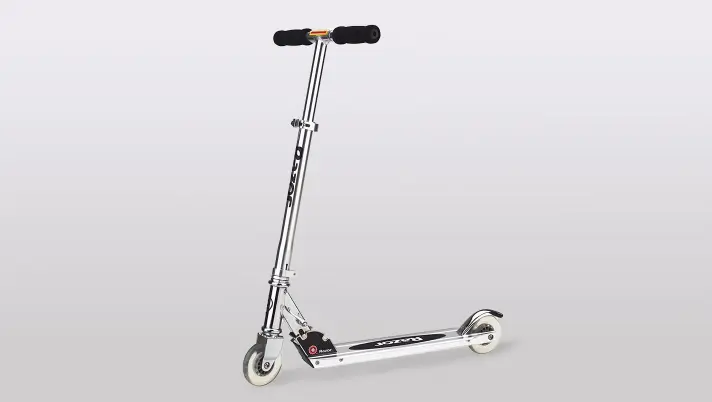
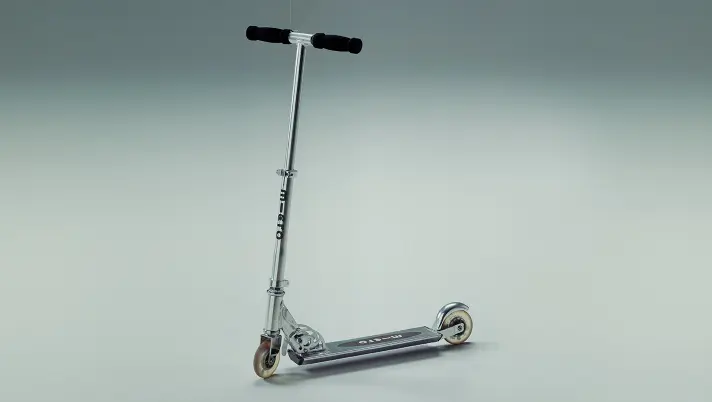
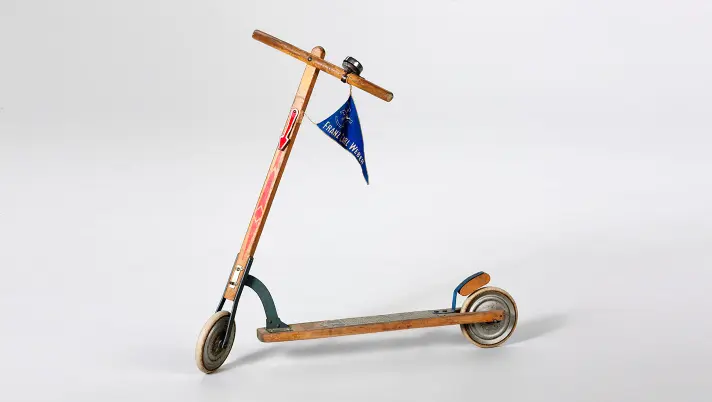
The kick scooter came roaring back in the late 1990s as a lightweight, foldable toy and transport tool. While companies like Switzerland’s Wisa Gloria AG had produced iconic metal scooters for kids between 1900 and 1950, the modern revival is credited to Swiss inventor Wim Ouboter and the company Micro. Their aluminum, foldable scooter with small polyurethane wheels was a hit. It was followed by the Razor scooter, which became a global phenomenon in the early 2000s.
This wasn’t a new invention mechanically, but it was a radical reinvention of the draisine’s concept for a new urban, recreational need. It separated the kick scooter from its motorized cousin as a distinct product category.
The Electric Scooter (2000s Onward)
Electric scooters have a longer prototype history, but their commercial proliferation is a 21st-century story. Early electric models were heavy and expensive, limited by battery technology. The real explosion happened in the 2010s with the advent of shareable, app-based e-scooters from companies like Bird and Lime. These answered the “last-mile” transport problem in cities.
Did they have electric scooters in 2001? Yes, but they were niche. Consumer-grade electric kick scooters existed, like the Peugeot Scoot’Elec, but they were costly and had limited range compared to today’s models.
The electric scooter didn’t replace the motor scooter; it created a new layer of the ecosystem, merging the simplicity of the kick scooter with a silent, on-demand motor.
Who invented the scooter?
The invention of the scooter is not credited to a single person. The earliest motor scooter on record is the 1902 French ‘Auto-Fauteuil’. Later, the 1916 Autoped offered a commercially available design with its engine mounted on the front wheel. The iconic modern scooter form was established after World War II. The Vespa was patented in April 1946, featuring a 98cc engine and a distinctive body that set the standard. That same year, the Japanese Fuji Rabbit S-1 entered production, and the Lambretta ‘A’ went on sale in late 1947. These post-war models, from different inventors and companies, defined the popular motor scooter.
Frequently Asked Questions
Did they have electric scooters in 2001?
Yes, but they were not mainstream. Companies like Peugeot were selling electric models such as the Scoot’Elec. However, they were expensive, heavy due to lead-acid batteries, and had a limited range. They were a curiosity, not a transport revolution.
Were there scooters in the 80s?
Absolutely. The 1980s saw the twilight of classic motor scooters like the Vespa PX and the rise of new automatic transmission models from Japan, like the Honda Spree. Kick scooters were primarily simple, welded-steel toys for children during this era, before the high-performance folding revival.
Who made the first ever scooter?
It depends on your definition. For a human-powered kick scooter, the credit goes to Karl von Drais for the 1817 draisine. For a motorized scooter, the earliest documented is the anonymous inventor of the 1902 French Auto-Fauteuil. For the mass-produced motor scooter, it’s the makers of the 1916 Autoped.
When did scooters become a thing?
Scooters “became a thing” in distinct waves: as a motorized novelty in the 1910s (Autoped), as a mass cultural phenomenon in the 1950s (Vespa/Lambretta), as a children’s toy in the mid-20th century (Wisa Gloria), and as an urban transport staple in the 1990s (kick scooter) and 2010s (electric scooter).
The Bottom Line
The scooter’s invention story is a relay race, not a sprint. If your question is about the kick scooter, the answer is 1817. If you mean the first motor scooter, look to 1902. If you’re thinking of the first commercially successful motor scooter, that’s 1916. And if your mental image is the modern seated scooter, that was defined in 1946.
Each iteration solved the core problem of cheap, simple, personal mobility with the best materials and power sources available at the time, wood and feet, then gasoline engines, then lightweight aluminum, and now lithium-ion batteries. The next time you see a kick scooter or a modern electric scooter, you’re seeing the latest chapter in a 200-year-old engineering dialogue about how to get from A to B on two wheels in a line.
