How Much Is a Mobility Scooter: The MSRP Illusion
This post contains affiliate links. As an Amazon Associate, we earn from qualifying purchases.
A mobility scooter’s price tag ranges from around $800 for a basic travel model to over $6,700 for a premium, full-suspension unit, based on official Manufacturer’s Suggested Retail Prices (MSRP). The price you actually pay can be drastically different, dictated by insurance coverage, battery size, weight capacity, and whether you buy new or used.
That MSRP figure is a starting point, not a finish line. It’s printed on order forms from companies like Pride Mobility, but a government study found these suggested prices “are generally not an accurate reflection of the actual sales price.” Your final cost hinges on a negotiation between your needs, your budget, and often, a complex insurance approval process.
What follows is a breakdown of those official prices, the real factors that change them, and how programs like Medicare shift the math from a sticker price to a coinsurance percentage.
Key Takeaways
- The listed Manufacturer’s Suggested Retail Price (MSRP) is a benchmark, not a fixed cost; online discounts can be significant.
- With Medicare Part B coverage, you typically pay 20% of the Medicare-approved amount after meeting your deductible, not the full MSRP.
- The HCPCS billing code on an order form (like K0801) is assigned by the manufacturer, but Medicare defines its own weight limits for that same code, creating a potential coverage gap.
- Battery capacity is a primary cost driver; upgrading from a 12AH to a 20AH battery in a Drive Medical Scout adds nearly $300 to the retail price.
- Long-term costs like battery replacements, tire changes, and out-of-warranty repairs often match the first year’s depreciation of a new scooter.
The MSRP Illusion: Why Sticker Price Isn’t Out-of-Pocket
Open a Pride Mobility order form and you’ll see a clean, bold number: $3,011 for a Victory 10 3-wheel. That’s the MSRP. It looks definitive. But right on that same document, in the fine print, the company states these codes “should not be considered as legal advice and do not guarantee reimbursement.” The sticker price and the out-of-pocket price live in two separate worlds.
This isn’t a conspiracy; it’s how durable medical equipment billing works. The MSRP is the manufacturer’s anchor. What Medicare or a private insurer agrees to pay, the “Medicare-approved amount”, is often lower. If you have coverage, you pay a percentage of that lower number. A 2014 market study commissioned by the UK Department for Transport put it bluntly, finding Manufacturer Recommended Retail Prices “are generally not an accurate reflection of the actual sales price,” with instances of the same scooter priced at £4,295 at one retailer and £1,295 at another.
A patient with Medicare Part B coverage pays 20% coinsurance of the Medicare-approved amount for Durable Medical Equipment (DME) after meeting the annual Part B deductible. The supplier must accept assignment, meaning they agree to the Medicare rate as payment in full.
So, a scooter with an MSRP of $3,011 doesn’t mean you write a check for $3,011. If Medicare approves it, you might pay 20% of a negotiated rate of $2,400, which is $480. The gap between MSRP and reality is where insurance, haggling, and market competition live. This is why simply comparing MSRPs across brands when you ask how much is a mobility scooter is the first mistake many buyers make. You need to compare the real cost drivers.
Breaking Down the Cost Drivers: From Batteries to Bumpers
If MSRP is a fuzzy starting point, what actually determines the number on the receipt? It comes down to a handful of physical and regulatory specs. Think of it like building a skate: the frame, the wheels, the bearings, each choice changes the final price. For scooters, the major components are battery capacity, weight capacity, and the features tied to intended use.
Battery capacity and type is the single biggest lever. It directly dictates range and price. Look at the Drive Medical Scout retail list: the 3-wheel model with a 12AH battery retails for $823. The identical scooter with a 20AH extended battery jumps to $1,115. That’s a $292 premium for an extended range; the 12AH battery provides a maximum range of 9 miles, while the extended battery provides 14–15 miles. For heavy-duty users, this upgrade isn’t optional; it’s the difference between a daily errand-runner and a machine that leaves you stranded.
Weight capacity is more than just a number, it’s a certification tier that triggers different HCPCS billing codes and builds. Pride Mobility labels the 400-lb Victory 10 with code K0801, but Medicare defines HCPCS code K0801 for a Group 1 Heavy Duty vehicle with a weight capacity of 300 lbs. A Pride Maxima, rated for 500 lbs, uses codes K0802 or K0808. That 100-lb difference in capacity correlates with a frame built with heavier-gauge steel, more robust motors, and a price jump from a $3,011 MSRP to a $4,536 MSRP for the 3-wheel Maxima.
Intended use and features split the market. A portable, folding travel scooter prioritizes lightweight materials and quick-disconnect parts, often sacrificing suspension and seat comfort. A full-size, outdoor cruiser like the Pride PX4 (MSRP $6,730) includes full suspension, pneumatic tires, and a more powerful motor for handling curbs and uneven terrain. Each added feature, a power-elevating seat (a $1,100 option on the Maxima), a heavier-duty charger, or a weather canopy, adds a line item to the order form.
| Cost Driver | Budget Impact | Real-World Trade-Off |
|---|---|---|
| Battery Capacity (12AH → 20AH) | +$250 to $300+ | Adds 5-6 miles range; essential for longer daily use. |
| Weight Capacity (300 lb → 400+ lb) | +$1,000 to $2,000+ | Heavier frame, larger motor; required for user safety. |
| Suspension & Tire Type | +$1,500+ | Pneumatic tires and full suspension smooth outdoor rides but add maintenance. |
| Portability Features | Can reduce cost | Lightweight, folding designs often use smaller batteries and simpler frames. |
Navigating Insurance and Medicare: The 20% Rule
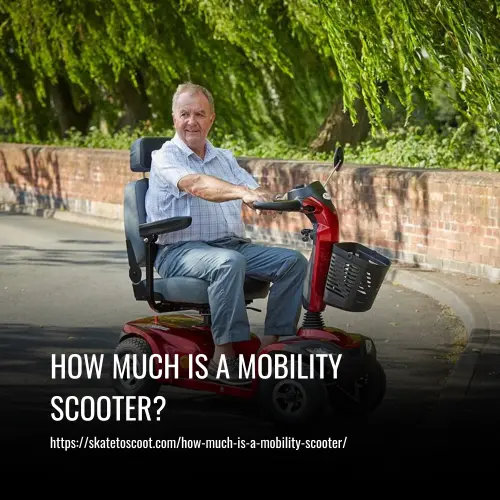
For many, the question isn’t “how much is a mobility scooter?” but “how much will I pay?” That’s where insurance, specifically Medicare Part B, changes the equation entirely. Medicare covers power-operated vehicles as Durable Medical Equipment (DME) if strict medical criteria are met. The key is that coverage is based on medical necessity within the home.
The process is specific. Your doctor must submit a written order detailing your need, and a supplier must verify the scooter can be used in your home. If approved, Medicare Part B pays 80% of the Medicare-approved amount after your annual deductible is met. You are responsible for the remaining 20% coinsurance. This is why understanding the Medicare mobility scooter coverage guide is critical; it outlines the exact criteria and patient responsibilities.
Common mistake: Assuming a scooter prescribed for “community mobility” qualifies. Medicare’s primary coverage is for use inside the home to perform activities of daily living. Needing it for shopping or visiting parks often doesn’t meet the strict “in-home” requirement, which can lead to denial.
This is where HCPCS codes get messy. A manufacturer assigns a code based on their product’s specs. Pride labels the 400-lb Victory 10 with code K0801. However, the official Medicare publication defines HCPCS code K0801 for a “Group 1 Heavy Duty” vehicle with a weight capacity of 300 lbs. This isn’t an error; it’s a disconnect between manufacturer labeling and payer definitions. It means a supplier billing for a Victory 10 under K0801 must justify why a 400-lb capacity scooter was medically necessary over a 300-lb model. This mismatch is a common point of denial and underscores why the manufacturer’s disclaimer about codes not guaranteeing reimbursement is a serious warning, not just fine print.
New vs. Used vs. Cheap: The Long-Term Cost Reality
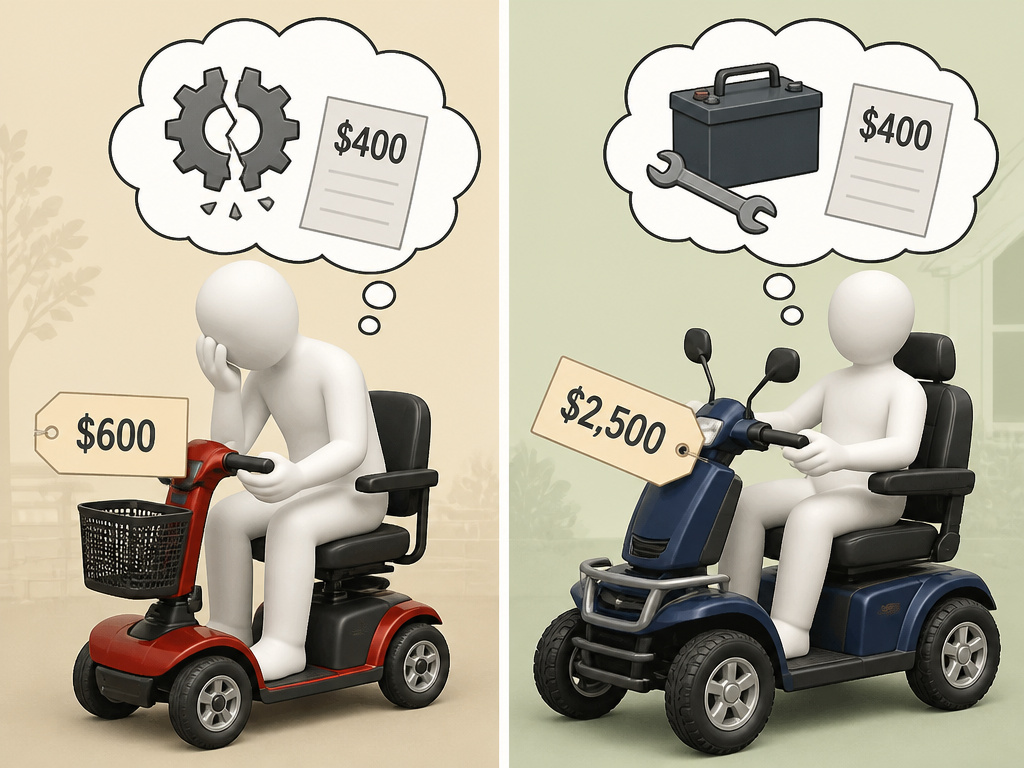
When the upfront price is the main barrier, the temptation is to find the cheapest option. The market obliges with sub-$1,000 new scooters and even cheaper used ones. But the real cost of a scooter isn’t the purchase price; it’s the total cost of ownership over two or three years. A cheap scooter can become the most expensive one you’ll ever own.
New, budget-tier scooters (often found online for $600-$1,200) cut corners. They use lower-grade plastics, less powerful motors, and smaller, non-AGM batteries. The first sign is often the sound: a high-pitched whine from the motor under load that a scooter like the Pride PX4, with its full suspension and 75Ah batteries, simply doesn’t make. These budget models also have shorter warranties, sometimes just 90 days on electronics. When the controller fails in month four, you’re paying for a repair that could cost half the scooter’s original price.
The used market is a calculated risk. Forums are full of success stories, but also warnings. The biggest hidden cost is battery replacement. A used scooter sold “as-is” might run for a week before the old, sulfated batteries refuse to hold a charge. A new set of quality AGM batteries can cost $300-$500. Without a warranty, a $500 used scooter plus a $400 battery repair puts you within a few hundred dollars of a new, warrantied entry-level model like the Drive Medical Scout.
Consider the actual long-term costs. Even a reliable scooter needs upkeep. Tires wear, brakes need adjustment, and connectors corrode. Owners on Reddit discussing long-term use mention budgeting for a major service or battery replacement around the 18-month mark. If you spend $2,500 on a scooter, expect to potentially spend another $500-$800 over two years on maintenance and consumables. That’s the real math.
A Model-by-Model Price Reality Check
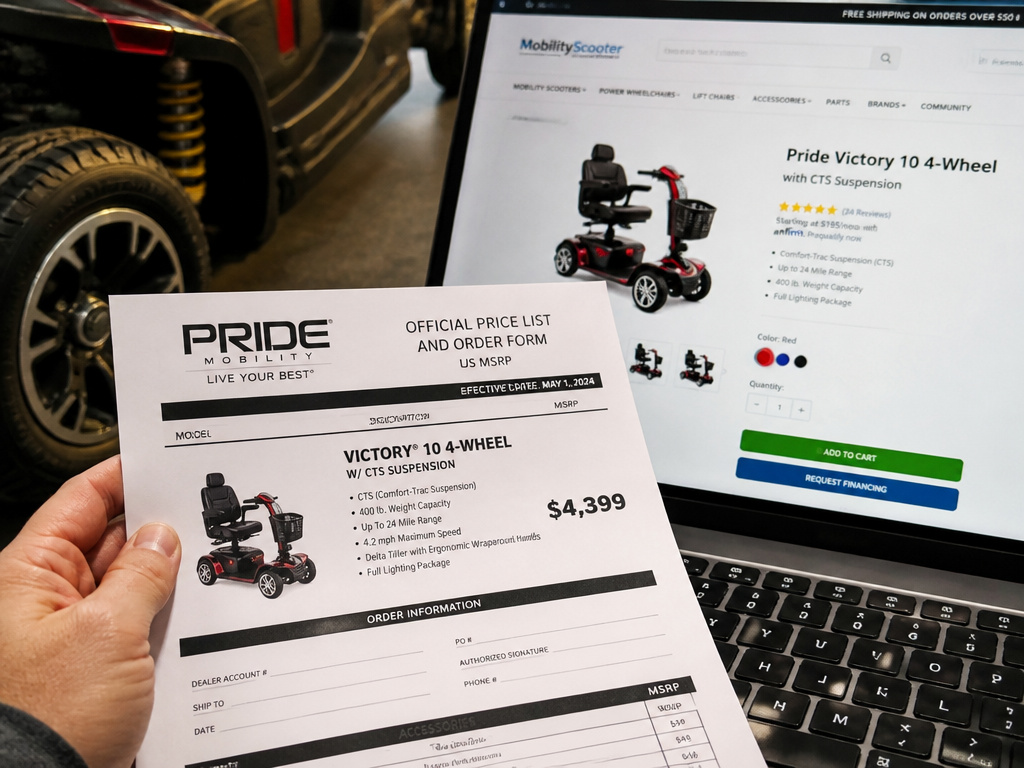
Abstract ranges are useful, but concrete numbers are better. Here are the official prices for specific models, drawn directly from manufacturer order forms and retailer price lists. This table moves from the most affordable portable option to a premium outdoor cruiser.
| Model & Type | Official Price (MSRP/Retail) | Key Specs | Who It’s For |
|---|---|---|---|
| Drive Medical Scout 3 (12AH) | $823 (Retail) | 300 lb capacity, 9-mile range, 4.25 mph | The budget-conscious buyer needing basic, portable mobility. |
| Pride Victory 10 3-Wheel | $3,011 (MSRP) | 400 lb capacity, K0801 code, foldable seat | Someone seeking a reputable mid-size scooter, possibly with insurance. |
| Golden Technologies Pioneer 3 | $3,975 (MSRP) | K0807 code, 22″ seat option | A user needing a scooter that Golden Technologies assigns code K0807, which Medicare defines for a Group 2 Heavy Duty vehicle (301-450 lbs). |
| Pride Maxima 3-Wheel | $4,536 (MSRP) | 500 lb capacity, K0802 code, depth-adjustable seat | Larger-framed users or those requiring a very heavy-duty build. |
| Pride PX4 4-Wheel | $6,730 (MSRP) | 500 lb capacity, full suspension, pneumatic tires, 8-amp charger | The outdoor enthusiast who needs comfort and capability over rough terrain. |
These prices are snapshots. The Drive Medical Scout price is a direct retail listing from a medical supplier. The Pride and Golden Technologies figures are MSRP from their 2026 order forms. The Pride Revo 2.0, for example, sits in the middle at a $2,765 MSRP for the 3-wheel model. Notice the pattern: as you move down the list, you’re paying for increased durability, comfort, and technology, not just a bigger number on the side.
The Hidden Costs Nobody Talks About
The purchase price is the first of several financial hits. The ongoing costs of scooter ownership are where many plans fall apart. They’re predictable, but only if you know to look for them.
First, battery replacement is not a matter of if but when. Sealed lead-acid (SLA) batteries, common in many models, have a lifespan of 12-18 months with regular use. A pair of U-1 AGM replacements can cost $250-$400. The Pride Maxima uses NF-22 batteries; the PX4 uses larger 75Ah batteries, which are even more expensive. Factor this in as a recurring annual or bi-annual expense.
Second, tires and wear items. Solid, flat-free tires last longer but give a harsher ride. Pneumatic tires, like those on the PX4, offer superior comfort but can puncture and require inflation. Pneumatic tires, like those on the PX4, offer superior comfort but can puncture and require replacement. Brake pads, throttle assemblies, and headlight bulbs are all consumables that wear out.
Finally, repairs outside of warranty. A reputable brand like Pride Mobility offers a longer warranty, but once it expires, repair costs add up. Once the warranty expires, repair costs for components like controllers or steering columns can add up. This is why the used market is perilous: you’re inheriting someone else’s wear-and-tear without the safety net. When reading mobility scooter reviews, pay close attention to discussions about part availability and repair costs, not just initial impressions.
Frequently Asked Questions
What is the average cost of a mobility scooter?
There is no single “average” because needs vary so widely. Portable travel scooters can start around $800, while heavy-duty, full-featured models easily exceed $4,000. The final price is drastically affected by insurance coverage, where your cost may be 20% of a lower, negotiated rate.
Will insurance pay for a mobility scooter?
It might, but strict criteria apply. Medicare Part B and many private insurers will cover a scooter as Durable Medical Equipment (DME) if your doctor documents a medical need for use inside your home. Coverage for outdoor or community use alone is often denied. The process requires a doctor’s order, a supplier’s home assessment, and prior authorization. Even with Medicare coverage, you are typically responsible for 20% coinsurance.
How much will Medicare pay for a mobility scooter?
Medicare doesn’t pay a fixed amount for a scooter. It pays 80% of the “Medicare-approved amount” for the specific HCPCS code after your Part B deductible is met. You pay the remaining 20%. This approved amount is often less than the Manufacturer’s Suggested Retail Price (MSRP). For example, if the MSRP is $3,000 but Medicare approves $2,200 for that code, Medicare pays $1,760 (80% of $2,200), and you pay $440 (20%), assuming you’ve met your deductible.
Can seniors get a free mobility scooter?
There is no universal free scooter program from the government or Medicare. However, some state Medicaid programs, veterans’ benefits, or local non-profit organizations may offer assistance or loaner programs. Be extremely wary of any advertiser or supplier offering a “free” scooter; these are often scams that exploit Medicare billing fraud. For legitimate pathways, research how to get a free scooter through verified charitable programs.
Before You Go
The real answer to “how much is a mobility scooter?” is a formula: (Sticker Price) – (Insurance Adjustment) + (Long-Term Ownership Costs). The MSRP on an order form is a conversation opener, not a closing argument.
Your first step shouldn’t be browsing prices online. It should be a conversation with your doctor about medical necessity and a call to your insurance provider to understand your DME coverage specifics. Know that a scooter with a 400-lb capacity might be labeled with a code Medicare reserves for 300-lb units, that disconnect can cost you.
If you’re paying out-of-pocket, weigh the initial savings of a cheap or used model against the near-certainty of a $400 battery replacement within the first year. Sometimes, the best mobility scooter for your budget is the one whose long-term costs you’ve actually budgeted for, not the one with the lowest sticker price. Your mobility is an investment, not just a purchase. Plan for the full distance.
