How to Make Electric Scooter Faster: The Free Tweaks First
This post contains affiliate links. As an Amazon Associate, we earn from qualifying purchases.
To make an electric scooter faster, you work within three constraints: physics, law, and your wallet. The free gains come from optimizing tire pressure, reducing weight, and removing brake drag. Real speed increases require matching hardware upgrades, higher-voltage battery, compatible high-wattage motor, and a beefier speed controller, which voids warranties, changes the vehicle’s legal class, and introduces new failure risks. The UK’s TRL Limited found motor size is the strongest predictor of acceleration, with 500W scooters accelerating about 2 m/s² faster than 250–350W devices.
That motor-power gap explains why simply removing a software speed limiter often disappoints. The limiter is there because the hardware, motor windings, controller current limits, battery discharge rate, has a physical ceiling. Pushing past it with firmware alone asks components to run beyond their design spec, which is how motors overheat and controllers burn out. A common question is how to make electric scooter faster.
What follows is a map of the territory, from the free and safe tweaks to the full-system rebuilds for anyone asking how to make electric scooter faster. We’ll ground each step in published data, name the specific risks, and show where the upgrade path crosses from a scooter into a different legal vehicle.
Key Takeaways
- Motor power dictates acceleration. A UK study found 500W scooters accelerated ~2 m/s² faster than 250–350W models; hardware sets the limit for what software can do.
- For a free speed bump, add 3–5 PSI over the recommended tire pressure. The Escooternerds manual notes this trade-off: you gain top speed but lose some traction and ride comfort.
- Speedometer readings are optimistic. The same TRL study found scooters over-read true speed by 2.5–5 km/h, with a mean over-read of 15%, your display says 25 mph, physics says 21.
- Upgrading one component in isolation usually breaks something else. A higher-voltage battery needs a compatible controller and motor; mismatching them is a reliability and fire risk.
- Exceeding 20 mph often changes the legal class of your vehicle in the US, potentially requiring registration, insurance, and a motorcycle license.
The Free (and Safe) Speed Tweaks
These methods cost nothing, void no warranties, and keep your scooter legal, addressing the basic how to make electric scooter faster question. They work by eliminating drag and optimizing what you already have. They’re also the first thing you should do before spending a dime, a surprising number of “slow” scooters are just poorly maintained.
The Tire Pressure Sweet Spot for Speed
Tire pressure is a direct trade between grip and rolling resistance. Under-inflated tires deform more, creating a larger contact patch and more drag. The UK’s Transport Research Laboratory (TRL) found privately owned scooters in their survey had pneumatic tires under-inflated by an average of 55%. That alone kills top speed.
For higher speeds, add about 3-5 PSI to recommended tire pressure. . Escooternerds, Electric Scooter Garage Manual
The manual gives a clear rule: for more traction, subtract 3–5 PSI; for higher speeds, add 3–5 PSI. It also adjusts for rider weight and weather: lighter riders may want to reduce tire pressure by 3-5 PSI; heavier riders should add 3-5 PSI. In hot weather (32°C / 90°F or hotter), reduce tire pressure by 2–3 PSI.
Check pressure before every ride. A digital gauge is more reliable than the stick-type ones bundled with pumps. A difference of a few PSI is a tangible change in how the scooter rolls and how fast it coasts.
Shedding Weight and Checking Brakes
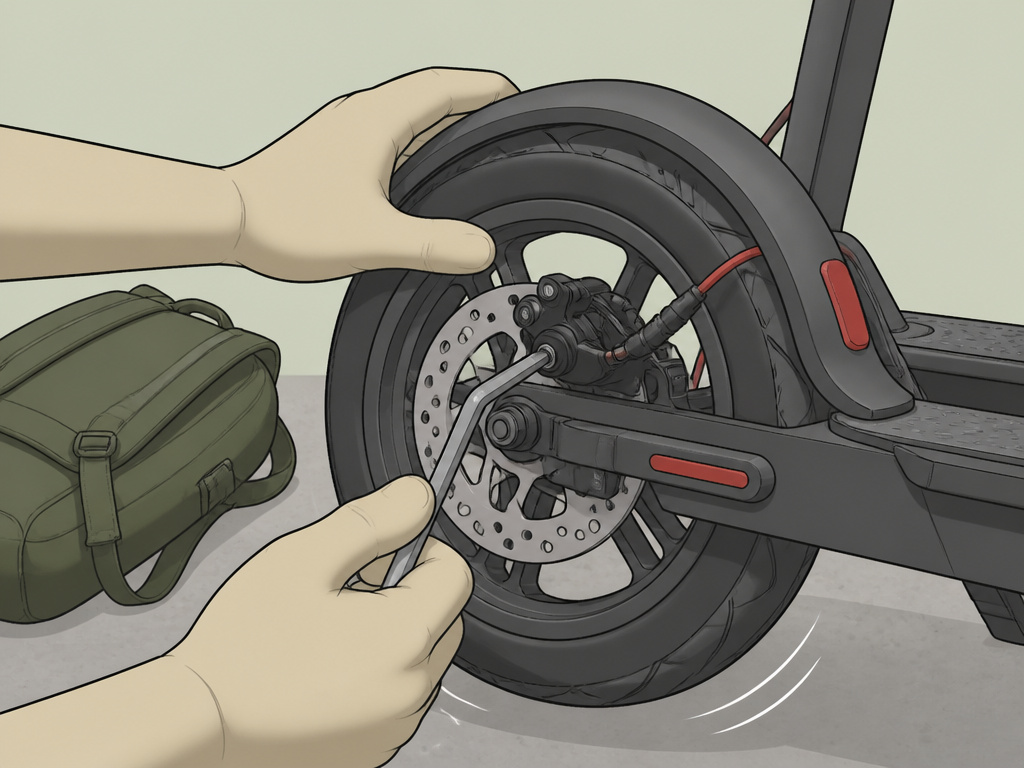
This isn’t about you going on a diet. It’s about the stuff you carry. A heavy backpack adds inertial mass the motor must overcome. The TRL report noted that increasing rider mass produced “inconsistent variations to acceleration,” but the principle is solid: less mass means the same power yields higher acceleration.
Next, spin the wheels by hand. They should rotate freely with only the faintest magnetic drag from the motor. If you hear a grinding sound or feel a gritty resistance, your brakes are dragging. A dragging brake is a constant power drain. The TRL survey of donated scooters found over 50% had brakes or steering in unserviceable condition. That’s an extreme case, but even slight drag costs speed.
Common mistake: Ignoring a slight brake drag. The constant friction robs top speed and range, and the brake pads wear unevenly, leading to a full failure within weeks.
The fix is usually simple: adjust the brake cable tension or re-center the caliper. If your scooter has a foot brake (the rear fender that presses against the tire), make sure it’s not bent and touching the tread.
The Full Charge Advantage and Riding Posture
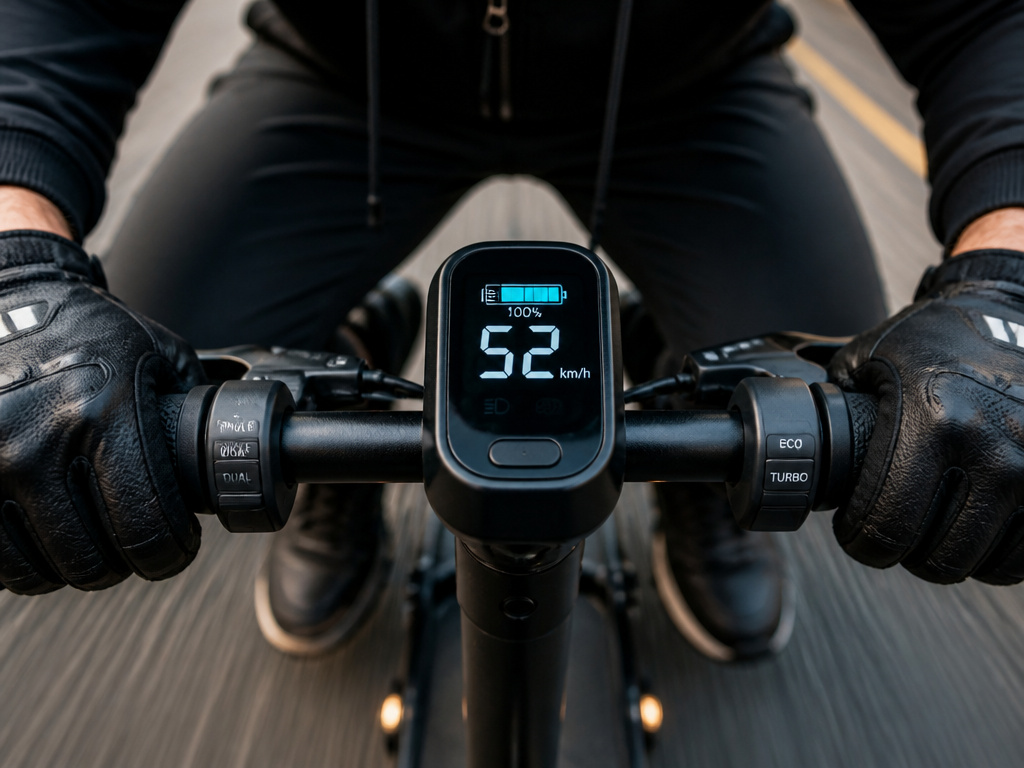
A lithium-ion battery delivers its highest voltage when fully charged. As it discharges, voltage sags, which can reduce the power available to the motor, especially at the top end. The Escooternerds manual advises completing your ride with at least 15% battery life instead of draining it completely, but for a speed run, start at 100%.
Posture is aerodynamics 101. Crouching reduces your frontal area. It looks silly on a scooter, but it works. Tuck your elbows in, bend your knees, and get low. The difference might be small, but it can help close the gap between a scooter’s claimed and actual speed.
The Hardware Upgrade Path
This is where you leave the free zone and enter the world of warranties voided, legal classifications changed, and real technical risk. Every modification here should be preceded by one question: would it be cheaper and safer to sell your current scooter and buy a faster one? For many people, the answer is yes.
Understanding the Powertrain Trinity
An electric scooter’s speed is governed by three linked components: the battery, the speed controller, and the motor. They must be matched. Upgrading one without considering the others invites failure.
| Component | Role in Speed | Upgrade Risk |
|---|---|---|
| Battery | Supplies voltage & current. Higher voltage can spin the motor faster. | Over-volting a stock controller can cause it to overheat and fail. Fire risk if cells are unbalanced or poor quality. |
| Speed Controller | Regulates power from battery to motor. Sets current limits and RPM ceiling. | A mismatched controller can fry a motor or battery. Proprietary controllers may not work with aftermarket parts. |
| Motor | Converts electrical power to wheel rotation. Wattage and winding design limit top RPM. | A higher-wattage motor draws more current. Paired with a weak battery or controller, it will underperform or burn out. |
The controller is the brain. It decides how much power the motor gets. Many scooters have a software or region-based speed limiter set well below the motor’s physical capability. Removing it via an app or custom firmware is a common first mod. It works, until it doesn’t. The controller and motor are still rated for a specific continuous power. Sustained operation above that rating generates heat, and heat degrades magnets, windings, and electronics.
Motor Wattage: The Acceleration Multiplier
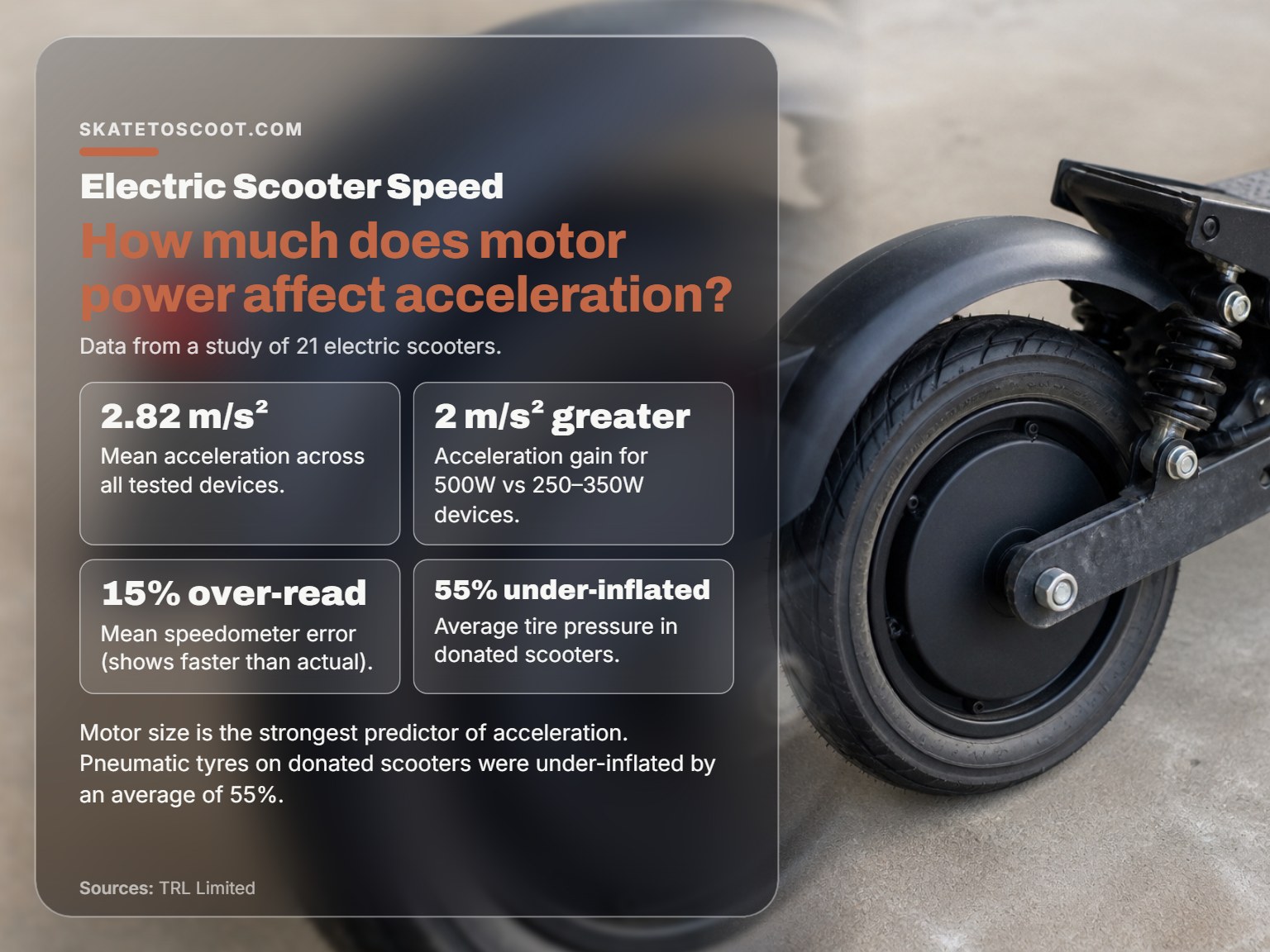
If you want to know how fast a scooter can be, look at the motor wattage first. The TRL Limited study tested 21 privately owned scooters and found motor size was the strongest predictor of acceleration. Their data showed 500W devices had a mean acceleration approximately 2 m/s² greater than 250–350W devices. The mean acceleration across all tested devices was 2.82 m/s².
The extra wattage lets it overcome resistance earlier in the acceleration phase, which is why the speed difference feels more pronounced from a stop.
Upgrading a motor means more than swapping in a higher-wattage unit. You need a compatible speed controller that can deliver the required current and a battery that can supply it without sagging. This is a job for a custom scooter build, not a simple bolt-on. You’re also moving from brushed DC motors (common on older, toy-grade scooters) to brushless DC (BLDC) scooter motors, which are more efficient but require more sophisticated controllers.
Battery Voltage: The RPM Ceiling Raiser
Motor RPM is directly proportional to voltage. A 36V motor spins faster on a 48V battery, in theory. In practice, the motor’s windings, the controller’s voltage tolerance, and the battery’s management system (BMS) all have limits.
- The Drive notes that many countries limit scooters to a maximum power output of 200 watts, which it states is “normally good for 15 mph at a maximum.” Kick & Volt, however, places 15-20 mph “inside the scooter definition essentially everywhere in the US.”
- Kick & Volt places 15-20 mph “inside the scooter definition essentially everywhere in the US.”
Pushing a scooter past 20 mph, especially via a battery voltage increase, often moves it into a different legal category (moped or motorcycle), with implications for licensing, insurance, and where you can ride it. Machines like the Kaabo King GTR (66 mph) and Solar Hyperion RST (57.5 mph) are designed as high-performance vehicles from the ground up, with brakes, frames, and tires to match. Retrofitting those capabilities is rarely successful or safe.
Reality Checks: What the Data Says About Modified Speed
Modifications exist in a world of marketing claims, forum anecdotes, and sparse independent testing. Two data points cut through the noise: speedometer inaccuracy and the real-world condition of privately owned scooters.
Your Speedometer Is Lying to You
You think you’re going faster. The numbers say you are. Physics disagrees. The TRL study instrumented scooters with GPS and found all tested devices overstated true speed.
- Speedometer over-read was 2.5–5 km/h.
- Actual peak speeds were 1.5–11 km/h lower than manufacturer-stated maximums.
- The mean over-read was 15%.
If your display reads 25 mph, you’re likely traveling closer to 21 mph, given the mean speedometer over-read was 15%. A modification that adds speed might result in a smaller true increase than the speedometer indicates, due to its inherent over-read. This illusion of progress is a powerful motivator and a common pitfall.
The Maintenance Baseline Most Riders Miss
Before you modify for more speed, ensure your scooter is delivering its stock performance. The TRL survey of donated private scooters is a sobering read:
-
50% had brakes or steering in unserviceable condition.
- 40% had broken/missing rear mudguards (often taking the rear light with it).
- Pneumatic tires were under-inflated by an average of 55%.
A scooter in this state won’t benefit from a motor upgrade. It will be unpredictable and dangerous at any speed. The study also compared brake types: devices with disc brakes produced slightly higher decelerations than drum brakes. If you increase speed, your braking distance increases exponentially. Better brakes are not an optional upgrade; they are a mandatory safety requirement.
Using performance firmware/custom software
Installing custom firmware can remove manufacturer-imposed speed limits and increase motor power output, but it comes with significant risks. This process directly alters the scooter’s controller software, which can lead to overheating, reduced component lifespan, and voided warranties. Published findings show that motor size is the strongest predictor of acceleration, with higher-wattage motors delivering substantially better performance. Before considering software tweaks, understand that pushing a small motor beyond its design limits is a primary cause of failure. This upgrade crosses into a legal gray area, as it often creates a vehicle that exceeds local power and speed definitions for electric scooters.
Frequently Asked Questions
How do I increase the speed of my electric scooter?
Start with the free methods: inflate tires to the high end of their recommended pressure (add 3-5 PSI), ensure brakes aren’t dragging, ride with a full battery, and adopt an aerodynamic posture. For a significant increase, you must upgrade the motor, battery, and controller as a matched set, a complex, expensive project that changes the scooter’s legal classification and voids all warranties.
How do I remove the speed limiter on an electric scooter?
Many scooters have a software limiter set in the firmware or region settings. Removal methods vary by brand and model: some use smartphone apps, others require physical dongles or accessing a hidden menu. This almost always voids the warranty. Crucially, the limiter is often set at or near the hardware’s safe maximum; removing it may not increase speed much but will increase heat and stress on components.
Do electric scooters have a speed limiter?
Yes, most consumer electric scooters have at least one speed limiter. There are typically two types: a hardware limiter set by the controller’s programming and a software/region limiter intended to comply with local laws (e.g., 15.5 mph / 25 km/h in many regions). The hardware limiter protects the motor and battery from damage; the software limiter is for legal compliance.
Will a bigger battery make my scooter faster?
Not directly. A bigger battery (higher capacity) adds range, not speed. A higher-voltage battery can increase motor RPM and thus top speed, but it requires a compatible speed controller and motor that can handle the increased voltage. Using a higher-voltage battery on stock components usually results in component failure.
Is it legal to make an electric scooter faster?
It depends entirely on your local laws and how fast the scooter ends up. In the US, most states define “electric scooter” or “low-speed electric bicycle” with specific speed and motor power limits (often 20 mph and 750W). Modifying your scooter to exceed those limits may reclassify it as a moped or motorcycle, requiring registration, insurance, a license, and possibly making it illegal to ride on bike paths or sidewalks.
The Bottom Line
Making an electric scooter faster is a puzzle with pieces labeled physics, law, and money. The free tweaks, tire pressure, brake drag, riding posture, are worth doing because they return your scooter to its designed performance. They highlight a truth: many scooters are slow because they’re poorly maintained, not underpowered.
The hardware upgrade path is a different game. It turns a consumer product into a project vehicle. The data shows a 500W motor accelerates about 2 m/s² harder than 250–350W devices, a real, measurable difference. But achieving that safely means matching a battery, controller, and motor, then upgrading brakes and possibly the frame. The total cost and effort often exceed the value of the original scooter.
Here’s the pragmatic choice: if you want a scooter that goes 25 mph, buy one designed and certified for that speed, like models from our list of the fastest scooters. Its brakes, tires, and frame will be rated for the task. If you want a project and accept the risks, start with a DIY scooter build from the ground up. Modifying a finished consumer product to be something it wasn’t designed to be is the most expensive and riskiest path of all.
