How to Switch Modes on Hoverboard: A Brand-by-Brand Guide
This post contains affiliate links. As an Amazon Associate, we earn from qualifying purchases.
To switch modes on a hoverboard, press the power button a specific way after turning it on, but the exact procedure changes by brand. For a Jetson Strike, stand it upright first. For a Swagtron T6, a second quick press changes Learning and Standard modes, but Advanced Mode needs the app. Most boards beep to confirm the switch.
That beep is your only audible confirmation. Miss the timing by a second, hold the button a hair too long, or have the board in the wrong position, and nothing happens. You’re left guessing if it worked. This is why knowing how to switch modes on hoverboard is critical.
What follows is a breakdown of the four major brand families. Jetson, Swagtron, Hoverzon, and Razor, with their exact button sequences, the quirks that break them, and what the different modes actually do for your ride. By the end, you’ll know why a “simple button press” is anything but.
Key Takeaways
- The button-press timing is critical; on most models, you must press a second time within a few seconds of powering on.
- Board orientation matters: The Jetson Strike requires an upright position, while others need the board flat.
- Advanced Mode on the Swagtron T6 is app-only; you cannot activate it with the physical button.
- Hold the button too long on a Hoverzon, and you’ll trigger calibration mode, forcing you to complete that process before trying again.
- Confirmation beeps or lights are your signal; if you don’t hear or see one, the mode didn’t change.
The Button-Press Procedure Isn’t Universal
Here’s an important clarification. Every guide says “press the button.” They’re not wrong, but they’re missing the specifics that make it work or fail. The core action in the how to switch modes on hoverboard process is a quick, second press of the power button shortly after turning the board on. But the devil is in the details your manual assumes you’ll read.
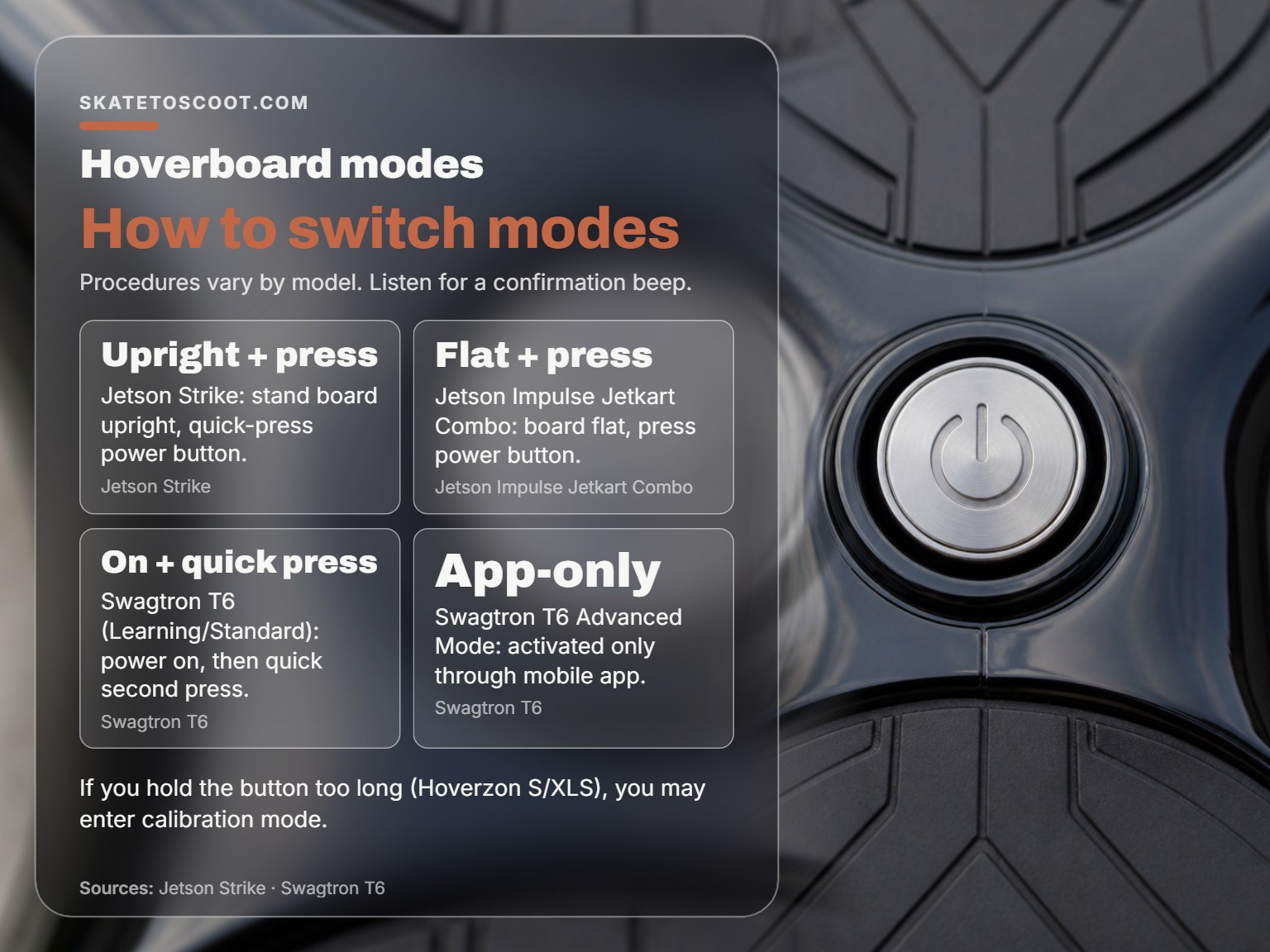
For most hoverboards, changing modes requires powering on, then quickly pressing the power button a second time. A confirmation beep will sound. If you press too slowly or hold the button, the attempt fails or triggers a different system function.
First, power on the board. Listen for the startup chime. Now, quickly tap the power button again. Don’t press and hold, tap. You should hear a distinct beep. That’s your success signal. No beep means you were too slow, or your board has a different rule.
Why the Same Action Doesn’t Work on Every Board
Here’s where the standard advice fractures. Manufacturers build different logic into that button press. It’s not a flaw; it’s a design choice that creates four distinct procedures.
| Brand & Model | Key Difference | Mode Switch Procedure | Success Signal |
|---|---|---|---|
| Jetson Strike | Board must be upright | Stand board vertically, power on, quick-press button. | (Per manual; likely beep/light) |
| Jetson Impulse Jetkart Combo | Board must be flat | With board flat, power on, quick-press button. | (Per manual; likely beep/light) |
| Hoverzon S/XLS | Risk of calibration mode | Power off, then power on and quickly press button a second time. | A confirmation beep. |
| Swagtron T580 / T6 (Learning/Standard) | Standard timing | Press power to power on, quickly press power a second time. | A confirmation beep. |
The Hoverzon S/XLS manual warns that if the power button is held too long during a mode-switch attempt, you may unintentionally enter calibration mode. If that happens, you must complete the calibration process before you can turn it off and try the mode switch again. It’s a frustrating detour born from a half-second of extra pressure.
For the Swagtron T6, that button sequence only toggles between Learning and Standard modes. Its Advanced Mode can only be activated through the Swagtron mobile app. You connect via Bluetooth (the default password is 000000), and the app activates the top speed tier. No amount of button pressing will get you there.
How to Ride Faster (and Slower) Inside Any Mode
Switching modes changes the ceiling, but your body controls the throttle. Every modern hoverboard uses gyroscopes and weight-shift sensors. Leaning forward doesn’t just suggest speed; it commands it.
On a Jetson, you lean or tilt your body slightly forward and put pressure on the front of your foot while moving to go faster. To slow down, pull your shoulders back and stand upright, centering your weight over the board. The board senses these shifts.
The Swagtron T580 manual quantifies it: shift your weight forward about 10º to move ahead. Shift back 10º to reverse. It’s a small, deliberate lean, not a dramatic lunge.
When paired with a Jetkart, the handles become your control. Pushing down (forward) on them increases speed; pulling up (backward) slows you down. It’s the same weight-transfer principle, just mapped to your hands.
The Hidden Limiter: Beginner or Practice Mode
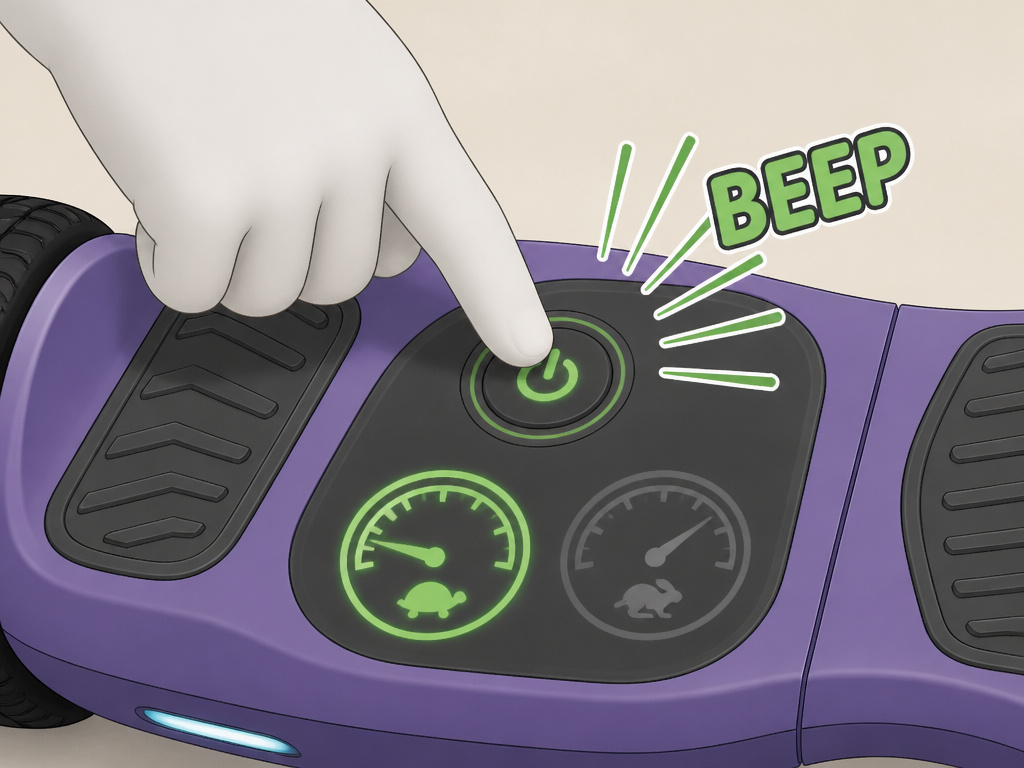
Most boards have a beginner-friendly mode with a hidden governor. It doesn’t just cap top speed; it can slow the board’s response time “just by a hair,” as one Reddit user described it. This artificial lag gives new riders a larger window to correct balance. The trade-off is a feeling of dullness, like riding through thick mud.
Hoverzon calls this Practice Mode, which “limits the board’s maximum speed.” Swagtron T580 has Learning Mode that “governs the maximum speed.” They’re the same idea: a software cap for safety.
The problem is the lack of a clear indicator for the how to switch modes on hoverboard process. You might not know which mode you’re in without feeling the difference. The fix is the same button press. Trust the beep.
What the Modes Are Actually Called (And What They Do)
The names vary, but the purpose splits into two or three tiers. It’s not just “slow” and “fast.” Each mode is a preset collection of limits.
- Practice / Learning Mode: This is for first-timers. It imposes a maximum speed limit and may soften the motor response for gentler acceleration and braking. Use this on your first dozen rides.
- Standard Mode: This removes the beginner restrictions. The board will reach its advertised top speed and respond directly to your weight shifts. This is for riders who have their balance.
- Advanced / Expert Mode: Found on higher-end models like the Swagtron T6, this activates the board’s full performance potential, often pushing speeds toward 12 mph or more. It demands full control.
Switching from Practice to Standard mode isn’t just about going faster. It’s about the board trusting your inputs more. The transition can feel abrupt, which is why I tell new riders to spend a full battery cycle in Practice Mode before even thinking about the switch.
Troubleshooting a Mode Switch That Won’t Work
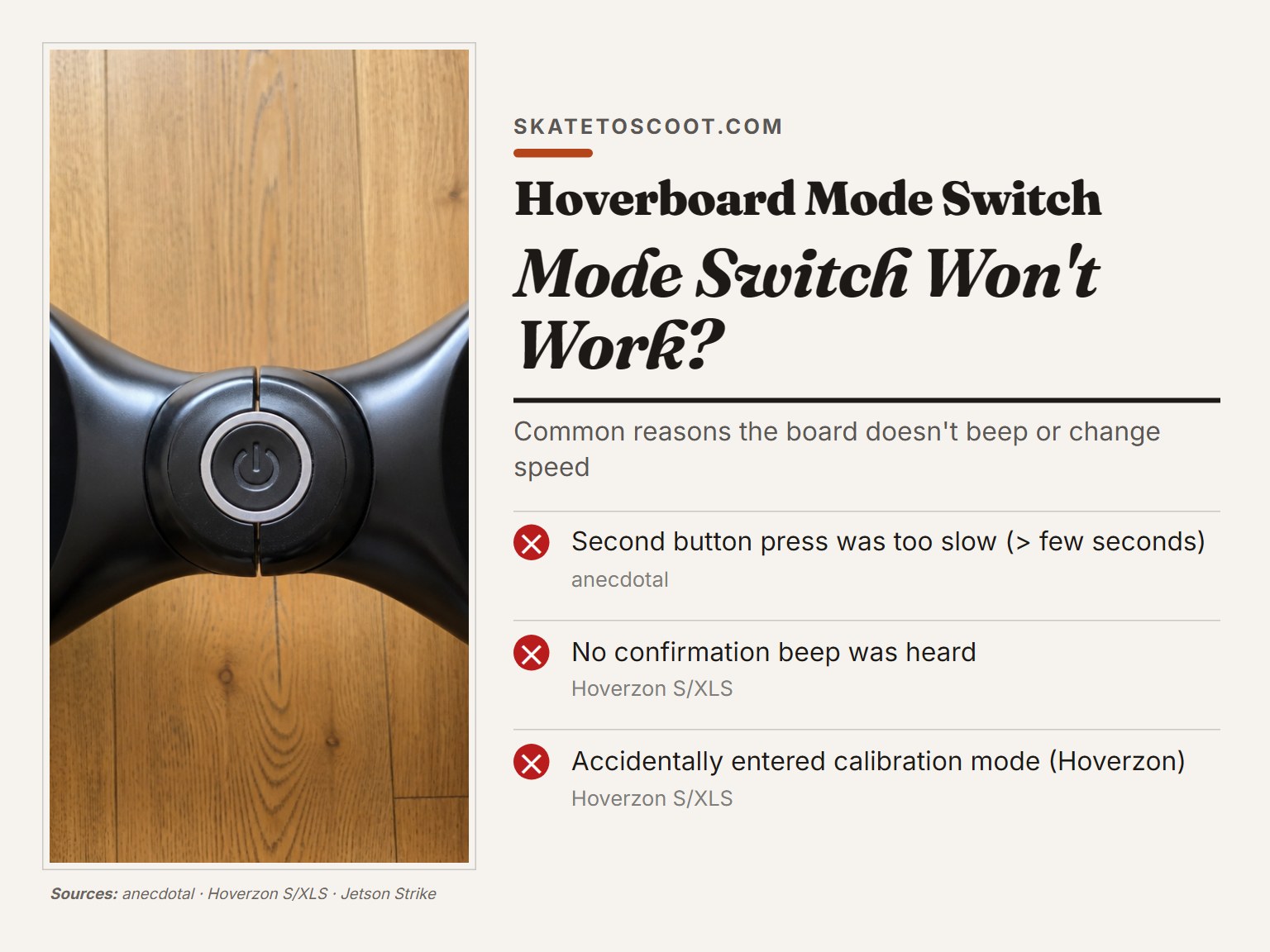
You followed the steps. No beep. The board just acts normal. Before you decide it’s broken, run through this checklist. These are the common failures I’ve seen skaters and new owners hit every time.
- Check the board’s orientation. Is it flat? The Jetson Strike is the glaring exception, it must be upright. Getting this wrong guarantees failure.
- Review your timing. The second press must come within a few seconds of powering on. Wait too long, and the board exits the mode-switch window. Power off completely and start over.
- Listen for the beep. This is essential. If you didn’t hear it, the mode didn’t change. Don’t assume.
- Beware of calibration mode. If you held the button a touch too long on a Hoverzon, you might be in calibration. The manual is clear: you must complete the calibration before trying again.
- Ensure the battery is charged. A low battery can cause all sorts of glitchy behavior, including unresponsive buttons.
If you’ve checked all this and it still fails, the issue might be a faulty button or a software glitch. That’s when you contact the manufacturer’s support. Many “broken” mode switches are just a missed step from this list.
Charging, Storage, and Conflicting Battery Advice
Your hoverboard’s ability to switch modes depends on a healthy battery. Here’s where manufacturer advice clashes with general battery science.
The Swagtron T580, T6, and Hoverzon S/XLS manuals all instruct you to fully charge the battery before storing the unit, while general lithium-ion best practice recommends storing at a ~40-60% state of charge for long-term health. Their goal is to prevent over-discharge during long idle periods, which can kill a lithium-ion pack.
However, general lithium-ion best practice from battery experts recommends storing at a ~40-60% state of charge for long-term health. A full charge at high voltage stresses the battery chemistry over months of storage.
So who’s right? Follow your manual for short-term storage (a few weeks). The manufacturer’s guidance is designed to prevent a completely dead board when you next grab it. For seasonal storage over several months, the expert 40-60% rule is better for the battery’s lifespan. It’s a direct contradiction you have to live with.
One absolute rule from the Razor Hovertrax 1.5 manual: “Do not charge at or below 32°F (0°C).” Charging a frozen battery can cause permanent damage. Let the board warm up to room temperature first.
How to Connect and Use the Swagtron App for Advanced Mode
For the Swagtron T6, Advanced Mode can only be activated through the Swagtron mobile app, not via the physical power button.
- Power on your T6.
- On your phone, enable Bluetooth and search for devices.
- You’ll see a device named “Swagtron”. Select “Swagtron” to connect for control.
- When prompted, enter the default password: 000000.
- Open the Swagtron app. The interface should show your board’s battery status and a mode selector.
- Select Advanced Mode.
The board will acknowledge the change. Now, your button presses will cycle between Learning and Standard modes. It’s a permanent activation for that session.
How to tell what mode your hoverboard is in
Most hoverboards use audible beeps rather than specific indicator lights to signal a mode change. For example, both the Hoverzon S/XLS and the Swagtron T6 emit a distinct confirmation beep when the mode successfully switches. This is your primary audio cue. You should rely on the board’s behavior and confirmation beeps to identify the mode. A beginner or practice mode will limit the board’s top speed and may slightly slow its response time. Standard mode removes these restrictions for a faster ride. If you hear the beep after the button sequence, you have changed modes; test the board’s acceleration in a safe area to confirm which one you’re in.
Frequently Asked Questions
How do you cut the speed limiter on a hoverboard?
You don’t “cut” a physical limiter. The speed is governed by software modes. Switching from Practice/Learning Mode to Standard or Advanced Mode electronically removes the software speed cap. On some models like the Swagtron T6, this requires a mobile app.
How do I make my hoverboard go faster?
First, ensure you’re in Standard or Advanced mode. Then, use your body: on a Jetson, lean forward with pressure on your front foot. On a Swagtron, shift your weight forward about 10 degrees. Pushing the handles forward on a Jetkart attachment also increases speed. Rider weight and smooth terrain are key to reaching top speed.
What’s the fastest speed a hoverboard can go?
Most consumer hoverboards have a maximum speed in their top mode (e.g., Swagtron T6 Advanced Mode). Performance varies by model, rider weight, battery charge, and terrain. The advertised top speed is usually a best-case scenario on flat, smooth pavement.
How do I control the hoverboard?
Control is through weight distribution. Lean forward to go forward, lean back to reverse or slow down. To turn, apply slightly more pressure on the foot in the direction you want to turn (left foot for left turn). The gyroscopes and sensors translate this into motor commands.
Before You Go
The one rule that overrides all others: find your manual. The exact steps for your Jetson, Swagtron, or Hoverzon are in there, and they differ just enough to matter. That document also holds the specific warnings, like the Hoverzon’s calibration trap or the Swagtron’s app requirement, that generic guides always miss.
If you’re buying used and the manual is gone, search the brand’s support site with your model number. A five-minute download can save you an hour of frustrated button-pressing. Once you’ve mastered the mode switch, you can focus on the real skill: using your weight to balance a hoverboard smoothly and safely. From there, learning to ride a hoverboard confidently opens the door to more advanced fun, and maybe even trying some cool hoverboard tricks. And if the standard performance isn’t enough, remember you can always customize your hoverboard with new wheels, lights, or grips to make it truly yours.
