iScooter i10 Review: Range, Speed, and Model Differences
This post contains affiliate links. As an Amazon Associate, we earn from qualifying purchases.
The iScooter i10 is a 650W commuter scooter with a claimed 28-mile range and a 25 mph top speed. Real-world testing shows a range of 20-25 miles for most riders, with the 25 mph speed often requiring a limiter removal via a 5-button-press sequence. Its 10-inch pneumatic tires and front/rear suspension provide a stable ride, but long-term durability issues with tires and motor heat are common owner complaints.
That gap between the marketing sheet and the parking lot is where you decide if a scooter is worth it. The i10 sits in a crowded bracket, decent power, a folding frame, a price that looks good on a screen. The question isn’t whether it can hit 25 mph on a fresh charge. It’s whether the motor stays cool, the tires last past 250 miles, and the range holds up after six months of daily commutes. This is the core of any honest iscooter i10 review.
What follows: a breakdown of the specs you’ll actually feel, the maintenance nobody mentions until something breaks, and the critical differences between the i10, i10 Pro, and i10 Max that most listings blur together in an iscooter i10 review. By the end, you’ll know exactly what you’re getting into, and what to check before you ride.
Key Takeaways
- Real-world range is 20-25 miles, not the advertised 28 miles, plan your commute around 20 miles to avoid a dead battery.
- Activate the 25 mph speed limiter by holding the brake and pressing the power/mode button exactly 5 times; the default is often 15.5 mph.
- The i10 Pro and i10 Max use different hardware: the Pro has a 48V battery and 800W peak motor, while the base i10 uses a 42V system and 650W motor.
- Tire wear is a known issue, some owners report wear to the tread wear indicators (TWIs) within 250 miles; keep a patch kit handy.
- Motor and tire heat are normal after long rides, but a motor that’s too hot to touch indicates potential overheating on repeated hard use.
The Real-World Range Gap
The website says up to 28 miles. The manual says 25-28 miles. In the driveway after a week of commuting, a typical iscooter i10 review will show you 20-25. That drop isn’t a defect; it’s physics. Rider weight, hills, wind, and how often you use the throttle change the math. A Reddit owner with the i10 Max reported getting 30-32 miles on eco mode, which limits top speed, but added that aggressive riding cut that number significantly.
Where this goes sideways: Assuming the advertised range is your daily distance. If your commute is 12 miles each way, the i10 will make it, but with single-digit battery left, and that margin shrinks every time you accelerate hard or climb a hill.
The battery is a 42V 15Ah unit in the base i10, which iScooter says charges in 6-8 hours. A full charge overnight is the standard move. Higher voltage usually means more power, but it also means you can’t swap chargers between the 42V and 48V models.
| Range Factor | Effect on Advertised 28-Mile Range | Why It Happens |
|---|---|---|
| Rider Weight (over 200 lbs) | Reduces by 4-6 miles | Motor works harder on acceleration and hills. |
| Riding Mode (Sport vs. Eco) | Eco adds 3-5 miles; Sport cuts 5-7 miles | Sport mode uses full motor power constantly. |
| Hill Climbing (15-20° incline) | Cuts 1-2 miles per sustained climb | Motor draws peak amps to maintain speed. |
| Tire Pressure (below 30 PSI) | Reduces by 2-3 miles | Increased rolling resistance. |
| Cold Weather (below 50°F / 10°C) | Can cut 3-5 miles | Lithium battery chemistry is less efficient. |
Keep the tires at 30 PSI, the sidewall says that’s the max, and running them soft kills range and wears the tread fast. Check them every two weeks with a gauge, not your thumb. A bicycle patch kit fixes most flats, and knowing how to use it beats waiting for a replacement tube.
Speed, Power, and That Hidden Limiter
The i10’s 650W rear hub motor is enough. It pulls you from a stoplight at a pace that holds 20 mph on flat pavement without strain. The claimed 25 mph top speed is real, but there’s a catch: it’s often locked behind a software limiter set to 15.5 mph out of the box.
Activating the full speed isn’t in the quick-start guide. Owners found the sequence: hold the left brake lever, then press the power/mode button on the handlebar exactly five times. The display will flash, and your top speed in sport mode jumps from 15.5 to 25 mph. Do this in a safe, open area first, the acceleration change is noticeable.
The iScooter i10 uses a brushless rear hub motor rated at 650W continuous power. The motor drives the rear wheel directly, providing torque for hill climbing and acceleration through four selectable speed modes controlled via the handlebar display.
The i10 Pro model, according to its EU manual, uses an 800W peak (600W rated) motor paired with a 48V battery. That’s a different scooter. The extra voltage and wattage mean better hill performance and slightly higher potential top speed, though EU laws may cap it at 25 km/h (15.5 mph). If you’re looking at an “i10” and the specs mention 48V or 800W, you’re likely looking at the Pro or a Max variant.
Cruise control is included. Engage it by holding the throttle at a steady speed for a few seconds until the cruise icon appears on the display. It’s useful for long, straight paths, but disengages as soon as you touch the brake.
Ride Quality, Comfort, and Daily Usability
You feel the 10-inch pneumatic tires first. They roll over cracks and pebbles that would jar your wrists on solid rubber. The front and rear suspension, basic coil shocks, take the edge off curb drops and potholes. It’s not a cloud, but for a commuter scooter under 50 pounds, it’s competent.
The deck is long enough for a comfortable stance, and the wide handlebars give good control. Folding it is straightforward: release the lever under the stem, collapse it, and secure the latch. The i10 Pro’s weight is reported as 24.45 kg (~54 lbs) in its EU manual, while the base i10 is listed as 44 lbs (20 kg) by the manufacturer, and a third-party review estimates the weight at 24–25 kg. Carry it more than a flight of stairs and you’ll feel the difference.
- Smooth acceleration from a stop, with a slight whir from the motor. A grinding noise or jerky start means a motor or controller issue.
- The suspension should compress and rebound quietly over bumps. A loud clunk means a loose bolt or worn shock.
- The brakes should bite smoothly. The rear electronic brake does most of the work; the front drum brake is for harder stops. If the lever feels spongy or the scooter doesn’t slow predictably, check for adjustment.
- The tires should look rounded and firm. Bulges, excessive wear on one side, or cords showing mean replacement is overdue.
The IP54 water resistance rating means it can handle a light drizzle and road spray. It does not mean you can ride through puddles or leave it out in the rain. Water inside the deck can damage the battery and controller. Dry the charging port thoroughly before plugging it in, the manual explicitly warns against connecting the charger if the port is wet.
Long-Term Ownership: What Breaks and What Lasts
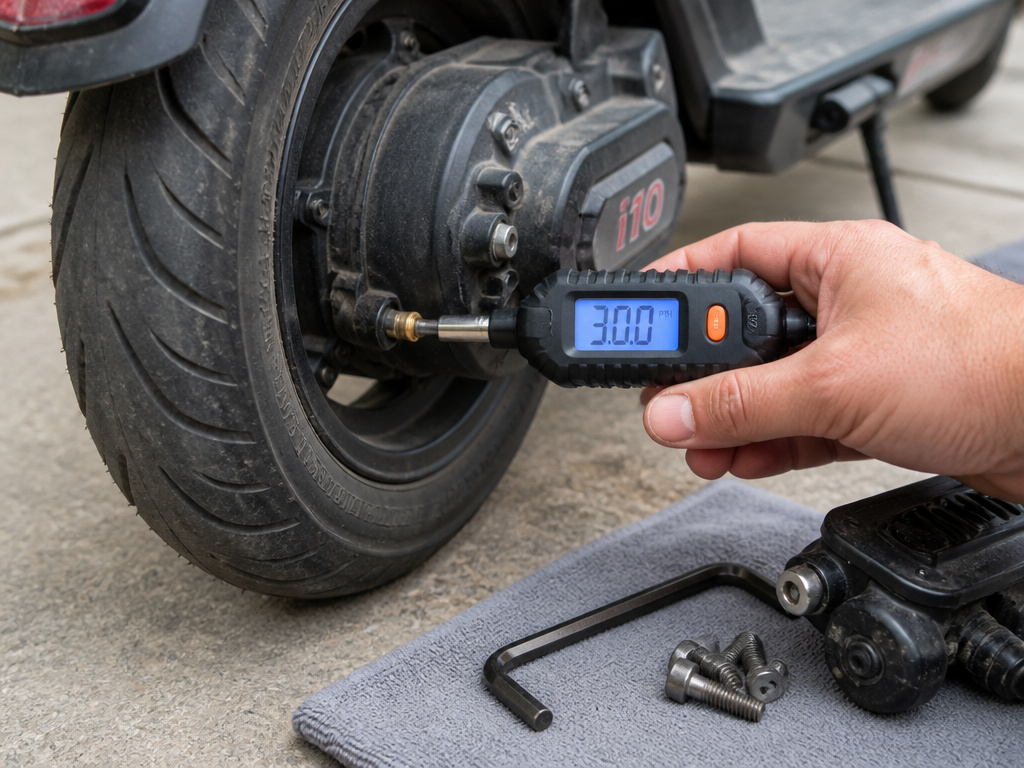
This is the section most reviews miss. They test a fresh scooter for a week. You live with it for a year. The i10’s weak points show up after the first hundred miles.
Tires wear fast. One owner reported the original tires wore down to the tread wear indicators within 250 miles. The sidewall of the i10’s tires lists a maximum pressure, which owners should follow; many scooter tires have higher pressure ratings. Softer tires wear quicker and offer less range. The fix is a tire upgrade; owners have found suitable 10-inch replacements.
Motor heat is normal. The rear motor and tire will be warm after a 30-minute ride. One Reddit user noted the motor usually runs around 80–90°C under load. If it gets too hot to touch and you smell burning, that’s a problem. Repeated overheating can degrade the motor’s magnets and insulation. Let it cool down between hard sessions.
The folding mechanism and stem bolts need checking. Vibration from riding can loosen them over time. The package includes a hex wrench and spare bolts for a reason. Give all the stem and folding latch bolts a tighten every month.
| Component | Common Issue | Owner-Reported Timeline | Fix / Prevention |
|---|---|---|---|
| Tires | Rapid tread wear, flats | 250-500 miles | Maintain 30 PSI; carry patch kit; upgrade to higher-pressure tires. |
| Motor | Overheating on long, fast rides | Within first 200 miles | Allow cool-down periods; avoid sustained top speed on hills. |
| Brakes | Spongy lever feel, reduced stopping power | 3-6 months | Adjust brake cable tension; check pad wear on drum brake. |
| Electronics | Error codes (E0, E4, E5, E6, E9) | Intermittent, often after water exposure or hard impact | Consult manual; disconnect battery for 5 minutes; contact support. |
| Suspension | Squeaking, bottoming out | 6-12 months | Lubricate pivot points; check for worn shock springs. |
Error codes appear on the display. The i10 Pro manual lists several: E0 (Over-Voltage), E4 (Accelerator Fault), E5 (Brake Lever Fault), E6 (Motor Hall Sensor Fault), and E9 (Motor Overheating). If you see one, the first step is to power off the scooter, wait a minute, and power it back on. If it persists, it’s a job for support.
i10 vs. I10 Pro vs. I10 Max: Cutting Through the Confusion
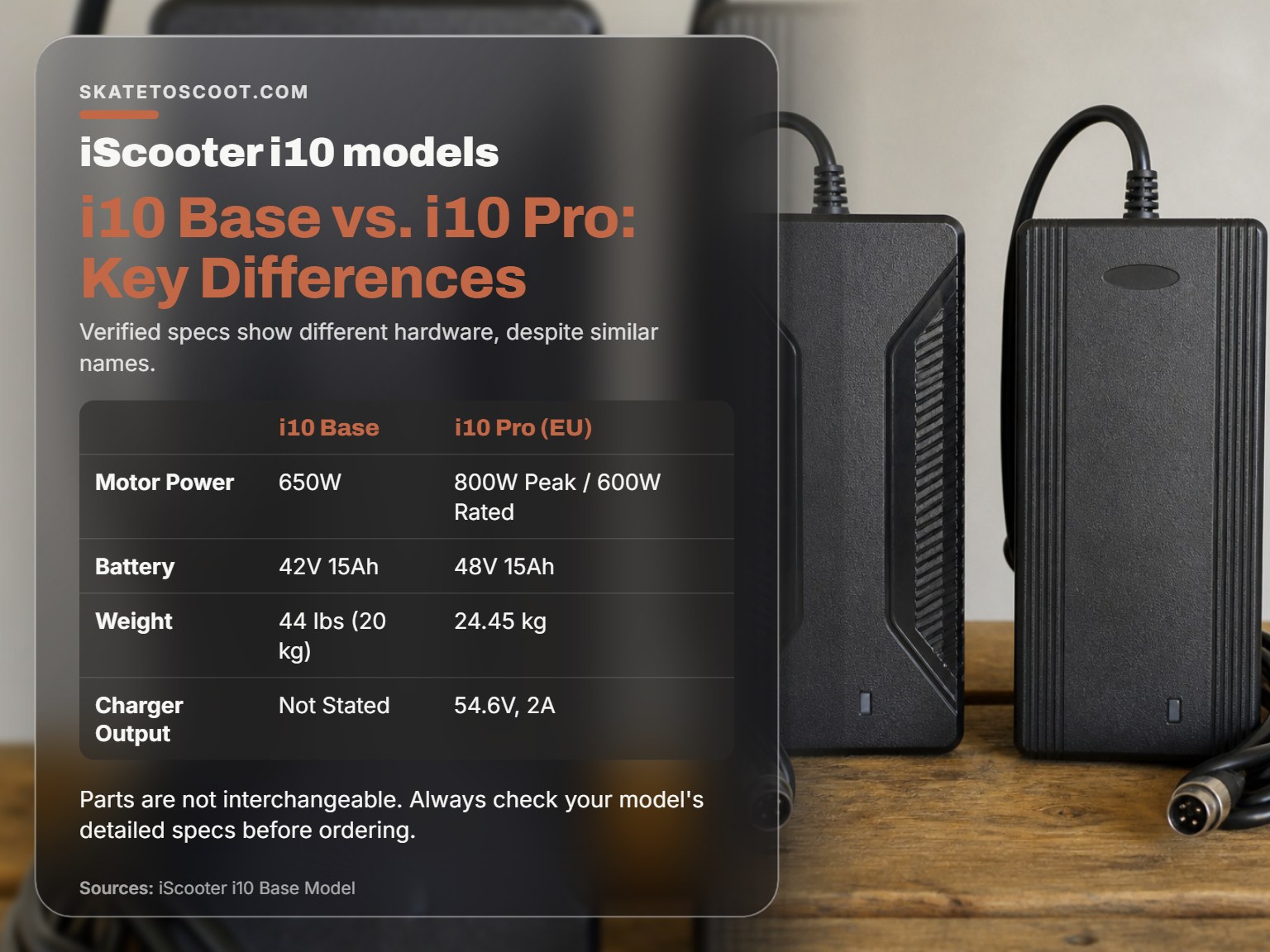
You see “i10” on a website. Is it the 650W base model, the 800W Pro, or the Max with a bigger battery? Sellers mix the names, but the hardware doesn’t lie. This table lays out the verified differences.
| Model | Motor | Battery | Weight | Key Identifiers |
|---|---|---|---|---|
| iScooter i10 (Base) | 650W | 42V 15Ah | 44 lbs (20 kg) | Listed as 650W, 42V. Charger output: 42V, 2A. |
| iScooter i10 Pro (EU) | 800W Peak / 600W Rated | 48V 15Ah | 24.45 kg (54 lbs) | Manual specifies 800W peak, 48V. Charger: 54.6V, 2A. |
| iScooter i10 Max | Likely 650W or 800W variant | Often 48V 18Ah (as per owner reports) | ~24-25 kg (53-55 lbs) | Marketed as “Max” for extended range. Battery capacity is the differentiator. |
The base i10 is the entry point. The i10 Pro is a hardware upgrade with more power. The i10 Max is marketed for extended range, but specifications vary; always check the product listing’s detailed specs. Always check the product listing’s detailed specs, not just the headline name. If it says 48V, you’re not getting the base model.
This matters for parts. A 42V battery is not interchangeable with a 48V battery. The chargers are different. Ordering the wrong part because you assumed all “i10” models are identical wastes time and money.
Maintenance You Can’t Skip
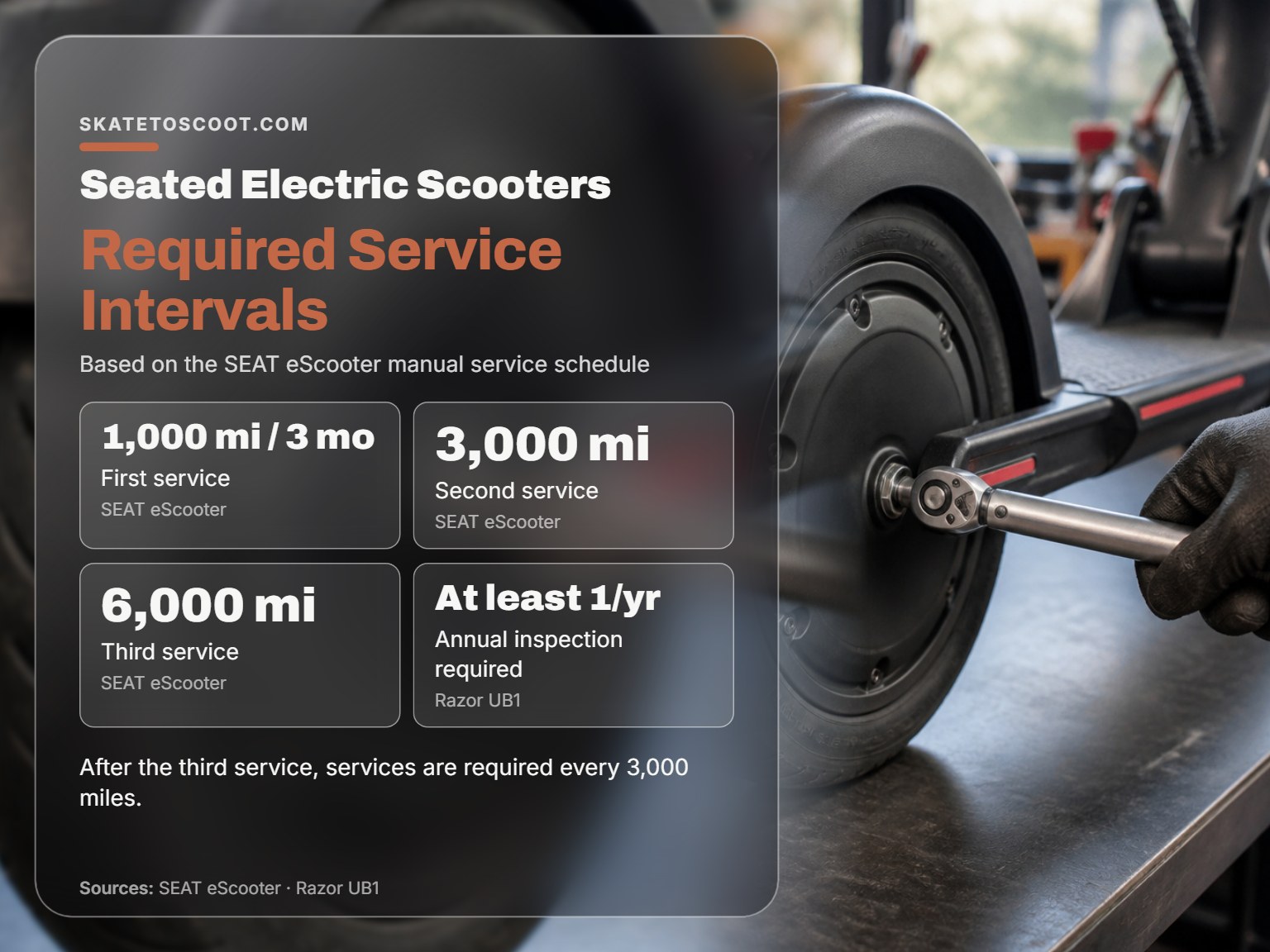
Scooters aren’t skateboards. You can’t just jump on and go forever. A five-minute check before you ride saves a roadside walk.
Before every ride:
- Tire Pressure: Use a gauge. 30 PSI front and rear. Low pressure causes premature wear and hurts range.
- Brakes: Squeeze the levers. They should engage firmly before hitting the handlebar. Adjust the cable barrel if they feel loose.
- Bolt Check: Give the stem clamp and folding mechanism bolts a visual once-over. If anything looks loose, use the included hex wrench.
- Lights: Tap the light button. The front LED and rear brake light are safety features, not just decorations.
Monthly:
- Clean the deck and wheels with a damp cloth. The manual warns against alcohol, gasoline, or kerosene, they can damage plastics and rubber.
- Inspect the tires for cuts, embedded debris, and tread depth.
- Check all suspension pivot points for play or squeaking.
Storage & Charging:
Before you start: Never charge a wet scooter. Store it in a dry place between -10°C and 40°C (14°F to 104°F). The manual explicitly says not to charge the battery below 0°C or above 40°C. Leaving it on the charger for days on end isn’t recommended.
The iScooter App lets you lock the scooter, track ride stats, and adjust some settings. It’s useful, but the core riding experience doesn’t depend on it. Download it, pair it, but know that the physical controls are what you’ll use every day.
Is iScooter a reliable brand?
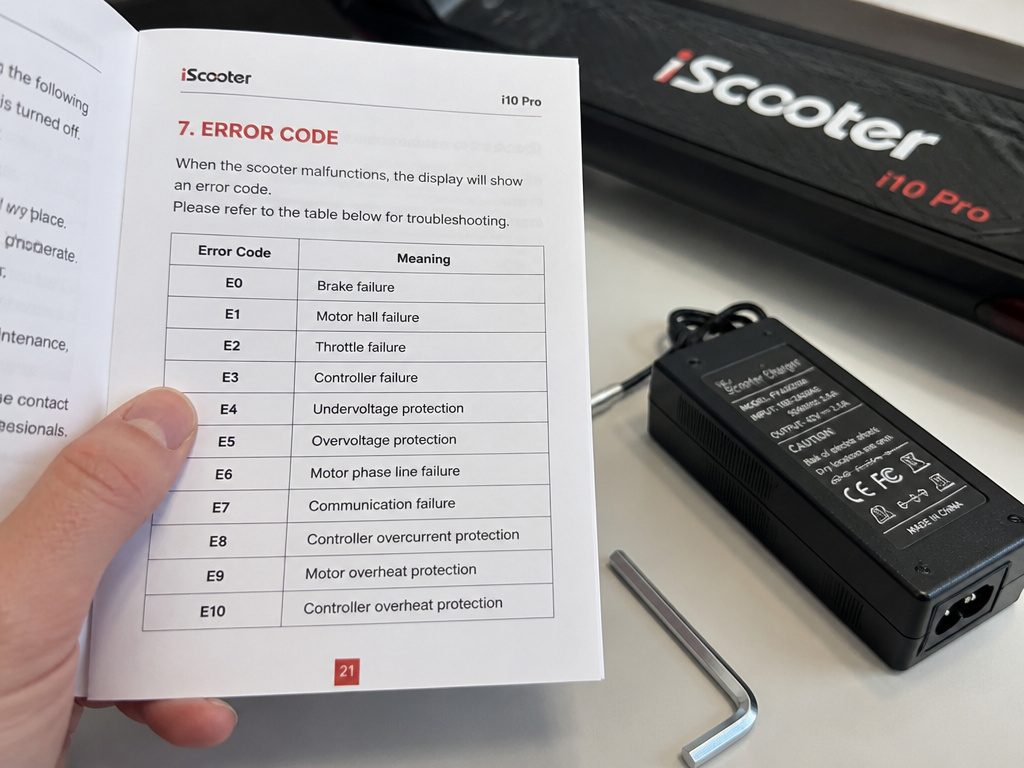
The iScooter i10 Pro (EU) package includes a hex wrench, bolts, a charger, and the scooter, along with a manual that includes troubleshooting codes. The iScooter i10 Pro (EU) manual lists specific error codes for issues like motor overheating (E9) or brake lever faults (E5). The iScooter i10 Pro (EU) manual provides clear warnings: don’t charge the battery below 0°C or above 40°C, avoid cleaning with alcohol or gasoline, and never connect the charger if the charging port is wet. While these guidelines help prevent common problems, the brand’s direct long-term support structure for repairs or parts replacement is less defined. Owners should be prepared to handle basic upkeep themselves and seek out third-party service for more complex issues.
Frequently Asked Questions
Is the iScooter i10 a good scooter?
For the price, it’s a solid commuter option if your daily round-trip is under 20 miles and your route has decent pavement. Its suspension and pneumatic tires provide good comfort, and the 650W motor has enough power for most city hills. Just go in knowing that long-term durability, especially with the tires, may require some extra attention and aftermarket parts.
Is iScooter a reliable brand?
IScooter produces budget to mid-range electric scooters. Their reliability is typical for the price segment: most units work fine, but quality control can be inconsistent, and some owners report issues like premature tire wear or occasional electronic faults.
How fast does an iScooter i10 go?
The base i10 has a maximum speed of 25 mph (40 km/h). However, many are shipped with a software limiter set to 15.5 mph (25 km/h). You can get the full speed by holding the brake lever and pressing the power/mode button five times in succession. Always activate and test this in a safe, controlled environment.
Is the iScooter i10 Plus good?
The “Plus” or “Pro” models generally refer to versions with upgraded hardware, like an 800W motor and 48V battery. These are better for riders who face more hills or want slightly more power and potential speed. They are good upgrades over the base i10 if you need that extra performance, but they also come with increased weight and cost.
How do I know if I have the i10, i10 Pro, or i10 Max?
Check your charger output and the product listing you purchased from. A charger labeled 42V 2A indicates the base i10. A 54.6V 2A charger indicates a 48V system (Pro or Max). The i10 Max is usually marketed with a focus on extended range (e.g., “48V 18Ah”). Your manual or the original sales page is the most reliable source.
The Bottom Line
The iScooter i10 is a capable tool for a specific job: getting one person across town on mostly flat roads. It’s not a luxury vehicle, and it’s not a toy. Think of it like a reliable pair of skate shoes, they’ll get you through the session, but you’ll need to replace the laces and watch the seams.
If your commute is under 10 miles each way and you can charge indoors, the i10 works. Check the tire pressure every other week, listen for new noises, and keep the bolts tight. Its value is in the basics it gets right: a comfortable ride, adequate power, and a folding design.
For anyone looking at hills, longer distances, or hassle-free ownership, the step up to the i10 Pro’s 48V system or a model from a brand with a stronger local service network might be worth the extra investment. The base i10 is a first-act scooter. It teaches you what you need, what you don’t, and where you might want to go next.
