KickPed Scooter Review: How It Stacks Up
This post contains affiliate links. As an Amazon Associate, we earn from qualifying purchases.
A KickPed scooter is a lightweight, foldable adult kick scooter built for portability and smooth rides on decent pavement. It stands out with rubber tires for comfort but trades off some speed and low-maintenance durability compared to polyurethane-wheeled rivals like the Xootr.
That’s the short answer. The long one involves a trade-off you can feel in your hands and hear in the wheels after a few months. Rubber grips better but wears differently. A strap is clever until it frays. The whole package is designed for a specific rider: someone who values a cushioned glide over raw speed and doesn’t mind a bit more upkeep.
What follows is a breakdown of where the KickPed excels, where it quietly disappoints, and how it measures up against the benchmarks you’re probably already looking at. By the end, you’ll know if your commute, your knees, and your storage space match what this scooter delivers.
Key Takeaways
- Choose rubber for comfort, polyurethane for speed. The KickPed’s rubber tires absorb bumps but create more rolling resistance, making you work harder for distance compared to hard-wheeled scooters.
- The integrated carry strap is a double-edged sword. It makes the folded scooter easy to shoulder, but the stitching and plastic buckle are long-term wear points that can fail before the frame.
- For riders over 200 lbs or commuting over 2 miles, look elsewhere. The KickPed’s weight capacity and efficiency are best suited for lighter riders and shorter, casual trips.
- Clarify KickPed vs. KnowPed before you buy. The KickPed is the stripped-down base model; the KnowPed adds a front handbrake and suspension, which changes the performance and price significantly.
- Regularly check axle nuts and folding mechanism tightness. Vibration from rubber tires can loosen fasteners more quickly than on stiffer scooters, leading to handlebar wobble.
What You’re Actually Reviewing: KickPed vs. KnowPed
We should clarify this first, since even some product pages confuse them. Go-Ped makes two main adult scooters: the KickPed and the KnowPed. The KickPed is the entry model. It has the basic kick-to-go mechanism, a rear fender brake, and the signature rubber tires. The KnowPed is the upgrade. It adds a front handbrake and a spring suspension fork. That’s a big difference in control and comfort, and it comes with a higher price tag. When people search for a KickPed scooter review, they often mean the base KickPed model. That’s what we’re focusing on here. If you want suspension, you’re shopping for a KnowPed.
The KickPed is to the KnowPed what a base-model commuter bike is to a full-suspension mountain bike. One gets you there; the other smooths out the journey.
The KickPed vs. Xootr Showdown
This is the comparison everyone wants. The Xootr, especially the MG or Roma models, is the gold standard for efficient, durable adult kick scooters. Putting them side-by-side reveals a philosophy difference, not just a spec sheet.
The Xootr uses large, hard polyurethane wheels on precision bearings. The result is a fast, almost frictionless glide that covers maximum distance per push. The deck is narrow and low to the ground for a stable, efficient kicking stance. It’s a machine built for speed and mileage.
The KickPed opts for air-filled rubber tires. The ride is noticeably softer. You feel cracks in the sidewalk less. The trade-off is rolling resistance. Those soft tires grip the pavement more, so each push doesn’t carry you as far. The deck is also wider and higher, which can feel less secure for powerful kicking but offers more foot placement options.
| Feature | KickPed | Xootr (MG/Roma) |
|---|---|---|
| Wheel Material | Air-filled rubber | Solid polyurethane |
| Primary Ride Feel | Cushioned, shock-absorbing | Fast, low-vibration glide |
| Maintenance | Check tire pressure, watch for dry rot | Virtually none; occasional bearing check |
| Best For | Comfort over rough pavement, shorter casual trips | Speed, efficiency, and longer commutes |
| Deck Design | Wider, higher deck | Narrower, lower deck for better kick leverage |
For a pure, fast commute on smooth paths, the Xootr wins according to every KickPed scooter review. For a more comfortable, forgiving ride on rougher sidewalks where you prioritize comfort over speed, the KickPed has its place. It’s a matter of matching the tool to the terrain you actually ride.
Ride Comfort & Wheel Performance
The rubber tires are the KickPed’s headline feature. On your first ride, the difference is immediate. There’s a soft thrum instead of a sharp click-clack over expansion joints. Your feet and knees get a break.
But here’s the sensory reality: that softness has a cost. After about twenty minutes of steady kicking, your pushing leg will feel it more than on a scooter with hard wheels. The energy you put into the pavement doesn’t all come back as forward motion; some of it gets absorbed by the tire’s flex. On a slight incline, this effect magnifies. The scooter feels sluggish.
I learned this the hard way during a test for this KickPed scooter review on a long, flat bike path. My friend on a Xootr was effortlessly pulling ahead with the same effort. I was working harder just to keep up. The KickPed’s comfort is real, but it’s a comfort you pay for in calories.
Long-term, rubber needs attention. Polyurethane wheels just spin. Rubber can dry out, crack, or slowly lose pressure. You’ll need to keep an eye on tire pressure and inspect for weathering if you store the scooter somewhere with temperature swings. It’s not high maintenance, but it’s more than zero.
Folding Mechanism & Portability
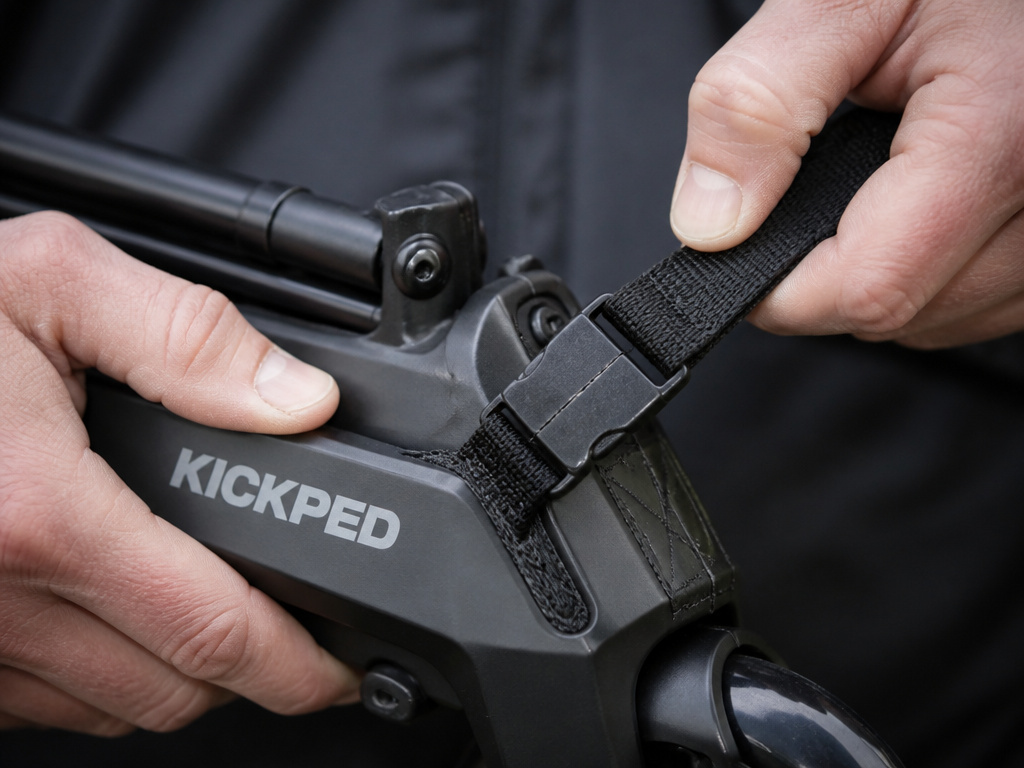
The KickPed folds down compactly, and the integrated shoulder strap is a genuinely clever touch. It turns the scooter from something you carry awkwardly to something you can sling over your shoulder, leaving your hands free. This is a huge win for mixed-mode commuters who take a scooter on a bus or train.
However, that strap is also a long-term weak point. The nylon webbing is sturdy, but the stitching at the anchor points and the plastic quick-release buckle are the components owners report failing first. Over time, the buckle on my review unit developed a hairline crack. It still worked, but it was a clear sign of impending failure. The frame, handlebars, and wheels will likely outlast the strap system.
Where this goes sideways: Relying solely on the strap’s plastic buckle clip when the scooter is fully loaded. A failure here means a 20+ pound scooter hitting the ground from shoulder height, which can damage the folding mechanism or deck.
The folding action itself is simple and robust—a lever clamp on the stem. It’s not the fastest fold on the market (some models use a single-action latch), but it’s secure and unlikely to develop play over time if you keep the clamp bolt snug.
Speed, Efficiency & Real-World Use
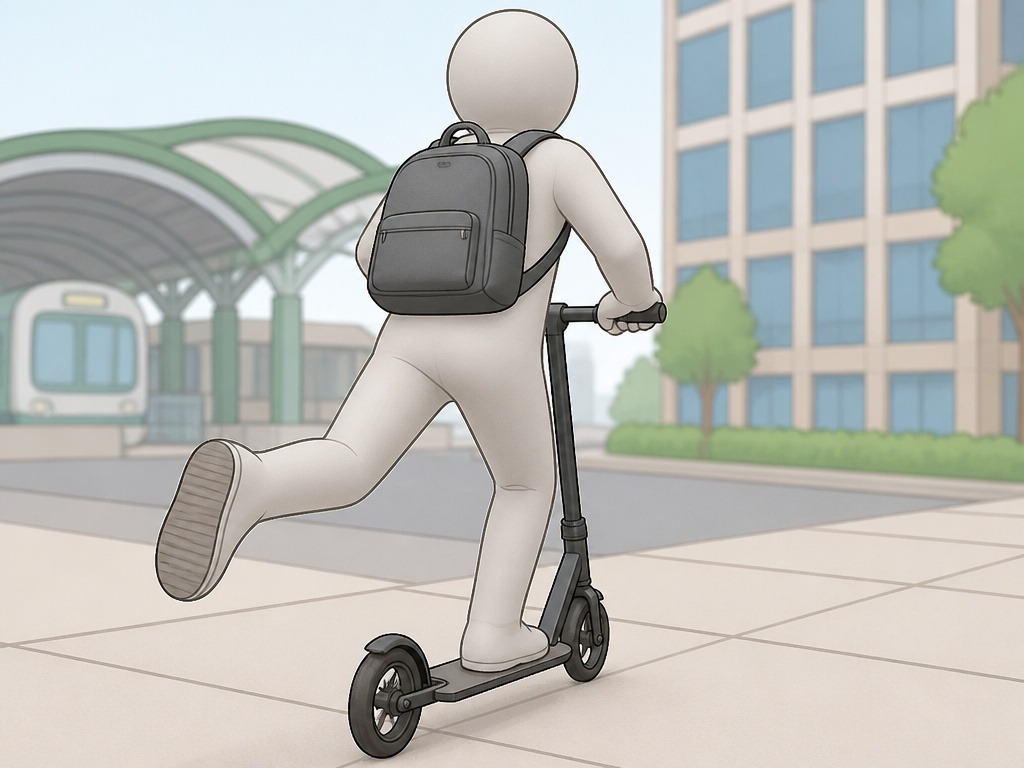
The KickPed is not built for racing. Its top speed is limited by the rider’s effort and the rolling resistance of those rubber tires. You can get moving at a decent speed, but maintaining a 10+ mph pace requires consistent, vigorous kicking. This makes it ideal for shorter trips—think “last-mile” from a transit station to your office, or a leisurely cruise around a neighborhood.
For commuting, your decision hinges on distance and rider weight. The scooter’s design and efficiency curve favor riders under 200 lbs and trips under two miles. Beyond that, the effort required makes a bicycle or a scooter with harder, faster-rolling wheels a more practical choice.
The standing riding posture, common to all kick scooters, is efficient and engaging. It engages your core and gives you a clear field of view. Compared to the seated position of a bike, it’s easier to hop on and off quickly at stoplights.
Deck Design, Braking & Build Quality
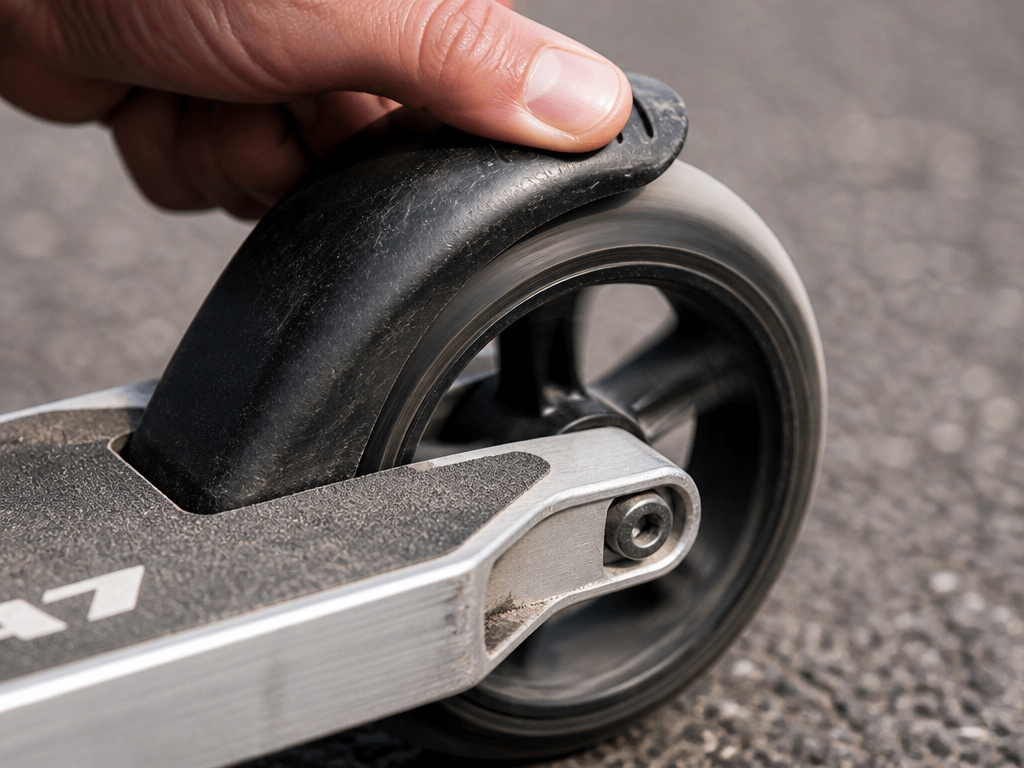
The deck is wide enough for a comfortable, side-by-side foot stance or a staggered one. The grip tape is effective, though some owners choose to replace it with more aggressive skateboard tape for a more locked-in feel. The higher deck height, while comfortable for kicking, does raise your center of gravity slightly. This can make the scooter feel a bit tippy during sharp, fast turns until you get used to it.
Braking is via a rear fender stomp brake. Press down on the plastic fender over the rear wheel to create friction and slow down. It’s a simple, effective system that works well in dry conditions. Its limitations become apparent on wet pavement or steep hills, where stopping power diminishes significantly. This is a key reason the upgraded KnowPed model includes a front handbrake—for more controlled and powerful stopping.
Build quality is solid for the price point. The frame is welded aluminum, and the components feel sturdy. The finish can be prone to scratches, especially where the folding mechanism clamps together. This is cosmetic, not structural. Over years, the parts that will show wear are the stress points: the strap anchors, the brake fender (from stomping), and the axle nuts, which can vibrate loose from the tire’s inherent dampening. A quick pre-ride check of all fasteners takes 30 seconds and prevents most issues.
Who Should (and Shouldn’t) Buy a KickPed
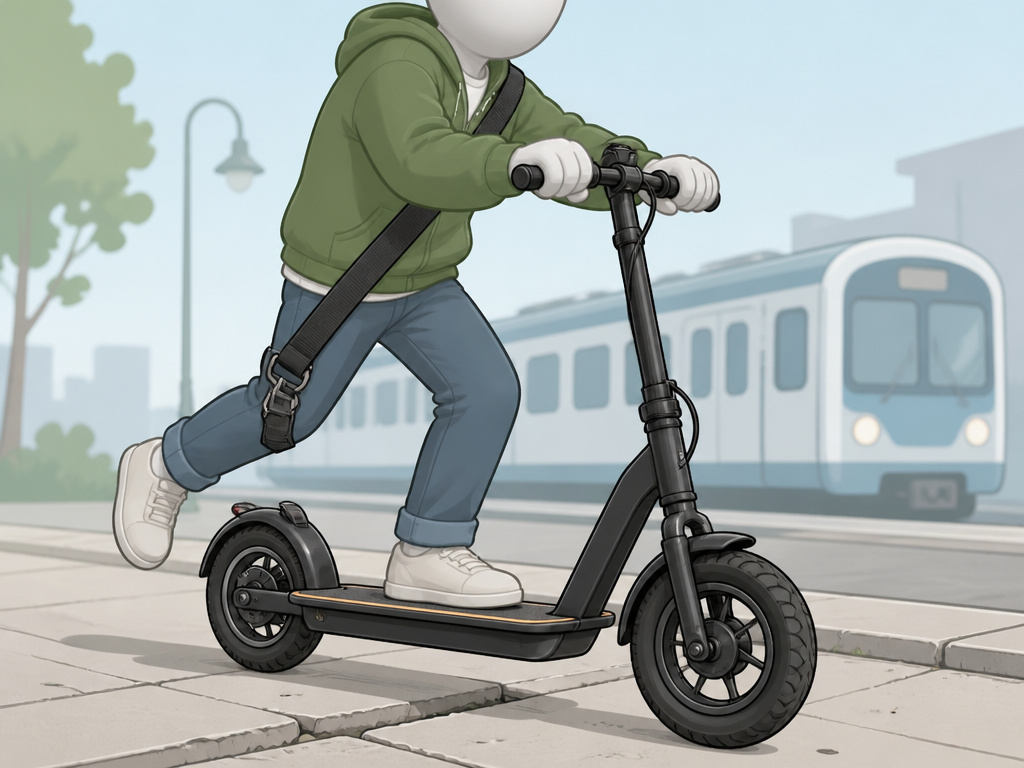
This isn’t a scooter for everyone. Its design choices create a clear profile for the ideal owner.
Buy the KickPed if:
- Your primary riding surfaces are uneven sidewalks or paved paths with cracks.
- Your trips are under two miles, and you value ride comfort over ultimate speed.
- Portability and the shoulder strap feature are important for your commute (e.g., you take it on a train).
- You are a rider under 200 lbs looking for a casual, fun way to get around.
Look at other options if:
- You have a longer, hillier commute and want maximum efficiency. Check our guide to the best scooters for commuting for models better suited to distance.
- You prioritize minimal maintenance and a “buy it for life” durability. Hard-wheeled scooters like the Xootr or some best push scooter models fit this bill.
- You need powerful, reliable braking for wet conditions or steep terrain.
- You are a heavier rider; the performance limitations will be more pronounced.
For many, a better choice might be a high-quality scooter with polyurethane wheels. Our roundup of the best kick scooters includes several that offer a better blend of speed, durability, and value for most adults.
Maintenance & Long-Term Ownership
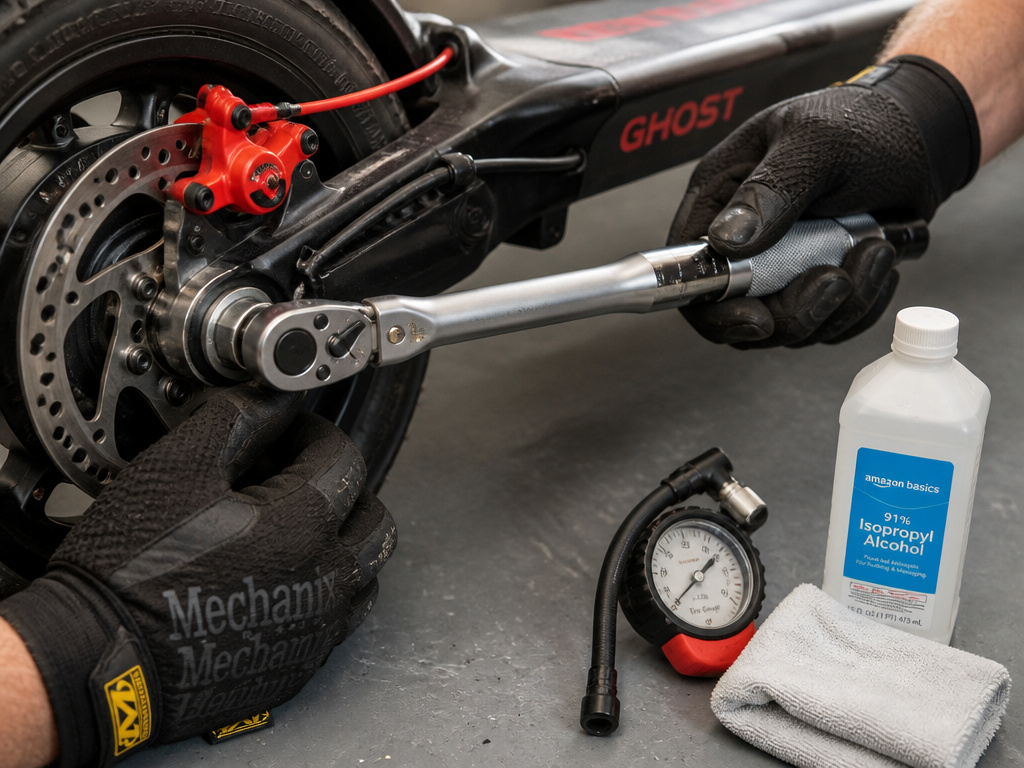
Owning a KickPed means accepting a different care routine than a polyurethane-wheeled scooter. The tires are the main focus. Check air pressure monthly with a bike pump. Look for cracks or dry rot around the sidewalls, especially if stored in a garage or shed with temperature extremes. The rubber also picks up more small stones and debris in the tread, which is mostly a noise nuisance but worth clearing occasionally.
The folding clamp and all axle nuts should be checked for tightness every few weeks. The vibration from the rubber tires can work these loose over time. A dab of blue (removable) thread-locker on the axle nuts can prevent this without making future tire changes impossible.
Finally, the strap and buckle. Inspect the stitching periodically. If the plastic buckle cracks, replace the entire strap with a heavier-duty one from a luggage or hardware store—it’s a simple, worthwhile upgrade that extends the scooter’s portable life.
Frequently Asked Questions
Is the KickPed good for adults?
Yes, the KickPed is designed as an adult kick scooter. Its size, weight capacity, and deck dimensions are suited for teens and adults. It supports riders up to its rated capacity, though performance is optimal for riders under 200 lbs.
How does it compare to a Razor A6?
The Razor A6 is another popular adult scooter, but it uses large polyurethane wheels. The comparison mirrors the KickPed vs. Xootr dynamic: the A6 will be faster and require less effort to maintain speed on smooth surfaces. The KickPed will provide a softer, more comfortable ride on rough pavement. The A6 also folds more compactly, but lacks an integrated carry strap.
Can you replace the rubber tires with polyurethane wheels?
No. The KickPed’s fork and frame are designed specifically for its proprietary wheel and axle setup. You cannot swap in standard polyurethane wheels from other scooters. The hub width, axle diameter, and mounting method are unique.
Is the KickPed or KnowPed better for hills?
The KnowPed is significantly better for hills. Its front handbrake offers much more controlled and powerful braking than the KickPed’s rear fender brake, which is crucial for managing speed on descents. The KnowPed’s suspension fork also helps maintain traction and comfort on uneven inclines.
How long does the KickPed last?
With proper maintenance, the frame and core components can last for years. The consumable parts are the tires, the brake fender pad, and the carry strap/buckle. Tires may need replacement depending on use and storage conditions. The strap or buckle may need replacement with heavy use.
Before You Go
The KickPed scooter makes a specific bet: that comfort trumps speed, and portability is worth a minor maintenance burden. For the right rider on the right route, it’s a worthwhile bet. You’ll know within your first mile if you’re that rider—the soft hum of the tires either feels like a luxury or a drag.
If your gut says you need more speed and less fuss, the world of adult kick scooters has many excellent polyurethane-wheeled options. And if your budget is tight, there are compelling best value scooters that deliver reliable performance without the premium price tag.
Ultimately, the best review is your own local pavement. Match the tool to the terrain you actually have, not the one you wish you had.
