Magneto Electric Skateboard Review: Who Should Buy It?
This post contains affiliate links. As an Amazon Associate, we earn from qualifying purchases.
The Magneto Revolution electric skateboard is a hub-motor board claiming a 20mph top speed and 12-mile range, assembled in Carlsbad, California. It offers a carbon fiber composite deck and a 6-month warranty, positioning itself as a mid-tier option for casual riders and short commuters on moderate hills.
That 15% grade climb claim is the pivot point. It decides whether this board works for your neighborhood or becomes a very expensive kick-pusher on the first real incline. The specs look good on paper, but the gap between a manufacturer’s claim and the pavement under a 190-pound rider is where every electric skateboard earns its keep—or doesn’t. This is the central question for any magneto electric skateboard review.
What follows is a breakdown of the Magneto Revolution’s build, real-world performance, and the safety and support landscape you won’t find in the marketing copy. We’ll weigh its value against other boards and see if it’s a solid buy or a gamble.
Key Takeaways
- The Magneto Revolution claims 20mph top speed and 12-mile range, but real-world results depend heavily on rider weight, terrain, and riding style.
- Its 6-month warranty is shorter than many competitors’, and a 2023 customer review alleges a canceled delivery after a shipping concern was raised, pointing to potential support issues.
- Hub motors offer efficiency and quiet operation but can struggle with heat on sustained climbs compared to belt-driven systems.
- Always check the operating environment; the Boosted S2 manual explicitly warns against charging or riding in rain or temperatures over 40°C, a universal lesson for lithium-ion boards.
- For most beginners, a general e-skate review and understanding how e-skateboards work is more valuable than fixating on any single brand’s top-line numbers.
Magneto Revolution Specs & Performance
The board’s pitch is straightforward: 20mph, 12 miles, climbs a 15% grade. Those numbers come from the manufacturer’s product page, as noted in the magneto electric skateboard review. In practice, they’re ceilings, not guarantees.
A rider’s actual range depends on three things: weight, hills, and throttle discipline. The manufacturer’s claim of up to 12 miles is a best-case scenario measured under ideal conditions. The same math applies to the 20mph top speed—it’s achievable, but maintaining it drains the battery exponentially faster.
The Magneto Revolution electric skateboard uses dual hub motors integrated into the rear wheels, eliminating the need for drive belts. This design prioritizes efficiency and reduces maintenance but can limit torque delivery on steep, sustained inclines compared to geared belt drives. The deck is a carbon fiber and maple composite for stiffness and strength.
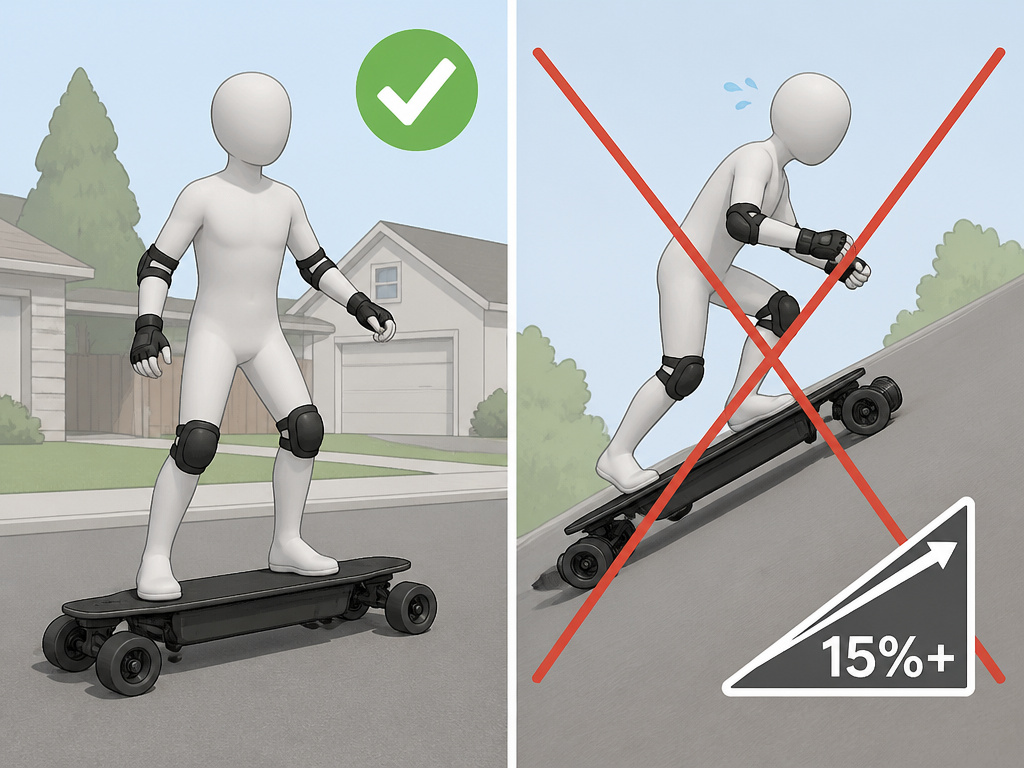
The 15% grade climb is the most critical spec. A 15% grade is a significant hill. It means for every 100 feet you travel forward, you climb 15 feet vertically. The board can handle this, but it will do so while pulling maximum current from the battery and generating heat in the motors. Repeated climbs will tax the system and reduce your overall range more than flat cruising.
Common mistake: Assuming the advertised range is a guarantee. It’s a best-case scenario measured under ideal lab conditions. Your commute is not a lab.
Build Quality, Ride Experience & Comparisons
The deck is a carbon fiber and maple laminate. It’s stiff, which provides stability at speed, but it lacks the flex of a traditional bamboo longboard that can absorb road vibrations. You’ll feel more of the pavement, which can be jarring on rough asphalt. The large wheels help, but this isn’t a cloud-like cruiser.
The hub motors are quiet. That’s a plus for stealthy commuting but can be a negative for pedestrians who don’t hear you coming. The wireless remote is standard fare: a throttle wheel, a brake trigger, and a reverse button. Responsiveness is adequate, but some reviewers note a slight lag compared to higher-end systems. There’s no advanced telemetry on the remote itself—just battery indicators for the board and remote.
How does it stack up against other options? It’s not competing with premium brands like Boosted (now defunct) or today’s high-end top-rated electric skateboards. It’s a budget-to-mid-tier contender. The Magneto longboard models are known for their classic cruiser shapes, but the electric Revolution is a different beast focused on performance.
Where this goes sideways: The thin 6-month warranty. The Magneto Revolution’s 6-month warranty is shorter than warranties offered by some competitors. A 6-month total warranty suggests less confidence in long-term durability. When you look at a general e-skate review of component lifespans, motors and batteries are the usual failure points well after half a year.
| Aspect | Magneto Revolution | Typical Budget Competitor |
|---|---|---|
| Deck | Carbon Fiber & Maple Composite | 7-Ply Maple or Bamboo |
| Drive | Dual Hub Motors | Single Hub or Belt Drive |
| Warranty | 6 Months | 1 Year (varies) |
| Key Advantage | Clean, integrated motor look | Often lower price or user-serviceable parts |
Safety, Charging & Warranty Considerations
This is where the rubber meets the road, literally. The FACT SHEET provides concrete safety rules from a Boosted S2 manual, and they are essential for any electric skateboard, Magneto or otherwise.
First, the battery. It’s a lithium-ion pack. The manual for the Boosted Model S2 states you should never charge outdoors or in the rain and avoid environments where the temperature exceeds 40°C (104°F). While this is sound advice for lithium-ion batteries, it is specifically documented for the Boosted S2. Ignoring it risks battery damage, reduced lifespan, or in extreme cases, a thermal event. The Magneto’s warranty likely won’t cover water damage.
Second, the recall history. While not for Magneto, the CPSC electric skateboard recall notice for Yvolve Sports’ Neon Nitro 8 boards in 2018 is a cautionary tale. Reports of tire deflation led to a federal recall (CPSC Recall 19-020). This shows that even branded products can have critical safety flaws that aren’t apparent at purchase.
Worth knowing before you start: The Boosted S2 manual explicitly warns to stop charging if the battery becomes abnormally hot, shows odor, discoloration, or deformation. That’s your sign to unplug everything and seek professional help. Do not ignore it.
The 6-month warranty is a red flag for long-term ownership. Warranties are a manufacturer’s bet on their product’s reliability. A short bet means they’re not confident. There’s also an anecdotal report from October 2023 where a customer alleged Magneto canceled a delivery after a shipping concern was raised. This doesn’t speak to product quality directly, but it does paint a picture of potential customer service friction.
Here are the absolute non-negotiables for operating any electric skateboard, synthesized from the source material:
- Wear a helmet. Always.
- Do not ride in water, on wet surfaces, or in the rain.
- Regularly inspect the board before riding (wheels, trucks, battery enclosure).
- Use only the provided charger.
- Unplug the charger when not in use.
Who Is The Magneto Revolution For? (And Who Should Skip It)
This board has a specific rider profile. It’s not for everyone.
It’s a fit for a light-to-average weight rider (under 180 lbs) with a relatively flat commute under 6 miles round trip. The quiet hub motors and clean design are good for campus or suburban use. If your route has short, moderate hills (that 15% grade or less), it should handle them. Think of it as a last-mile vehicle or a weekend park cruiser.
You should look elsewhere if:
- Your commute has long, steep hills.
- You weigh over 200 lbs.
- You want a soft, carvy ride (the stiff deck won’t provide it).
- You prioritize a long warranty and proven customer service.
- You need maximum range regardless of conditions.
The electric vs traditional skateboard question is also relevant here. If you’re a pure beginner to skating, adding a motor multiplies the risk. You need to be comfortable with the basics of balance, pushing, and foot braking on a regular board first. The motor amplifies speed and consequence.
The part nobody mentions: Resale value. Boards with shorter warranties and less established brand reputations depreciate faster. If you think you might upgrade in a year, a Magneto might be harder to sell than a board from a more recognized name in the best electric skateboards category.
Long-Term Reliability & Common Issues
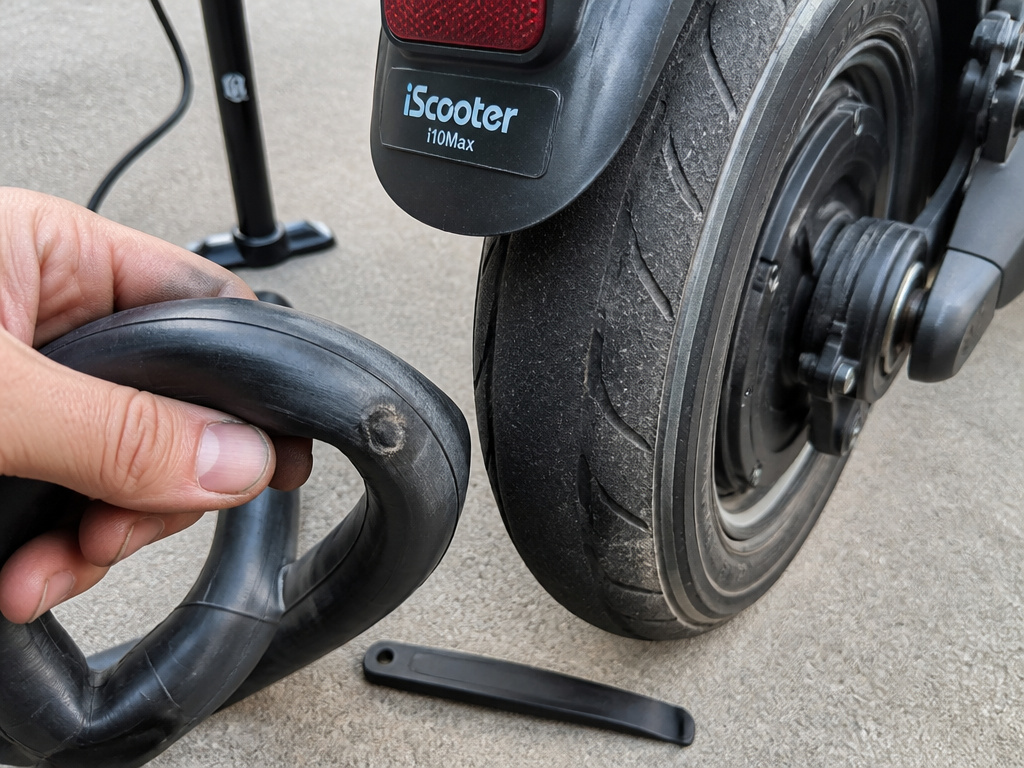
The research here is thin, which is itself a data point. There are no widespread, documented failure modes for the Magneto Revolution like the CPSC recall for other brands. However, forum snippets and review comments hint at the classic pain points of budget e-skateboards.
Hub motors can overheat. Unlike belt drives, where you can replace a burnt-out motor relatively easily, a hub motor is the wheel. If the internal electronics fail, the entire wheel assembly needs replacement. This is a more costly and complex fix.
Battery degradation is the other big unknown. The battery’s capacity is not detailed in the available specifications, making comparisons difficult. Lithium-ion batteries lose capacity over time and charge cycles. Lithium-ion batteries lose capacity over time and charge cycles, which can reduce range. The 6-month warranty certainly doesn’t cover that.
Owners of earlier Magneto products have noted things like regional power plugs (a UK plug on a board sold in the US, per a 2016 review), suggesting supply chain or quality control inconsistencies. It’s a small thing, but it points to the kind of hiccups that can frustrate the unboxing experience.
I’ve seen too many riders blame themselves when a board fails. Sometimes it’s not your technique; it’s a solder joint that couldn’t handle the third big bump. Check the hardware first.
For a detailed look at the engineering, the Massey University hub motor control study and the Cal Poly electric skateboard design project show how complex these systems are. They’re not toys; they’re personal electric vehicles with all the associated engineering challenges.
What comes in the box
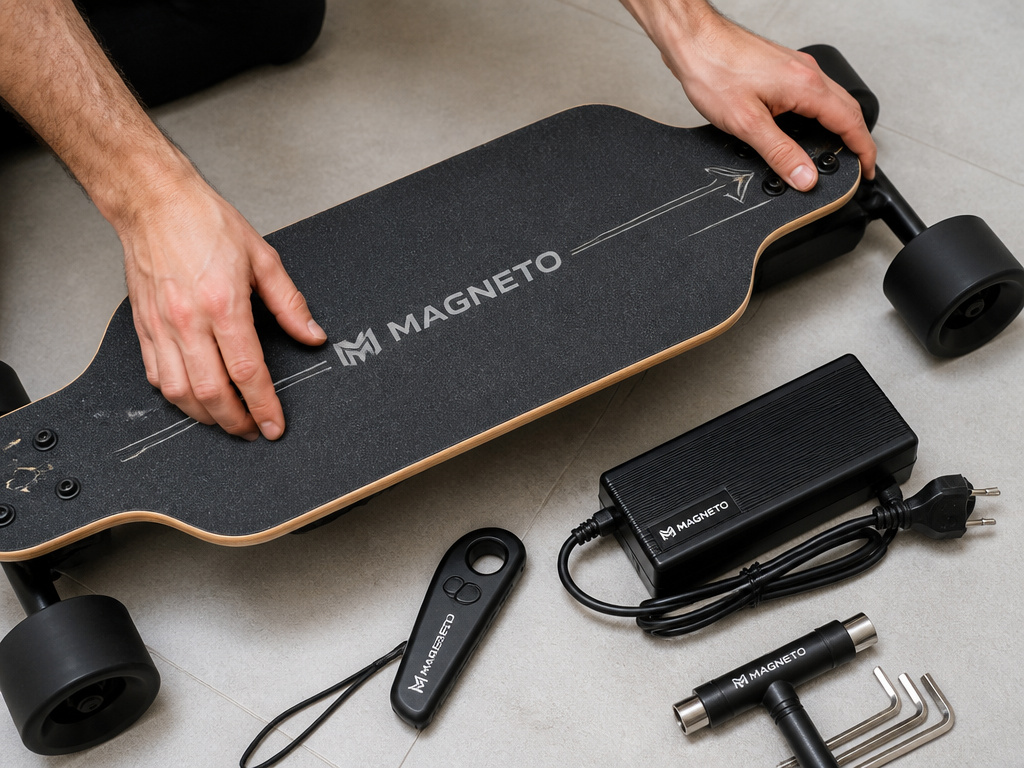
When your board arrives, the packaging is designed to protect the components during shipping. You should find the skateboard itself, a wireless remote, a charger, and any necessary tools or accessories. Inspect all items immediately upon unboxing. Check for any visible shipping damage to the board or its electronics before your first ride. Lay out all the parts in a clear space to ensure nothing is missing. The charger plug type may vary depending on your region, so verify you have the correct one for your country’s outlets. Always save the original packaging and any documentation in case you need to make a warranty claim.
Frequently Asked Questions
Are Magneto skateboards good quality?
For their price point, they are adequate. The build uses standard materials like maple and carbon fiber, which are good. However, the 6-month warranty is a significant drawback compared to the 1-year or longer warranties offered by more established brands. Quality control might be inconsistent, as suggested by older reviews mentioning accessory mismatches.
What is the best electric skateboard for the money?
“Best for the money” depends entirely on your needs. If you want a low-cost entry point to see if you like e-skating, ultra-budget brands exist. If you want a reliable commuter, you often need to step up to a mid-priced board from a company with a strong warranty and community support. The Magneto Revolution sits in between, making it a compromise rather than a standout value leader.
Which brand of electric skateboard is considered the best?
There’s no single “best” brand. Different brands excel in different areas: some in power, others in range, others in ride comfort or customer service. Premium brands like those previously made by Boosted set early benchmarks for polish and reliability. Other brands have strong followings in various segments of the electric skateboard market. It’s more useful to study overall electric skateboard performance in the category you care about (e.g., off-road, long-range, lightweight) than to chase a brand name.
Can you get a DUI on a non-motorized skateboard?
This is a legal question that varies by jurisdiction. Generally, a DUI applies to operating a vehicle while impaired. Many local laws define vehicles to include bicycles, scooters, and yes, electric skateboards. A traditional, non-motorized skateboard might fall into a gray area, but the prudent assumption is that operating any device on public roads while impaired is a serious legal risk. Always check your local laws.
The Bottom Line
The Magneto Revolution electric skateboard is a specific tool for a specific job. It’s a passable choice for a lighter rider with a flat, short commute who values a clean look and quiet operation. The 20mph and 12-mile specs are realistic only under ideal conditions.
The short warranty and anecdotal customer service concerns are real marks against it. In a market where you can often find last year’s models from more established brands at similar prices, the Revolution struggles to justify itself as the obvious pick.
My rule for budget gear: if the warranty is shorter than it takes to truly test the product, be wary. You need at least a year of seasons—summer heat, winter cold, rain, and dry spells—to know what a board is made of. Six months doesn’t cut it.
If your hills are mild and your expectations are measured, it might work. But for most people, saving a little longer for a board with a stronger safety net from the company that built it is the better long-term play. Your future self, staring at a dead battery or a silent motor, will thank you for the patience.
