Meepo Electric Skateboard Review: Which Is Best for You?
This post contains affiliate links. As an Amazon Associate, we earn from qualifying purchases.
Meepo electric skateboards deliver high speed and decent range at a budget price, but performance varies wildly between models and real-world reliability hinges on understanding a strict warranty that excludes water damage and wear-and-tear parts.
The difference between a fun commuter and a frustrating paperweight often comes down to the fine print and a single spec mismatch. A board marketed for 28 mph might feel sketchy past 25; a 20-mile range claim can drop to 14 for a heavier rider. The specs tell one story, but the ride tells another, which is why a detailed Meepo electric skateboard review is essential.
What follows is a breakdown of three current Meepo models, the V5, Go, and Flow, with their verified performance numbers, a clear look at what the warranty actually covers, and the real-world quirks owners report. By the end, you’ll know which board fits a beginner’s first mile, a commuter’s daily route, or a carver’s weekend hills.
Key Takeaways
- The Meepo V5 is the entry-level pick with a light 18.5 lb weight and a handle, but its dual 500W hub motors (theoretically 432W each) prioritize efficiency over raw power, making it better for learners.
- The Meepo Go uses a belt-drive system with dual 4230 brushless motors combining for 3,000 watts, tackling 30% inclines and reaching a tested top speed of 28 mph, but its default “freestyle” reverse mode can be dangerous for new riders.
- Meepo’s official warranty is 6 months for most models (1 year for Hurricane, Monster, Bison), but it explicitly excludes water damage despite IP ratings (e.g., IP55 for the V5) and doesn’t cover wear-and-tear parts like decks, grip tape, or PU sleeves.
- Real-world range often falls short of marketed claims, with one V3 reviewer noting a severe performance decline at ~40% battery, dropping speed by nearly a third on a mild incline.
- For a surfy, carving ride, the Meepo Flow with its Double King Pin trucks and Hobbywing ESC is the choice, but its 26% hill grade and 24-mile advertised range come with a stiffer price and heftier 34 lb weight.
The Meepo Lineup: V5, Go, and Flow Explained
You don’t buy a skateboard. You buy a ride feel. A hub-motor cruiser feels different underfoot than a belt-drive hill climber, and a carving deck reacts nothing like a stiff commuter. Picking the wrong one means fighting the board’s personality every time you step on.
Meepo makes three distinct types of ride experiences right now. The V5 is your classic, simple hub-motor board. The Go is a muscular, belt-drive workhorse built for power and customization. The Flow is a specialized carver designed for surfy turns and street surfing. Their components dictate their job.
The Meepo V5 uses an LY-FOC 24H ESC (10S/36V, 2x12A) paired with a 10S2P, 144Wh battery. The Meepo Go employs a JK-FOC24B ESC with a 12S2P, 345.6Wh battery. The Meepo Flow runs a Hobbywing 9028 ESC and a 12S2P, 432Wh battery pack.
Meepo V5: The Beginner’s Baseline
The V5 is the logical next step if you’re moving from a regular skateboard. Its 8-ply Canadian maple deck has a mild flex and a deep concave that locks your feet in without being punishing. At 18.5 lbs, it’s light enough to carry with its built-in handle, a feature that looks clunky but you’ll use constantly.
Its dual hub motors are advertised as 500W each, but a teardown of the LY-FOC ESC suggests a theoretical 432W per motor. That’s not a lie; it’s a rounding-up that reflects real-world performance. The board’s marketed top speed is 27 mph, while a no-load test measured 29 mph, illustrating a common variance between advertised and theoretical maximum speeds. For a beginner, the difference is academic. You won’t be maxing it out day one.
The V5’s party trick is simplicity. There’s no belt to maintain, and the hub motors are enclosed in the wheels. You just charge and go. The trade-off is less torque for hills and a ride feel that transmits more road vibration through the 90mm urethane wheels. It’s a board that gets you from A to B efficiently, not luxuriously.
Where this goes sideways: Buying the standard 144Wh battery for an 11-mile marketed range. Most new riders burn through that faster than they think. The extended 288Wh battery nearly doubles the cost but also the usable range, making it the smarter buy if you plan to ride for more than 30 minutes at a time.
Meepo Go: The Power Upgrade
The Go is where Meepo stops playing nice. Its dual 4230 brushless motors combine for a stated 3,000 watts, and it shows. This board tackles a 30% incline and claims a 28 mph top speed. The belt-drive system delivers that power with a satisfying whir, but it also means maintenance, you will replace belts, and the board won’t freewheel as quietly as a hub model.
Common mistake: Riding the Meepo Go with its default “freestyle mode” enabled. This setting makes the board go into reverse when you pull back on the remote thumbwheel, instead of braking. For a rider expecting to slow down, this causes a sudden, dangerous fishtail. Disable it in the settings immediately.
In practice, real-world range will vary based on rider weight, terrain, and speed mode. That’s the reality of battery claims: weight, temperature, and riding style chop them down. The board’s saving grace is its smooth, customizable ESC. You can dial in braking intensity from 0% to 100%, a feature that genuinely impresses for finding your comfort zone.
Meepo Flow: The Carver’s Choice
The Flow is a different beast. It’s built for turning, not just going fast, with a deck and truck design oriented toward carving.
Powered by dual 2520W belt motors and a Hobbywing ESC, it claims a high top speed and a 26% hill grade. The advertised range from its 432Wh battery is optimistic; real-world range will be lower with aggressive riding.
The Hobbywing ESC is the star here, providing smooth acceleration and braking curves. This is the board you buy if straight lines bore you and you want to carve up bike paths or parking lots. The trade-off is its heavier weight and lack of a carry handle, making it a commitment to lift and store.
Meepo V5 vs. Meepo Go vs. Meepo Flow: A Side-by-Side Comparison
Picking one requires matching their strengths to your terrain, weight, and riding style. This table lays out the hard numbers from the source material.
| Specification | Meepo V5 | Meepo Go | Meepo Flow |
|---|---|---|---|
| Drive System | Hub Motor | Belt Drive | Belt Drive |
| Motors | Dual 500W Hub (theor. 432W) | Dual 4230 Brushless (3000W combined) | Dual 2520W Belt |
| Battery | 144Wh (Std), 288Wh (ER) | 345.6Wh (12S2P) | 432Wh (12S2P) |
| Marketed Top Speed | 27-29 mph | 28 mph | 32 mph (tested ~30 mph) |
| Marketed Range | 11 mi (Std), 19.8 mi (ER) | 20 mi | 24 mi (tested 17-20 mi) |
| Hill Grade | Not specified | 30% | 26% |
| Deck | 8-ply Maple | Bamboo & Fiberglass | Maple, Fiberglass, Bamboo Composite |
| Weight | 18.5 lbs | Not specified in sources | 34 lbs |
| Best For | First-time e-skater, portability | Power riders, hill climbers, customizers | Carving, surf-style riding, smooth streets |
The V5 wins on portability and simplicity. The Go wins on raw power and hill climb. The Flow wins on ride feel and carving agility. Your local hills and road surfaces decide more than any marketing copy.
Performance and Real-World Quirks
Advertised specs are a best-case scenario drafted in a lab. Real performance lives in the details owners discover after a few weeks of riding. Two patterns emerge: battery behavior and remote connectivity.
Battery Sag is Real
One detailed Meepo electric skateboard review of the V3 noted a severe performance cliff. At around 40% battery, the board’s speed dropped from its normal range to 25-30 km/h (15-18 mph) and struggled on a 5% incline. This suggests a relatively high low-voltage cutoff, a design choice that protects the battery from deep discharge but leaves a lot of unused capacity on the table. You haven’t run out of battery; the board has decided you’re too low to have fun. It’s a quirk common to many budget packs.
Remote Range and Auto On/Off
The Meepo Go’s remote has a max connection range of 46 meters. That’s ample for most situations, but the board’s auto-on/off feature, where the remote wakes the board, may not work consistently, sometimes requiring use of the physical power button. It’s a minor annoyance that breaks the seamless experience.
The Stiffness Problem
Out of the box, some riders find Meepo models ship with very hard bushings, which can affect turning responsiveness. For a beginner, this might feel stable. For anyone wanting to carve, swapping to softer bushings is a common modification. It’s the clearest place where Meepo saves a few cents per unit at the cost of immediate ride quality.
Build Quality and Durability Concerns
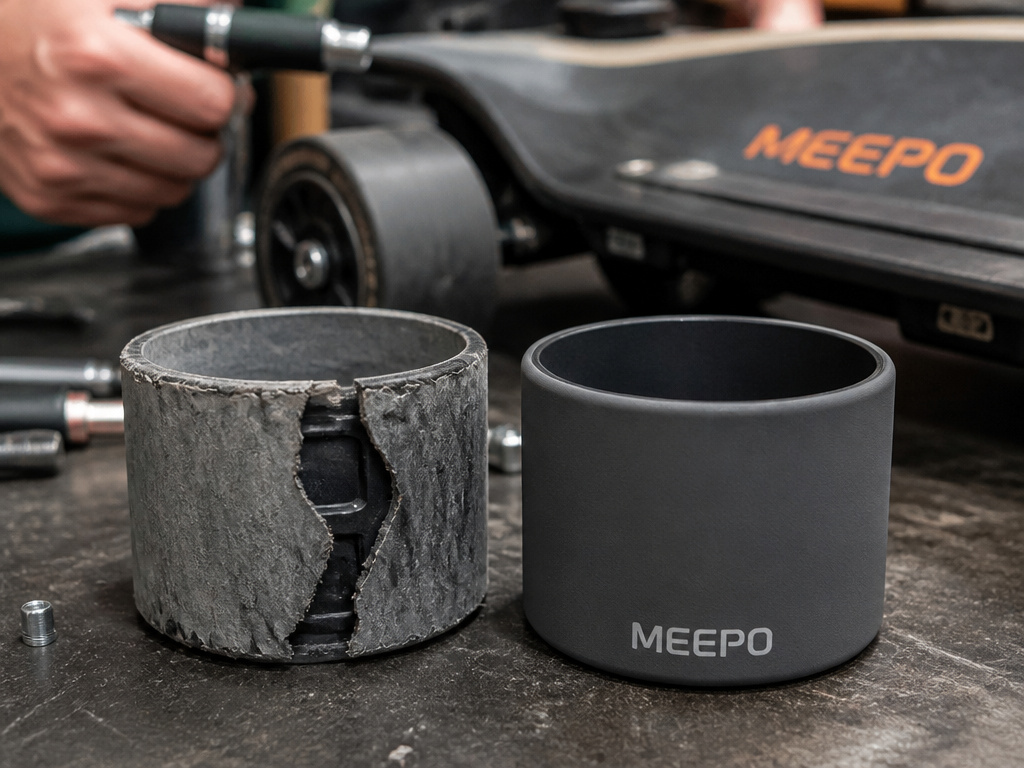
Meepo’s reputation is built on value, not indestructibility. The components are decent for the price, but long-term durability has specific pain points owners report.
A user reported a Meepo V5 purchased in June 2023 experienced a complete motor/accelerator failure after just two months of use in August 2023. While covered under the 6-month warranty, this kind of early failure points to potential quality control variance or the stresses put on budget components. It’s not the norm, but it’s a documented risk.
The decks themselves are generally well-regarded. The V5’s 8-ply maple is stiff enough for speed, while the Go and Flow use different deck constructions aimed at varying ride characteristics. The weak points are the consumables: the polyurethane sleeves on hub motors wear down, belts on the Go and Flow will require replacement, and grip tape wears out. These are all explicitly listed as wear-and-tear exclusions in the warranty.
The Warranty Fine Print and What It Really Covers
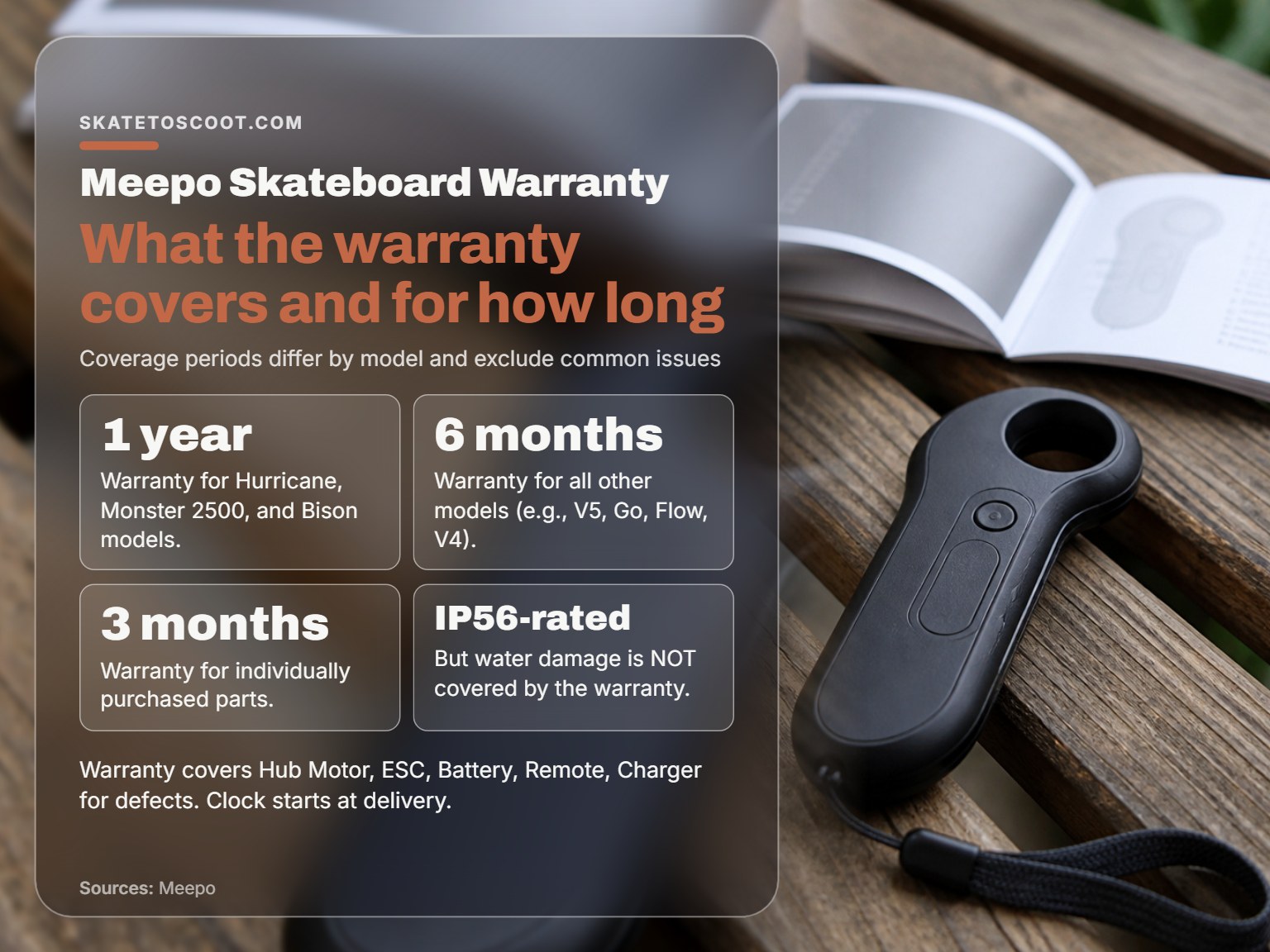
Meepo’s warranty is a masterclass in managing expectations. It’s not bad, but it is very specific about what it won’t do. Reading it changes how you treat the board from day one.
Coverage Timeline:
- Meepo Hurricane, Monster 2500, and Bison models: 1-year warranty.
- All other models (V5, Go, Flow, V4): 6-month warranty.
- Individually purchased parts: 3-month warranty.
What’s Covered: Hub Motor, ESC, Battery, Remote, Charger. If these fail due to a manufacturing defect within the period, Meepo will repair or replace them.
What’s NOT Covered (The Critical List):
- Wear-and-Tear Parts: Front wheels, skateboard decks, motor belts, grip tape, and PU sleeves. You buy these anew.
- Water Damage: This is the big one. The warranty states boards are IP56-rated but “are not waterproof.” Water intrusion voids coverage. A reviewer might say riding through puddles is fine, but the warranty says otherwise. Choose your risk.
- Inactivity Doesn’t Pause It: The warranty clock starts at delivery, not first use. Storing the board for 4 months eats 4 months of your coverage.
Worth knowing before you start: Meepo offers a 30-Day Money Back Guarantee for the U.S. Only (excluding refurbished boards). Returns may incur a 15%-30% restocking fee if the product is used or not in brand-new condition.
The warranty is adequate for catastrophic manufacturing faults. It is not a maintenance plan. You are responsible for everything that normally wears out, and you must keep the board dry. This makes the IP rating more about splash resistance than peace of mind.
Which Meepo Board is Best for You?
This isn’t about the “best” board. It’s about the board whose compromises you can live with. Your weight, typical route, and storage situation make the decision for you.
- Choose the Meepo V5 if: You’re a first-time e-skater, need maximum portability (stairs, buses, carrying into work), have mostly flat terrain, and want the simplest, no-maintenance experience. Get the extended battery.
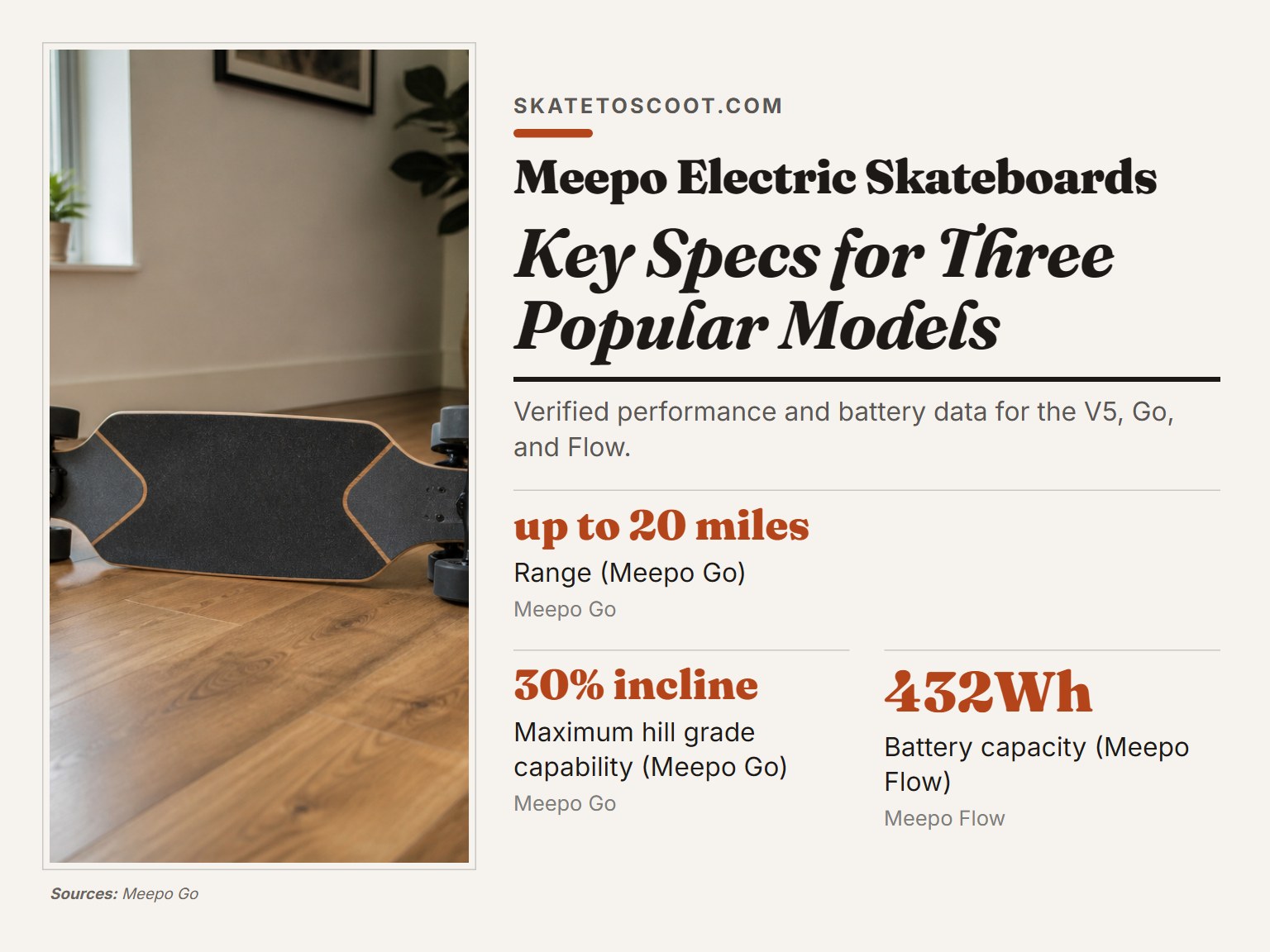
- Choose the Meepo Go if: You have hills to climb (up to 30%), want the highest power and customizable braking, don’t mind replacing belts, and need a board that can handle a heavier rider weight.
- Choose the Meepo Flow if: You prioritize carving and a surfy ride feel over absolute top speed, ride on smooth pavement, and are willing to pay more for the Hobbywing ESC’s smoothness and the premium composite deck.
For most beginners taking their first steps into electric skateboarding, the Meepo V5 with the extended range battery is the default recommendation. It covers the basics well, its limits are forgiving, and its light weight reduces the intimidation factor. The Go is for the rider who already knows they want power. The Flow is for the rider who already loves carving.
What is Meepo’s warranty and support like?
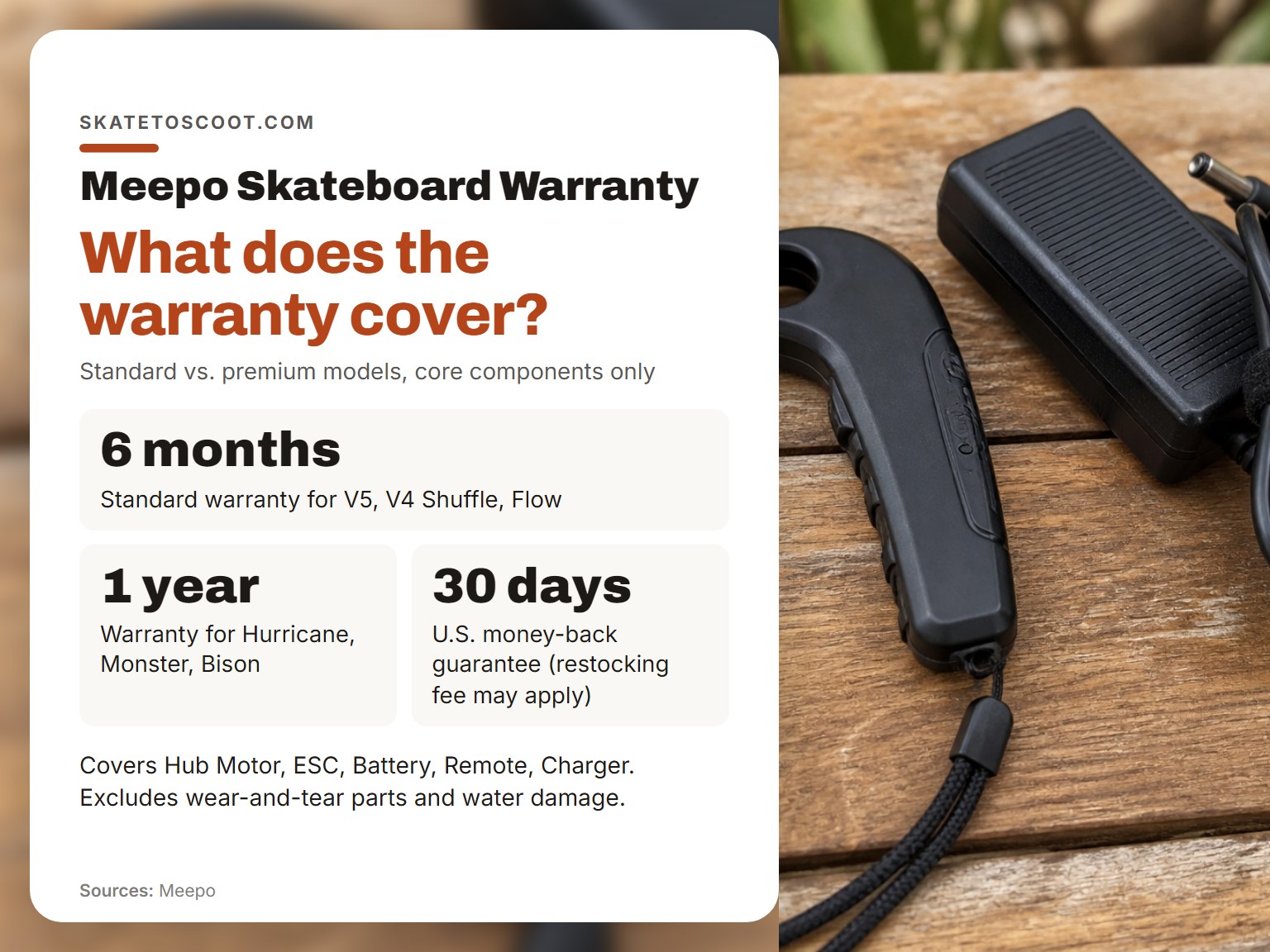
Meepo offers a standard 6-month warranty on most of its boards, including the V5, V4 Shuffle, and Flow. Higher-end models like the Hurricane, Monster, and Bison come with a full year of coverage. This warranty covers core components like the hub motors, ESC, battery, remote, and charger. It does not cover wear-and-tear items like wheels, decks, grip tape, or PU sleeves. Crucially, water damage is excluded even though boards carry an IP rating; they are water-resistant, not waterproof. For U.S. Customers, there’s a 30-day money-back guarantee for new boards, but returns may incur a restocking fee if the product has been used. Support is handled directly through Meepo’s website, and the warranty clock starts ticking from the day your board is delivered.
Frequently Asked Questions
Are Meepo electric skateboards good?
Yes, for the price. Meepo boards deliver competitive speed and range specifications that often match or beat more expensive brands. The trade-off comes in areas like ride refinement, component longevity, and warranty coverage. They are good value if your expectations are set around their budget positioning and you understand the maintenance and warranty exclusions.
Which Meepo board is considered the best?
There is no single “best.” The Meepo V5 is the best for beginners and portability. The Meepo Go is the best for hill-climbing power and customization. The Meepo Flow is the best for a smooth, carving-focused ride. Your priority, ease of use, raw power, or ride feel, determines the winner.
What is the best electric skateboard for the money?
Within the Meepo lineup, the V5 represents the strongest value-for-money proposition for a new rider. Its combination of a proven hub-motor design, adequate performance, and low entry cost is hard to beat. If your budget is under $500 and you want a new board from a known brand, the V5 is a top contender. For a broader market view, check our curated list of the best electric skateboards or a specific Meepo electric skateboard review across all price ranges.
Is Backfire or Meepo better?
This is a classic rivalry. Backfire often uses Hobbywing ESCs, which are praised for their smooth, intuitive control curves, and frequently offers longer warranties. Meepo often pushes higher raw power numbers and more aggressive pricing. Backfire might be “better” for ride smoothness and warranty length; Meepo might be “better” for outright speed per dollar. It comes down to whether you prioritize refined control or maximum spec-sheet performance.
Before You Go
Look past the top-speed number. The real limit for a Meepo board isn’t its advertised 28 or 32 mph; it’s the point where the ride feels unstable or the battery sags cuts your fun short. For the V5, that’s around 25 mph. For the Go, it’s managing the abrupt reverse mode. For the Flow, it’s accepting its heft.
Your first move after unboxing shouldn’t be a speed run. It should be to adjust the truck bushings, disable any gimmicky ride modes, and read the warranty exclusions one more time. These boards are tools, not toys. Their value is immense, but you only get it by treating them with the respect their budget components require. The difference between a board that lasts a season and one that lasts years is often just knowing what you bought.
