Electric Skateboard Review: Which Is Right for You?
This post contains affiliate links. As an Amazon Associate, we earn from qualifying purchases.
An electric skateboard review should start with verified manufacturer specs, not marketing claims. The real differences lie in hill-climbing ability (from 15% to 25-degree grades), top speeds (10 to 45 kph), and how brands handle safety recalls. For most new riders, a board with a 15-20 mph top speed, dual-motor power, and clear warranty terms is the practical choice.
That hill-climbing spec defines the difference between cruising your neighborhood and tackling a real incline without the motor straining to the point of damage. The manuals are explicit about this: push a board past its rated gradient, and you risk permanent electronic failure that no warranty will cover.
What follows is a breakdown built from the actual user manuals and government recall notices. We’ll compare the hard numbers on speed, range, and weight limits, explain the conflicting advice on battery storage, and detail the two major CPSC recalls that every buyer should know. By the end, you’ll be able to read any spec sheet and spot the claims that matter versus the ones that are just noise.
Key Takeaways
- Hill-climbing ability varies wildly, from the Acton Blink S‘s 15% grade to the Evolve GTR‘s 25-degree gradient. Exceeding this limit risks immediate, non-warranty electronic damage.
- Manufacturers disagree on battery storage. Evolve says store at 40-50% charge for long periods; Razor says fully charge it; Evolve GT says keep it fully charged “at ALL times.” This isn’t a minor detail.
- Two major CPSC recalls exist, a 2017 Boosted recall for battery fire risk and a 2019 Yvolve/Neon recall for tire-related fall hazards. Checking recall history is an essential step before buying any used board.
- Real-world range is shorter than claimed, manufacturer tests assume ideal conditions (specific rider weight, flat terrain, warm temps). Cold weather alone can significantly reduce your range, per Evolve’s own manual which states cold affects battery life and power output.
- Warranties are shorter than you think, the Evolve GT series warranty lasts 180 days and explicitly excludes water damage, shipping damage, and “misuse.” Read the fine print before you assume you’re covered.
How Do You Compare Key Electric Skateboard Specs?
Forget “powerful” and “long-range.” Those are marketing adjectives. You need the numbers printed in the OEM manuals. They tell you exactly what the board can and cannot do, and where it will fail if pushed too hard.
The most critical specs form a tight triangle: speed, range, and hill climb. A board might excel in one but sacrifice another. The Acton Blink S, for example, claims a 15 mph top speed and a 5.6-mile range, but its manual states a maximum incline rate of just 15%. That means a moderately steep driveway could be its limit. Conversely, the Evolve GTR manual says it can handle a 25-degree gradient, but that performance comes with a warning: riding continuously on such a steep hill stresses the electronics, and the board’s internal protection will slow it down as a warning.
A board’s hill-climbing rating is a ceiling, not a target. The Evolve GTR manual explicitly warns that if you feel the board slowing on a steep hill, the current protection is kicking in. You must stop to avoid damaging the electronics, damage not covered by warranty.
Where does this data come from? Directly from the source. The 5.6-mile range for the Acton Blink S is listed “with 160 lbs load.” The Meepo V5‘s 45 kph top speed and 18% hill climb are from a review source. The Inboard M1‘s 20 mph top speed and 7-10 mile range are from its official user guide. These aren’t estimates; they are test conditions.
| Board Model | Top Speed | Claimed Range | Max Hill Grade | Key Limitation (from manual) |
|---|---|---|---|---|
| RazorX Cruiser | 10 mph (16 km/h) | Not specified | Not specified | Must be moving 3 mph before motor engages; 220 lb weight limit. |
| Acton Blink S | 15 mph (25 km/h) | 5.6 miles (9 km) | 15% | Performance rated for 160 lb rider; not for use at/below freezing. |
| Inboard M1 | 20 mph (32 km/h) | 7-10 miles (11-16 km) | Not specified | 90-minute charge time; 280 lb rider capacity. |
| Evolve GTR | Not specified | Not specified | 25-degree gradient | Continuous steep hill riding stresses electronics; battery performance drops in cold. |
| Meepo V5 | 45 kph (28 mph) | 18 km | 18% (10°) | 2x 500W motors; remote operates at 2402 MHz. |
The 220 lb weight limit on boards like the RazorX Cruiser and Acton Blink S is a hard stop. Exceeding it, the manuals warn, could injure the rider and damage the board. This isn’t legal padding; it’s an engineering limit. Heavier riders need to look at the Inboard M1 (280 lb capacity) or similar.
What Do the Safety Recalls Tell You?
If specs tell you what a board should do, recalls tell you what can go wrong. Two documented CPSC recalls highlight very different failure modes: fire and falls.
The first is a Boosted skateboard safety recall from January 2017. It involved specific 2nd Generation Boosted Dual+ boards (serial numbers S2634 through S2644) sold between September and November 2016. The hazard? The lithium-ion battery pack could overheat and smoke, posing a fire risk. There were two reports of this occurring. The fix was a free battery replacement.
The second is a Yvolve Sports skateboard recall from October 2019 for Neon Nitro 8 one-wheel boards. The hazard here was a flat tire causing a fall. There were 128 reports of this. The remedy wasn’t a refund or replacement, but new warning labels and updated tire inflation instructions.
Common mistake: Assuming a recall means a full product replacement. In the Yvolve Sports case, the “repair” was a new warning label and instruction sheet. For Boosted, it was a battery swap. The scope and remedy vary wildly.
What’s the takeaway for your review of an electric skateboard? First, check the CPSC database for any model you’re considering, especially if buying used. Second, understand that recalls often target specific batches (like Boosted’s serial range). A recall on one model doesn’t condemn an entire brand, but it reveals a specific point of failure. Third, note the response. A company offering a full refund is different from one mailing out a warning sticker.
Why Is Battery Care So Confusing?
Here’s where the manuals directly contradict each other. There is no consensus, which means following the wrong advice could shorten your battery’s lifespan.
For long-term storage (3+ months), The Evolve GT manual says to “keep the battery fully charged at ALL times.” These aren’t subtle differences.
| Manufacturer | Storage Advice (>3 months) | Operating Temp Advice |
|---|---|---|
| Evolve GTR | Store at 40-50% charge. | Cold reduces battery life and power output. Heat protection is ineffective if left in a hot car. |
| RazorX Cruiser | Fully charge before storage. Do not charge at/below 32°F (0°C). | Not specified. |
| Acton Blink S | Not specified. | Battery best used at 50-75°F (10-24°C). No riding at/below freezing. |
| Inboard M1 | Not specified. | Storage and operating range: 0-40°C (32-104°F). |
| Boosted Charger | Not specified. | Charger for indoor use only. Do not charge outdoors/in rain. Do not use above 40°C. |
Sources disagree on the best practice: the Evolve GTR manual advises storing at 40-50% charge for prolonged non-use, the RazorX Cruiser manual says to fully charge before storage, and
The temperature rules are just as critical. The Acton Blink S manual states “NO RIDING AT/BELOW FREEZING TEMPERATURE” because cold can permanently damage the battery. The Evolve GTR manual notes cold affects “battery life and power output.” The Boosted Model S2 charger manual says it’s for indoor use only and should not be used outdoors or in the rain.
What’s the Real Cost of Ownership?
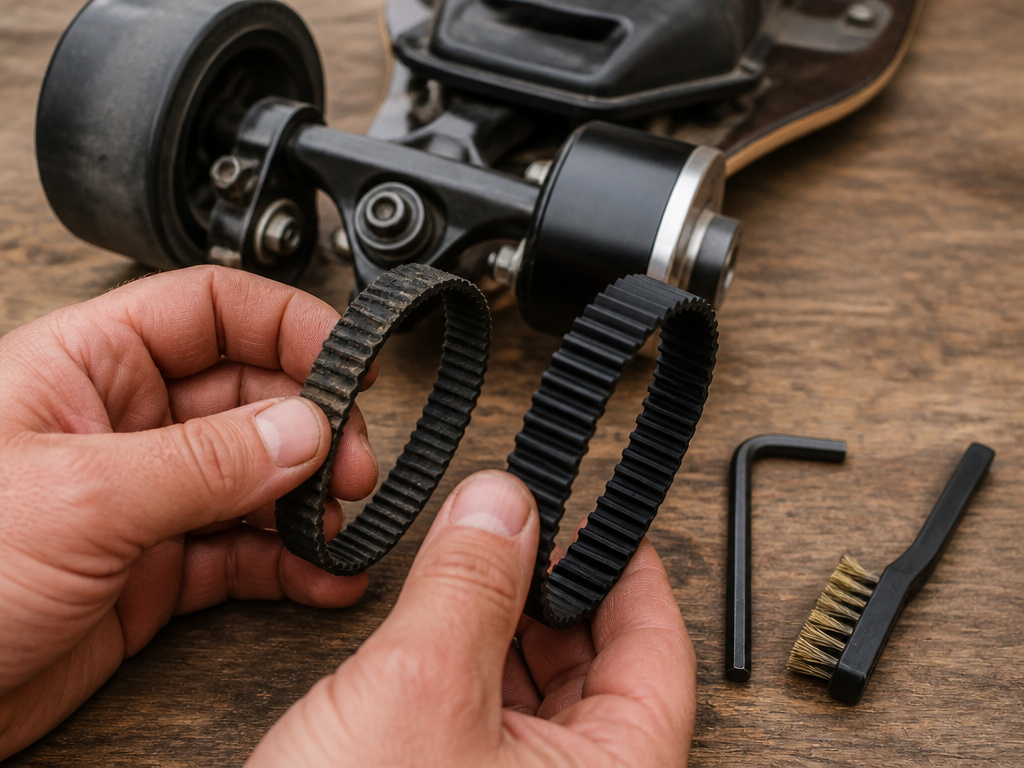
The purchase price is the first check you write. The second is for maintenance, repairs, and eventual battery replacement. No manual includes this math, but the requirements are there in black and white.
Evolve’s manuals are the most detailed. They state you are responsible for maintenance, and failure due to lack of maintenance voids warranty. Their list includes:
- Cleaning bearings for best roll (dirty bearings reduce battery performance).
- Checking all screws and nuts are tight.
- Rotating wheels (drive wheels wear fastest).
- Cleaning and checking the belt and drive gear for damage, replacing if necessary.
- Keeping All Terrain tyres between 30-45 PSI.
To put it plainly. Belts wear out. The TechGearLab review of the Backfire Zealot S2, which hit a tested 30.8 mph, notes “will need to replace belts at some point.” Bearings need cleaning and eventual replacement. Tires lose pressure and wear down. These are consumables, not defects.
Where this goes sideways: Thinking the warranty covers everything. The Evolve GT warranty lasts 180 days and explicitly excludes “misuse, neglect, abuse, accident or riding in water and shipping damage.” Water damage is a huge one. Many boards are not waterproof, and riding in water can damage electronics, which is often excluded from warranty coverage.
Then there’s the battery itself. Even with perfect care, lithium-ion batteries lose capacity over time. The cost of a replacement battery from the manufacturer can be several hundred dollars. Factor that into your 3-5 year ownership plan. This long-term financial picture is a key part of your electric skateboard review and safety planning, ensuring your board remains reliable and doesn’t fail unexpectedly mid-ride.
Which Electric Skateboard Is Right for You?
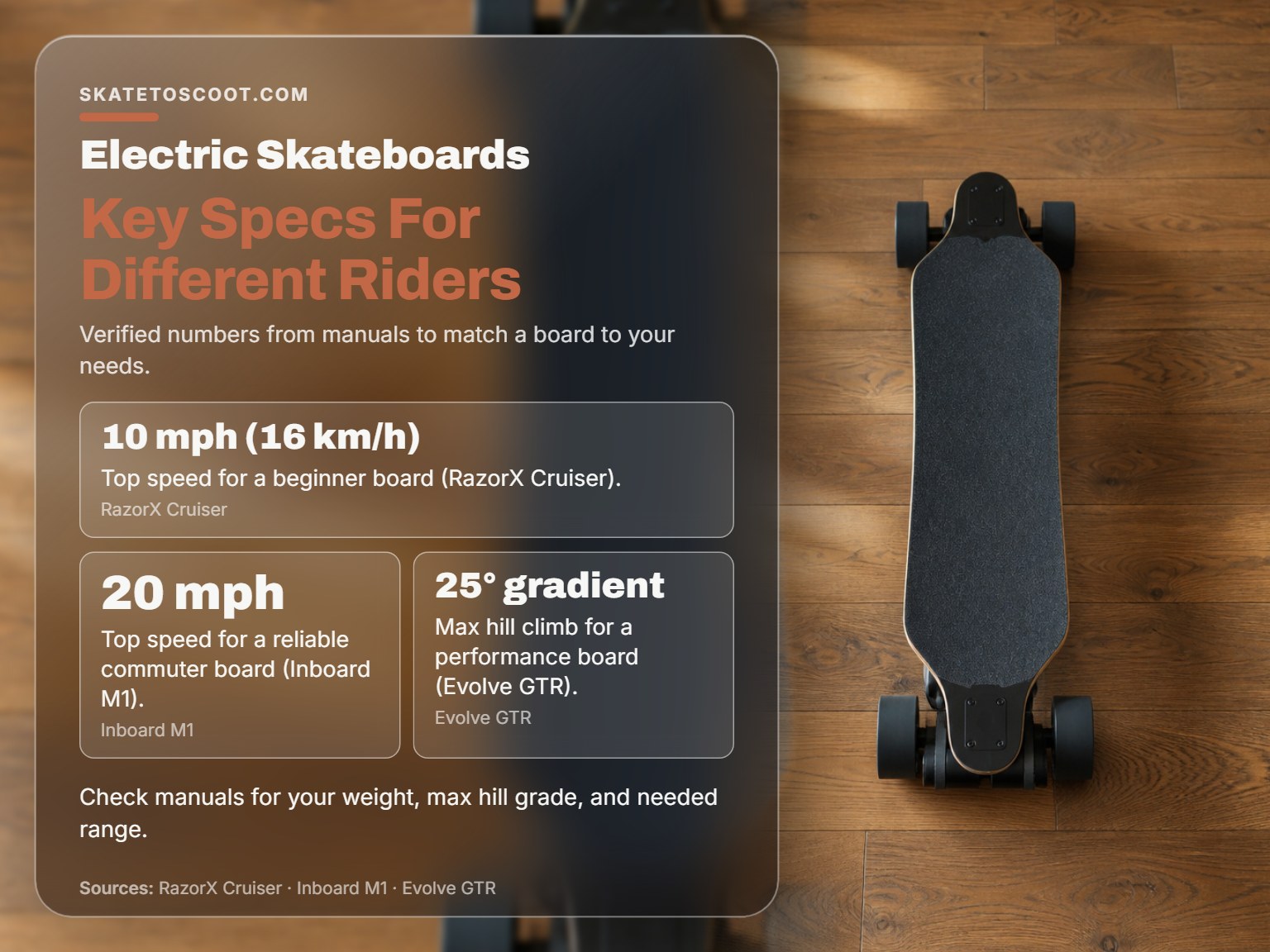
This process is about matching the board’s verified capabilities to your specific needs, weight, and local terrain.
For a complete beginner, especially a younger rider, the constraints are clear. The RazorX Cruiser has a 10 mph top speed and a strict 220 lb weight limit. Its manual also says it’s not for riders under age 9. The low speed and simple operation make it a candidate, but the weight limit is the deciding factor. Many beginner boards have similar limits.
For a commuter needing reliability, look at the specs that affect daily use. The Inboard M1 offers a 20 mph top speed and a 7-10 mile range with a 90-minute charge time. Its 280 lb rider capacity covers most adults. The Meepo V5 offers more speed (28 mph) and range (18 km) but comes from a brand with a different support network. For a commuter board, also consider the hill grade on your route versus the board’s max climb.
For performance riders, the trade-off is between power and warranty risk. The Evolve GTR can tackle 25-degree hills, but the manual warns that pushing it continuously on such terrain can damage the electronics, damage not covered. The Backfire Zealot S2, per TechGearLab, delivered a tested top speed of 30.8 mph. You accept that belts will need replacing.
When comparing top electric skateboards, use the spec table from the manuals as your baseline, not the marketing headlines. Your decision should flow from three answers: What’s my weight? What’s the steepest hill I need to climb? How far do I really need to go on a single charge? Match those to the hard numbers.
Frequently Asked Questions
Are electric skateboards worth it?
They can be, as a fun recreational device or short-distance commuter tool. Their worth depends entirely on matching a board’s real, manual-stated capabilities to your needs. A board that can’t climb your driveway or that you exceed the weight limit for is a wasted investment. Consider the ongoing cost of belts, bearings, and eventual battery replacement in your calculation.
What is a good brand of electric skateboard?
“Good” means reliable, with clear specs and responsive support. Brands like Evolve and Boosted (pre-2020) have extensive manual documentation, which is a sign of professionalism. However, even good brands have recalls (see Boosted, 2017) and specific model limitations.
How hard is it to learn to ride an electric skateboard?
The learning curve is steep if you have no board sport experience. The RazorX Cruiser manual states the board must be moving at least 3 mph before the motor engages, forcing a push-start. All manuals emphasize wearing a helmet and protective gear. The remote control, with its acceleration and brake triggers, adds a layer of complexity vs a traditional skateboard. Master stopping and starting at low speeds in a safe area before attempting any real commute.
How long do electric skateboards last?
The mechanical parts (belts, wheels, bearings) are wear items needing periodic replacement, as outlined in maintenance guides. The lithium-ion battery will degrade over time depending on use and care, with replacement being a significant cost. The deck and trucks can last much longer. Lifespan is directly tied to following the manufacturer’s maintenance schedule and heeding their warnings on weight limits, water, and temperature.
The Bottom Line
An electric skateboard review should end with a filter, not a ranking. Run any board you consider through these three questions, using only the manufacturer’s manual for answers.
First, do you exceed the rider weight limit? If yes, that board is disqualified. It’s not a suggestion.
Second, can it handle the steepest hill on your regular route? Compare that grade to the manual’s max hill climb spec (15% for Acton, 25-degrees for Evolve). If your hill is steeper, pick a different board or be prepared to walk it.
Third, what’s the battery storage rule for your climate? If you live somewhere with freezing winters and the manual says “no riding at/below freezing,” that board will be unusable for months unless you have indoor storage and charging. The conflicting advice on storage charge (40% vs. 100%) means you must follow the manual for your specific model, not generic online tips.
Finally, check the CPSC recall database. It takes two minutes. Knowing that a brand has handled a safety issue transparently is more valuable than any star rating. Your goal is to find a capable board whose limits you understand and whose manual you’ll actually read. Start there.
