What Is an Electric Skateboard? Types, Motors, and Brakes
This post contains affiliate links. As an Amazon Associate, we earn from qualifying purchases.
An electric skateboard is a motorized skateboard propelled by a battery-powered electric motor, controlled via a handheld remote. It’s designed for recreation, commuting, and “last-mile” transportation, offering speeds from 15 mph to over 30 mph and ranges from 10 to over 35 miles on a charge, far exceeding the effort-based 5-8 mph of a regular skateboard.
The motor changes everything. It’s not just about going faster with less effort. It introduces a layer of complexity, electronics, batteries, software, that a traditional wooden deck and trucks never had to worry about. That complexity brings new questions about safety, legality, and real-world usability that a simple push board doesn’t. A fundamental question many new riders have is: what is an electric skateboard?
What follows: a breakdown of exactly what’s under the deck, how the law sees these boards (often differently than manufacturers do), the critical safety recall every rider must know about, and a realistic look at where they fit into your life.
Key Takeaways
- The core difference is the motor and battery system, which can propel riders at 15-30+ mph versus the 5-8 mph of manual pushing.
- Legality is local and contested: California’s AB-604 law defines them as “Electrically Motorized Boards” (EMBs) with a 20 mph speed cap, but high-performance models far exceed this, creating a regulatory gray area.
- Safety is essential: A 2023 CPSC recall of all Onewheel models, linked to four rider deaths, mandates immediate firmware updates or refunds and underscores the absolute need for a helmet.
- Weight and range are trade-offs: Electric boards weigh 15-25 pounds (vs. 6-8 lbs for regular boards) but can travel 10-25+ miles on a charge, making them practical for short commutes.
- They are not waterproof: Riding in the rain risks electronic failure; no major manufacturer recommends it, regardless of a board’s IP rating.
The Core Components That Make It Go
An electric skateboard is a specific set of parts working together. Miss one, and you’re just carrying a heavy regular board.
The deck is what you stand on, usually made of wood or composite. The trucks connect the wheels to the deck and let you turn by leaning. So far, it’s identical to a traditional skateboard. The change starts with the battery pack, almost always a lithium-ion unit, mounted underneath. This is the fuel tank. Its capacity, measured in watt-hours (Wh), dictates your range.
The motor is the engine. Most boards use either a hub motor (built into the wheel, quieter and more protected) or a belt-drive motor (external, connects to the wheel via a toothed belt, easier to maintain and swap). The hub motor design, like the one in a Massey University thesis prototype, integrates the motor inside the wheel.
The Electronic Speed Controller (ESC) is the brain. It takes the signal from your thumb on the remote control and translates it into precise power delivery to the motor for acceleration and braking. A flaky ESC means unpredictable speed changes. The remote itself is your throttle and brake lever. Lose Bluetooth connection, and the board will coast, it doesn’t slam on the brakes. You need to know how to foot-brake.
| Component | Primary Function | What Fails If It’s Wrong |
|---|---|---|
| Battery | Stores energy for the motor | Under-capacity cuts range by half; poor cells can swell or fail |
| Motor | Provides propulsion | Under-powered motor bogs on hills; over-powered motor drains battery fast |
| ESC | Controls power to motor | Laggy response causes jerky acceleration; failure can lead to runaway board |
| Remote | Sends rider commands to ESC | Dead connection leaves rider with no control; low battery triggers sudden shutdown |
For a detailed look at each part’s role, check our guide on electric skateboard components.
Electric Skateboard vs. Regular Skateboard: The Real Trade-Offs
This is the fundamental choice when you compare a what is an electric skateboard. It’s not about which is better, but which is better for you.
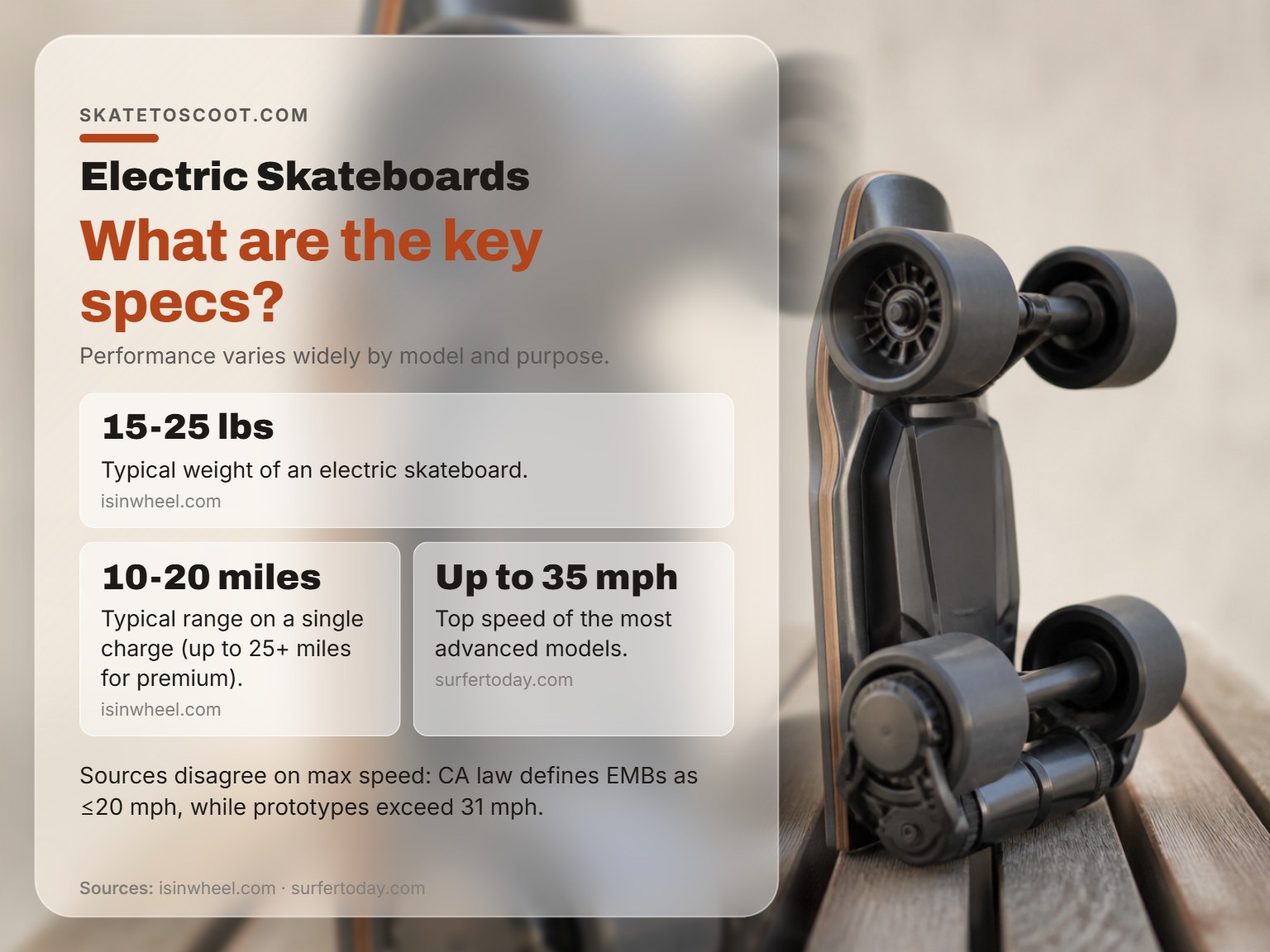
An electric skateboard gives you speed and range without the sweat. Most entry-level models hit 15-20 mph. High-performance boards push 25-30+ mph. That Massey University prototype clocked over 50 km/h (31 mph). Your range is 10-20 miles, with premium boards claiming 25 miles or more. The motor laughs at hills. The cost starts under a hundred dollars and climbs past two thousand.
A regular skateboard is simpler, lighter, and cheaper. Your speed caps at 5-8 mph for casual cruising, dictated by your leg power and courage. It weighs 6-8 pounds. You can pick it up with one hand. There’s no battery to charge, no remote to pair, no firmware to update. The cost? Often under a hundred dollars.
Where this goes sideways: Assuming an electric skateboard is just a faster regular skateboard. The weight, 15-25 pounds, makes it a chore to carry up stairs or onto a bus. The need to plan around a battery charge turns a spontaneous ride into a logistics puzzle. That premium board with a 30-mile range is useless if you left it charging at home.
The learning curve is different, too. Balance is balance, but managing a remote control while carving adds a cognitive layer. I’ve watched new riders focus so hard on the thumb throttle that they forget to look where they’re going. A regular board teaches you to generate your own power; an electric board teaches you to manage power that’s already there.
For a full side-by-side breakdown, see our electric vs regular skateboard comparison.
How Fast Can They Really Go? (And Why the Law Cares)
Here’s the conflict no sales page will highlight in the what is an electric skateboard discussion: what your board can do and what the law says it can do are often two different numbers.
Under California’s AB-604 law, an “Electrically Motorized Board” or EMB is legally defined as having a speed capability of no more than 20 miles per hour. This California e-skateboard operation law governs where you can ride and what safety gear you need. The law was designed to bring these devices into the same category as bicycles for road-use purposes.
Meanwhile, commercial reality laughs. Sources disagree on maximum speed: surfertoday.com states the most advanced models can go up to 35 mph, while the California Vehicle Code defines an EMB as having a speed capability of no more than 20 mph. The academic prototype was built for over 50 km/h (31 mph). Common high-performance boards tout 25-30+ mph. Your brand-new board, straight out of the box, likely exceeds the legal speed limit for its class in its highest performance mode.
So who’s right? The engineer pushing the envelope, or the traffic regulator worried about mixing a 30-mph silent vehicle with bike-path traffic? Both, in their own contexts. This discrepancy means you, the rider, must be the judge. Riding a 30-mph board on a path legally limited to 20-mph devices is a calculated risk. Many local ordinances simply adopt the state’s EMB definition, so knowing your local code is step one.
The Safety Equation: Recalls, Gear, and Real-World Risks
Be realistic about safety. A motor adds energy, and that energy has to go somewhere in a crash. This is a matter of physics.
The most stark data point is the September 2023 CPSC Onewheel recall notice. The U.S. Consumer Product Safety Commission and Future Motion recalled all Onewheel self-balancing skateboards, every model ever sold. The reason: the boards “can stop balancing the rider if the boards’ limits are exceeded,” leading to a crash hazard. Four reported deaths between 2019 and 2021 were linked to these incidents. In at least three of the fatal crashes, the rider wasn’t wearing a helmet. The mandated fix is a firmware update to add a “Haptic Buzz” warning system, or for older models, a refund.
This serves as a case study in the unique risks of motorized, self-balancing platforms. Even standard e-skateboards have inherent dangers. A California Highway Patrol report from 2016-2019 found 40 reported crashes involving EMB riders, accounting for less than 0.004% of all state traffic crashes.
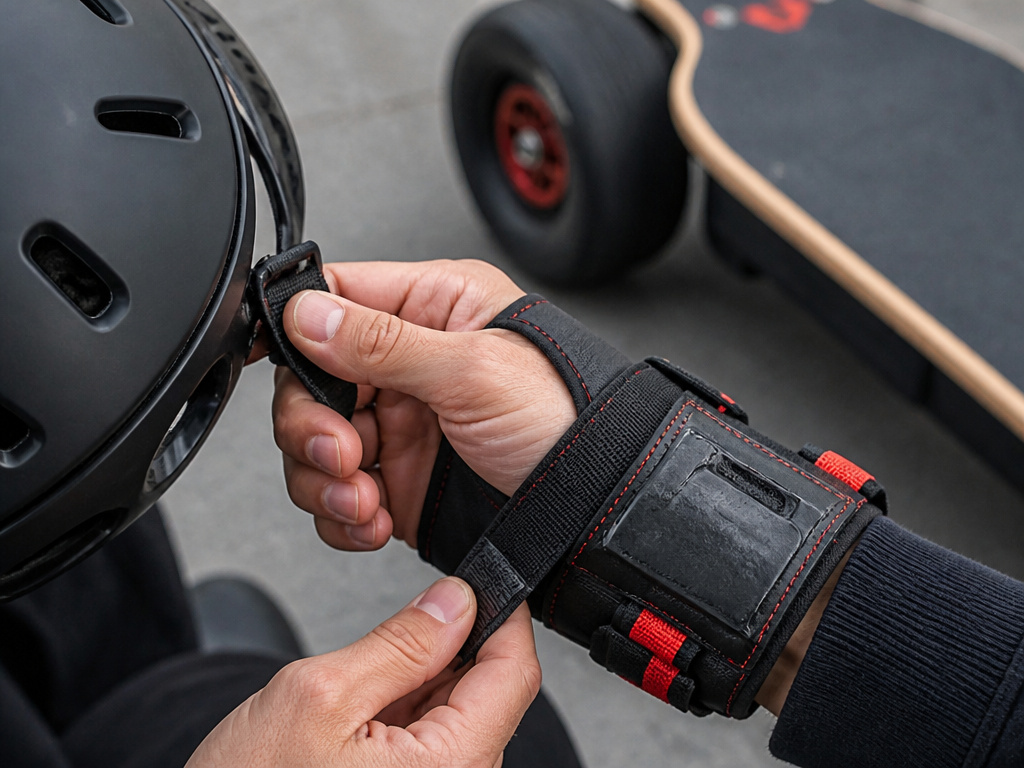
Your gear is your margin for error. A helmet is non-optional. The CPSC and every seasoned rider will tell you that. Wrist guards, knee pads, and elbow pads turn a potential fracture into a scrape. The board itself needs maintenance: check tire pressure, listen for bearing noise, and inspect the battery enclosure for cracks.
Common mistake: Relying solely on the electronic brake. Learn to foot-brake. If your remote disconnects or the battery dies, the board coasts. Knowing how to slow down without the remote is a fundamental skill most beginners skip.
For a full look at mitigating risk, read our article on the safety of electric skateboards.
Where You Can (and Can’t) Ride
Legality is a patchwork. It changes by country, city, and sometimes by the type of path.
In California, thanks to AB-604, EMBs are legal on streets, bike paths, and trails unless specifically prohibited by local ordinance. According to surfertoday.com, the board must have headlights, reflectors, and a motor under 1,000 watts to comply with California’s AB-604 law. Other states and countries vary wildly. Some treat them like motor vehicles, requiring registration. Others ban them from sidewalks but allow them on roads. Many places haven’t updated their laws at all, leaving you in a gray zone.
“The absence of a law forbidding the right to ride an electric skateboard does not necessarily mean that it is legal to get them to the streets.” That line from a Surfertoday.com article sums up the challenge. You must proactively check your local county and city transportation codes.
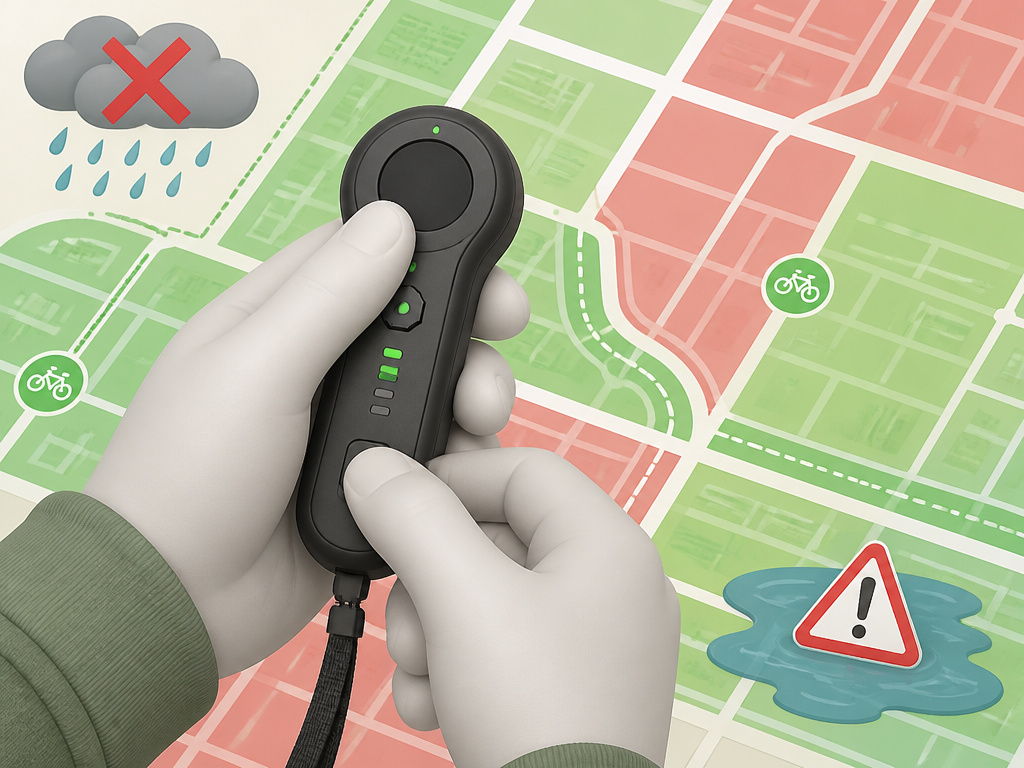
Riding in the rain is a firm “don’t.” Water and electronics are enemies. Even if a board has an IP rating, prolonged exposure can lead to corrosion in motor bearings and ESC failure. The advice is universal: avoid puddles, and if you get caught in a shower, dry the board thoroughly afterward.
As for terrain, most e-skateboards are built for smooth pavement. All-terrain models with big, knobby tires exist for grass and hard-packed dirt, but they’re the exception. Hitting a large crack or rock on a standard street wheel at 20 mph is a guaranteed way to test your safety gear. Start on empty parking lots and smooth bike paths. Graduate to city streets only when your control is instinctive.
Need ideas for practice spots? We’ve compiled a list of suitable areas to learn and ride.
Buying Considerations: Price, Performance, and Purpose
You get what you pay for, but you don’t always need the most expensive option.
Prices span from under a hundred dollars for toy-grade models to over $2,000 for high-performance boards. The recalled Onewheel models sold for between $1,050 and $2,200. Most reputable beginner boards land in a mid-range price bracket. That price buys you decent range (10-15 miles), adequate speed (15-20 mph), and enough reliability for casual use.
Think about your primary use case:
- Last-Mile Commuter: You need portability (lighter weight), enough range for your trip plus a safety margin, and reliability. A hub-motor board often fits here.
- Weekend Warrior: You want thrill and performance. Look at belt-drive systems for torque, higher top speeds (25+ mph), and range over 20 miles. Brands like Evolve or Boosted (before its demise) targeted this market.
- All-Terrain Explorer: You’ll encounter rough paths or grass. You need larger, air-filled tires and a powerful motor. These are heavier and more expensive.
Remember the hidden costs: a helmet ($50-$150), pads ($30-$100), replacement tires or belts ($20-$50 per set), and eventually, a new battery pack ($200-$500). The board is the entry fee; the gear and upkeep are the subscription.
For those just starting out, we have a dedicated guide to boards for new riders.
Types of electric skateboards
Electric skateboards come in different forms to suit various riding styles. Common categories include longboards, which offer stability at higher speeds and a smoother ride for commuting, and all-terrain boards, built with larger, rugged tires to handle rougher surfaces like gravel paths or grass. The specific design, from the deck shape to the wheel size, dictates where and how comfortably you can ride. Choosing the right type depends on whether you plan to stick to paved city streets or venture onto more uneven ground.
Hub motor vs belt drive electric skateboards
The two main motor systems are hub motors and belt drives. Hub motors are built directly into the wheels, resulting in a quieter, more discreet board that often resembles a regular skateboard. Belt-drive systems use a separate motor connected to the wheels via a belt and pulley. This setup typically allows for more torque for climbing hills and makes it easier to swap out standard wheels. Your choice affects the board’s maintenance, sound, and feel when accelerating.
How electric skateboard braking works
Electric skateboards use electronic braking systems controlled by a handheld remote. When you engage the brake, the electric motor resists its own rotation, slowing the board. Many systems feature regenerative braking, which captures some of the energy during braking to recharge the battery slightly, extending the overall range. The effectiveness and smoothness of the braking are crucial for safety, so it’s vital to practice in a controlled area to understand how your specific board responds.
Frequently Asked Questions
Is an electric skateboard legal in the USA?
There is no federal law. Legality is determined by state and local ordinances. California has specific laws (AB-604) permitting EMBs with restrictions. Many other states have no explicit laws, creating a gray area. Always check your city and county codes before riding in public. For a detailed analysis, see our article on the legality of electric skateboards.
How much does an electric skateboard cost?
Prices range from under $100 for basic models to over $2,000 for high-performance boards. Most quality beginner boards from reputable brands cost between $400 and $800. The ongoing costs of safety gear, maintenance, and eventual battery replacement add to the total investment. Our guide on the cost of an electric skateboard breaks it down further.
Can you use an electric skateboard as a regular skateboard?
Yes, but it’s not ideal. When powered off, you can push it manually. However, the added weight (15-25 lbs vs. 6-8 lbs) makes it much more cumbersome to kick-push than a traditional board. It’s a useful backup if your battery dies, but you wouldn’t choose to ride it unpowered regularly.
Is it hard to learn to ride an electric skateboard?
If you have prior skateboarding, snowboarding, or surfing experience, you’ll adapt quickly, often within a session or two. If you’re entirely new to board sports, expect a learning curve of several hours over a few days to feel comfortable with balance, remote control, and braking. Always learn in a safe, open area away from traffic.
What is an electric longboard?
It’s a subtype of electric skateboard characterized by a longer deck (typically over 36 inches) and larger, softer wheels. This design prioritizes stability and comfort at higher speeds over the agility of a shorter cruiser-style e-board. You can learn more about this specific style in our explainer on electric longboards.
The Bottom Line
An electric skateboard is a tool for specific jobs. It’s a brilliant solution for a 3-mile flat commute where you can avoid major roads. It’s a fun way to explore paved trails on the weekend. It is not a toy, and it is not a direct replacement for a traditional skateboard.
The single most important thing you can do is respect its limits and the law’s limits. That high-performance board might do 30 mph, but the legal path you’re on might be governed by a 20 mph EMB rule. Your safety gear is what stands between a minor fall and a traumatic injury, a fact underscored by the federal recall of an entire popular product line.
If you’re considering one, start with a mid-range board from a known brand, invest in a high-quality helmet before you even take the board out of the box, and dedicate your first week to parking-lot drills. The skill you build there is the foundation for everything that comes after. The board just adds the power.
