Mobility Scooter Review: The 3-Wheel vs. 4-Wheel Debate
This post contains affiliate links. As an Amazon Associate, we earn from qualifying purchases.
A mobility scooter review should cut through marketing and focus on three things: stability (4-wheel beats 3-wheel for most users), battery care (contradictory manuals create real confusion), and real-world durability (peer-reviewed studies show a wide reliability gap). The best scooter for you depends less on brand and more on matching your daily terrain and transport needs.
Most reviews list features. They skip the part where a scooter that works fine at the mall starts bottoming out on a tree-root-heaved sidewalk after six months. Or where one manual says “charge daily” and another says “charge weekly,” leaving you to guess which protocol kills a $200 battery pack faster.
What follows is a breakdown of the specs that matter, the brands that back them up, and the research that shows why some scooters fail long before others. We’ll start with the single biggest safety choice.
Key Takeaways
- Choose a 4-wheel scooter for daily outdoor use; a 3-wheel model’s tipping risk isn’t worth the tighter turn radius for most users.
- Battery care is not universal: the Pride Raptor manual says fully charge for storage, while the Invacare Leo manual says recharge before half-full, know which protocol your scooter uses.
- Real-world durability varies wildly: a 2013 study applying ANSI/RESNA standards found scooter survival life ranged from 62,512 to over 1 million cycles.
- For transport, verify the heaviest disassembled piece is something you can lift into your vehicle.
- Look beyond the sales sheet: a recall for firmware-caused power loss (like the 2022 NIU MQiGT EVO) is a more telling reliability signal than a warranty length.
The 3-Wheel vs. 4-Wheel Stability Debate
A three-wheel scooter tips over. It’s not a maybe; it’s physics. The front wheel sits on a single pivot point, and any sharp turn or uneven pavement load can shift the center of gravity outside that tiny triangle of support. A four-wheel scooter has a wider, rectangular base. That extra wheel on the front axle spreads the load.
Consumer Reports states four-wheeled scooters are generally preferable for safety reasons. Their testing of a popular 3-wheel model found they “weren’t able to stop on a downhill section using the hand brake” and noted it would be “unsuitable for those who lack the core strength… To prevent the device from tipping.”
Where this goes sideways: Leaning into a turn on a 3-wheeler. The inside wheel lifts first, and if your speed is above a crawl, the scooter rolls onto its side before you can correct. An ankle sprain is the common result.
The trade-off is maneuverability. A 3-wheeler can pivot in a tighter circle, which is great for narrow indoor aisles. But if your primary use is outdoors, on sidewalks, paths, or any non-perfect surface, the stability of four wheels is essential. It’s the difference between a tool you use confidently and one you’re constantly bracing against.
Decoding Scooter Specs and Standards
The numbers on a spec sheet tell a story, but you need to know the language. Two of the most important are the IP rating and the weight capacity.
IPX4 is a common ingress protection rating, listed for models like the Pride Raptor and Invacare Leo. It means the scooter is protected against water splashes from any direction. It is not waterproof. You can ride it in light rain, but a deep puddle or leaving it out in a downpour is a gamble. The electronics are sealed against sprays, not immersion.
Weight capacity is the other critical number. It’s not a suggestion. Exceeding it stresses the frame, motor, and brakes, leading to premature failure. A heavy duty mobility scooter might have a higher weight capacity, but a standard travel model often has a lower limit. Include your weight plus anything you’ll regularly carry, a purse, groceries, an oxygen tank.
| Key Spec | What It Means | Red Flag If Missing |
|---|---|---|
| Weight Capacity | Max user + cargo weight. Exceeding it voids warranties and breaks things. | Listed only as “user weight” with no cargo allowance. |
| IP Rating (e.g., IPX4) | Dust/water resistance per IEC 60529. X means no dust rating; 4 means water splashes. | No IP rating mentioned for a scooter marketed for “all-weather” use. |
| Battery Type & Voltage | Usually 12V or 24V Sealed Lead Acid (SLA) or Lithium. Defines range and charge care. | Vague claims like “long-lasting battery” with no chemistry or voltage. |
| Braking Distance | How far it travels to stop from a set speed (e.g., Invacare Leo: 1000mm at 6 km/h). | No published braking data, especially for a 4-wheel model. |
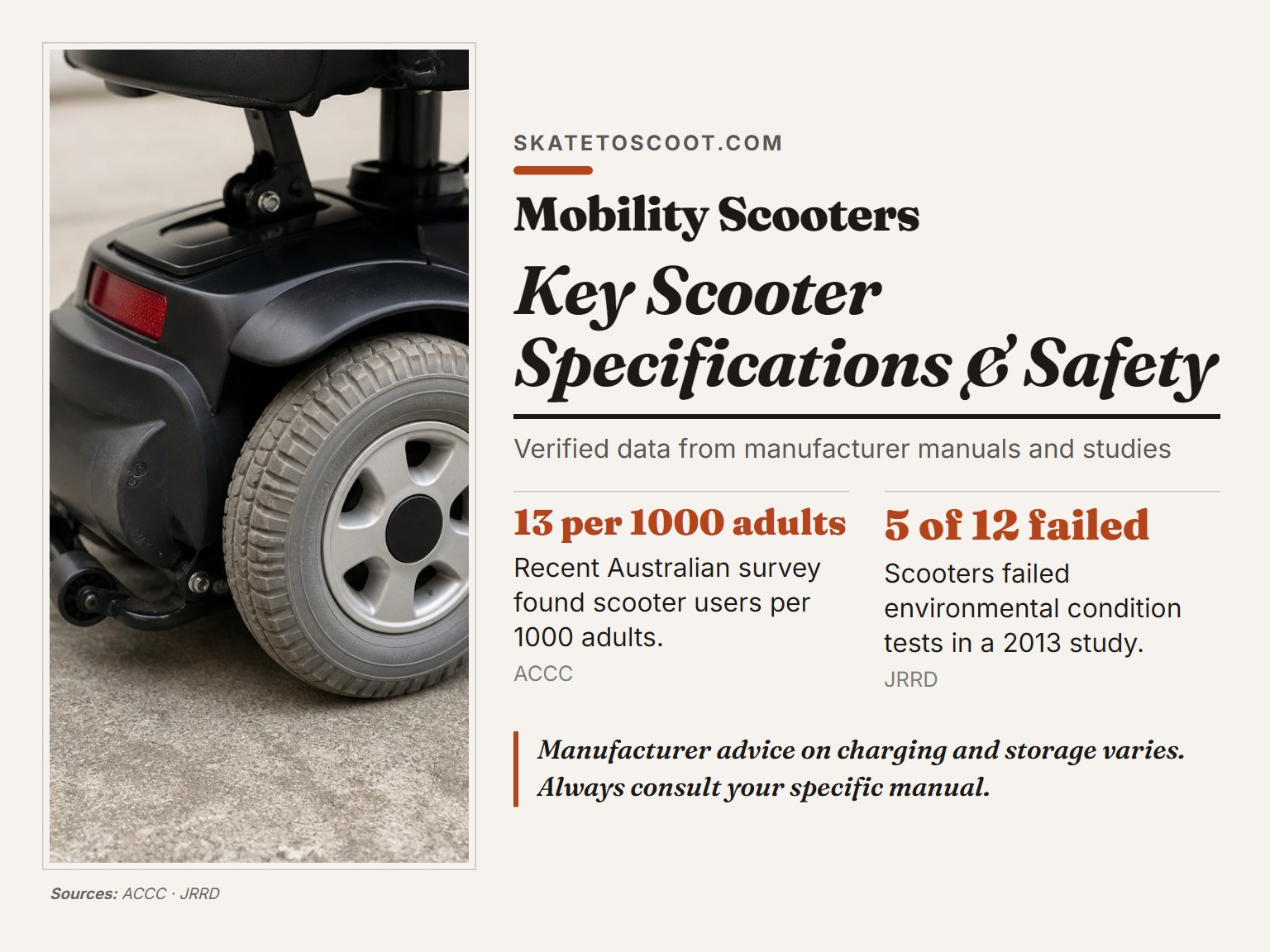
One standard you won’t see on a sales sheet but matters immensely is ANSI/RESNA WC-4. This is the wheelchair (and scooter) durability standard used in independent testing. A 2013 study in the Journal of Rehabilitation Research and Development applied these standards to 12 scooters. The results were stark: survival life ranged from 62,512 to 1,178,230 cycles against a 400,000-cycle pass threshold. Five of twelve scooters failed environmental tests outright. This is the kind of mobility scooter standards testing that separates marketing claims from engineering reality.
Battery Care: Where the Manuals Contradict Themselves
This is the most confusing part of ownership. Manufacturers don’t agree, and following the wrong advice can shorten your battery’s life by months.
For long-term storage (over a month), the Pride Mobility Raptor manual states to fully charge its batteries prior to storage. The Invacare Leo manual advises checking monthly and recharging before the gauge reads half full for long-term storage (>4 weeks). One says a full charge protects the battery; the other says a full charge left for months can sulfate the plates.
For daily charging, advice varies: the Invacare Leo manual recommends charging daily after every discharge, while the CareCo X-Go Astro manual says to recharge after each use and also to charge at least once a week even if not used.
Common mistake: Leaving a scooter with a half-charged SLA battery in a cold garage over winter. The charge depletes further in the cold, the electrolyte freezes, and the plates crack. You’ll replace it in spring.
Here’s a quick guide to navigate the noise:
- Identify your battery: Most are Sealed Lead Acid (SLA). A growing number of lightweight mobility scooter models use Lithium.
- Find your manual: Stick to your specific brand’s protocol. Don’t apply Pride’s rules to an Invacare.
- Watch the temperature: Almost all manuals warn against charging in extreme cold (<10°C/50°F) or heat (>30°C/86°F). The Invacare Leo manual explicitly states this.
The takeaway? There is no universal “best practice.” Your scooter’s manual is the final word.
Real-World Reliability and What Breaks First
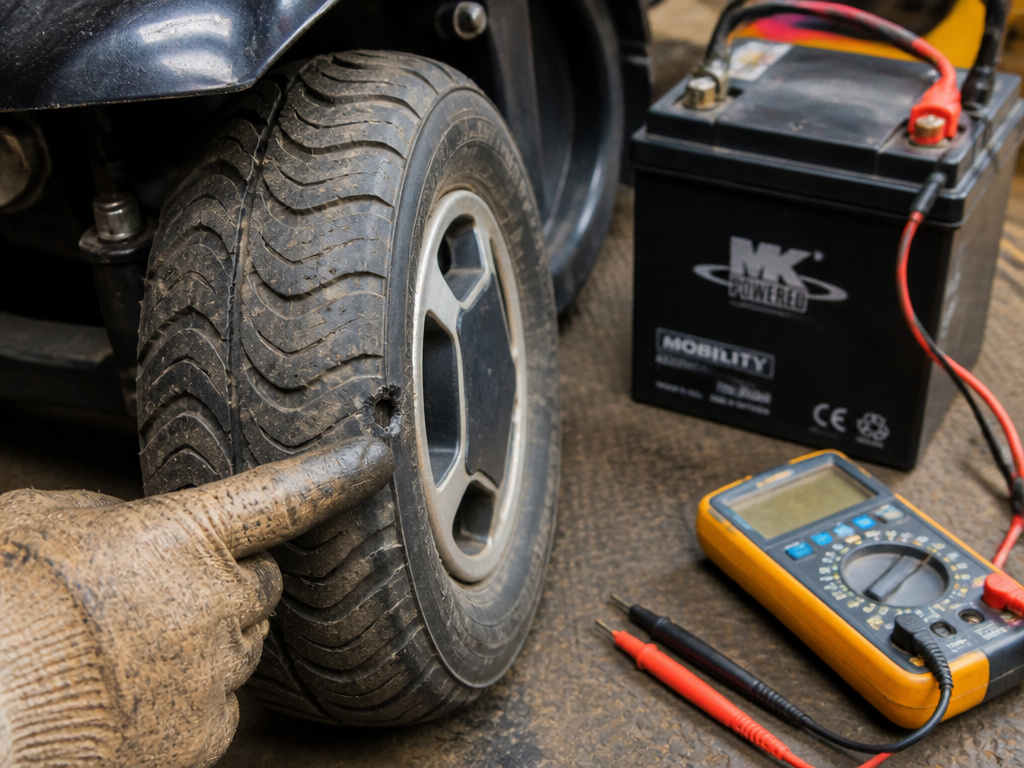
Online reviews glow about comfort and turn radius, but a thorough mobility scooter review must check forum threads, which tell a different story. The real pain points are tires, batteries, and electronics, the parts that face daily wear.
A Reddit user with a Pride GoGo noted needing “the battery and tires replaced multiple times” in less than two years with daily use. That’s a recurring cost many buyers don’t factor into the mobility scooter cost.
Tires wear down, especially on pavement. Solid tires last longer but give a harsher ride. Pneumatic tires are more comfortable but can puncture. The best outdoor scooter often has larger, more rugged tires, but they still need replacement.
Electronics fail, too. The 2022 NHTSA recall for the NIU MQiGT EVO is instructive. The cause was “firmware-caused loss of motor power and excessive handlebar vibration.” A software glitch could strand a rider. This is why brand reputation for service matters. For example, the CareCo Pinnacle scooter frame has a two-year limited warranty, while its controllers and electronic components have a one-year limited warranty.
I’ve seen scooters where the plastic shrouds crack after a year of sun exposure, and the tiller wiring gets frayed from constant adjustment. These aren’t deal-breakers, but they’re the kind of real-world wear a brochure photo never shows.
When evaluating, look past the glossy images. Search for “[your model] + problem” or “[your model] + repair.” The forum results are a more honest mobility scooter review than any sales page.
Portability and Transport: The Weight You Actually Lift

“Portable” and “lightweight” are relative. A scooter that disassembles into five pieces is only portable if the heaviest piece fits in your car and you can lift it.
Many foldable mobility scooters advertise a low total weight. The catch is that weight is distributed. The front section, the tiller, floorboard, and motor, is often the densest chunk. Can you lift 44 lbs into your trunk? If not, you’ll need a ramp or a helper, which defeats the “easy travel” claim.
Here’s what to check before you buy for transport:
- Disassembled weight of the heaviest piece: Call the dealer or scour YouTube reviews for this exact number.
- Trunk dimensions: Measure your trunk space and compare it to the dimensions of the largest scooter piece.
- Lift assist: Some models have a lightweight lithium battery pack you can remove first, dropping the heft of the main frame.
If you travel by air, the rules tighten. Airlines and cruise ships may approve certain foldable travel scooters with specific lithium battery watt-hour ratings. You must check with the carrier every time. “Airline approved” in a product description is a starting point, not a guarantee.
How to Use This Review to Choose
Lists of the best mobility scooters are everywhere. Use them as a shortlist, not a final answer. Your choice boils down to a short series of honest questions.
First, profile your daily use:
- Terrain: Smooth indoor floors? Pavement? Grass? Gravel paths?
- Distance: How many miles/kilometers between charges?
- Transport: Will it live in your home, or do you need to lift it into a car daily?
- Storage: Do you have a garage, shed, or only a small apartment closet?
Second, match a scooter type to that profile:
- For indoor/outdoor pavement: A standard 4-wheel, medium-weight scooter like many from Pride’s lineup.
- For travel and tight spaces: A true lightweight mobility scooter that folds or disassembles quickly.
- For outdoor paths and mild slopes: An all terrain mobility scooter with larger tires and more power.
- For higher weight capacity: A heavy duty mobility scooter built on a reinforced frame.
Third, read the real-world evidence. Look up the model name alongside “recall,” “forum,” and “repair.” A scoping review of mobility studies confirms that user experiences and accident data are critical, yet under-studied, resources. This due diligence is more valuable than any star rating.
Finally, if possible, test-drive. A local dealer or medical supply store may have floor models. Feel the seat comfort, test the tiller adjustment, and listen for any motor whine or controller buzz. Your body and instincts are the final review.
Frequently Asked Questions
Which mobility scooter brand is the most reliable?
No single brand is universally the most reliable, as it varies by model and use case. Pride Mobility and Invacare have strong reputations for build quality and widespread service networks, which aids repairability. However, peer-reviewed studies like the 2013 ANSI/RESNA evaluation show durability can differ dramatically even within a brand’s lineup. Look for models with longer standard warranties and readily available parts.
How much will Medicare pay for a mobility scooter?
Medicare Part B may cover a portion of the cost for a power mobility device if you meet specific medical criteria and have a doctor’s prescription stating it’s medically necessary for use in your home. It does not typically cover scooters intended solely for outdoor or recreational use. You will likely be responsible for a 20% coinsurance after the deductible. Always consult with your provider and the scooter supplier about the documentation required.
What is the best brand of mobility scooters?
There is no objective “best” brand. Pride Mobility is renowned for its extensive model range and comfort features. Golden Technologies is often praised for its smooth ride and durability. Invacare is a leader in clinical-grade equipment. The best brand for you is the one that makes a scooter fitting your specific needs, terrain, weight capacity, portability, and has a service provider near you.
Are 3-wheel or 4-wheel scooters better?
For most users, especially those using scooters outdoors, 4-wheel scooters are better. They offer significantly greater stability and reduce tipping risk on uneven surfaces. Consumer Reports recommends them for safety. A 3-wheel scooter can be suitable for very smooth indoor environments where its tighter turning radius is a major advantage, but the stability trade-off is substantial.
The Bottom Line
A mobility scooter isn’t a luxury item; it’s a daily tool for independence. The right review doesn’t just compare cup holders and basket sizes. It tells you that a 4-wheel base is a safety essential, that battery care manuals conflict, and that a model’s survival in a lab test ranges from 60,000 to over a million cycles.
Skip the generic “best of” list. Start with your essential requirement: the terrain you’ll actually cross every day. Then filter for the weight capacity and portability you genuinely need. Finally, invest an hour searching for that specific model’s real-world gripes. The goal isn’t to find a perfect scooter, they don’t exist. It’s to find one whose known flaws you can live with, and whose strengths match the life you want to lead.
