Penny Skateboard Review: How Does It Ride?
This post contains affiliate links. As an Amazon Associate, we earn from qualifying purchases.
A Penny 22″ skateboard is a 22-inch long, 6-inch wide plastic cruiser designed for portability and casual riding, not tricks. Its official specs include 59mm 83A wheels, ABEC 7 bearings, a 250 lb weight limit, and a 12-month warranty that excludes weather damage. It’s best for experienced riders who need a compact board for short trips, not for beginners seeking stability.
That weight limit and warranty exclusion matter more than you think. They draw a hard line around what this board is built for: durable, fair-weather cruising, not a beater board for all conditions. The plastic deck and small wheels create a specific riding experience that splits opinion, and the stock components invite immediate upgrades from some owners. This is the core of every penny skateboard review.
What follows is a breakdown of every major part, where the manufacturer’s claims meet real-world feedback, and a clear verdict from a penny skateboard review on who should walk away with a Penny and who should look at a best skateboard for beginners instead.
Key Takeaways
- The Penny 22″ is 22 inches long and weighs 4.19 lbs, making it supremely portable but less stable for beginners than larger cruisers.
- Its warranty excludes damage from warping from exposure to heat, rain, or snow, framing it as a finesse tool, not an all-weather tank.
- Opinions on the stock bearings vary: Penny Skateboards describes them as Premium ABEC 7 stainless steel bearings, while reviewers from Quick Quiver and HipsterPixel found them subpar and recommend upgrading to aftermarket options like Zealous or ABEC-9 bearings.
- The deck’s grip is a point of contention: Penny Skateboards states the 22″ deck has a waffle non-slip pattern but no applied griptape, while a Quick Quiver reviewer noted the convex shape doesn’t ‘cup’ your foot and added grip tape to a 27″ model for use in rain.
- For most new skaters, a 27-inch Penny Nickel or a standard complete skateboard offers a safer, more forgiving learning platform.
Who Should Buy a Penny 22″?
The Penny 22″ isn’t a universal board. It solves specific problems for a narrow audience. If you’re an experienced rider with decent balance, need a board you can stash in a backpack or under a bus seat, and only plan to cruise smooth paths for a mile or two, it’s a brilliant tool. Its size is its superpower.
Conversely, if you’re learning to skate, have size-11 shoes or larger, ride on cracked city sidewalks daily, or want a board for tricks, this is the wrong choice. The small platform demands quick reflexes. A best skateboard for beginners with a wider deck and softer, larger wheels will cause far less frustration.
Where this goes sideways: Choosing the 22″ for a beginner because it’s cheaper or cuter. The learning curve is steep, and a bad first week on an unstable board is the top reason people quit. A YouTube anecdote encouraged the 27″ nickel board over the 22″ penny board for a complete beginner for stability.
I see this mistake often. Someone buys a 22″ for their teen because it looks fun, not realizing it requires a level of board control that takes weeks to build. The result is a wobbly, scary experience that teaches the wrong kind of caution. Start with stability.
The Commuter & Traveler Use Case
For getting from a dorm to class or a hotel to a beach, the Penny 22″ is hard to beat. It is supremely portable. The seven-year durability anecdote from a YouTube user, using it as an everyday driver for two years, then casually for five more, speaks to a board that survives neglect. That’s the dream for a travel board: reliable and forgettable.
The Experienced Rider’s “Fun” Board
If you already skate, the 22″ is a hilarious change of pace. You won’t use it for your main session, but for messing around on a smooth parking lot, it delivers a unique grin.
What Are the Official Penny 22″ Specs?
The manufacturer’s website lists precise numbers for most specs. These aren’t marketing estimates; they’re the baseline for any penny skateboard review or comparison. If a board doesn’t match these, it’s not a genuine Penny.
| Component | Penny 22″ Specification | Why It Matters |
|---|---|---|
| Deck | 22″ L x 6″ W x 5″ H (55.8 x 15.2 x 12.7 cm) | Defines the riding platform. |
| Deck Material | Plastic with molded waffle non-slip pattern | Plastic with molded waffle non-slip pattern. |
| Weight | 4.19 lbs (1.9 kg) | Extremely light for easy carrying. |
| Wheelbase | 11 3/8 inches (28.9 cm) | Short distance between trucks affects turning agility and stability. |
| Wheels | 59mm diameter, 83A hardness polyurethane | |
| Bearings | Premium ABEC 7 stainless steel | Manufacturer’s designation for precision; a point of contention among reviewers. |
| Trucks | 3″ A-grade 356 cast aluminum powder-coated | |
| Weight Capacity | 250 lbs (per Concrete Waves review, citing manufacturer) | Sets a hard limit for rider size. |
| Warranty | 12 months on 22″, 27″, 36″ skateboards (90 days on 32″, 29″) | Warranty excludes damage from heat, rain, snow, and tail drag. |
This 50-word technical summary covers the Penny 22″‘s key physical and mechanical specifications: a 22-by-6-inch plastic deck with a waffle grip pattern, 59mm 83A wheels, ABEC 7 bearings, 3-inch aluminum trucks, a 4.19-pound total weight, and a 250-pound load capacity, backed by a 12-month warranty that excludes environmental damage.
The “waffle non-slip” deck is a key differentiator. It’s molded plastic, not a layer of gritty tape. That’s why one reviewer added griptape to a 27″ model for wet weather use.
The Penny 22″ Component Breakdown
A complete board is only as good as its weakest part. Here’s where the factory specs meet the pavement, based on teardowns and long-term tests.
The Plastic Deck: Flexible Friend or Slippery Foe?
The deck is the brand’s icon. It’s a single piece of molded plastic, which gives it a slight flex. The downside is the grip, or lack thereof.
The convex shape and smooth plastic mean your foot isn’t “cupped” in place. On a steep hill or during a quick turn, you might feel your foot shift. For beginners, this lack of a secure pocket is a real stability hurdle.
Wheels: 59mm and 83A – The Comfort Compromise
The stock 59mm, 83A wheels are the default for a reason. They’re a middle ground.
Common mistake: Assuming the stock wheels are good for sliding or freeride. A reviewer noted their squared-off bezel “will not work well for sliding” and they require a long break-in period. They are pure cruising wheels.
If your commute has rough patches, an immediate upgrade to 60mm wheels like SharkWheels California Rolls (60mm, 78A) is a popular and reported improvement. The extra millimeter and softer durometer roll over cracks more easily and dampen vibration.
Bearings: The Great ABEC Debate
Penny specs “Premium Abec 7 stainless steel bearings.” The ABEC rating (1-9) indicates manufacturing tolerance, not necessarily skate performance. Higher ABEC numbers mean tighter manufacturing tolerances.
Independent reviews disagree sharply with the “premium” label. One states they “almost always recommend replacing included bearings,” suggesting aftermarket options like Zealous. Another found ABEC-9 bearings from SharkWheels “much better than stock, clean and lubed bearings from Penny Co.”
The takeaway? The stock bearings work. They spin. But for riders sensitive to pushing effort and coasting distance, upgrading bearings is the first and most cost-effective performance mod.
Trucks, Bushings, and Hardware
The 3-inch trucks are cast aluminum and well-finished.
A common issue on generic penny-style boards is rock-hard bushings that prevent turning. Penny avoids this. You can loosen the kingpin nut for deeper carves without immediate speed wobbles, though on a 22″ board, wobbles can appear faster than on a longer penny board vs longboard.
How Does the Penny 22″ Ride?

The riding experience is direct and unfiltered. You feel every crack through the small, firm wheels. The board responds to the slightest lean with an immediate turn. This is agility, not stability. On pristine bike paths, it’s a dream, quiet, fast, and playful. On city streets with patchy asphalt, it’s a full-body workout as you constantly adjust your balance and steer around debris.
The sound is a distinct, soft rumble from the polyurethane wheels. When the bearings are dry or dirty, you’ll hear a gritty, grinding hum that tells you it’s time for maintenance. The board doesn’t glide silently like a longboard; it announces its presence.
Stability vs. Maneuverability Trade-Off
This is the core dynamic. The short 11 3/8-inch wheelbase and narrow trucks make the board incredibly maneuverable. You can dodge pedestrians and make tight turns on a sidewalk. The trade-off is a lower stability threshold. Speed wobbles can start at lower speeds than on a longer board, and maintaining a straight line at higher speeds requires more focused ankle control.
For a beginner, this trade-off is punishing. They need stability to build confidence. For an experienced rider, it’s exhilarating, the board becomes an extension of their reflexes.
Penny 22″ vs. Alternatives: Where It Fits
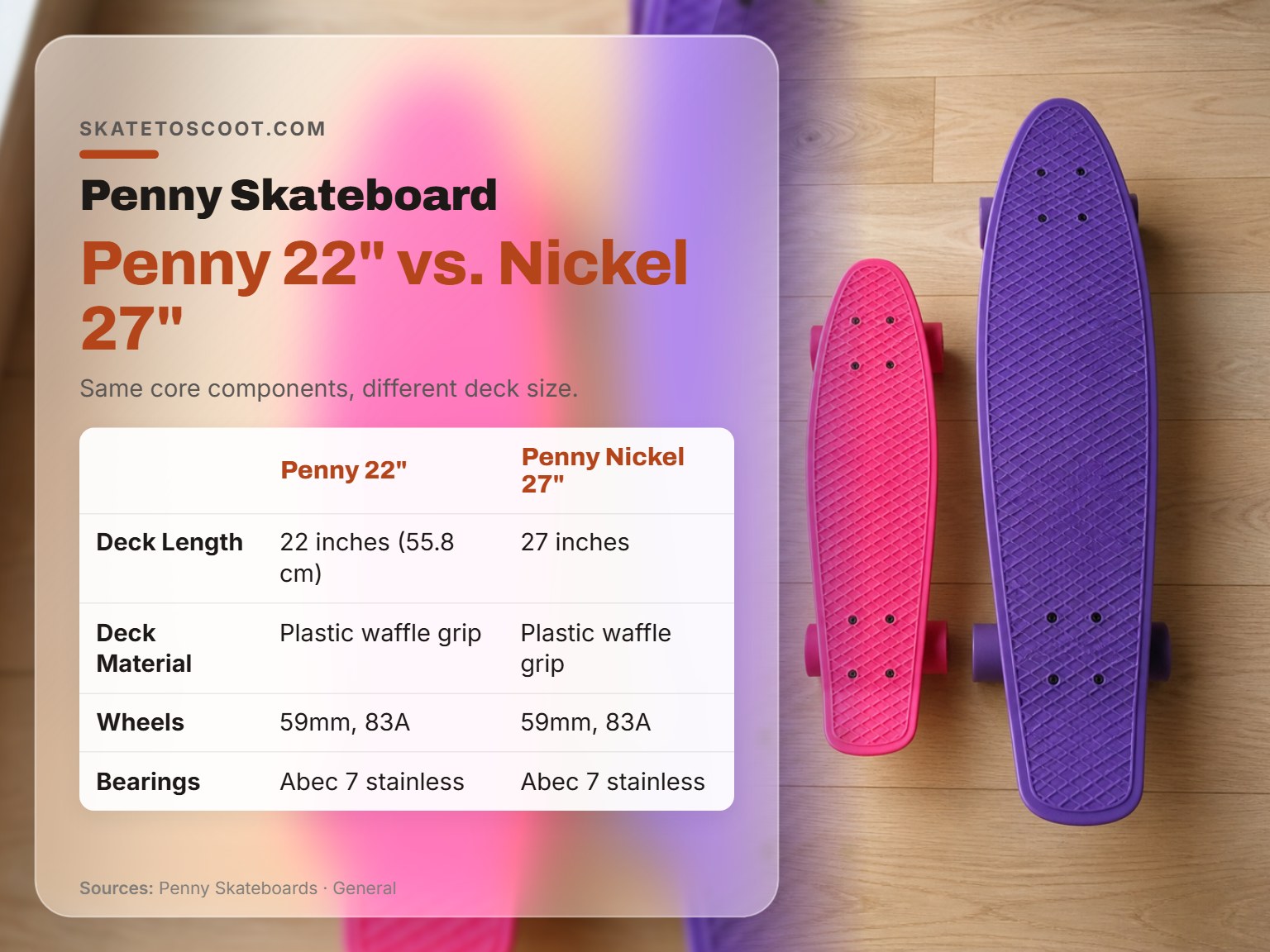
The Penny 22″ occupies a specific niche. To see where it stands, you need to hold it up against its closest relatives.
| Comparison | Penny 22″ | Penny Nickel (27″) | Standard Skateboard (31″-32″) | Longboard (36″+) |
|---|---|---|---|---|
| Best For | Ultra-portability, experienced riders, short smooth commutes. | Beginner cruisers, riders with larger feet, more stable commuting. | Learning tricks, street skating, technical control. | Distance commuting, downhill speed, relaxed carving. |
| Deck Feel | Small, convex plastic platform. | Larger, more foot space, similar plastic. | Concave wood with gritty griptape. | Long, flat or dropped wood deck. |
| Stability | Low (short wheelbase, narrow trucks). | Medium-High. | Medium (good for tricks, less for cruising). | High (long wheelbase, wide trucks). |
| Portability | Excellent (fits in backpacks). | Good (carry by hand or strap). | Poor (must carry). | Poor (must carry). |
| Ride Comfort | Low (harsh on rough ground). | Medium (better over cracks). | Low (hard small wheels). | High (soft, large wheels). |
If you’re debating between Penny sizes, the 27″ Nickel is almost always the more practical choice. It uses the same wheels, bearings, and bushings, so the ride quality is similar, but the longer deck provides a noticeable comfort and stability boost. The portability hit is minor unless your backpack is truly tiny.
For a broader view of the market, our guide on the best skateboards covers everything from professional street decks to cruisers.
Maintenance, Upgrades, and Longevity
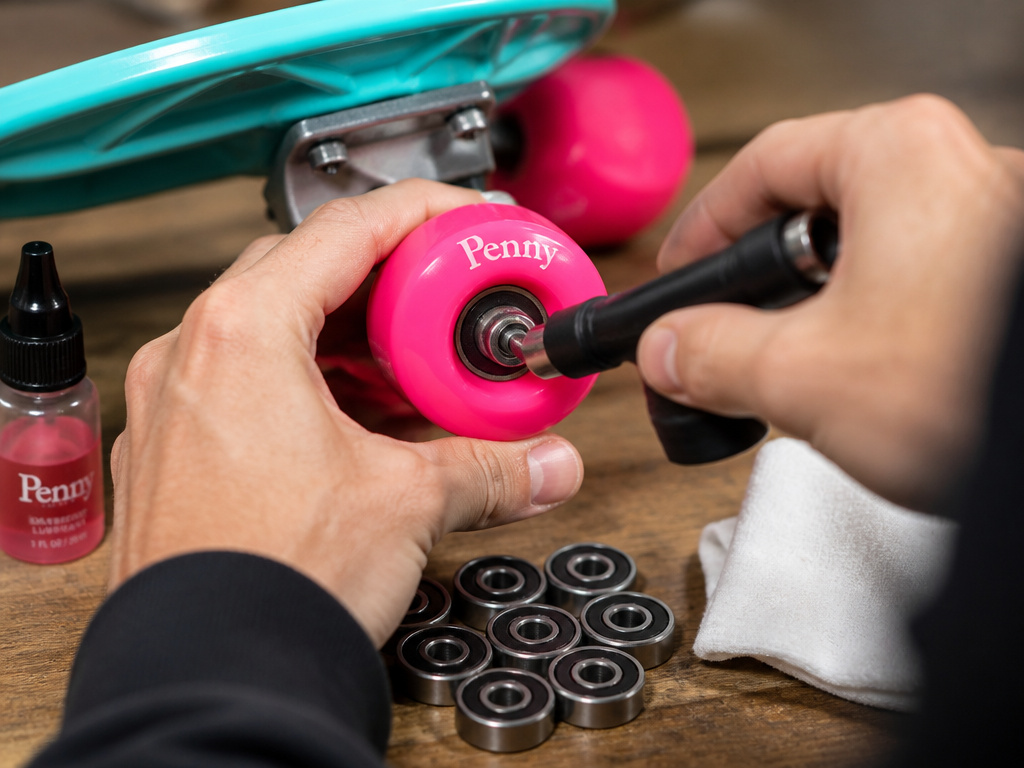
Penny markets low maintenance, and the seven-year anecdote with zero care proves it’s possible. But a little attention improves the ride. The manufacturer provides a video guide on wheel replacement, acknowledging that parts wear and customization is expected.
Essential Maintenance Kit:
- Skate tool (fits the axle and kingpin nuts)
- Replacement bearings (e.g., Zealous built-in bearings or Bronson G3)
- Bearing lubricant (like Speed Cream)
- Rag for cleaning
Recommended First Upgrade: Bearings. This is the unanimous advice from critical reviewers. A set of quality aftermarket bearings reduces pushing effort and increases roll time dramatically. It’s a 15-minute, sub-$20 upgrade that feels like a new board.
Considered Upgrade: Wheels. If your terrain is rough, jump to 60mm or 62mm soft wheels (78A-80A). The larger diameter rolls over obstacles better. The softer durometer absorbs vibration. Remember, larger wheels might require loosening your trucks or adding riser pads to prevent wheel bite, though this is less common on a 22″ board.
The stock aluminum spacers between the bearings inside the wheel can crush over time. If your wheels start spinning poorly even with clean bearings, check the spacers. Upgrading to steel spacers solves this permanently.
Frequently Asked Questions
Are Penny Boards good skateboards?
For their intended purpose, casual, short-distance cruising on smooth terrain, yes, they are good. They are durable, portable, and fun. They are not good “skateboards” in the traditional sense of performing ollies, kickflips, or grinding rails. They are specialized cruisers.
Are Penny Boards hard to ride?
The 22″ model is challenging for beginners due to its small size and low stability. The 27″ Nickel is significantly easier to learn on. If you have no board sport experience, a larger, softer cruiser from our best complete skateboards list will provide a gentler learning curve.
Which is better, Penny board or skateboard?
This depends on your goal. A “skateboard” typically means a popsicle-shaped deck for tricks. For doing tricks, a standard skateboard is better. For carrying on a bus and cruising a boardwalk, a Penny board is better. They are different tools. A Penny cruiser is a subtype of skateboard designed for transportation.
What are Penny Boards good for?
They excel at short-distance commuting where portability is key (college campuses, beach towns, train-to-office last mile), as a travel board that stashes in luggage, and as a fun, nimble secondary board for experienced riders.
The Bottom Line
The Penny 22″ is a brilliantly focused tool that masters one job: being the most portable cruiser on the market. It is not a beginner board, not a trick board, and not an all-weather commuter. Its value is in its constraints.
If your use case fits inside its narrow specs, experienced rider, smooth paths, short trips, fair weather, you’ll love it. The potential for long-term durability is proven, and the aftermarket upgrade path is straightforward. If any of those conditions are a stretch, especially the “experienced rider” part, step up to the 27″ Nickel or a beginner cruiser like the 27″ Nickel. The right tool makes the sport fun; the wrong one makes it a chore. This board is right for far fewer people than its colorful graphics suggest.
