Urbanmax C1 Electric Scooter Review: Who It’s For
This post contains affiliate links. As an Amazon Associate, we earn from qualifying purchases.
The Urbanmax C1 is a budget-friendly, seated electric scooter with a 36V 10Ah battery, a claimed 22-25 mile range, and a top speed of 15.5-18.6 mph, but its advertised motor power, speed, and rider height range vary significantly between official sources, and real-world reports highlight issues with battery longevity and throttle/controller failures.
That variance in specs isn’t just confusing, it changes what the scooter can actually do for you. The difference between a 300W and a 450W motor decides whether you’ll climb a hill or walk it, and a 5-mile gap in claimed range is the difference between a reliable commute and a gamble. This is precisely why you need a detailed UrbanMax C1 electric scooter review.
What follows: a breakdown of the verified specs, the documented failures you won’t find in the marketing, and a clear look at who this scooter actually fits. By the end, you’ll know exactly what the C1 can deliver and what you’re signing up for.
Key Takeaways
- The scooter’s core specifications are inconsistent across official channels, with motor power listed as both 300W and 450W, and seat height ranges differing by nearly half a foot.
- Real-world range can drop below 11 miles within months, according to user reports, far short of the advertised 22-25 miles.
- Throttle and controller failures are documented community repair issues, with Error 008 and a non-responsive motor being common faults.
- For a teenager or light adult needing short, flat commutes under 5 miles, the C1’s price and features are workable. For heavier riders or longer distances, its power and reliability are questionable.
- Always check for the UL2272 safety certification before purchase, as this is a critical fire-safety standard not always prominently advertised.
Who the Urbanmax C1 is For (And Who Should Look Elsewhere)
The C1 isn’t trying to be a performance machine. It’s built for a specific, simple job. If you’re a teenager, a lighter adult, or someone who needs a runabout for very short, flat trips, think a mile to the bus stop, a quick dash to the corner store, or cruising a paved bike path, the included seat and basket make it a convenient option.
But if your commute has any meaningful incline, if you weigh closer to its 265-pound max load, or if you need a dependable 10+ mile range every single day, this scooter’s inconsistent power and battery reports should give you pause. It sits in a price bracket where you’re trading some long-term reliability for upfront cost. That’s a fine trade if your needs are modest and your expectations are managed. It’s a frustrating one if you’re depending on it.
Where this goes sideways: Buying it for a hilly area or a longer daily commute. The motor, whether it’s 300W or 450W, will struggle on sustained inclines, and the real-world range drop means you could be pushing it home sooner than you think.
The 450W vs. 300W Motor Power Confusion
You can’t evaluate a scooter’s hill-climbing ability if you don’t know how strong it is. With the C1, you have to pick a number.
Official sources disagree on the motor power for the URBANMAX C1: the manufacturer’s website lists a 450W brushless motor, while an Amazon listing states it is 300W. This isn’t a minor discrepancy. A 300W motor will provide adequate power for flat ground and very gentle slopes for a lighter rider. A 450W motor offers noticeably more torque, making it capable of handling moderate hills and providing snappier acceleration.
| Source | Claimed Motor Power | Likely Model Variant |
|---|---|---|
| URBANMAX Product Page | 450W brushless | C1 Pro |
| Amazon Listing | 300W | Base C1 |
| Anecdotal Reddit Reports | 450W (C1), 550W (C1S) | C1, C1S |
Why does this matter? If you order a “C1” from a marketplace, you need to scrutinize the product details. That “great deal” might be the lower-powered version. For most adults, a 300W motor will feel underpowered, especially if you’re near the weight limit. The 450W version is the minimum I’d consider for general urban use.
Decoding the Speed, Range, and Rider Fit Claims
Just like the motor, other key specs dance between different numbers. Official sources disagree on the maximum speed: Amazon lists 15.53 mph, while the URBANMAX site lists 18.6 mph. Official sources disagree on the maximum range: Amazon lists 22 miles, while the URBANMAX site lists 25 miles. Official sources disagree on the adjustable seat height range: the URBANMAX site states 4’9″ to 6′, while Amazon states 5’1″ to 6’1″.
This isn’t just marketing fluff. These are the numbers you use to decide if the scooter fits your life. A 3 mph difference in top speed changes how you mix with city traffic. A several-inch variance in seat height range determines if you’ll be cramped or comfortable.
The real story, however, comes from owners. One user reported in June 2024 that their scooter’s range plummeted from a claimed 21 miles to under 11 miles within two months of purchase. That kind of degradation points to battery quality or management issues. When you see a 25-mile claim, plan for 15-18 miles in real-world use with some battery aging factored in. If you need 25 miles, you need a scooter rated for 35+.
Build, Features, and the Day-to-Day Experience
Putting the spec debates aside, what’s it like to live with? One review lists the product weight as 42.8 pounds. It’s not ultra-light, but the folding mechanism works for getting it in and out of a car. The 12-inch pneumatic tires are the right choice for comfort, soaking up small cracks and pavement seams far better than solid tires.
The dual braking system is adequate for the scooter’s speeds. The seat, while not plush, is a welcome feature for longer rides compared to standing the whole time.
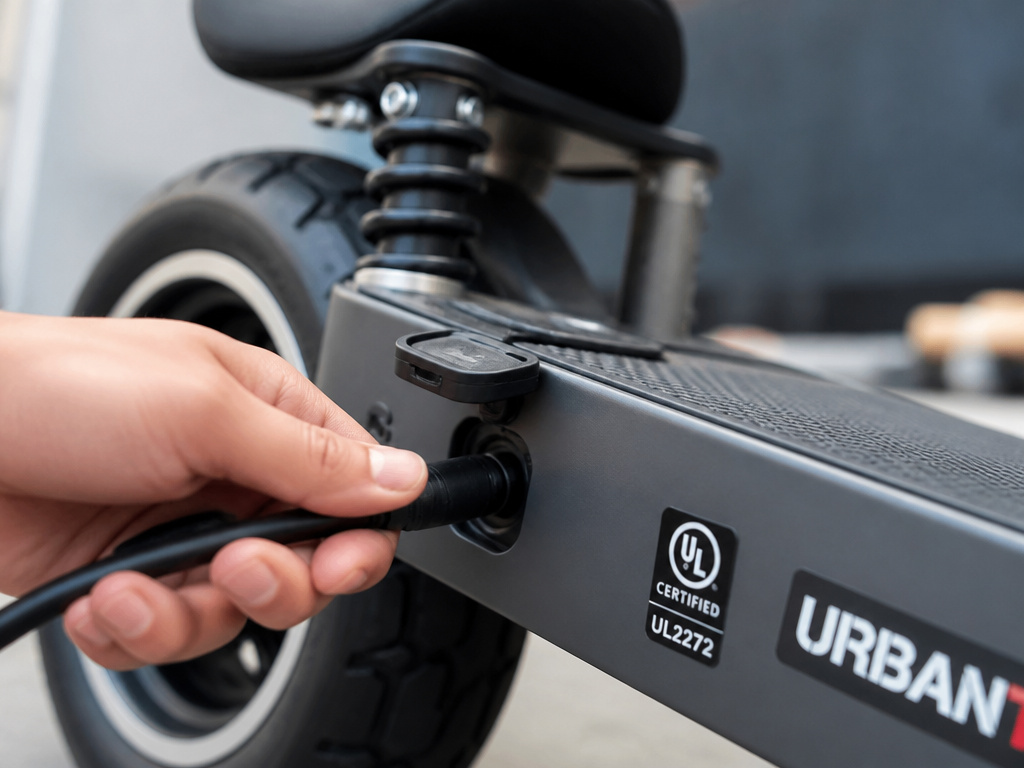
The charging time is a solid five hours. You’ll be plugging it in overnight. And a crucial, often-overlooked spec: the scooter is listed as UL2272 certified on Amazon. This is a critical fire-safety standard for the battery and electrical system. Never buy an electric scooter without this certification.
The Reality of Reliability: Documented Failures and Fixes
This is where community forums become invaluable. The polished product pages don’t show the repair logs.
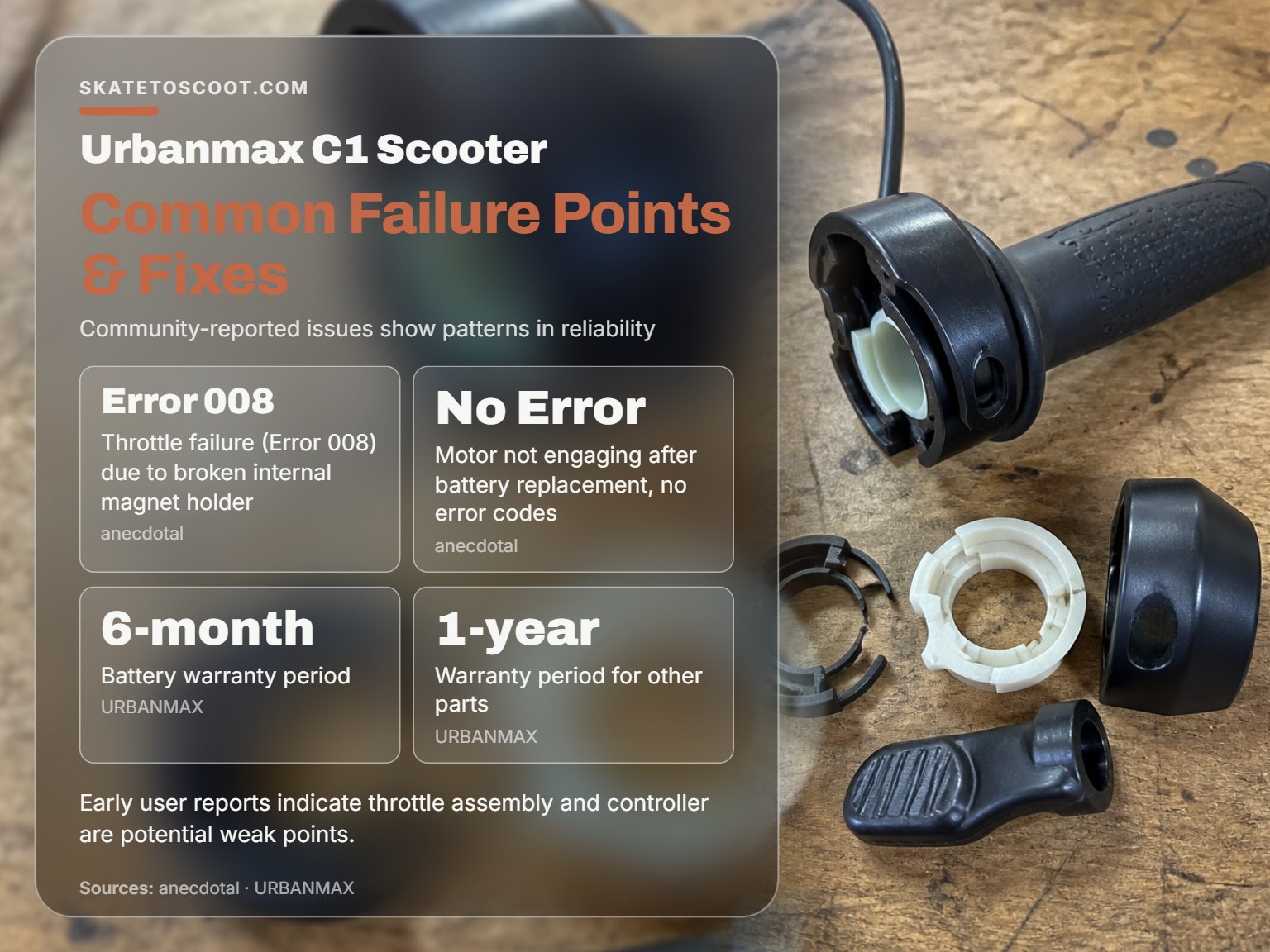
A detailed forum post from September 2025 documents a specific throttle failure (Error 008) on a C1. The issue wasn’t electronic but mechanical: the plastic rail inside the throttle grip that holds a magnet had broken. This is a physical wear-and-tear or manufacturing defect that causes the scooter to fault and stop working.
In a 2026 Reddit thread, an owner described a C1 with a motor that wouldn’t engage after a battery replacement. No error codes appeared. After troubleshooting with a multimeter, they diagnosed a faulty controller, the electronic brain that sends power to the motor. The controller wasn’t outputting power on any of the three phase wires to the motor.
| Symptom | Error Code | Likely Cause | Community-Sourced Fix |
|---|---|---|---|
| Motor doesn’t engage, no error | None | Faulty controller | Replace controller unit |
| Throttle error, scooter stops | 008 | Broken internal throttle magnet holder | Disassemble throttle, repair or replace grip assembly |
| Rapid range loss | None | Battery cell degradation or BMS issue | Battery replacement (complex due to integrated design) |
These aren’t isolated “lemons.” They’re patterns. They tell you that the C1’s weakest links, based on early user reports, are its throttle assembly and controller. Knowing this before you buy means you can check warranty terms (often 6 months for the battery, 1 year for other parts) and decide if you’re willing to potentially deal with these repairs.
How It Stacks Up Against Similar Scooters

The C1 is competing in a crowded field. It’s going up against brands like Hiboy, Gotrax, and entry-level models from Segway. Its main advantage is the included seat and basket, which many competitors in this range treat as add-ons.
However, when you compare real-world reliability and brand reputation for support, the C1’s ambiguous sourcing (also sold under Gyroor, Phantom, Kistp names) can be a downside. A Segway or Xiaomi might cost a bit more, but you’re buying into a clearer support channel and more consistent manufacturing. For example, our review of Segway scooters often highlights their more robust app connectivity and diagnostic features, which the C1 lacks.
If your primary goal is the lowest possible price for a seated scooter, the urbanmax c1 electric scooter review places it on the list. If your priority is a dependable daily driver, spending a little more for a model from our guide on the best commuter scooters is a wiser long-term investment.
Assembly, Manuals, and Ongoing Maintenance

The C1 comes partially assembled. You’ll typically attach the handlebar, secure the seat, and inflate the tires. The process is straightforward. Finding the correct manual can be tricky due to the brand name changes. Searching for “Gyroor C1 manual” often yields better results than “Urbanmax C1 manual.”
For maintenance, keep the tire pressure at the recommended level. Check it monthly. Listen for new creaks or rattles from the folding mechanism and tighten bolts as needed.
The most important maintenance task is battery care. The manual contains conflicting advice: one section says to charge the battery once a month if not in use to prevent capacity loss. The safe bet is the monthly charge. Letting a lithium battery sit completely dead for months is a sure way to kill it permanently.
Frequently Asked Questions
Is the Urbanmax C1 a good scooter for a 12-year-old?
According to the manufacturer, it’s suitable for riders aged 12 and up. Its speed is limited (15-18 mph), and it has a seat for stability. However, a full-size, 42-pound scooter might be bulky for a smaller 12-year-old to maneuver. A lighter, kick-scooter-style electric model might be more appropriate as a first scooter.
What does UL2272 certification mean?
UL2272 is a safety standard set by Underwriters Laboratories specifically for the electrical systems of personal e-mobility devices. A certification means the battery and electrical components have been tested for fire and electrical hazards. It is an essential safety standard. Always verify this certification is listed before purchasing any electric scooter.
Why are there so many different names for this scooter (Gyroor, Phantom, etc.)?
This is common with lower-cost scooters manufactured overseas. A single factory produces a model, and then different companies or importers sell it under their own brand name. The Gyroor C1, Urbanmax C1, and others are often the same hardware in different boxes. This can complicate warranty support, so you should buy from a retailer with a clear return policy.
How do I find the manual or get support?
Start by searching for “Gyroor C1 manual” as the OEM is often Gyroor. Support will depend on where you bought it. If purchased on Amazon, contact the seller through Amazon’s system. The manufacturer’s website (urbmx.com) has a contact link, but response times can vary. For technical issues, community forums like the Electric Scooter subreddit or Endless Sphere can be more helpful for diagnostics.
Can the battery be replaced?
Yes, but it’s not a simple consumer swap. The battery is integrated into the deck. Replacement requires partial disassembly of the scooter deck, disconnecting the old battery pack, and installing a new one with the same voltage and connector. It’s a repair best left to those with technical experience or a local e-bike/scooter repair shop.
The Bottom Line
The Urbanmax C1 is a textbook example of “you get what you pay for.” It packages a seat, a basket, and a usable range into a very low price. But that price comes with compromises: inconsistent specifications, component quality that leads to documented throttle and controller failures, and real-world range that can disappoint.
Here’s the rule of thumb: if your daily ride is under 5 miles on flat ground, you’re a lighter rider, and you have a place to perform basic maintenance (or a local repair shop), the C1 can work. View it as a semi-disposable transport tool that might last a couple of years with care.
If you have hills, need a reliable 10+ mile range, or aren’t handy with a multimeter, your money is better spent elsewhere. The peace of mind that comes with a more established brand from our list of the best electric scooter models is worth the extra investment. For city use, also check our roundup of the best city scooters for alternatives better suited to urban landscapes.
Fair warning: buying based solely on the highest number in the ad copy, as noted in any urbanmax c1 electric scooter review, is how you end up with a scooter that doesn’t meet your needs. Check the specs against the source, read the owner reports, and match the weakest claimed spec to your daily requirement. That’s how you avoid a costly mistake.
