What Is the Difference Between Roller Skates and Roller Blades?
This post contains affiliate links. As an Amazon Associate, we earn from qualifying purchases.
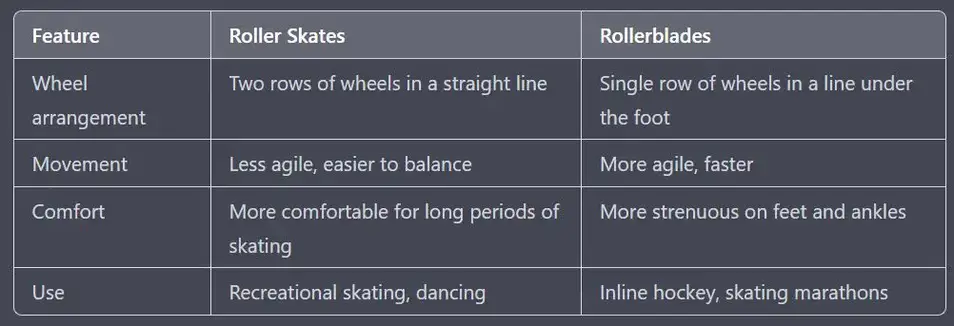
Roller skates (quads) have four wheels in a rectangular, two-by-two configuration, offering inherent stability for lateral movement and dance. Rollerblades (inlines) have wheels mounted in a single line, prioritizing forward speed and efficiency over rough ground. The choice isn’t about which is universally better, but which geometry matches your primary skating goals: artistic expression and maneuverability (quads) versus fitness, distance, and all-terrain cruising (inlines).
That stability-versus-speed trade-off is the mechanical heart of the debate. It dictates everything from the muscles you’ll feel burning the next day to the specific risks you manage on different terrains. Most guides stop at “quads are stable, inlines are fast,” but that’s just the surface. The real decision lives in the details: the ankle support your body actually needs, the stopping mechanism you can reliably execute under pressure, and the long-term cost of maintaining each system. This is what is the difference between roller skates and roller blades.
What follows: a breakdown of the four-wheeled “box” versus the single-line “blade” that answers the what is the difference between roller skates and roller blades, the muscles and motions each one demands, a no-nonsense look at braking and safety recalls, and the one maintenance spec that keeps your skates from becoming a hazard. By the end, you’ll know which wheel arrangement fits not just your aspirations, but your local pavement and your willingness to do a five-minute pre-skate check.
Key Takeaways
- Quad skates offer a stable, rectangular wheel base ideal for lateral movement, dancing, and park skating where maneuverability at slower speeds is key.
- Inline skates prioritize forward speed and roll over obstacles more easily, making them the default for fitness skating, long-distance trails, and urban commuting.
- The braking systems are fundamentally different: quads use a toe stop for controlled, precise stopping, while inlines rely on a heel brake for gradual slowing, which requires a specific technique to be effective.
- Always check axle and frame bolt tightness before skating, using the manufacturer’s torque specs (e.g., 2.4-2.9 N∙m for a Rollerblade Twister) to prevent loose hardware, a known failure mode documented in CPSC recalls.
- Your local terrain often decides for you: flat, smooth rinks or tennis courts favor quads; hills, cracks, and rough bike paths strongly favor inlines.
Wheel Arrangement & Stability: The Foundation
Look at the bottom of the skate. On quads, you see a rectangle. On inlines, you see a blade. This isn’t just aesthetics; it’s engineering that dictates your center of gravity.
A quad skate’s four wheels form a wide, stable platform. It feels like standing on a short, sturdy box. This geometry makes it inherently easier to balance side-to-side, which is why you can shuffle, dance, and pivot in place without immediately tipping over. The trade-off is that pushing forward requires a deliberate, powerful motion. It’s a deliberate, powerful motion.
The NYC Administrative Code legally defines a “roller skate” as a device “with a pair of small wheels near the toe and another pair at the heel.” An “in-line skate” is defined by “a series of two or more wheels mounted in a single line.” This legal distinction underscores the fundamental mechanical difference recognized even by municipal regulators.
Inline skates, with their wheels in a single line, place your balance on a narrow track. Your ankles become the primary stabilizers. This setup mimics the biomechanics of walking or running more closely, making the initial push into a glide feel more intuitive for forward motion. However, that same line makes lateral (side-to-side) stability a learned skill. You can’t just stand there; you have to actively engage your ankles and core to stay upright.
Here’s how that foundation changes the feel:
| Aspect | Quad Skates (Roller Skates) | Inline Skates (Rollerblades) |
|---|---|---|
| Default Stance | Stable, upright platform | Requires active ankle engagement |
| Initial Learning Feel | Easier to stand still, harder to start moving | Harder to stand still, easier to start gliding forward |
| Primary Stability | Lateral (side-to-side) | Forward/Backward |
| Best For | Dance, artistic moves, park skating, derby | Fitness skating, distance, speed, urban traversal |
The “easier to learn” debate is personal, but the mechanics aren’t. Sources disagree on beginner ease: some find the inline’s natural rolling motion gives it an edge for forward motion, while others find quad skates easier or equally easy to learn on. If your goal involves hopping, spinning, or any movement where your feet leave their forward-facing alignment, the quad’s stable platform is the better starting point. I’ve coached students who struggled for weeks on inlines because their ankle strength wasn’t there, and others who felt trapped and unable to turn freely on quads. Your anatomy and your target style decide.
Speed, Agility & Terrain Performance
Speed is about reducing friction, and agility is about managing inertia. Inlines win on friction; quads can win on inertia.
The inline’s linear wheel alignment and typically larger wheel diameters let you maintain momentum with less effort. There’s less rotational mass fighting you with each push. This is why trail skaters and fitness enthusiasts gravitate to them, you can cover miles with a smooth, efficient stride. They also roll over sidewalk cracks, pebbles, and rough asphalt more easily. A small bump that might stop a quad wheel dead will often just be a thump-thump under an inline frame.
Quads excel at quick, sharp changes of direction. Quad skates allow you to lean and carve turns with a responsiveness that feels direct and immediate. This is a huge advantage in roller derby, artistic skating, and skate parks where you’re constantly adjusting your line. That agility comes at the cost of top speed and rough-terrain performance. Quad skates can be more sensitive to imperfections in the pavement.
Common mistake: Choosing quads for a hilly neighborhood because they feel safer at a standstill. Going down a hill on quads without a mastered reverse toe-stop drag is a fast track to a runaway crash. Inlines, with their longer wheelbase and heel brake, offer more controllable descent options for beginners on inclines.
The terrain question settles many debates. For purely outdoor use on mixed surfaces, inlines are the pragmatic choice. For controlled environments like rinks, skate parks, or smooth tennis courts, quads allow for a wider movement vocabulary. I’ve tried both on the same rough bike path, the inlines felt like a luxury sedan, the quads like a go-kart. Both fun, but only one was efficient.
Braking & Stopping Power: A Critical Divergence
This is the single biggest safety differentiator, and the techniques are not interchangeable. Get this wrong, and you’re relying on luck and pavement to stop.
Quad skates use a toe stop, a rubber pad mounted at the front of the skate. Stopping involves dragging this pad behind you, which requires lifting your heel and shifting your weight forward. It’s a precise, powerful method that gives you a lot of control once mastered. You can feather the stop for slight speed checks or plant it firmly for an emergency stop. This technique is fundamental to roller derby and park skating.
Inline skates use a heel brake, a rubber pad mounted on the back of the right skate (usually). The standard technique involves rolling forward on the left skate, bending your knees, and extending the right foot forward, pressing the brake pad down onto the ground. The Rollerblade manual is clear: this system is “for gradual slowing, not instant stopping.” Stopping distance increases dramatically with speed.
| Brake Type | Activation | Best For | Risk If Unmastered |
|---|---|---|---|
| Toe Stop | Lift heel, drag rubber pad behind you. | Controlled, precise stops; speed checks; park skating. | Catching the stop can cause a forward tumble. |
| Heel Brake | Extend braking foot forward, press heel down. | Gradual speed reduction on straightaways. | Panic-stomping can cause a spin-out or loss of balance. |
Rollerblade strongly recommends leaving the brake on the skate. Their brake pads have a wear limit line; once reached, they must be replaced to avoid “loss of braking force and consequent injury.”
Most advanced inline skaters learn alternative stops like the T-stop or powerslide and remove the brake for greater freedom of movement. But for a beginner, on a hill, that heel brake is your most reliable safety tool. Ignoring its proper use, or skipping brake checks, is how minor outings turn into incidents. The CPSC inline skate recall documents 31 reports of loose bolts, not brake failures, but it highlights a broader point: hardware integrity is your first line of defense.
Boot Design & Muscles Worked: Where You Feel the Burn
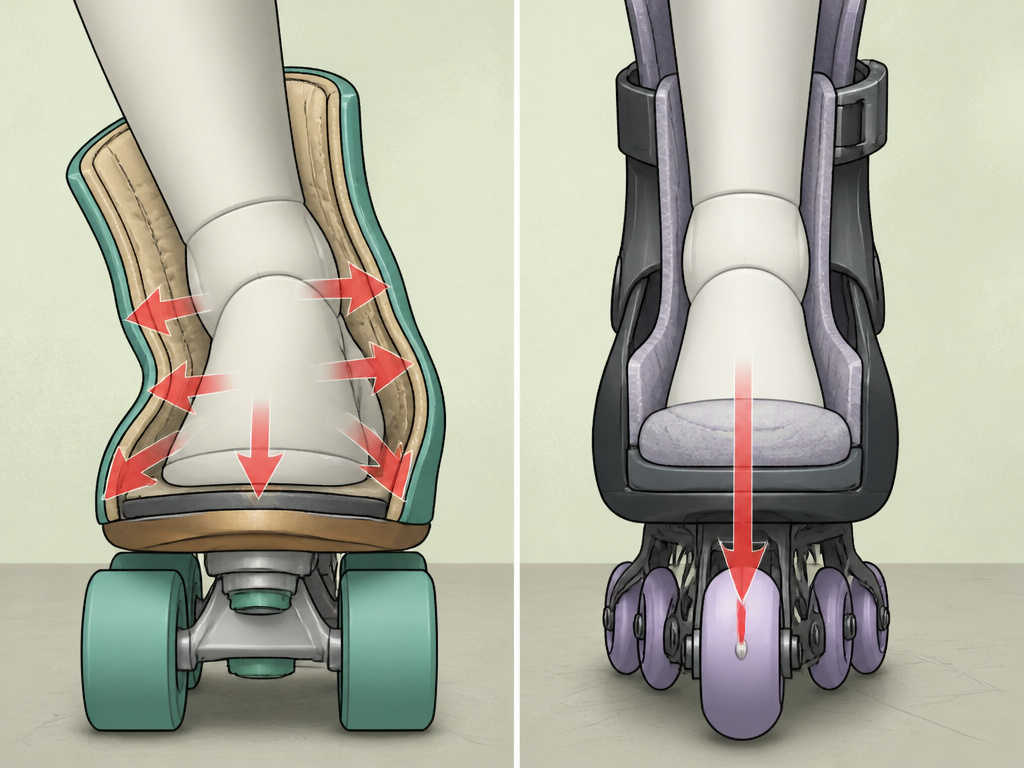
The boot isn’t just a shoe; it’s a torque transfer device. A quad boot is often softer, allowing for significant ankle flexion. An inline boot is typically a rigid shell, locking your ankle at a 90-degree angle to channel all your leg power directly into the frame.
This difference changes your entire kinetic chain. In my own switching between the two, the muscle soreness tells the story. After a long inline session, I feel it in my outer shins and hips, the muscles responsible for stabilizing that narrow line. After a quad session, my inner thighs and glutes are more engaged from the constant push-off against the stable platform.
The rigid inline boot provides support. That same rigidity can feel restrictive if you’re used to the expressive footwork of quads. Conversely, the high-top, supportive quad boots common in derby or artistic skating offer a different kind of stability, focused on lateral support rather than forward alignment.
Where this goes sideways: Using a running shoe-style soft boot quad skate for outdoor trail skating. The lack of lateral support is a known risk; I’ve seen a student’s ankle roll on a simple turn over a minor crack. The force that a rigid inline boot would have absorbed went straight into the joint.
If your focus is cardiovascular fitness and leg endurance, inlines are often chosen for distance skating. Quad skating engages muscles for power and dynamic control. Neither is “better”, they train different physical attributes.
Maintenance & Safety Reality Check
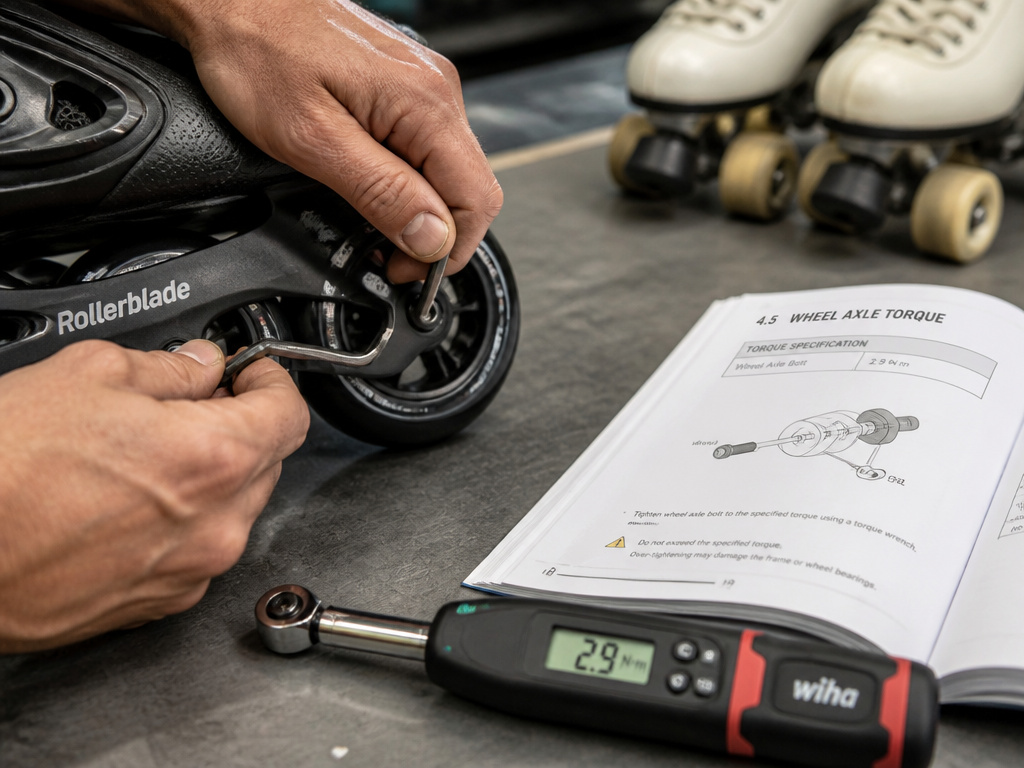
Skates are mechanical devices under load. Ignoring maintenance turns a recreational tool into a liability. The specs aren’t suggestions.
Rollerblade publishes specific torque settings for different models in their technical manual. For example, the wheel axles on a Twister or Blank model require 2.4-2.9 N∙m (25-30 kg cm). The aluminum frame on a Twister/Maxxum requires 5.4-5.8 N∙m (55-60 kg cm). The plastic frame on a Blank model requires 4.9-6.8 N∙m (50-70 kg cm). A Revv model’s wheel axle needs 3.9-5.4 N∙m (45-55 kg cm). These numbers matter. Overtightening can strip threads; undertightening leads to loose wheels and frames.
The evidence isn’t theoretical. In 2010, the U.S. Consumer Product Safety Commission announced a recall of specific Rollerblade Spark and Spitfire models after receiving 31 reports of loose frame or wheel bolts. One reported fall resulted in minor injuries requiring medical attention. The government skate defect alert is a matter of public record.
The manual’s instruction is simple: “Check axle tightness before every use.” It takes a short time with the right Allen key. For quads, the same vigilance applies to kingpin nuts on trucks and toe-stop locks. A loose toe stop can unexpectedly rotate mid-stop, dumping you onto the ground.
Both types of skates are rated to the DIN EN 13843 standard, which defines weight classes: Class A for users up to 100 kg (220 lb), Class B for users up to 60 kg (132 lb). Exceeding these limits voids any structural warranty and increases the risk of component failure. This is the unsexy side of skating, reading the manual, checking bolts, and respecting load limits. Skip it, and you’re betting your skin that everything was perfectly assembled at the factory and hasn’t vibrated loose since.
The Bottom Line
The quad vs. Inline choice is a question of geometry leading to purpose, which is the essence of the what is the difference between roller skates and roller blades. It’s not which is objectively better, but which tool is right for the job you have in front of you.
If your scene is a rink, a skate park, or a dance floor, anywhere lateral movement, quick pivots, and style are the currency, start with quad skates. The learning curve for basic movement is steeper, but the platform opens up a world of artistic and aggressive expression.
If your goal is exercise, exploring bike trails, commuting, or simply covering ground efficiently on mixed surfaces, start with inline skates. The initial balance challenge is higher, but the forward motion is intuitive and the rough-terrain capability is superior.
Before you buy anything, do this: step outside your front door and honestly assess the ground you’ll actually skate on most often. Then, read the Wikipedia roller skating entry for a solid historical and technical overview, it’s a free resource that clarifies much of the terminology. Your local pavement and your personal ambitions are the two data points that matter most. Everything else is just noise.
Are roller skates or rollerblades better for indoor or outdoor use?
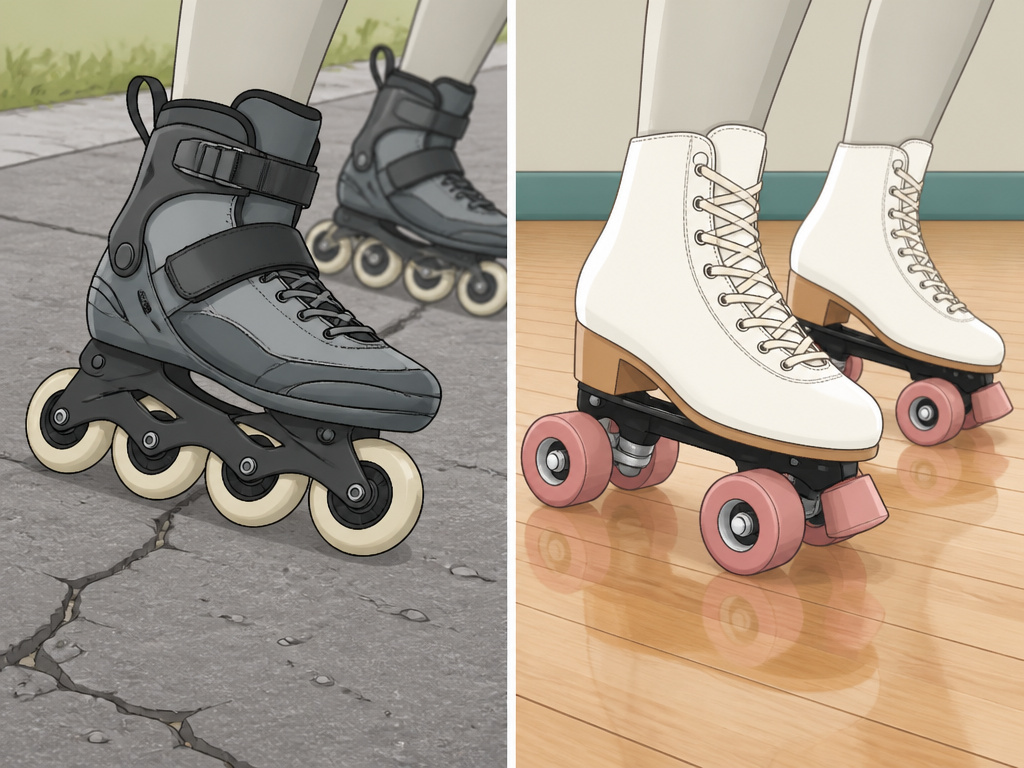
Rollerblades are generally more capable on varied outdoor terrain. Their in-line wheel arrangement rolls more easily over cracks and small bumps found on trails and boardwalks. For navigating hills, sources disagree: some skaters find inlines have a notable advantage on mixed terrain, while others argue quad skates are good for hills because they can rely on toe stops for controlled descent. Both types can be used indoors on smooth surfaces, but traditional quad roller skates, with their wider stance, are often the preferred choice for the lateral movements and stability needed in roller rinks and dance-style skating.
What is the difference in wheel size and shape?
The wheel arrangement is the most obvious difference. Roller skates, or quads, have two pairs of wheels mounted near the toe and heel, creating a wide, stable platform. Rollerblades have a series of wheels mounted in a single line. This fundamental shape affects their performance. The in-line configuration of rollerblades typically allows for longer, narrower wheels that can roll over obstacles more smoothly and maintain speed on pavement. Quad skate wheels are often wider and set in a rectangular formation, prioritizing stability for lateral moves over straight-line speed. The specific wheel profile influences how each type handles different surfaces.
Frequently Asked Questions
Is it easier to rollerblade or roller skate?
For basic forward motion and stopping on flat ground, most beginners find rollerblading (inlines) slightly easier because the rolling motion mimics walking. For standing still and executing lateral moves, roller skates (quads) feel more stable. “Easier” depends entirely on your starting point and what you want to do first.
Why is rollerblading not popular anymore?
Rollerblading’s peak popularity in the 90s has given way to a more diversified skating scene, but it’s far from dead. Inline skating remains extremely popular for fitness, speed, and urban skating. The perception of decline often overlooks strong niche communities in slalom, aggressive inline, and marathon skating.
Which one is better, rollerblades or skates?
Neither is universally better. Rollerblades (inlines) are better for forward speed, distance, and rough terrain. Roller skates (quads) are better for dance, artistic expression, derby, and park skating where lateral agility is key. Choose based on your primary activity.
Is rollerblading or roller skating a better workout?
Both provide excellent workouts, but they stress different muscle groups. Rollerblading is more cardiovascular and targets the outer shins, hips, and hamstrings for stability. Roller skating engages the inner thighs, glutes, and core for power and propulsion. For distance skating, inlines are often chosen for their efficiency.
Can I use the same protective gear for both?
Absolutely. A certified multi-impact helmet, knee pads, elbow pads, and wrist guards are essential for both activities, especially when learning. The protection required is the same for both activities.
