Inline Skate vs Rollerblade: The Real Difference Explained
This post contains affiliate links. As an Amazon Associate, we earn from qualifying purchases.
Inline skate vs rollerblade isn’t a product comparison, it’s a language lesson. “Rollerblade” is a brand name, like Kleenex or Band-Aid. “Inline skate” is the generic term for any skate with wheels in a single line. So, all Rollerblades are inline skates, but not all inline skates are Rollerblades. Your real choice isn’t between these terms, but between the specific types of inline skates: aggressive, fitness, recreational, hockey, and racing, each defined by wheel size, boot design, and purpose.
The confusion is historical, not technical. Rollerblade the company dominated the 90s market so thoroughly that their brand name became shorthand for the entire activity. This means when you walk into a shop asking for “rollerblades,” a knowledgeable salesperson will hear “inline skates” and should ask you what kind of skating you plan to do. That’s the question that matters.
What follows is a breakdown of the five main inline skate categories, the specs that define them, and a look at what a real-world model, the Rollerblade RB Pro X, delivers. By the end, you’ll know exactly what to search for online or ask for in a store.
Key Takeaways
- The “inline skate vs rollerblade” debate is purely about terminology; “Rollerblade” is a brand, “inline skate” is the product category.
- Your decision hinges on skate type, not brand names: aggressive (55-80mm wheels), fitness (90-110mm), recreational (70-90mm), hockey (72-80mm), or racing (>110mm).
- For beginners, conflicting advice exists: some sources say smaller wheels aid stability, while others recommend a short, wide wheel. Your foot shape and confidence level decide.
- Always check the wheel durometer rating (e.g., 85A) and frame material; metal frames last longer on rough pavement.
- A model like the Rollerblade RB Pro X shows how specs translate to real-world use, with a hard shell for support.
What’s the Actual Difference Between Inline Skates and Rollerblades?
Let’s clear something up. You’re not comparing two different products. You’re untangling a brand name from a generic term. “Inline skate” describes the design: wheels arranged in a single, straight line. “Rollerblade” is the trademark of a specific company, Rollerblade Inc., founded in the 1980s.
The Skating Boutique blog notes that this confusion stems from Rollerblade’s dominant role in popularizing the sport, making their brand name synonymous with the activity itself.
This is common in consumer goods. People say “Hoover” for vacuuming or “Google it” for searching online. In the skating world, saying “I’m going rollerblading” usually means “I’m going inline skating,” regardless of whether your skates are made by Rollerblade, K2, or another brand. When you’re shopping, knowing this helps you cut through the noise and focus on the specs that matter for your skating style.
Types of Inline Skates: From Park Grinds to Long-Distance Fitness
The “inline skate vs rollerblade” question masks the real diversity within the category. Your experience is dictated by the skate’s design, which is built for a specific purpose. Here are the five main types you’ll encounter.
Aggressive Inline Skates: Built for the Skate Park
These are the tanks of the inline world. Aggressive skates are built for “sliding, grinding and jumping,” as noted by Discovery UK. They have a hard plastic shell, a reinforced sole, and a distinctive H-block, a gap between the second and third wheels designed specifically for grinding on rails and ledges.
Wheel size varies by source and preference. The Skating Boutique blog states aggressive skates usually have a smaller wheel size of 55 mm to 59 mm, while Discovery UK says they are usually sold with 60mm wheels and notes some skaters prefer 80mm for more speed. This range (55-80mm) reflects a trade-off: smaller wheels keep you lower to the ground for stability during tricks, while slightly larger ones help you maintain speed between features.
Fitness and Recreational Inline Skates: The Everyday Riders
These are the most common types you’ll see on bike paths and pavements. Inline fitness skates are, per the Skating Boutique blog, “the most commonly found type.” They have larger wheels (90-110 mm diameter) designed for a smooth, efficient roll over longer distances, making them ideal for cardio workouts.
Inline recreational skates are similar but often have slightly smaller wheels (70-90 mm) and may feature more casual boot designs. They’re versatile for casual street skating, park use, and general fun. The Canadian Sporting Team guide identifies inline skates as best for “fitness, trail skating, hockey training, and long distances” due to this efficient, linear stride.
Inline Hockey and Racing Skates: The Specialists
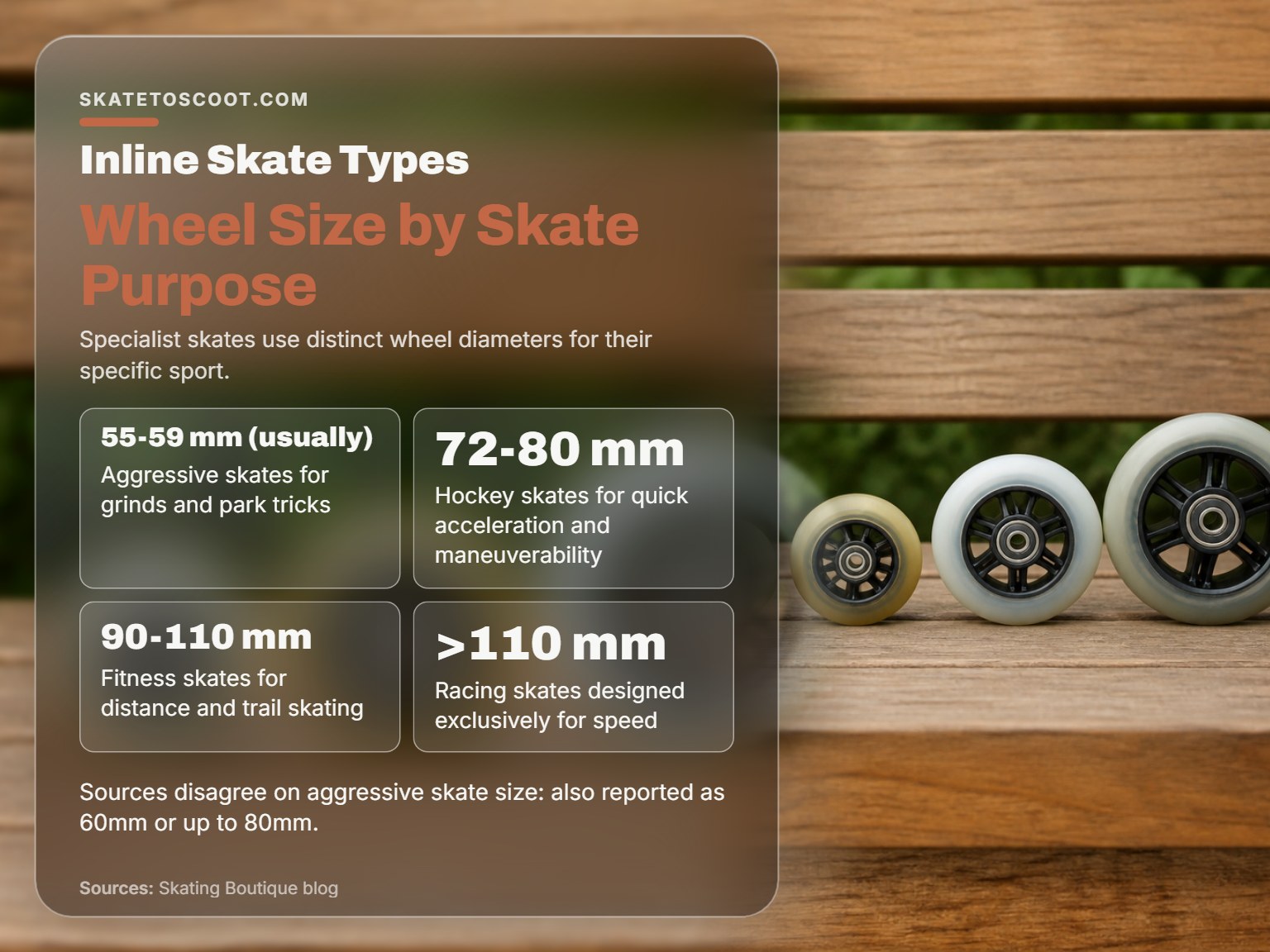
These are purpose-built tools. Inline hockey skates mimic ice hockey skates with a lower-cut boot for ankle flexion and wheel sizes typically between 72-80 mm for quick acceleration and maneuverability on sport courts.
Inline racing skates are the thoroughbreds. Designed exclusively for speed, they feature the largest wheels (over 110 mm, often up to 125 mm), a very short, low-cut boot for aerodynamic tucking, and a lightweight frame. As Rollerskatedad.com points out, they are a significant investment, with most models starting at a higher price point due to advanced materials like carbon fiber.
| Skate Type | Primary Use | Typical Wheel Size | Key Design Feature |
|---|---|---|---|
| Aggressive | Grinds, jumps, skate park tricks | 55-80 mm | H-block for grinding, hard shell boot |
| Fitness | Distance, cardio, trail skating | 90-110 mm | Tall boot for ankle support, large wheels for speed |
| Recreational | Casual street/park skating | 70-90 mm | Balanced design for versatility |
| Hockey | Roller hockey play | 72-80 mm | Low-cut boot for mobility, quick-turn frame |
| Racing | Speed skating competitions | >110 mm | Ultra-low cut boot, long frame, max wheel diameter |
Breaking Down a Real Skate: The Rollerblade RB Pro X
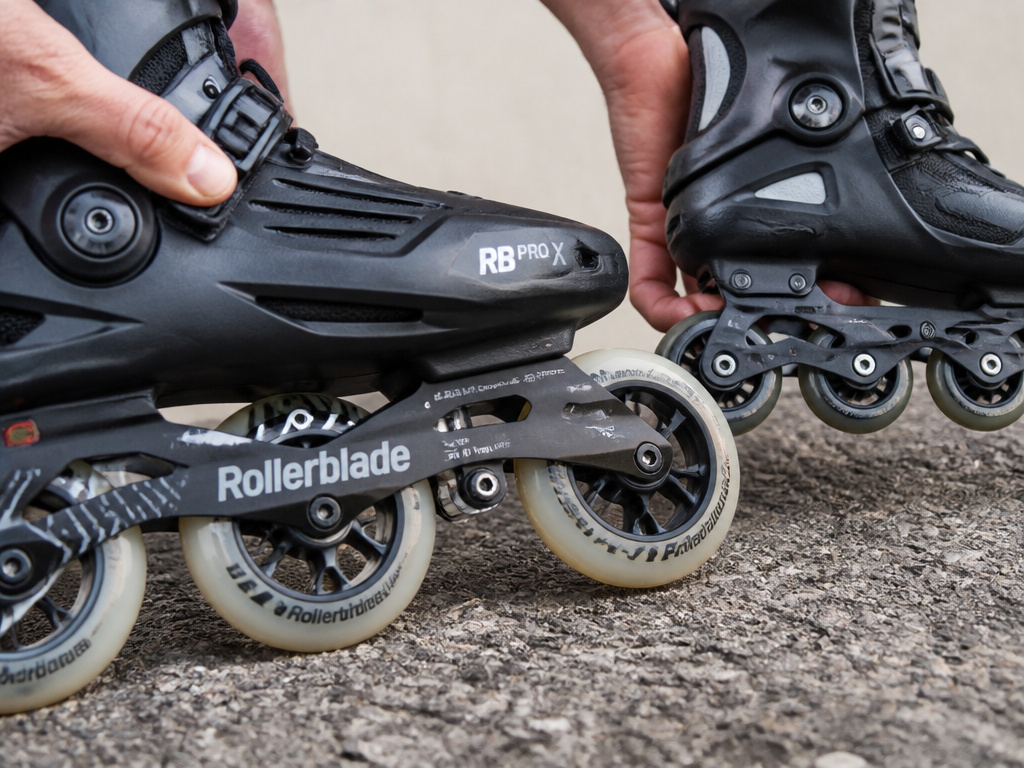
Abstract categories are useful, but a real model shows how these specs come together. We will examine the Rollerblade RB Pro X, a popular aggressive skate, using data from a Testix UK product test. This gives us grounded, non-commodity specifics.
In your hand, an 85A wheel feels solid and slightly rigid, offering a mix of grip and slide that aggressive skaters want.
During a 5 km city route test, the RB Pro X maintained a consistent average speed, demonstrating how an aggressive skate can still cover ground efficiently when needed.
This is a critical, often omitted detail: new skates, especially performance models, don’t feel perfect on day one. Your foot needs to mold the interior, and the materials need to loosen up. Pushing through that initial stiffness is part of the process.
Key Specs That Actually Matter for Your Ride
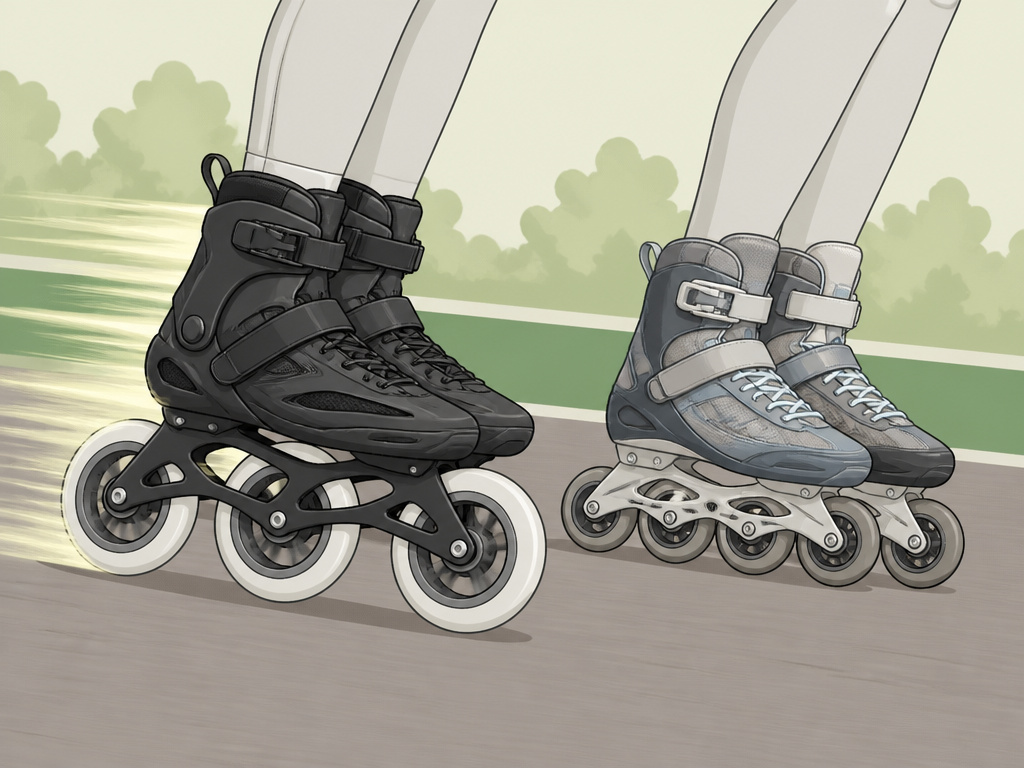
Beyond the skate type, three components directly control your experience: the wheels, the frame, and the brake system. Knowing these parts helps you assess any skate, no matter the brand.
Wheel Diameter, Hardness, and the Beginner Stability Debate
Wheel diameter affects speed and stability. Larger wheels (like the 90-110 mm on fitness skates) roll faster and smoother over cracks. Smaller wheels (like the 55-60 mm on aggressive skates) provide a lower, more stable platform for tricks.
Here’s where sources openly disagree on beginner advice, a perfect example of a content gap most articles gloss over. The Skating Boutique blog states a general principle: “the wider the wheel, the less stability it provides. So, if you’re a beginner inline skater, opt for skates with a smaller or medium diameter.” Conversely, Rollerskatedad.com advises beginners to seek “a rollerblade / inline skate with a short, wide wheel for more stability.”
Who’s right? It depends on your definition of “stable.” A wider wheel has a larger contact patch with the ground, which can feel more secure side-to-side. A smaller-diameter wheel lowers your center of gravity, which helps with forward/backward balance. For a true beginner, a recreational skate with mid-sized wheels (70-80mm) offers a compromise between these philosophies.
Frame Material: Plastic vs. Metal
The frame holds the wheels to the boot. Plastic frames are lighter and cheaper. Metal frames are sturdier and can withstand bumpy or uneven surfaces, as the Skating Boutique blog advises. For anything beyond smooth indoor rinks or perfect pavement, which means most real-world skating, a metal frame is a worthwhile investment in durability. A plastic frame on rough concrete will flex, causing energy loss and potentially cracking over time.
Braking Systems: Heel Brake vs. ABT
Stopping is essential. The traditional heel brake is a rubber pad on the back of the right skate. You stop by lifting your toe and pressing the pad down. It works but requires good balance.
Rollerblade’s ABT (Advanced Braking Technology) system, found on some entry-level models, is designed for beginners. The main difference is that it allows the skater to keep all four wheels on the ground while stopping and remaining balanced. You engage it by extending your leg forward rather than lifting your toe. It’s more intuitive for new skaters who haven’t yet mastered the one-foot balance of a traditional heel stop.
What Should a First-Time Buyer Actually Do?
So, you’re confused by the inline skate vs rollerblade lingo and just want to start skating. Here is your action plan, step-by-step.
- Forget the word “rollerblade” in your search. Use “beginner inline skates” or “recreational inline skates” instead. This opens up results from all brands.
- Decide where you’ll skate most. Smooth bike paths and trails? Look at fitness or recreational skates. Local skate park or want to learn tricks? Look at aggressive skates.
- Check the key specs. Aim for wheels in the 70-80mm range for a balance of stability and roll, a durometer rating around 78A-82A for a blend of grip and durability, and a metal frame if your budget allows.
- Look for inline skates with safety buckles.
- Expect a break-in period. Like the Testix review found with the RB Pro X, even well-fitting skates will need a few short sessions to feel comfortable. Don’t judge them on the first 10 minutes.
Common mistake: Buying a skate based on a brand name alone. A “Rollerblade” brand recreational skate might be perfect, or a K2 fitness model might suit you better. The brand doesn’t skate for you, the specs do.
That category is designed for exactly that use case.
Frequently Asked Questions
Is rollerblading the same as inline skating?
Yes, in everyday language. “Rollerblading” almost always means “inline skating.” Technically, rollerblading should only refer to using Rollerblade-brand skates, but decades of common use have blurred the line. When people say they’re going rollerblading, they mean they’re going inline skating.
What is easier, inline skates or rollerblades?
This question misunderstands the terms. Since “rollerblades” are a type of inline skate, you’re really asking if one brand is easier than other brands. The ease of use comes from the skate’s type and fit, not its logo. A beginner-friendly recreational inline skate from Rollerblade will be similar in difficulty to a beginner-friendly recreational inline skate from K2 or another brand.
Why is rollerblading not as popular as it used to be?
The 90s craze was a peak driven by massive marketing and novelty. Like any trend, it cooled. However, inline skating never disappeared; it matured. The community is now more focused on specific disciplines like aggressive skating, speed skating, or slalom rather than mass casual use. The gear is better, and the knowledge base is deeper, even if there are fewer people simply “blading” on boardwalks.
Can I use any inline skate at a roller rink?
Most rinks allow inline skates, but it’s best to call and check their specific roller rink rules. Some traditional rinks prefer quad skates (roller skates) because their softer wheels and different turning style are seen as better for the finished wood floor. Aggressive skates with very hard wheels might be frowned upon.
How do I maintain my inline skates?
Basic maintenance extends their life. Wipe down the boot and frame after use, especially if you’ve skated on wet ground. Regularly check that axle nuts are tight. The most common wear items are wheels and bearings. Rotate your wheels periodically to ensure even wear, and clean or replace bearings when the roll becomes gritty or noisy. For a deep dive on upkeep, our guide on inline skate selection and upkeep covers longevity considerations.
Before You Go
The takeaway isn’t that “rollerblade” is a brand name. It’s that this linguistic shortcut has been obscuring a more interesting choice for decades. Your decision isn’t about words; it’s about matching a tool to a task.
If you take away one practical tip, let it be this: walk into a shop or start an online search for “inline skates,” and immediately describe what you want to do on them. Say “I want to skate on trails for exercise,” or “I want to learn basic tricks at the skate park.” That frames the conversation around the types of roller skates (and inline skates) that exist, moving you past the brand-name fog and toward actual performance.
Here is a crucial point: whatever you choose, budget for a helmet and pads before you budget for a more expensive skate. The best skate in the world won’t help if you’re too scared to fall. Your fundamentals, including knowing how to fall safely, are your foundation. Everything else, from a smooth fitness ride to a perfect grind, builds from there.
